
An Important Alternative Dispute Resolution Procedure
Post 5034
Sanctions & The Appraisal Process
Read the full article at https://lnkd.in/gTDubMra, see the full video at https://lnkd.in/gRG_iPVc and at https://lnkd.in/gJ2D7w_2 and at https://zalma.com/blog plus more than 5000 posts.
Appraisal is a form of alternative dispute resolution that sets a disputed loss amount. When an insurance policy has an appraisal provision, the right to appraisal is not permissive but is instead mandatory, so once a demand for appraisal is made, neither party has the right to deny that demand. [McGowan v. First Acceptance Ins. Co., Inc., 411 F.Supp.3d 1293, 1296 (M.D. Fla. 2019).]
Sometimes the appraisal process is abused by people attempting to abuse an insurer and bring about a future bad faith suit rather than resolve the claim. In an example of such abuse attorney Eric Dick demanded appraisal on behalf of his client only to do everything necessary to make it impossible to reach a fair award.
The Court made the following findings in support of its imposition of sanctions in Mitchell v. USAA Gen. Indem. Co., 09-23-00042-CV (Tex. App. Feb 27, 2025) and found that these facts are good cause for the sanctions imposed by the Court detailed in its opinion to impose the ultimate sanction, dismissal of the plaintiff’s suit:
On April 13, 2021, Plaintiff, Michael Mitchell (“Plaintiff or “Mitchell”), sued USAA.
After filing suit, Plaintiff filed a Motion to Compel Appraisal and Abatement.
USAA GIC opposed that Motion, and on July 30, 2021, the Court granted Plaintiffs Motion.
The appraisal, however, never occurred as Plaintiff refused to allow access to his property despite several attempts by Plaintiffs chosen appraiser to schedule an inspection.
Plaintiffs appointed appraiser reported that he contacted both Plaintiff and his legal counsel, but there was no response to any communications from either.
On May 25, 2022-nine months after the Court entered an order compelling appraisal upon Plaintiffs motion-USAA GIC moved to vacate the order compelling appraisal because Plaintiff continued to refuse access to his property.
In response, counsel for Plaintiff filed a response and a Suggestion of Death.
Counsel for Plaintiff reported that “while investigating whether the facts stated in Defendant’s Motion are true, has discovered that the reason Plaintiff is unreachable is because Plaintiff is deceased.”
At the oral hearing on USAA GIC’s motion to vacate the appraisal order, the Court re-set the hearing and gave Plaintiffs’ counsel the opportunity to confirm Plaintiffs passing.
The day before the re-set oral hearing, counsel for Plaintiff filed a retraction of Plaintiff s previous Suggestion of Death, stating that “Plaintiffs’ counsel was finally able to physically locate Plaintiff, who is actually very much alive and has new contact information.
When counsel for Plaintiff failed to appear at the re-set hearing, the Court granted USAA GIC’s motion to vacate the appraisal order on July 28, 2022, and as a result, the abatement of discovery was lifted.
Prior to the abatement, on July 1, 2021, USAA GIC served Plaintiff with Interrogatories and Requests for Production.
As a result of the order vacating the order of abatement, on July 9, 2022, Plaintiffs objections and responses to USAA GIC’s discovery requests were due.
It is clear Plaintiff understood that the abatement of written discovery had been lifted as he served Interrogatories, Requests for Production, and Requests for Admission on USAA GIC on July 19, 2022.
Plaintiff completely failed to serve his answers and responses as required by Tex.R.Civ.P. 197.2(a).
USAA GIC conferred with Plaintiff about his late discovery responses on numerous occasions, but Plaintiff never responded to USAA GIC or provided any responses. After these multiple attempts, USAA GIC filed its original motion to compel discovery responses on October 17,2022, setting a hearing on the motion for November 3, 2022.
On the morning of the oral hearing on USAA GIC’s motion to compel, counsel for Plaintiff filed a response at 10:04 a.m. stating the following: “Plaintiffs’ Counsel experienced the utmost difficulty in communicating with Plaintiff in acquiring answers, documents and other responsive material. Specifically, Plaintiff has not responded to Plaintiffs Counsel’s diligent and persistent attempts to reach Plaintiff and confer over discovery. Plaintiffs’ Counsel has been unsuccessful in this endeavor because Plaintiff has been unreachable. Plaintiffs’ Counsel informs while attempting to facilitate Plaintiffs compliance with discovery requirements the reason Plaintiff is unreachable is because Plaintiff is deceased. Plaintiffs’ Counsel is actively trying to locate heirs of Plaintiff s estate who may have an interest in the suit.”
In support of this response, counsel for Plaintiff cited the previously retracted Suggestion of Plaintiff s Death.
Within hours of Plaintiffs’ counsel re-asserting Plaintiffs Suggestion of Death, Plaintiffs’ counsel served discovery responses, including answers to Interrogatories, purportedly answered by Plaintiff.
These responses were served on USAA GIC fifteen (15) minutes prior to the oral hearing on USAA GIC’s motion to compel.
In light of the responses being provided to USAA GIC, albeit belated, the Court gave Plaintiff an opportunity to comply with his discovery obligations by resetting the hearing by one week, giving USAA GIC time to review the responses and raise any remaining concerns.
Prior to the re-set hearing on USAA GIC’s motion to compel, USAA GIC filed a renewed Motion to Compel, outlining inadequacies throughout Plaintiffs purported discovery responses.
Specifically, the court concluded that the Plaintiffs responses were deficient, incomplete, and effectively provided no answers to the requests. In addition, the Interrogatory answers were not verified by Plaintiff.
After multiple opportunities and hearings to comply with the Texas Rules of Civil Procedure, Plaintiff has completely failed to fulfill discovery obligations and has abused the discovery process. Under Tex.R.Civ.P. 215.1(c), Plaintiff has abused the discovery process by serving or incomplete answers to discovery requests and has effectively failed to answer discovery requests. Under Tex. R Civ. P. 215.1(b)(3), Plaintiff has abused the discovery process by failing to participate in the discovery process at all in this case.
In addition, counsel for Plaintiff violated Tex.R.Civ.P. 13 by signing and filing pleadings that were groundless, brought in bad faith, or brought for the purpose of harassment. Specifically, counsel for Plaintiff incorrectly filed a Suggestion of Plaintiff s Death, then retracted it, then re-asserted it. Under these circumstances, the Court has discretion to strike the Plaintiffs pleadings and dismiss the case under Tex.R.Civ.P. 215.2(b)(5).The Court determined that based on multiple violations of the Texas Rules of Civil Procedure and violations of the Court’s orders, there are no lesser sanctions that would fully promote compliance. The Court considered the availability of lesser sanctions, but given Plaintiffs repeated failure to comply with this Court’s orders and his discovery obligations, lesser sanctions would be ineffective to promote full compliance.
The court then struck Mitchell’s pleadings and dismissed his case with prejudice.
ZALMA OPINION
In my career I have been an adjuster testifying in an appraisal, an appraiser, counsel to an insured during an appraisal, and counsel to an insurer during an appraisal. The appraisal worked in most cases. The amount of loss was established by the appraisers quickly and fairly in most cases. Only once, during an appraisal, a contractor for the insured testified that at the request of the insured he participated in creating a fraudulent claim. As long as it is dealt with fairly by the parties and the appraisers, it fulfills the purpose for which it was included in the New York Standard Fire Insurance policy in the 1800’s and as long as the process is not abused it will be effective and useful to both insurer and insured.
(c) 2025 Barry Zalma & ClaimSchool, Inc.
Please tell your friends and colleagues about this blog and the videos and let them subscribe to the blog and the videos.
Subscribe to my substack at https://barryzalma.substack.com/subscribe
Go to X @bzalma; Go to Newsbreak.com https://www.newsbreak.com/@c/1653419?s=01; Go to Barry Zalma videos at Rumble.com at https://rumble.com/account/content?type=all; Go to Barry Zalma on YouTube- https://www.youtube.com/channel/UCysiZklEtxZsSF9DfC0Expg
Go to the Insurance Claims Library – https://lnkd.in/gwEYk

Insurance Expert May Not Testify to Speculative and Contains Unsupported Conclusions.
Posted on September 18, 2026 by Barry Zalma
See the full video at and at https://rumble.com/v7fmifw-expert-may-only-testify-to-what-experience-supports.html
In Michele A. Over, and The Estate Of Paul R. Over v. State Farm Mutual Automobile Insurance Company, and State Farm Fire And Casualty Company, Civil Action No. 23-cv-02243-PAB-STV, United States District Court, D. Colorado (September 14, 2026) Michele and Paul Over sued State Farm Fire and State Farm Auto over hail-damage and stolen-vehicle claims.
The operative dispute concerned State Farm Auto’s motion to exclude or limit opinions from plaintiffs’ insurance-industry expert, Aaron Castillo. Castillo.
Law
The proponent of expert testimony must establish by a preponderance of the evidence that an expert is qualified and that the opinions are helpful, sufficiently grounded, and reliably derived and applied. Experience-based opinions must explain how the...
150 Months in Prison for Tax Fraud
Post 4846
Posted on September 17, 2026 by Barry Zalma
See the full video at https://lnkd.in/g8rh3JBX and https://lnkd.in/gmkdy-9C, In United States Of America v. Thomas Addaquay, Nos. 25-10609, 25-10611, United States Court of Appeals, Eleventh Circuit (September 9, 2026) the Eleventh Circuit affirmed all challenged convictions, the 150-month aggregate sentence, and the challenged $4,123,474.55 restitution award.
FACTS
In United States Of America v. Thomas Addaquay, United States Of America v. Thomas Addaquay, Nos. 25-10609, 25-10611, United States Court of Appeals, Eleventh Circuit (September 9, 2026) the Eleventh Circuit affirmed all challenged convictions, the 150-month aggregate sentence, and the challenged $4,123,474.55 restitution award.
FACTS
Thomas Addaquay controlled United Consolidated Accounting and Business Services (UC), nominally a check-cashing business.
The government proved a three-stage tax-refund scheme that converted the resulting refund checks into usable funds through ...
Major Fraud Perpetrator Asserts Fifth Amendment Privilege to Avoid Prosecution
Post 5489
Posted on September 14, 2026 by Barry Zalma
Fraudster Refuses to Answer Questions About His Alleged Fraud
See the full video at https://lnkd.in/gvicAMDr and at https://lnkd.in/gvicAMDr
In Great American Insurance Co. v. Gemstone Property Management, LLC, et al., No. 23-cv-9100 (LJL), United States District Court, S.D. New York (September 8, 2026) Great American Insurance Company alleged that it was defrauded through a scheme in which Subin Associates, LLP recruited individuals to stage construction-site injuries, arranged unnecessary medical treatment and litigation funding, and pursued fraudulent personal-injury claims.
Luis Manuel Garcia Salcedo, resulted in a $6 million settlement. Non-party Jose Hernandez allegedly worked as an assistant manager at Subin, operated Hernandez Associates, and owned litigation-funding companies that shared office space with Subin and provided services to its clients.
After Great American ...
No Breach of Contract no Bad Faith
Post 4568
Posted on October 23, 2026 by Barry Zalma
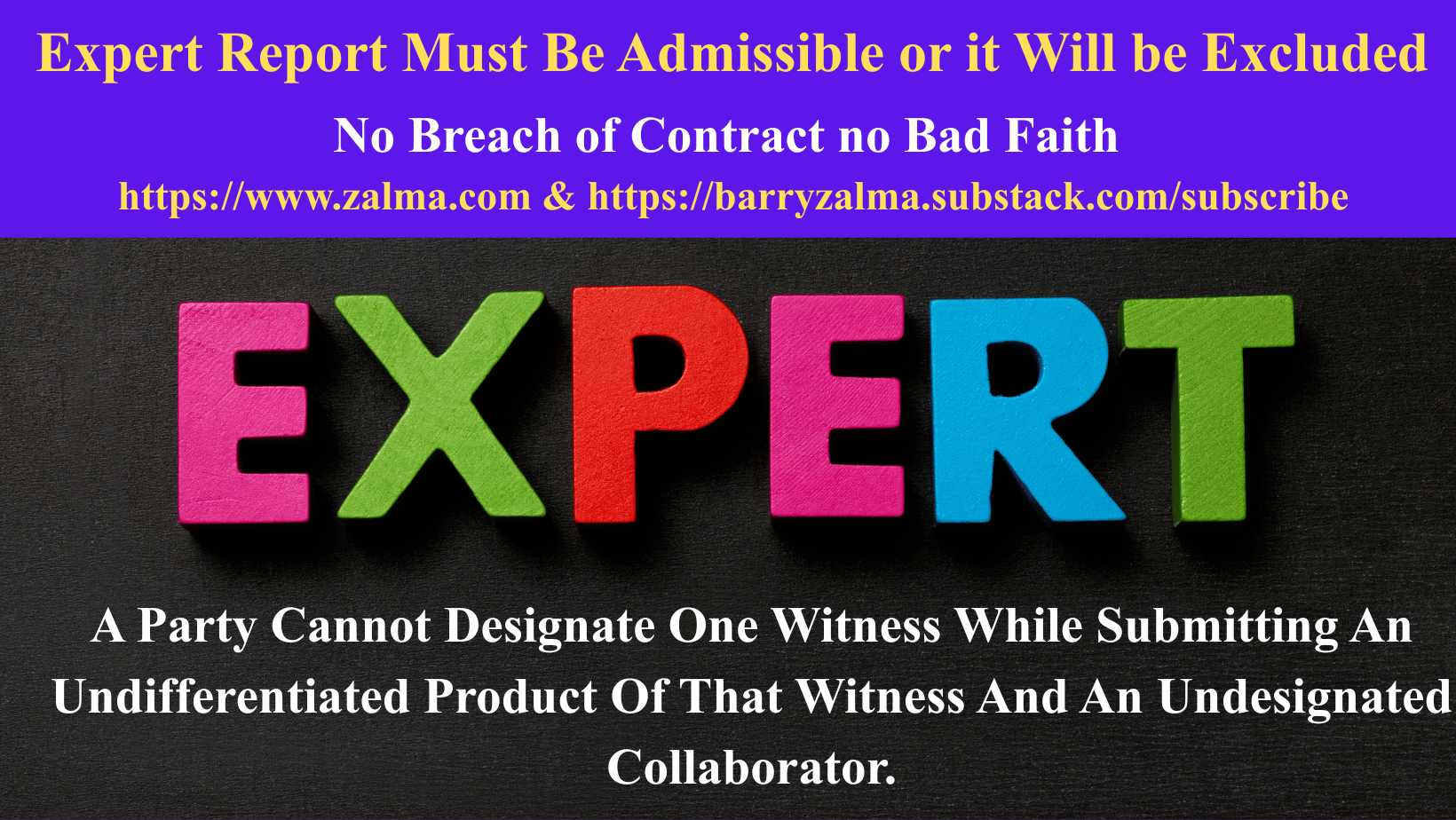
A Party Cannot Designate One Witness While Submitting An Undifferentiated Product Of That Witness And An Undesignated Collaborator.
Post 4568
In Dustin Cain; Amanda Cain v. State Farm Fire and Casualty Company, No. 25-60442, United States Court of Appeals, Fifth Circuit (October 16, 2026) Dustin and Amanda Cain sought homeowners’ insurance benefits after a tree fell on their Mississippi home on August 27, 2022. State Farm concluded that the tree caused only a roof puncture and that other damage resulted from excluded long-term conditions. It paid $10,042.90 and later an additional $3,130.08.
The Cains relied on an engineering report and contractor estimate asserting substantially greater damage, sued for breach of contract and related relief, and designated Sean Fee as their sole expert. Fee’s report and a later repair estimate were jointly authored with Jim Irmiter, but neither document identified which opinions, work, or ...
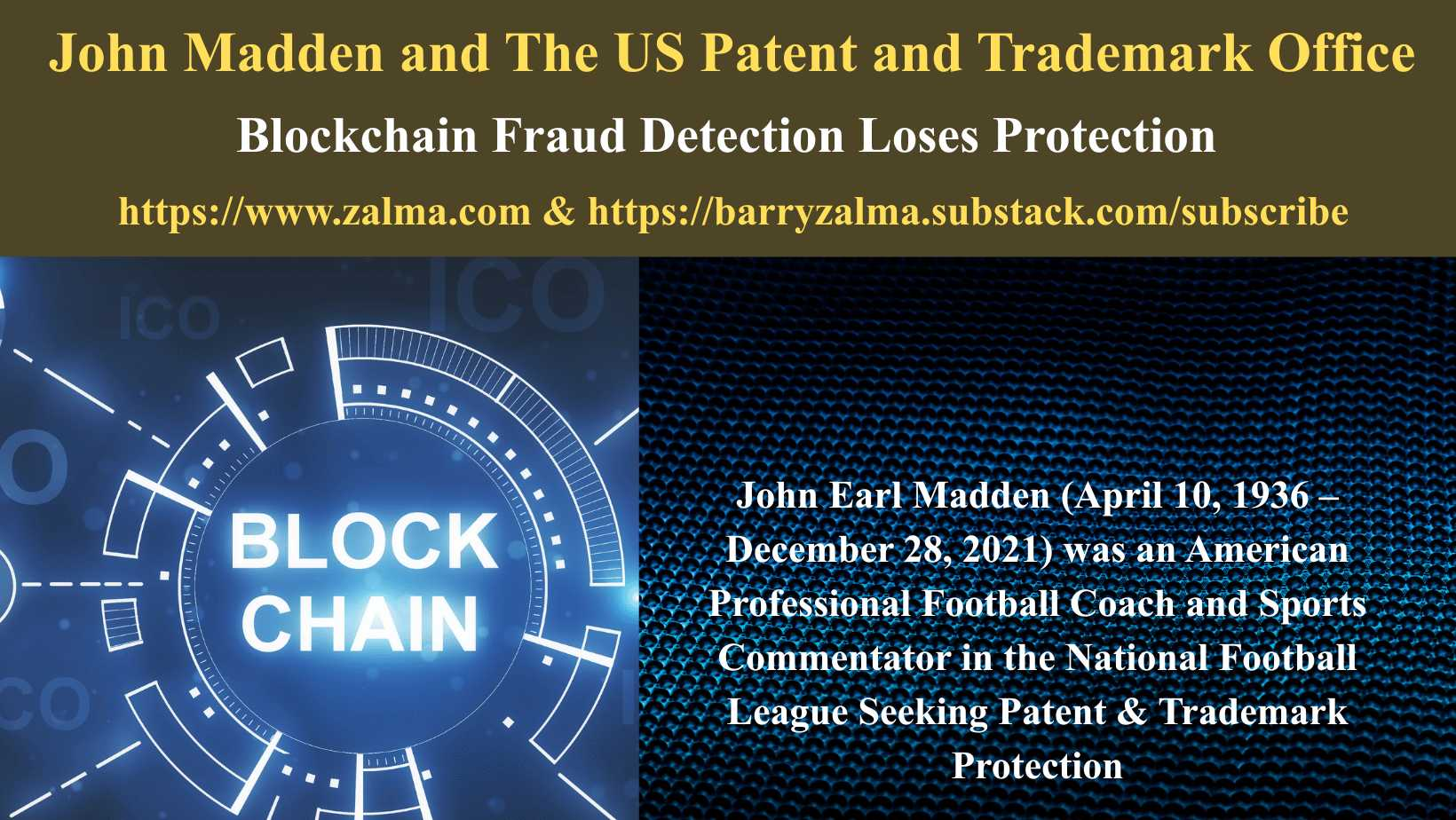
Blockchain Fraud Detection Loses Protection
Posted on October 22, 2026 by Barry Zalma
John Earl Madden (April 10, 1936 – December 28, 2021) was an American Professional Football Coach and Sports Commentator in the National Football League Seeking Patent & Trademark Protection
BLOCKCHAIN FRAUD
Mr. Madden was more than football. He was working to establish a program called “Fraud Protection Systems, Methods, and Computer Programs for Blockchain Financial Transactions.”
In Ex parte John Madden, Appeal 2026-001497, Application 18/495,506, Technology Center 3600, United States Patent and Trademark Office, Patent Trial and Appeal Board (October 14, 2026)
The Examiner rejected claims several numbered claims under 35 U.S.C. § 101 as directed to an abstract idea without significantly more.
THE LAW
Section 101 makes patentable any new and useful process, machine, manufacture, or composition of matter.Laws of nature, natural phenomena, and abstract ideas are implicitly excluded.
THE PATENT TRIAL AND ...
Sovereign Immunity Defeats Suit Against Police Officers
Post 4866
Posted on October 21, 2026 by Barry Zalma
In Chad Lightfoot, et al. v. Progressive Direct Insurance Company, et al., Civil Action No. 26-434, United States District Court, E.D. Louisiana (October 9, 2026) Chad Lightfoot was involved in an Orleans Parish automobile accident in 2011 and filed claims with several insurers, including Progressive.
After a related civil dispute, Progressive counsel allegedly submitted a false affidavit stating that Lightfoot had fraudulently received a $50,000 payment. A New Orleans police detective relied on the affidavit to obtain an arrest warrant, and Louisiana State Police Lieutenant Alan Arcana allegedly reported that Lightfoot had received the payment. Lightfoot was arrested in 2015 and charged with theft, insurance fraud, and perjury.
Plaintiffs alleged that no record of the payment existed and that the criminal charges were dismissed on October 15, 2024.
Lightfoot and Geralyn Hawkins filed suit in October 2025 and ...