

Prior Conviction for Insurance Fraud Material to Decision of Insurer
Post 4857
Read the full article at https://lnkd.in/gKkrQzDu, see the full video at https://lnkd.in/gssJGShm and at https://lnkd.in/gVktgyeY and at https://zalma.com/blog plus more than 4850 posts.
Jose Palma appealed the trial court’s summary judgment in favor of Allied Trust Insurance Co that found a lie about a prior insurance fraud conviction was a material misrepresentation causing the insurer to rescind the policy.
In Jose Palma v. Allied Trust Insurance Co., No. 14-23-00063-CV, Court of Appeals of Texas, Fourteenth District (August 13, 2024) the Court of Appeals agreed with the insurer.
BACKGROUND
Palma purchased an insurance policy for his home with Allied. During the policy period, there was a fire at Palma’s home. Palma submitted an insurance claim under the policy only to be faced with the discover of a prior conviction for insurance fraud that was not disclosed on his application for insurance. Allied rescinded the policy stating that Palma’s misrepresentation rendered the policy void and that it would not have insured Palma had Palma disclosed his prior insurance fraud conviction.
Palma sued Allied for breach of contract, and a litany of bad faith charges. Allied answered and asserted the defense that it rescinded the policy because of Palma’s “material misrepresentation” among other affirmative defenses.
THE MOTION FOR SUMMARY JUDGMENT
Allied moved for summary judgment concluding that the policy issued to Palma is void due to Palma’s material misrepresentation in the policy application that he was never convicted of insurance fraud. Allied argued that Palma misrepresented material facts and in support of these elements, Allied submitted five exhibits: the policy application; the policy; the “DocuSign certification of completion;” correspondence with insurance agent; and Palma’s criminal conviction for insurance fraud.
The trial court rendered a final summary judgment in favor of Allied.
Misrepresentation in Insurance Application
Palma argued that whether a misrepresentation is material is a question of fact both under the Insurance Code and common law and, therefore, summary judgment was improper. Allied countered that there was ample, undisputed evidence in the record to show that Palma’s misrepresentation was material and no evidence to the contrary.
ANALYSIS
The policy application included a statement that Palma agreed the policy would be void “if such information is false or misleading in any way that would affect the premium charged or eligibility of the risk based on company underwriting guidelines.”
The purpose of a summary judgment is to provide a method of summarily terminating a case when it clearly appears that only a question of law is involved and that there is no genuine issue of fact. Various elements of claims may be a “question of fact” where there is an actual, genuine dispute between the parties about the facts. However, when no genuine issues of material facts exist, a court may properly grant summary judgment because there are no facts to find.
Allied submitted its undisputed evidence establishing its affirmative defense. Palma did not respond with evidence to dispute the facts as stated by Allied.
Put simply, the plain language of the statute indicates that a policy provision rendering the policy void or voidable for any false statement is a defense if the insurer demonstrates the misrepresentation was material to the risk or contributed to the contingency or event on which the policy became payable or due. None of these requirements obviates the insurer’s ability to obtain summary judgment on its defense when the facts are undisputed.
ZALMA OPINION
A convicted insurance criminal lied on an application for insurance, obtained a policy based on the lie, only to have his home catch fire and burn resulting in a major claim. The insurer learned of the conviction by searching public records and, based on the lie, rescinded the policy from its inception because of the material misrepresentation about the plaintiff’s criminal record and prior conviction for insurance fraud. The court affirmed the rescission.
(c) 2024 Barry Zalma & ClaimSchool, Inc.
Please tell your friends and colleagues about this blog and the videos and let them subscribe to the blog and the videos.
Subscribe to my substack at https://barryzalma.substack.com/subscribe or subscribe to my substack at https://lnkd.in/gmmzUVBy
Go to X @bzalma; Go to Newsbreak.com https://www.newsbreak.com/@c/1653419?s=01; Go to Barry Zalma videos at Rumble.com at https://rumble.com/account/content?type=all; Go to Barry Zalma on YouTube- https://www.youtube.com/channel/UCysiZklEtxZsSF9DfC0Expg
Go to the Insurance Claims Library – https://lnkd.in/gwEYk.

Insurance Expert May Not Testify to Speculative and Contains Unsupported Conclusions.
Posted on September 18, 2026 by Barry Zalma
See the full video at and at https://rumble.com/v7fmifw-expert-may-only-testify-to-what-experience-supports.html
In Michele A. Over, and The Estate Of Paul R. Over v. State Farm Mutual Automobile Insurance Company, and State Farm Fire And Casualty Company, Civil Action No. 23-cv-02243-PAB-STV, United States District Court, D. Colorado (September 14, 2026) Michele and Paul Over sued State Farm Fire and State Farm Auto over hail-damage and stolen-vehicle claims.
The operative dispute concerned State Farm Auto’s motion to exclude or limit opinions from plaintiffs’ insurance-industry expert, Aaron Castillo. Castillo.
Law
The proponent of expert testimony must establish by a preponderance of the evidence that an expert is qualified and that the opinions are helpful, sufficiently grounded, and reliably derived and applied. Experience-based opinions must explain how the...
150 Months in Prison for Tax Fraud
Post 4846
Posted on September 17, 2026 by Barry Zalma
See the full video at https://lnkd.in/g8rh3JBX and https://lnkd.in/gmkdy-9C, In United States Of America v. Thomas Addaquay, Nos. 25-10609, 25-10611, United States Court of Appeals, Eleventh Circuit (September 9, 2026) the Eleventh Circuit affirmed all challenged convictions, the 150-month aggregate sentence, and the challenged $4,123,474.55 restitution award.
FACTS
In United States Of America v. Thomas Addaquay, United States Of America v. Thomas Addaquay, Nos. 25-10609, 25-10611, United States Court of Appeals, Eleventh Circuit (September 9, 2026) the Eleventh Circuit affirmed all challenged convictions, the 150-month aggregate sentence, and the challenged $4,123,474.55 restitution award.
FACTS
Thomas Addaquay controlled United Consolidated Accounting and Business Services (UC), nominally a check-cashing business.
The government proved a three-stage tax-refund scheme that converted the resulting refund checks into usable funds through ...
Major Fraud Perpetrator Asserts Fifth Amendment Privilege to Avoid Prosecution
Post 5489
Posted on September 14, 2026 by Barry Zalma
Fraudster Refuses to Answer Questions About His Alleged Fraud
See the full video at https://lnkd.in/gvicAMDr and at https://lnkd.in/gvicAMDr
In Great American Insurance Co. v. Gemstone Property Management, LLC, et al., No. 23-cv-9100 (LJL), United States District Court, S.D. New York (September 8, 2026) Great American Insurance Company alleged that it was defrauded through a scheme in which Subin Associates, LLP recruited individuals to stage construction-site injuries, arranged unnecessary medical treatment and litigation funding, and pursued fraudulent personal-injury claims.
Luis Manuel Garcia Salcedo, resulted in a $6 million settlement. Non-party Jose Hernandez allegedly worked as an assistant manager at Subin, operated Hernandez Associates, and owned litigation-funding companies that shared office space with Subin and provided services to its clients.
After Great American ...
Is Exhaustion Required to Seek Declaratory Relief From an Excess Insurer?
Post 4578
Posted on November 9, 2026 by Barry Zalma
In Fox Paine & Company, LLC, et al. v. Twin City Fire Insurance Company et al., S287404, 593 P.3d 832, 593 P.3d 838, 346 Cal.Rptr.3d 541, Supreme Court of California, (July 27, 2026) the Supreme Court noted that Insurance is sometimes procured in a series of layers, with an insured acquiring a primary insurance policy that provides an initial layer of coverage for loss or liability and an excess insurance policy or policies that provide additional coverage in the event the underlying coverage is exhausted. Usually, the first layer of coverage must be exhausted before the excess layers are available to the insured.
Exhaustion
Fox and Paine’s investment-firm dispute generated extensive litigation and competing insurance claims. Their insurance tower consisted of a $10 million primary policy and four $10 million excess layers.
The Fox Parties alleged that insurers paid their rivals, withheld information,...

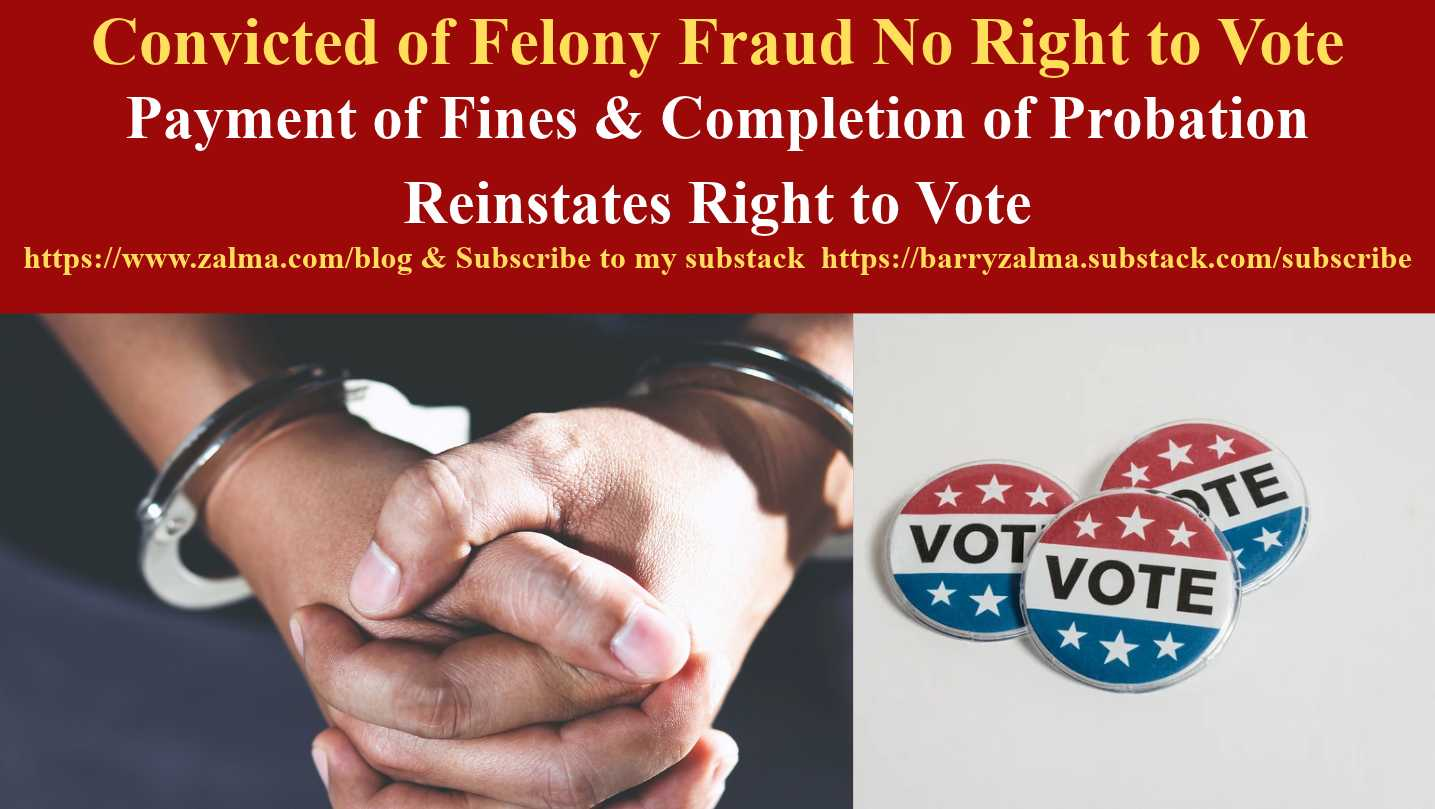
Payment of Fines & Completion of Probation Reinstates Right to Vote
Post 4576
Posted on November 5, 2026 by Barry Zalma
To Restore Voting Rights The Felon Must Pay Fines of $546.00
In Florida Supreme Court Mediator Ethics Advisory Committee, ETH F-26-377, No. F-26-377 (October 29, 2026) citizen unnamed and to Ron Desantis Governor, Cord Byrd the Secretary of State Florida Division of Elections provided an advisory opinion to a convicted felon about his right to vote:
To: [redacted] We received your request for an advisory opinion. You indicate that you have one or more felony convictions and request whether you are eligible to vote, including whether you have any outstanding legal financial obligations under section 98.0751, Florida Statutes, and, if so, a statement of the amount that must be paid to make you eligible to vote, and an explanation of how the amount was calculated.
The Division hereby responds to your request pursuant to its legal authority under section 106.23(2), Florida Statutes, and Florida ...

Administrative Review Permits the Agency to Apply its Expertise
Post 4574
In Erwin Jordan Castro Valdez v. Warden, Otay Mesa Detention Center, No. 26-cv-06147-BAS-JLB, United States District Court, S.D. California (October 30, 2026) Castro Valdez, a Cuban national paroled into the United States, was arrested on June 23, 2026, for alleged insurance fraud, grand theft, and making a false report to law enforcement. In his first habeas action, the district court ordered a bond hearing within fourteen days to determine whether the changed circumstances justified revoking his parole.
An Immigration Judge subsequently denied bond because of his pending state criminal case. Castro Valdez filed a second petition under 28 U.S.C. § 2241, challenging that determination and requesting immediate release without first appealing to the Board of Immigration Appeals (BIA).
LAW
According to the supplied text, § 2241 does not expressly require administrative exhaustion, but courts impose exhaustion as a prudential requirement. ...