

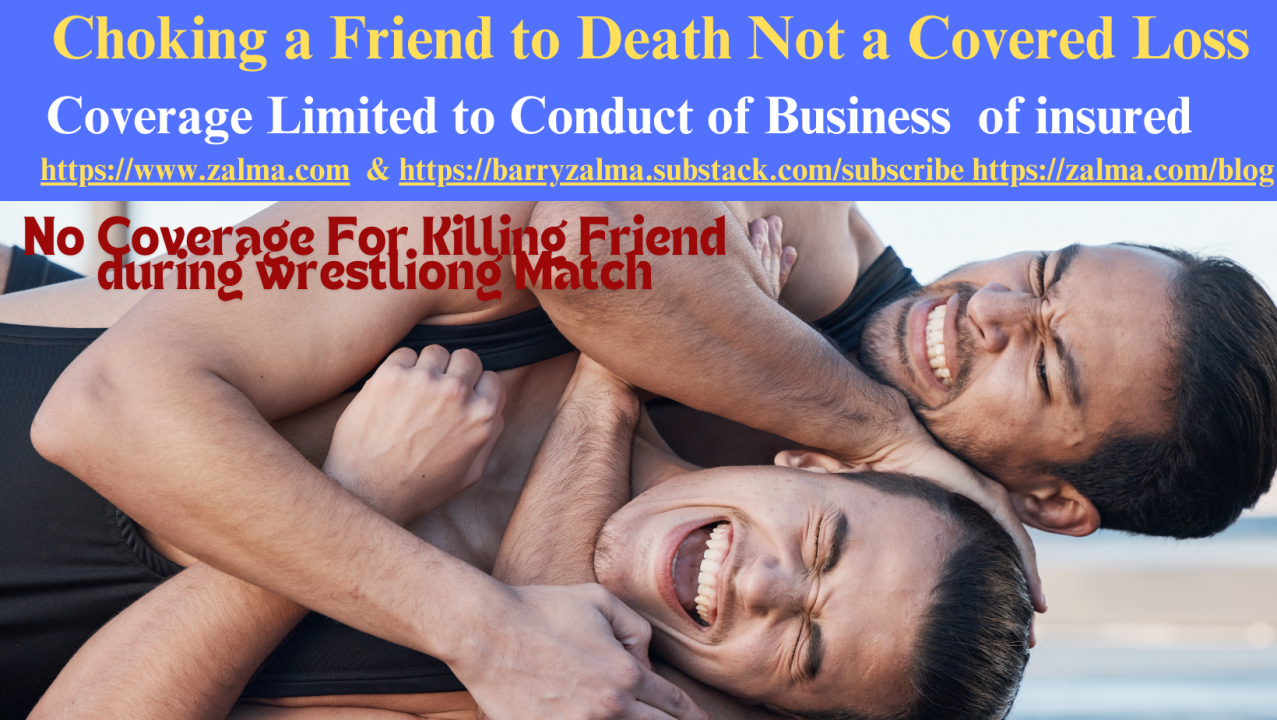
Coverage Limited to Conduct of Business of Insured
Read the full article at https://lnkd.in/g4sDVGan, see the full video at https://lnkd.in/gaU3jvXZ and at https://lnkd.in/gFKrsvw7 and at https://zalma.com/blog plus more than and more than 4750 posts.
Post 4787
Jodi Greenlaw, as personal representative of the estate of her late husband Philip J. Greenlaw (collectively, the Estate), appealed from a judgment of the Superior Court granting a motion for summary judgment filed by MMG Insurance Company (MMG) on MMG’s complaint seeking a declaratory judgment that it had no duty to indemnify Joseph McNeely, a close friend of Greenlaw, in a separate wrongful death action that the Estate filed against McNeely after Greenlaw’s death.
In MMG Insurance Company v. Estate Of Philip J. Greenlaw et al., 2024 ME 28, No. Cum-23-228, Supreme Court of Maine (April 18, 2024) the Supreme Court interpreted the policy as written.
BACKGROUND
In 2019, McNeely operated, as sole owner, a landscaping business called Cutter’s Edge Lawn Maintenance. MMG issued a businessowners insurance policy providing both property and liability coverage to McNeely (the MMG Policy).
McNeely had discussed with Greenlaw, his close friend, measuring and providing a proposal to hydroseed Greenlaw’s backyard. On May 20, 2019, Greenlaw hosted “an informal social group” of men at his house. The group “met year-round on Monday evenings to share their enthusiasm for motorcycles by eating, drinking, telling stories, and taking a ride together if the weather permitted.” The group also “discussed business-related topics” and “engaged in frequent business dealings.” McNeely attended these meetings when he could.
McNeely and Greenlaw went to the backyard, where McNeely measured and provided pricing for the project. Greenlaw said he planned to think about the project and would get back to McNeely about it. At around 8:00 p.m., Jodi returned home, and the men, including McNeely and Greenlaw, “wereinebriated.” After 10:00 p.m., Jodi asked how the measuring for the hydroseeding went, and either McNeely or Greenlaw told her about the project’s progress. “Late in the evening,” while “sitting and gabbing,” Greenlaw initiated a wrestling match with McNeely. During the wrestling bout, McNeely put Greenlaw in a chokehold, and Greenlaw lost consciousness and died soon after, despite McNeely’s efforts to revive him.
The MMG Policy, stated that MMG will pay those sums that the insured becomes legally obligated to pay as damages because of bodily injury to which this insurance applies. The MMG Policy defines an “insured” as anyone “designated in the Declarations” as an “individual . . . but only with respect to the conduct of a business of which [the named insured is] the sole owner.” (Emphasis added.)
DISCUSSION
The Estate contends that “whether Greenlaw’s death occurred with respect to the conduct of McNeely’s business” is a triable issue of fact and that the court “erred by discounting the ‘earlier business dealings’ and the litany of other facts . . . when summarily finding that the ‘wrestling itself was not business-related.'”
Unambiguous contract language, however, must be interpreted according to its plain meaning. The Supreme Court concluded that MMG Policy provision was unambiguous. The MMG Policy designated McNeely as an individual, and McNeely was thus covered as an insured, only with respect to the conduct of a business of which he was the sole owner.
The Supreme Court found that the trial court did not err in determining that there was no genuine issue of material fact and that McNeely’s actions while he was wrestling with Greenlaw were not with respect to the conduct of McNeely’s landscaping business.
Although it is undisputed that earlier in the evening McNeely had measured Greenlaw’s backyard and discussed his landscaping business with several individuals, there is no contention, that McNeely’s actions while wrestling with Greenlaw were to further McNeely’s business. In the opinion of the Supreme Corut an ordinary person would not think that the policy’s language would cover McNeely’s actions while wrestling with Greenlaw.
ZALMA OPINION
Getting drunk with a friend, entering into a wrestling match at the home of the friend, and choking his friend to death, could not be part of the landscaping business of the insured even though the two discussed business before the drinking and wrestling began. Wrestling and a fatal choke hold have nothing to do with landscaping.
(c) 2024 Barry Zalma & ClaimSchool, Inc.
Please tell your friends and colleagues about this blog and the videos and let them subscribe to the blog and the videos.
Subscribe to my substack at https://barryzalma.substack.com/subscribe
Go to X @bzalma; Go to Newsbreak.com https://www.newsbreak.com/@c/1653419?s=01; Go to Barry Zalma videos at Rumble.com at https://rumble.com/c/c-262921; Go to Barry Zalma on YouTube- https://www.youtube.com/channel/UCysiZklEtxZsSF9DfC0Expg.
Go to the Insurance Claims Library – https://lnkd.in/gwEYk.
Please tell your friends and colleagues about this blog and the videos and let them subscribe to the blog and the videos.
Subscribe to my substack at https://lnkd.in/gmmzUVBy
Go to X @bzalma; Go to Barry Zalma videos at Rumble.com at https://lnkd.in/gV9QJYH; Go to the Insurance Claims Library – https://lnkd.in/gwEYk.
Insurance Expert May Not Testify to Speculative and Contains Unsupported Conclusions.
Posted on September 18, 2026 by Barry Zalma
See the full video at and at https://rumble.com/v7fmifw-expert-may-only-testify-to-what-experience-supports.html
In Michele A. Over, and The Estate Of Paul R. Over v. State Farm Mutual Automobile Insurance Company, and State Farm Fire And Casualty Company, Civil Action No. 23-cv-02243-PAB-STV, United States District Court, D. Colorado (September 14, 2026) Michele and Paul Over sued State Farm Fire and State Farm Auto over hail-damage and stolen-vehicle claims.
The operative dispute concerned State Farm Auto’s motion to exclude or limit opinions from plaintiffs’ insurance-industry expert, Aaron Castillo. Castillo.
Law
The proponent of expert testimony must establish by a preponderance of the evidence that an expert is qualified and that the opinions are helpful, sufficiently grounded, and reliably derived and applied. Experience-based opinions must explain how the...
150 Months in Prison for Tax Fraud
Post 4846
Posted on September 17, 2026 by Barry Zalma
See the full video at https://lnkd.in/g8rh3JBX and https://lnkd.in/gmkdy-9C, In United States Of America v. Thomas Addaquay, Nos. 25-10609, 25-10611, United States Court of Appeals, Eleventh Circuit (September 9, 2026) the Eleventh Circuit affirmed all challenged convictions, the 150-month aggregate sentence, and the challenged $4,123,474.55 restitution award.
FACTS
In United States Of America v. Thomas Addaquay, United States Of America v. Thomas Addaquay, Nos. 25-10609, 25-10611, United States Court of Appeals, Eleventh Circuit (September 9, 2026) the Eleventh Circuit affirmed all challenged convictions, the 150-month aggregate sentence, and the challenged $4,123,474.55 restitution award.
FACTS
Thomas Addaquay controlled United Consolidated Accounting and Business Services (UC), nominally a check-cashing business.
The government proved a three-stage tax-refund scheme that converted the resulting refund checks into usable funds through ...
Major Fraud Perpetrator Asserts Fifth Amendment Privilege to Avoid Prosecution
Post 5489
Posted on September 14, 2026 by Barry Zalma
Fraudster Refuses to Answer Questions About His Alleged Fraud
See the full video at https://lnkd.in/gvicAMDr and at https://lnkd.in/gvicAMDr
In Great American Insurance Co. v. Gemstone Property Management, LLC, et al., No. 23-cv-9100 (LJL), United States District Court, S.D. New York (September 8, 2026) Great American Insurance Company alleged that it was defrauded through a scheme in which Subin Associates, LLP recruited individuals to stage construction-site injuries, arranged unnecessary medical treatment and litigation funding, and pursued fraudulent personal-injury claims.
Luis Manuel Garcia Salcedo, resulted in a $6 million settlement. Non-party Jose Hernandez allegedly worked as an assistant manager at Subin, operated Hernandez Associates, and owned litigation-funding companies that shared office space with Subin and provided services to its clients.
After Great American ...
Denial Of Mental Health Diversion And Probation Condition Were Affirmed
Posted on October 9, 2026 by Barry Zalma
Post 4860
In The People v. Nicholas Daniel Stiles, A173483, A173646, California Court of Appeals, First District, Second Division (September 29, 2026) Nicholas Daniel Stiles pleaded no contest to one count of insurance fraud arising from his purchase of automobile insurance after a June 2021 collision, and to grand theft arising from an April 2024 incident at a 7-Eleven.
In both cases, the trial court suspended imposition of sentence and placed him on two years’ probation. Before the pleas, Stiles sought mental health diversion in both matters and filed a written motion seeking substitute appointed counsel. The diversion applications were denied, and the court never held a hearing on the motion.
LAW
Penal Code section 1001.36 permits pretrial mental health diversion when a defendant is eligible and suitable and the proposed treatment will meet the defendant’s specialized needs; denial is reviewed for ...
If Grounds For Dismissal Are Apparent From The Face Of The Complaint, A Court May Also Dismiss The Case on The Court’s Own Motion
Posted on October 5, 2026 by Barry Zalma
Pro Se Plaintiff Failed to Make a Short and Plain Statement
Post 4856
In Tak Lun Ng v. United Financial Casualty Company, No. 26-cv-03136-LJC, United States District Court, N.D. California (September 28, 2026) Tak Lun Ng, proceeding pro se, sued United Financial Casualty Company over a March 2, 2021 automobile accident and the insurer’s March 24, 2021 refusal to pay him.
He appeared to assert breach of contract, fraud, negligence, premises liability, product liability, and related theories. United removed the action from state court and moved to dismiss.
Ng missed that deadline but later filed several documents, including a motion for leave to amend, all of which the court reviewed.
LAW
Under Federal Rules of Civil Procedure, a complaint must provide a short and plain statement containing enough factual matter to state a facially plausible...
If Grounds For Dismissal Are Apparent From The Face Of The Complaint, A Court May Also Dismiss The Case on The Court’s Own Motion
Posted on October 5, 2026 by Barry Zalma
Pro Se Plaintiff Failed to Make a Short and Plain Statement
Post 4856
In Tak Lun Ng v. United Financial Casualty Company, No. 26-cv-03136-LJC, United States District Court, N.D. California (September 28, 2026) Tak Lun Ng, proceeding pro se, sued United Financial Casualty Company over a March 2, 2021 automobile accident and the insurer’s March 24, 2021 refusal to pay him.
He appeared to assert breach of contract, fraud, negligence, premises liability, product liability, and related theories. United removed the action from state court and moved to dismiss.
Ng missed that deadline but later filed several documents, including a motion for leave to amend, all of which the court reviewed.
LAW
Under Federal Rules of Civil Procedure, a complaint must provide a short and plain statement containing enough factual matter to state a facially plausible...