
Private Citizen May Not Compel Enforcement of a Criminal Law
Read the full article at https://lnkd.in/gZPHe22r, se the full video at https://lnkd.in/gCVTa9T2 and at https://lnkd.in/gF-jue4C and at https://zalma.com/blog and more than 4750 posts.
Post 4774
Ronald Rothman appealed from an order of the District Court dismissing his complaint with prejudice and remanding a foreclosure proceeding to state court.
In Ronald S. Rothman v. CABANA SERIES IV TRUST; IGLOO SERIES IV TRUST; U.S. BANK TRUST NATIONAL ASSOCIATION, as Trustee; WELLS FARGO BANK, N.A.; BALBEC CAPITAL, L.P.; SN SERVICING CORPORATION; FRIEDMAN VARTOLO, LLP; QUENTEN GILLIAM, ESQ., No. 23-2455, United States Court of Appeals, Third Circuit (April 2, 2024) the USCA, 3rd Circuit resolved the dispute.
FACTS
In June 2023, Rothman sued the defendants alleging that defendants violated federal civil and criminal laws in connection with an “invalid mortgage loan.” Rothman claimed that the loan was obtained by his son in 2006 to finance the purchase of a property from Rothman, that the “Notice of Settlement” for the loan was improperly recorded, and that the defendants illegally collected (or benefitted from) insurance payments on the “invalid” loan. The action was based on the False Claims Act and numerous criminal statutes, including the RICO Act. Rothman sought “declaratory judgments,” nullifying the mortgage loan and the sale of the property, and requiring restitution of the insurance payments.
In July 2023, Rothman filed a letter with the District Court, seeking to remove a 2022 foreclosure action (which stemmed from an alleged default of the mortgage loan) from the New Jersey Superior Court, Chancery Division, to the District Court. In a Memorandum Order entered July 31, 2023, the District Court granted Rothman’s motion to proceed in forma pauperis, and screened and dismissed the complaint with prejudice pursuant to 28 U.S.C. § 1915(e)(2)(B).
JURISDICTION
Appellees contend the Third Circuit lacked jurisdiction to review the order remanding the foreclosure matter. The complaint was not a notice of removal but rather an original action, and the District Court appropriately treated it as such.
In its Memorandum Order, the District Court considered the claims and dismissed them. That determination was final. It is reviewable by the Third Circuit. A district court cannot prevent appellate review of a final order by contemporaneously remanding a case to state court.
THE COMPLAINT
The complaint sought to hold defendants civilly and criminally liable for insurance fraud. Rothman claimed that the suit was “in the [p]ublic [i]nterest” because the defendants were depriving the “American [p]ublic and [c]itizens” of the federal funds.
The Third Circuit agreed with the District Court that Rothman, in essence, asserted a False Claims “qui tam” suit. In such cases, the Government is the real party in interest. Although a private person (the relator) may bring the suit on behalf of the Government circuit courts agree that a pro se litigant, like Rothman, may not. Nor could Rothman, as a private citizen, compel enforcement of criminal law. The District Court properly dismissed the complaint.
ZALMA OPINION
Qui tam suits are a powerful tool against insurance fraud. However, as the Third Circuit made clear, a private citizen acting in pro se may not nor may a private citizen compel enforcement of criminal law. The case established the old saying that “he who represents himself has a fool for a client.”
(c) 2024 Barry Zalma & ClaimSchool, Inc.
Please tell your friends and colleagues about this blog and the videos and let them subscribe to the blog and the videos.
Go to X @bzalma; Go to Newsbreak.com https://www.newsbreak.com/@c/1653419?s=01; Go to Barry Zalma videos at Rumble.com at https://rumble.com/c/c-262921; Go to Barry Zalma on YouTube- https://www.youtube.com/channel/UCysiZklEtxZsSF9DfC0Expg.
Subscribe to my substack at https://lnkd.in/gcZKhG6g, Go to X @bzalma; Go to the Insurance Claims Library – https://lnkd.in/gwEYk.

Insurance Expert May Not Testify to Speculative and Contains Unsupported Conclusions.
Posted on September 18, 2026 by Barry Zalma
See the full video at and at https://rumble.com/v7fmifw-expert-may-only-testify-to-what-experience-supports.html
In Michele A. Over, and The Estate Of Paul R. Over v. State Farm Mutual Automobile Insurance Company, and State Farm Fire And Casualty Company, Civil Action No. 23-cv-02243-PAB-STV, United States District Court, D. Colorado (September 14, 2026) Michele and Paul Over sued State Farm Fire and State Farm Auto over hail-damage and stolen-vehicle claims.
The operative dispute concerned State Farm Auto’s motion to exclude or limit opinions from plaintiffs’ insurance-industry expert, Aaron Castillo. Castillo.
Law
The proponent of expert testimony must establish by a preponderance of the evidence that an expert is qualified and that the opinions are helpful, sufficiently grounded, and reliably derived and applied. Experience-based opinions must explain how the...
150 Months in Prison for Tax Fraud
Post 4846
Posted on September 17, 2026 by Barry Zalma
See the full video at https://lnkd.in/g8rh3JBX and https://lnkd.in/gmkdy-9C, In United States Of America v. Thomas Addaquay, Nos. 25-10609, 25-10611, United States Court of Appeals, Eleventh Circuit (September 9, 2026) the Eleventh Circuit affirmed all challenged convictions, the 150-month aggregate sentence, and the challenged $4,123,474.55 restitution award.
FACTS
In United States Of America v. Thomas Addaquay, United States Of America v. Thomas Addaquay, Nos. 25-10609, 25-10611, United States Court of Appeals, Eleventh Circuit (September 9, 2026) the Eleventh Circuit affirmed all challenged convictions, the 150-month aggregate sentence, and the challenged $4,123,474.55 restitution award.
FACTS
Thomas Addaquay controlled United Consolidated Accounting and Business Services (UC), nominally a check-cashing business.
The government proved a three-stage tax-refund scheme that converted the resulting refund checks into usable funds through ...
Major Fraud Perpetrator Asserts Fifth Amendment Privilege to Avoid Prosecution
Post 5489
Posted on September 14, 2026 by Barry Zalma
Fraudster Refuses to Answer Questions About His Alleged Fraud
See the full video at https://lnkd.in/gvicAMDr and at https://lnkd.in/gvicAMDr
In Great American Insurance Co. v. Gemstone Property Management, LLC, et al., No. 23-cv-9100 (LJL), United States District Court, S.D. New York (September 8, 2026) Great American Insurance Company alleged that it was defrauded through a scheme in which Subin Associates, LLP recruited individuals to stage construction-site injuries, arranged unnecessary medical treatment and litigation funding, and pursued fraudulent personal-injury claims.
Luis Manuel Garcia Salcedo, resulted in a $6 million settlement. Non-party Jose Hernandez allegedly worked as an assistant manager at Subin, operated Hernandez Associates, and owned litigation-funding companies that shared office space with Subin and provided services to its clients.
After Great American ...
No Breach of Contract no Bad Faith
Post 4568
Posted on October 23, 2026 by Barry Zalma
A Party Cannot Designate One Witness While Submitting An Undifferentiated Product Of That Witness And An Undesignated Collaborator.
Post 4568
In Dustin Cain; Amanda Cain v. State Farm Fire and Casualty Company, No. 25-60442, United States Court of Appeals, Fifth Circuit (October 16, 2026) Dustin and Amanda Cain sought homeowners’ insurance benefits after a tree fell on their Mississippi home on August 27, 2022. State Farm concluded that the tree caused only a roof puncture and that other damage resulted from excluded long-term conditions. It paid $10,042.90 and later an additional $3,130.08.
The Cains relied on an engineering report and contractor estimate asserting substantially greater damage, sued for breach of contract and related relief, and designated Sean Fee as their sole expert. Fee’s report and a later repair estimate were jointly authored with Jim Irmiter, but neither document identified which opinions, work, or ...

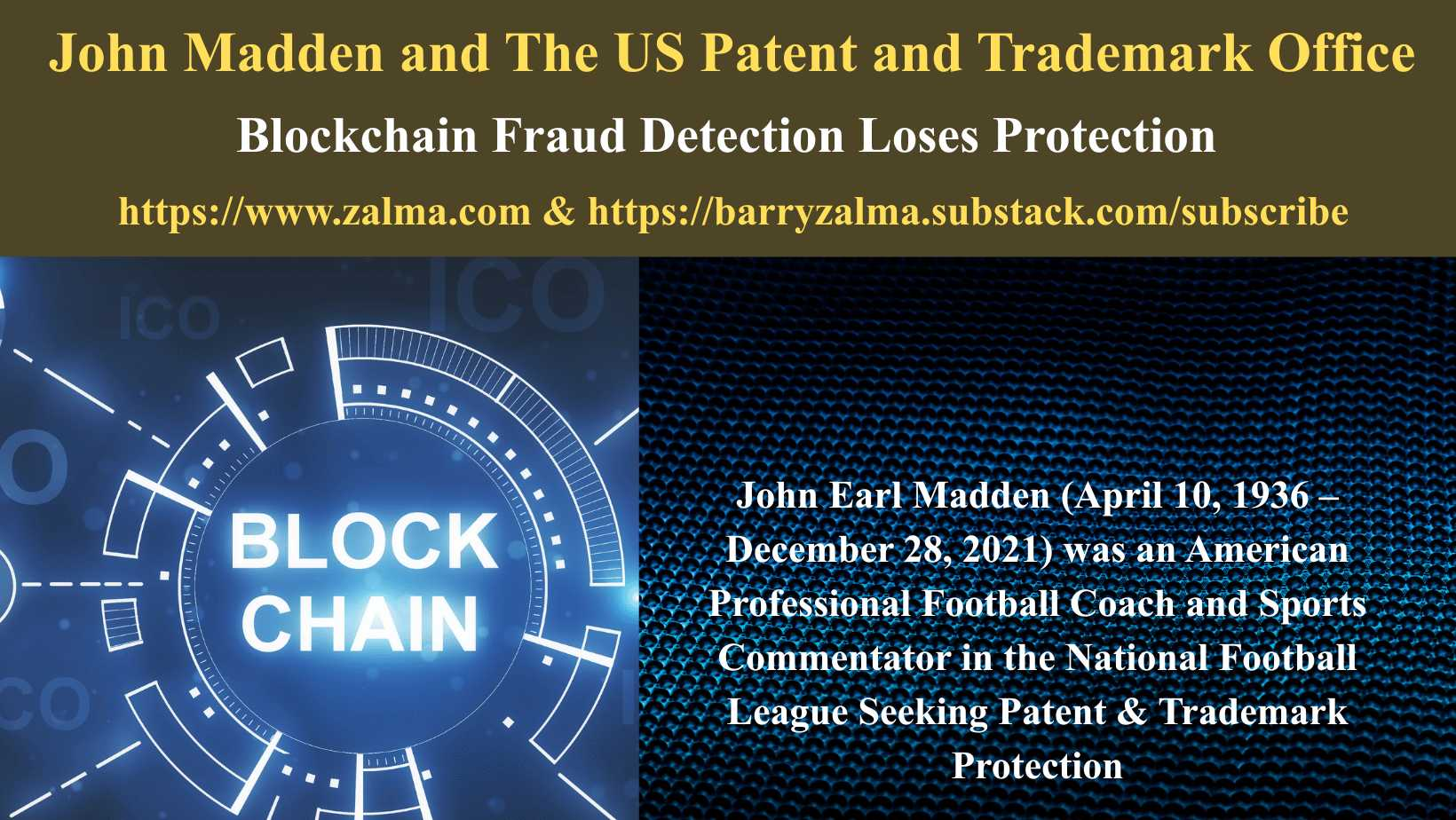
Blockchain Fraud Detection Loses Protection
Posted on October 22, 2026 by Barry Zalma
John Earl Madden (April 10, 1936 – December 28, 2021) was an American Professional Football Coach and Sports Commentator in the National Football League Seeking Patent & Trademark Protection
BLOCKCHAIN FRAUD
Mr. Madden was more than football. He was working to establish a program called “Fraud Protection Systems, Methods, and Computer Programs for Blockchain Financial Transactions.”
In Ex parte John Madden, Appeal 2026-001497, Application 18/495,506, Technology Center 3600, United States Patent and Trademark Office, Patent Trial and Appeal Board (October 14, 2026)
The Examiner rejected claims several numbered claims under 35 U.S.C. § 101 as directed to an abstract idea without significantly more.
THE LAW
Section 101 makes patentable any new and useful process, machine, manufacture, or composition of matter.Laws of nature, natural phenomena, and abstract ideas are implicitly excluded.
THE PATENT TRIAL AND ...
Sovereign Immunity Defeats Suit Against Police Officers
Post 4866
Posted on October 21, 2026 by Barry Zalma
In Chad Lightfoot, et al. v. Progressive Direct Insurance Company, et al., Civil Action No. 26-434, United States District Court, E.D. Louisiana (October 9, 2026) Chad Lightfoot was involved in an Orleans Parish automobile accident in 2011 and filed claims with several insurers, including Progressive.
After a related civil dispute, Progressive counsel allegedly submitted a false affidavit stating that Lightfoot had fraudulently received a $50,000 payment. A New Orleans police detective relied on the affidavit to obtain an arrest warrant, and Louisiana State Police Lieutenant Alan Arcana allegedly reported that Lightfoot had received the payment. Lightfoot was arrested in 2015 and charged with theft, insurance fraud, and perjury.
Plaintiffs alleged that no record of the payment existed and that the criminal charges were dismissed on October 15, 2024.
Lightfoot and Geralyn Hawkins filed suit in October 2025 and ...