
States Make Insurance Fraud a Crime
Barry Zalma
Dec 21, 2023
Read the full article at https://lnkd.in/gBbGfRKt and see the full video at https://lnkd.in/gy93J2m6 and at https://lnkd.in/gme38MSg and at https://zalma.com/blog plus more than 4690 posts.
In Hawaii, a person was convicted of fraud in State v. Whitaker, 175 P.3d 136, 117 Hawai’i 26 (Haw.App. 12/31/2007). As a result of a claim made by Hiram Whitaker (Whitaker) to AIG Hawaii Insurance Company, Inc. (AIG), his automobile insurance carrier, in which he sought insurance benefits for vandalism damages to his car, Whitaker was indicted, convicted, and sentenced for Insurance Fraud in violation of Hawaii Revised Statutes (HRS) § 431:10C-307.7(a) (1) and (b) (2) (2005), and Attempted Theft in the Second Degree (Attempted Theft 2) in violation of HRS § 708-831(1) (b) (Supp. 2000) and HRS § 705-500 (1993).
At trial, Cheryl Cabrera (Cabrera), an AIG claims-service representative, testified that she was assigned to follow up on Whitaker’s telephone call to AIG in which he reported the vandalism to his car. She called Whitaker at home, asked him to specifically describe the damages to his car, and requested that Whitaker “come in the next day for an estimate.” Cabrera recalled that the damages claimed by Whitaker were pretty extensive for a vehicle being vandalized. “I remember him stating his vehicle, the entire car was scratched or keyed. I remember damages he mentioned to the hood, trunk, passenger side, and driver’s side signal light.” The damages were inconsistent of a vehicle being vandalized. Every part of his vehicle was damaged, either scratched or indented and so forth.
Both Whitaker and his wife, Eva, testified at trial. They described the vandalism damages to the car that they observed on March 1, 2001. They also acknowledged that some of the damages to the car pre-existed the vandalism.
As to the Insurance Fraud offense, the indictment charged that Whitaker did knowingly present, cause or permit to be presented false information on a claim to AIG with intent to obtain benefits or recovery or compensation for benefits or services provided, to wit, insurance proceeds. When the definition of an offense specifies the state of mind sufficient for the commission of that offense, without distinguishing among the elements thereof, the specified state of mind shall apply to all elements of the offense, unless a contrary purpose plainly appears.
Not all insurance fraud cases deal with individual acts like those cases. Some involve major conspiracies to defraud insurers by multiple acts of fraud. Consider a case where 46 counts of fraud were charged and how many more counts could have been charged against the schemers who operated a capping (running) scheme to recruit injured persons and inflate their injuries for profit. In New York a “runner is defined as:
"‘Runner’ shall mean any person who, for a pecuniary benefit, procures or attempts to procure a client, patient or customer when such person knows, or a reasonable person would know, that the purpose of an owner of a no-fault motor vehicle insurance medical clinic is to falsely or fraudulently: (I) obtain medical benefits from a no-fault motor vehicle insurer; or (ii) assert a claim against an insured or a no-fault motor vehicle insurer for the provision of health care services to such client, patient or customer; provided, however, that such term shall not include a person who procures or attempts to procure clients, patients or customers through public media or a person who refers clients, patients or customers as authorized by law.
"Nothing in this chapter shall be deemed to prohibit an agent, broker or employee of a health maintenance organization from seeking to sell health maintenance organization coverage or health insurance coverage to any individual or group. [New York City Administrative Code § 20-900.]"
In People v. Zanoletti, 173 Cal.App.4th 547, 92 Cal.Rptr.3d 757 (Cal.App. Dist.2 04/28/2009) Ramon Alfonso Zanoletti (Alfonso) and his wife Magdalena Rosalis Zanoletti (Magdalena) appealed their convictions by jury of insurance fraud. Specifically, Alfonso was convicted of 19 counts of felony insurance fraud (Pen. Code, § 550, subd. (a)(1)) (counts 1, 4, 7, 10, 12, 14, 16, 18, 20, 22, 24, 26, 28, 32, 34, 38, 40, 42 & 45), with findings of a pattern of fraudulent taking of more than $100,000 (§ 186.11, subd. (a)(3)) and damages exceeding $50,000 (§ 12022.6, subd. (a)(1)). He was also convicted of one count (count 3) of misdemeanor unauthorized practice of law (Bus. & Prof. Code, § 6126, subd. (a)). Magdalena was convicted of the same insurance fraud counts and special allegations, plus another 19 counts of felony insurance fraud (§ 550, subd. (a)(5)) (counts 2, 5, 8, 11, 13, 15, 17, 19, 21, 23, 25, 27, 29, 33, 35, 39, 41, 43 & 46), with the same special allegations. The trial court sentenced each to 22 years in state prison.
Magdalena worked as an office manager at the Franklin Chiropractic Clinic on West 8th Street in Los Angeles (the clinic) and received an annual salary of $40,000. Clarence Franklin worked as a chiropractor at the clinic. Magdalena’s husband Alfonso leased the space for the clinic and also leased some of the medical equipment, including the X-ray machine, and paid the clinic’s telephone bill. Alfonso, who was not an attorney, had an office at the Law Offices of Taghizadeh & Associates (the law office). Between December 12, 2003 and December 3, 2004, Alfonso received $183,115.42 from the law firm in sporadic checks of unequal sizes, often with the notation “for ex-services.”
Magdalena testified on her own behalf. She and Alfonso had been married 35 years and have two daughters. She had worked at the clinic approximately 11 years, and denied directing patients to sign for more treatments than they received. She attributed errors in the billings to human error. Alfonso would meet clients at the clinic and also discussed patients with her. Alfonso leased the space for the clinic and paid the clinic’s telephone bill.
Alfonso testified on his own behalf. He worked at the clinic from 1992 through 1995 as an administrator, and again from 2003 to 2006, though he did not recall that time very well. He also began working at the law office around September 2003. As to the $183,000 he received from the law office in 2004, he cashed the checks, then returned an unspecified sum to the law office, though he paid taxes on the full amount.
The court concluded that multiple convictions were appropriate. Sign-in sheets used by the clinics were clearly fraudulent. Magdalena assisted in the preparation of this documentation, as well. She was appropriately convicted under section 550, subdivision (a) (5)
The court found that a conspiracy exists when the defendant and another person have the specific intent to commit an offense and a member of the conspiracy commits an overt act in furtherance of the conspiracy. The existence of a conspiracy may be inferred from the conduct, relationship, interests, and activities of the alleged conspirators before and during the alleged conspiracy. In this case the evidence overwhelmingly established that Alfonso and Magdalena were part of a sophisticated conspiracy to make fraudulent insurance claims. With minor modification in the judgments the two were ordered to serve their sentence.
ZALMA OPINION
Insurance fraud is a serious crime – a felony – in most states. Every person convicted of insurance fraud or acting as a runner or capper to assist unscrupulous lawyers to commit insurance fraud, should be arrested, tried and if convicted sentence to the full penalty allowed by the state’s insurance fraud statute.
(c) 2023 Barry Zalma & ClaimSchool, Inc.
Please tell your friends and colleagues about this blog and the videos and let them subscribe to the blog and the videos.
Subscribe to my substack at https://barryzalma.substack.com/publish/post/107007808
Go to Newsbreak.com https://www.newsbreak.com/@c/1653419?s=01
Follow me on LinkedIn: http://www.linkedin.com/comm/mynetwork/discovery-see-all...
Daily articles are published at https://zalma.substack.com.
Go to the podcast Zalma On Insurance at https://podcasters.spotify.com/pod/show/barry-zalma/support; Go to Barry Zalma videos at Rumble.com at https://rumble.com/c/c-262921; Go to Barry Zalma on YouTube- https://www.youtube.com/channel/UCysiZklEtxZsSF9DfC0Expg; Go to the Insurance Claims Library – http://zalma.com/blog/insurance-claims-library.
Please tell your friends and colleagues about this blog and the videos and let them subscribe to the blog and the videos.
Subscribe to my substack at https://lnkd.in/gcZKhG6g
Go to Newsbreak.com https://lnkd.in/g8azKc34 ; Go to Barry Zalma videos at Rumble.com at https://lnkd.in/gV9QJYH; Go to Barry Zalma on YouTube- https://lnkd.in/g2hGv88; Go to the Insurance Claims Library – https://lnkd.in/gwEYkxD.

Insurance Expert May Not Testify to Speculative and Contains Unsupported Conclusions.
Posted on September 18, 2026 by Barry Zalma
See the full video at and at https://rumble.com/v7fmifw-expert-may-only-testify-to-what-experience-supports.html
In Michele A. Over, and The Estate Of Paul R. Over v. State Farm Mutual Automobile Insurance Company, and State Farm Fire And Casualty Company, Civil Action No. 23-cv-02243-PAB-STV, United States District Court, D. Colorado (September 14, 2026) Michele and Paul Over sued State Farm Fire and State Farm Auto over hail-damage and stolen-vehicle claims.
The operative dispute concerned State Farm Auto’s motion to exclude or limit opinions from plaintiffs’ insurance-industry expert, Aaron Castillo. Castillo.
Law
The proponent of expert testimony must establish by a preponderance of the evidence that an expert is qualified and that the opinions are helpful, sufficiently grounded, and reliably derived and applied. Experience-based opinions must explain how the...
150 Months in Prison for Tax Fraud
Post 4846
Posted on September 17, 2026 by Barry Zalma
See the full video at https://lnkd.in/g8rh3JBX and https://lnkd.in/gmkdy-9C, In United States Of America v. Thomas Addaquay, Nos. 25-10609, 25-10611, United States Court of Appeals, Eleventh Circuit (September 9, 2026) the Eleventh Circuit affirmed all challenged convictions, the 150-month aggregate sentence, and the challenged $4,123,474.55 restitution award.
FACTS
In United States Of America v. Thomas Addaquay, United States Of America v. Thomas Addaquay, Nos. 25-10609, 25-10611, United States Court of Appeals, Eleventh Circuit (September 9, 2026) the Eleventh Circuit affirmed all challenged convictions, the 150-month aggregate sentence, and the challenged $4,123,474.55 restitution award.
FACTS
Thomas Addaquay controlled United Consolidated Accounting and Business Services (UC), nominally a check-cashing business.
The government proved a three-stage tax-refund scheme that converted the resulting refund checks into usable funds through ...
Major Fraud Perpetrator Asserts Fifth Amendment Privilege to Avoid Prosecution
Post 5489
Posted on September 14, 2026 by Barry Zalma
Fraudster Refuses to Answer Questions About His Alleged Fraud
See the full video at https://lnkd.in/gvicAMDr and at https://lnkd.in/gvicAMDr
In Great American Insurance Co. v. Gemstone Property Management, LLC, et al., No. 23-cv-9100 (LJL), United States District Court, S.D. New York (September 8, 2026) Great American Insurance Company alleged that it was defrauded through a scheme in which Subin Associates, LLP recruited individuals to stage construction-site injuries, arranged unnecessary medical treatment and litigation funding, and pursued fraudulent personal-injury claims.
Luis Manuel Garcia Salcedo, resulted in a $6 million settlement. Non-party Jose Hernandez allegedly worked as an assistant manager at Subin, operated Hernandez Associates, and owned litigation-funding companies that shared office space with Subin and provided services to its clients.
After Great American ...
Plaintiff’s Reading of the Policy is Plaintiff’s Reasonable Allegations
Posted on October 19, 2026 by Barry Zalma
Post 4868
CLASS ACTION THAT STATES A SIMPLE CLEAR AND PLAUSIBLE CAUSE OF ACTION SURVIVES
In Sheila Marino v. Farmers New World Life Insurance Company, No. 2:25-cv-02200-JNW, United States District Court, W.D. Washington, Seattle (October 13, 2026) defendant Farmers New World Life Insurance Company’s (“FNWL”) moved to dismiss Plaintiff Sheila Marino’s putative class action involving flexible universal life insurance.
Marino filed a putative class action in King County Superior Court alleging: (1) breach of contract, (2) breach of the implied covenant of good faith and fair dealing, and (3) violation of the Washington Consumer Protection Act (CPA).
She pleaded two theories: an “overcharge” theory and an “underpayment of interest” theory asked the Court to take judicial notice of historical Federal Funds Effective Rates.
THE LAW
Pleading Standard.
To survive a Rule 12(b)(6) motion, a ...

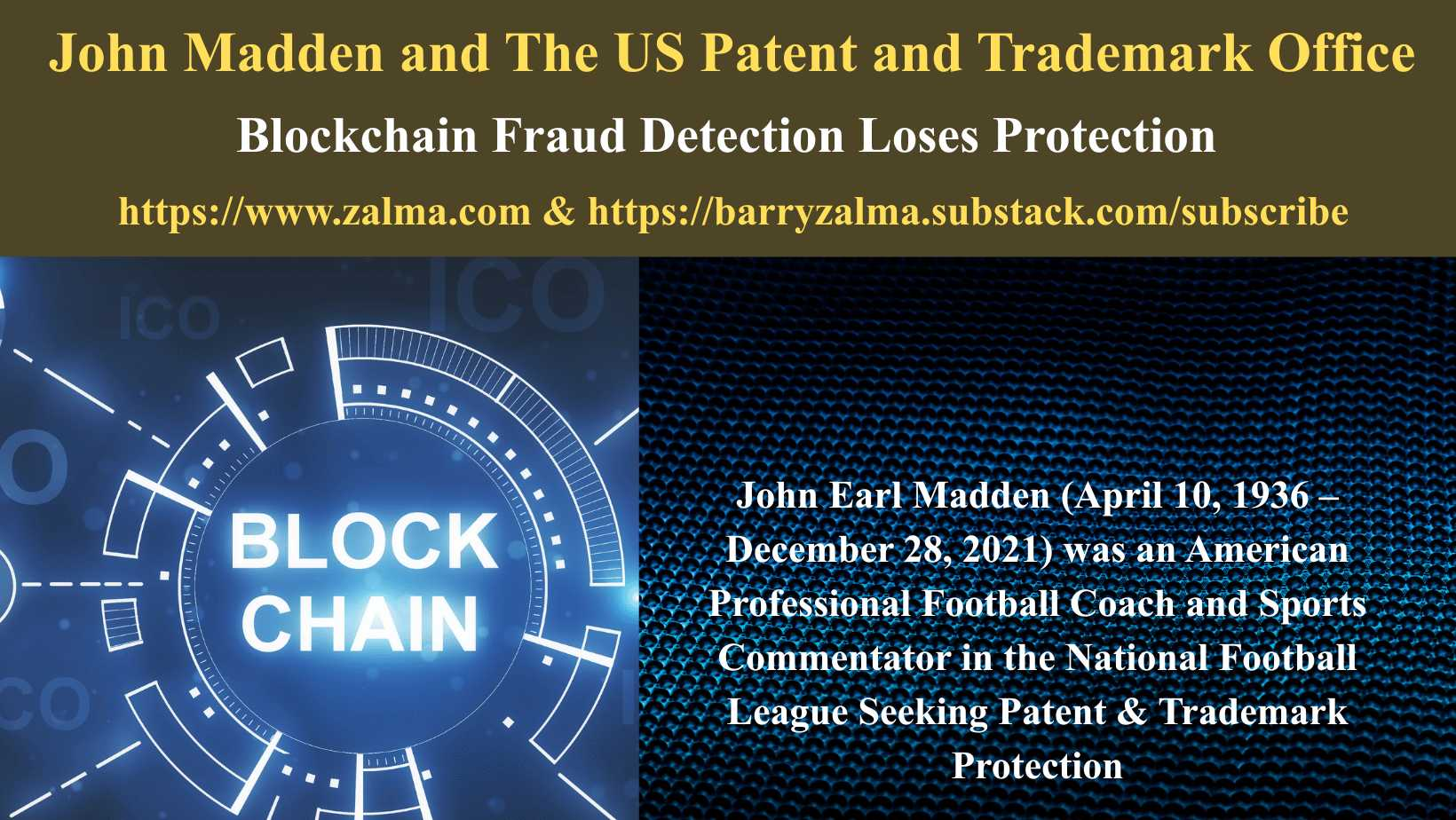
Blockchain Fraud Detection Loses Protection
Posted on October 22, 2026 by Barry Zalma
John Earl Madden (April 10, 1936 – December 28, 2021) was an American Professional Football Coach and Sports Commentator in the National Football League Seeking Patent & Trademark Protection
BLOCKCHAIN FRAUD
Mr. Madden was more than football. He was working to establish a program called “Fraud Protection Systems, Methods, and Computer Programs for Blockchain Financial Transactions.”
In Ex parte John Madden, Appeal 2026-001497, Application 18/495,506, Technology Center 3600, United States Patent and Trademark Office, Patent Trial and Appeal Board (October 14, 2026)
The Examiner rejected claims several numbered claims under 35 U.S.C. § 101 as directed to an abstract idea without significantly more.
THE LAW
Section 101 makes patentable any new and useful process, machine, manufacture, or composition of matter.Laws of nature, natural phenomena, and abstract ideas are implicitly excluded.
THE PATENT TRIAL AND ...
Sovereign Immunity Defeats Suit Against Police Officers
Post 4866
Posted on October 21, 2026 by Barry Zalma
In Chad Lightfoot, et al. v. Progressive Direct Insurance Company, et al., Civil Action No. 26-434, United States District Court, E.D. Louisiana (October 9, 2026) Chad Lightfoot was involved in an Orleans Parish automobile accident in 2011 and filed claims with several insurers, including Progressive.
After a related civil dispute, Progressive counsel allegedly submitted a false affidavit stating that Lightfoot had fraudulently received a $50,000 payment. A New Orleans police detective relied on the affidavit to obtain an arrest warrant, and Louisiana State Police Lieutenant Alan Arcana allegedly reported that Lightfoot had received the payment. Lightfoot was arrested in 2015 and charged with theft, insurance fraud, and perjury.
Plaintiffs alleged that no record of the payment existed and that the criminal charges were dismissed on October 15, 2024.
Lightfoot and Geralyn Hawkins filed suit in October 2025 and ...