


A True Crime Story of Insurance Fraud
Barry Zalma
Aug 18, 2023
Read the full true crime story at https://lnkd.in/gpE8DUrr and at https://zalma.com/blog plus more than 4550 posts.
(c) 2023 Barry Zalma & ClaimSchool, Inc.
This is a fictionalized True Crime Story of Insurance Fraud from an Expert who explains why Insurance Fraud is a “Heads I Win, Tails You Lose” situation for Insurers. The stories help to Understand How Insurance Fraud in America is Costing Everyone who Buys Insurance Thousands of Dollars Every year and Why Insurance Fraud is Safer and More Profitable for the Perpetrators than any Other Crime. The names, and places have been changed to protect the Guilty.
Arson for Profit can be Expensive
Most people do not understand how hard it is to set fire to a house that will destroy the entire dwelling and its contents. Most residences simply do not have sufficient combustibles in the right place to allow for a sustained fire. Many homes, especially the more modern ones, have fail-safe devices everywhere that make accidental fires a thing of the past.
An Insured decided that the only possible means of escaping his mortgage was to burn down his house. Being a rather imaginative fellow, he decided to also make the fire look like an accident.
On leaving his house in the afternoon, he opened the gas jets on the stove, blew out the pilot on his gas dryer and water heater, and set the thermostat on his electronically ignited furnace to 80 degrees Fahrenheit. It was a hot Summer day, but he assumed it would eventually cool off a little, the thermostat would kick on the furnace, and the electronic starter would cause a gas explosion that would destroy the entire house. What he did not count on was Southern California’s Santa Ana Winds that brought heat from the desert and kept the outside temperature in the hundreds all day and into the night. The Insured was shocked that a nosy neighbor with clear sinuses would smell the gas, turn it off at the meter, and save the house.
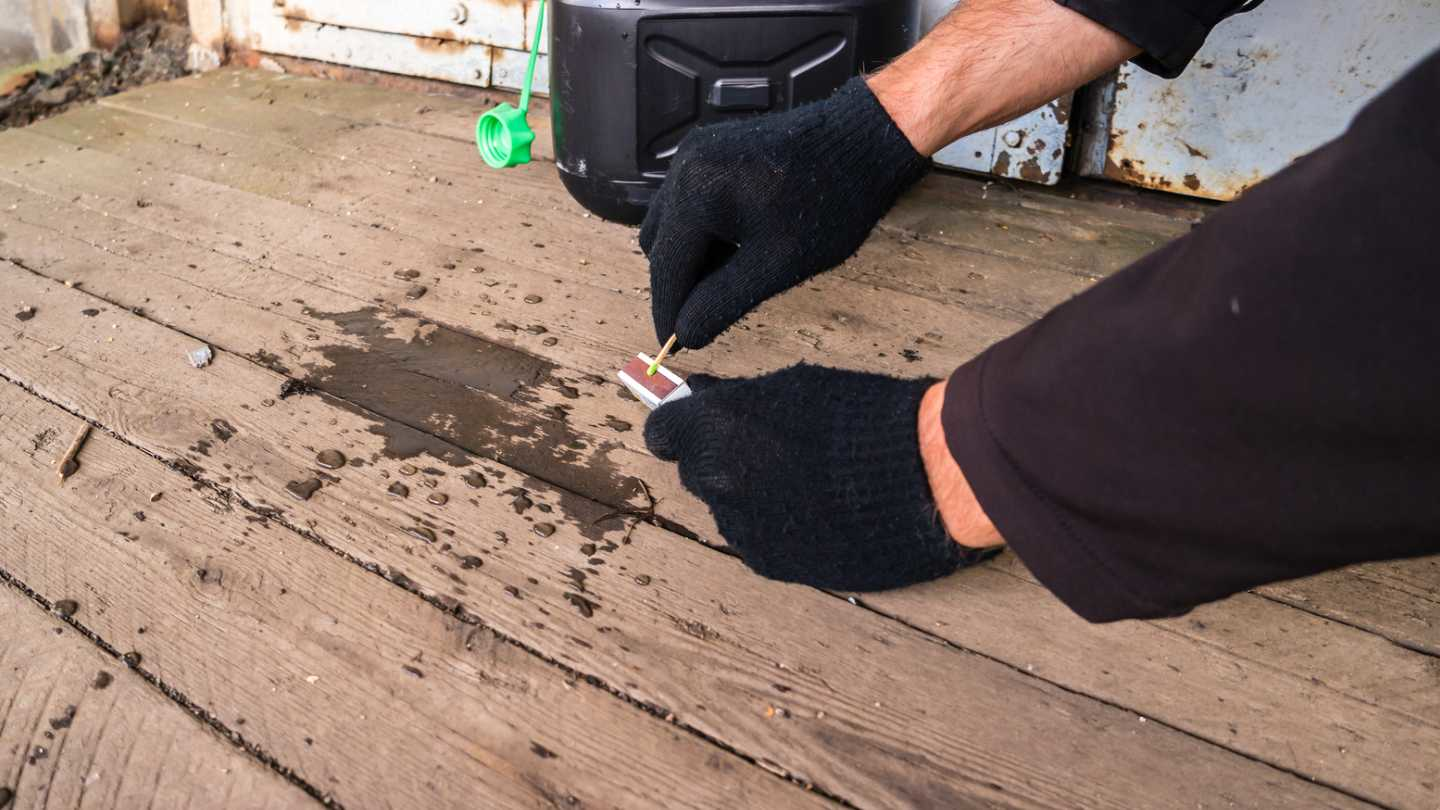
Of course, when the Insured returned home, he had to hide his disappointment that the house was still there. Undaunted, however, he tried again the next week. This time he took no chances. He went to the hardware store and bought a case of Coleman cooking fuel and spread it throughout the house. Then he tore up a book of paper matches so that there was no cover, only matches. He lit a cigarette and placed it low between the matches and left the house confident that when the cigarette burned down it would ignite the match heads and burn down the house. He was again sorely disappointed when he returned home to find the house still there.
The would-be arsonist had his innocent wife with him as an alibi. When they entered the house, she became hysterical at the sight of the flammable liquids poured throughout the house. She insisted that he report the incident to the fire department. He wouldn’t do it so she, against his wishes, called in the Arson Investigators.
“Boy, you were lucky.” A young fire arson unit investigator said. “The idiot who tried to set fire to your house set his fuse upside down!” Immediately, his partner kicked him in the shins but it was too late to stop him.
The fact that the cigarette, to be used as a fuse, must be placed at the head of the matches, not the base, was not known to the insured and the cigarette merely burned itself out.
The Insured learned a lesson from the arson investigator. The house burned down almost totally two days later.
The claim to the insurer included, among many other things, one encyclopedia Britannica and a wooden duck decoy. These inconsequential items, making up part of a claim for more than $100,000.00 in personal property, led to the Insured’s arrest when they were found, intact and undamaged in his temporary residence.
The Insured was arrested for arson and insurance fraud. His claim was denied.
He, of course, sued for bad faith, and the insurer was required to defend the law suit for a total of five years because it could not compel his testimony at deposition or trial until his criminal case was resolved. In the fifth year of the bad faith suit the insured’s lawyer called the insurer’s lawyer and suggested his client would provide a release and dismiss the suit with prejudice for a payment of only $5,000. The adjuster in charge – although he had spent over $30,000 defending the suit, refused the settlement and instructed his lawyer to offer only $2,000.
Following instructions, the insulting offer was made and, much to the surprise of the defense lawyer, the offer was accepted. The suit finally settled with the arsonist and his presumably innocent spouse, for a payment of $2,000.00. Twenty times less than that amount expended by the insurer to defend the spurious lawsuit brought by the Insured.
Why did the Insured offer to settle for so little? For at least two reasons:
Because the District Attorney could not set a man free to try the arson case and it was continued over and over again until all the witnesses were gone or had forgotten everything they knew.
Because the District Attorney and the Insured had made a deal that if the Insured pleaded guilty to one count of insurance fraud he would not go to jail.
The District Attorney, although he knew of the insurer’s interest in the case and the lawsuit pending against it did not advise the insurer of the deal. Of course, had the insurer known that the insured was going to plead guilty to insurance fraud they would have paid nothing.
The case was never tried. Two days after the settlement was paid in the civil action and more than five years after the fire, the Insured appeared in criminal court and pleaded guilty to one count of insurance fraud. He was given probation. The case wasn’t a priority matter to the prosecutor since only an insurance company was being hurt. The fact that the insurer was required to defend a bad faith suit for five years at enormous cost was of no apparent concern to the prosecutors.
The Insured did not profit from the fire with a cash award. He was relieved of his mortgage debt [which the insurer was required to pay to the mortgagee who had not been culpable in the arson] and he paid his lawyer one third of the $2,000 settlement. Since the insured was judgment proof the insurer lost, as uncollectable, the amount paid to the mortgagee and sold the bare land.
Interestingly, the arson investigator who worked so hard to find evidence to arrest the insured was later arrested and convicted as a serial arsonist. Apparently, he was upset that there was an arson fire in his town that he did not set.
Adapted from my book Insurance Fraud Costs Everyone available https://www.amazon.com/gp/product/B08QG3MYCR?pf_rd_r=845HWBP1C0XK5A3GZ6BQ&pf_rd_p=9d9090dd-8b99-4ac3-b4a9-90a1db2ef53b&pd_rd_r=787f0f76-2377-4ad2-9d91-df3dbda2a0e7&pd_rd_w=R9LjE&pd_rd_wg=QXi9P&ref_=pd_gw_unk
(c) 2023 Barry Zalma & ClaimSchool, Inc.
Please tell your friends and colleagues about this blog and the videos and let them subscribe to the blog and the videos.
Subscribe to Excellence in Claims Handling at locals.com https://zalmaoninsurance.locals.com/subscribe.
Subscribing to my publications at substack at https://barryzalma.substack.com/publish/post/107007808
Go to Newsbreak.com https://www.newsbreak.com/@c/1653419?s=01
Follow me on LinkedIn: www.linkedin.com/comm/mynetwork/discovery-see-all?usecase=PEOPLE_FOLLOWS&followMember=barry-zalma-esq-cfe-a6b5257
Daily articles are published at https://zalma.substack.com. Go to the podcast Zalma On Insurance at https://podcasters.spotify.com/pod/show/barry-zalma/support; Go to Barry Zalma videos at Rumble.com at https://rumble.com/c/c-262921; Go to Barry Zalma on YouTube- https://www.youtube.com/channel/UCysiZklEtxZsSF9DfC0Expg; Go to the Insurance Claims Library – https://zalma.com/blog/insurance-claims-library
Adapted from my book Insurance Fraud Costs Everyone available as a Kindle Book https://lnkd.in/guPbnt5xhttps://lnkd.in/guPbnt5xhttps://lnkd.in/guPbnt5xhttps://lnkd.in/guPbnt5xhttps://lnkd.in/guPbnt5xhttps://lnkd.in/guPbnt5xhttps://lnkd.in/guPbnt5xhttps://lnkd.in/guPbnt5x
Subscribe to my publications at substack at https://lnkd.in/gcZKhG6g
Follow me on LinkedIn: https://lnkd.in/guWk7gf
MGo to the Insurance Claims Library – https://lnkd.in/gWVSBde

Insurance Expert May Not Testify to Speculative and Contains Unsupported Conclusions.
Posted on September 18, 2026 by Barry Zalma
See the full video at and at https://rumble.com/v7fmifw-expert-may-only-testify-to-what-experience-supports.html
In Michele A. Over, and The Estate Of Paul R. Over v. State Farm Mutual Automobile Insurance Company, and State Farm Fire And Casualty Company, Civil Action No. 23-cv-02243-PAB-STV, United States District Court, D. Colorado (September 14, 2026) Michele and Paul Over sued State Farm Fire and State Farm Auto over hail-damage and stolen-vehicle claims.
The operative dispute concerned State Farm Auto’s motion to exclude or limit opinions from plaintiffs’ insurance-industry expert, Aaron Castillo. Castillo.
Law
The proponent of expert testimony must establish by a preponderance of the evidence that an expert is qualified and that the opinions are helpful, sufficiently grounded, and reliably derived and applied. Experience-based opinions must explain how the...
150 Months in Prison for Tax Fraud
Post 4846
Posted on September 17, 2026 by Barry Zalma
See the full video at https://lnkd.in/g8rh3JBX and https://lnkd.in/gmkdy-9C, In United States Of America v. Thomas Addaquay, Nos. 25-10609, 25-10611, United States Court of Appeals, Eleventh Circuit (September 9, 2026) the Eleventh Circuit affirmed all challenged convictions, the 150-month aggregate sentence, and the challenged $4,123,474.55 restitution award.
FACTS
In United States Of America v. Thomas Addaquay, United States Of America v. Thomas Addaquay, Nos. 25-10609, 25-10611, United States Court of Appeals, Eleventh Circuit (September 9, 2026) the Eleventh Circuit affirmed all challenged convictions, the 150-month aggregate sentence, and the challenged $4,123,474.55 restitution award.
FACTS
Thomas Addaquay controlled United Consolidated Accounting and Business Services (UC), nominally a check-cashing business.
The government proved a three-stage tax-refund scheme that converted the resulting refund checks into usable funds through ...
Major Fraud Perpetrator Asserts Fifth Amendment Privilege to Avoid Prosecution
Post 5489
Posted on September 14, 2026 by Barry Zalma
Fraudster Refuses to Answer Questions About His Alleged Fraud
See the full video at https://lnkd.in/gvicAMDr and at https://lnkd.in/gvicAMDr
In Great American Insurance Co. v. Gemstone Property Management, LLC, et al., No. 23-cv-9100 (LJL), United States District Court, S.D. New York (September 8, 2026) Great American Insurance Company alleged that it was defrauded through a scheme in which Subin Associates, LLP recruited individuals to stage construction-site injuries, arranged unnecessary medical treatment and litigation funding, and pursued fraudulent personal-injury claims.
Luis Manuel Garcia Salcedo, resulted in a $6 million settlement. Non-party Jose Hernandez allegedly worked as an assistant manager at Subin, operated Hernandez Associates, and owned litigation-funding companies that shared office space with Subin and provided services to its clients.
After Great American ...
Denial Of Mental Health Diversion And Probation Condition Were Affirmed
Posted on October 9, 2026 by Barry Zalma
Post 4860
In The People v. Nicholas Daniel Stiles, A173483, A173646, California Court of Appeals, First District, Second Division (September 29, 2026) Nicholas Daniel Stiles pleaded no contest to one count of insurance fraud arising from his purchase of automobile insurance after a June 2021 collision, and to grand theft arising from an April 2024 incident at a 7-Eleven.
In both cases, the trial court suspended imposition of sentence and placed him on two years’ probation. Before the pleas, Stiles sought mental health diversion in both matters and filed a written motion seeking substitute appointed counsel. The diversion applications were denied, and the court never held a hearing on the motion.
LAW
Penal Code section 1001.36 permits pretrial mental health diversion when a defendant is eligible and suitable and the proposed treatment will meet the defendant’s specialized needs; denial is reviewed for ...
If Grounds For Dismissal Are Apparent From The Face Of The Complaint, A Court May Also Dismiss The Case on The Court’s Own Motion
Posted on October 5, 2026 by Barry Zalma
Pro Se Plaintiff Failed to Make a Short and Plain Statement
Post 4856
In Tak Lun Ng v. United Financial Casualty Company, No. 26-cv-03136-LJC, United States District Court, N.D. California (September 28, 2026) Tak Lun Ng, proceeding pro se, sued United Financial Casualty Company over a March 2, 2021 automobile accident and the insurer’s March 24, 2021 refusal to pay him.
He appeared to assert breach of contract, fraud, negligence, premises liability, product liability, and related theories. United removed the action from state court and moved to dismiss.
Ng missed that deadline but later filed several documents, including a motion for leave to amend, all of which the court reviewed.
LAW
Under Federal Rules of Civil Procedure, a complaint must provide a short and plain statement containing enough factual matter to state a facially plausible...
If Grounds For Dismissal Are Apparent From The Face Of The Complaint, A Court May Also Dismiss The Case on The Court’s Own Motion
Posted on October 5, 2026 by Barry Zalma
Pro Se Plaintiff Failed to Make a Short and Plain Statement
Post 4856
In Tak Lun Ng v. United Financial Casualty Company, No. 26-cv-03136-LJC, United States District Court, N.D. California (September 28, 2026) Tak Lun Ng, proceeding pro se, sued United Financial Casualty Company over a March 2, 2021 automobile accident and the insurer’s March 24, 2021 refusal to pay him.
He appeared to assert breach of contract, fraud, negligence, premises liability, product liability, and related theories. United removed the action from state court and moved to dismiss.
Ng missed that deadline but later filed several documents, including a motion for leave to amend, all of which the court reviewed.
LAW
Under Federal Rules of Civil Procedure, a complaint must provide a short and plain statement containing enough factual matter to state a facially plausible...