
Lie to Your Insurer and You Will Lose
Barry Zalma
Jul 19, 2023
Read the full article at https://lnkd.in/gCiyqPV5 and see the full video at https://lnkd.in/gex-BuXW and at https://lnkd.in/gDmQTwN4 and at https://zalma.com/blog plus more than 4550 posts.
Plaintiffs Richard Converse and Stephanie Converse own the property. Defendant State Farm Fire and Casualty Company (“State Farm”) insured the property at the relevant time. After a fire on December 8, 2019, Plaintiffs sought coverage under the insurance policy. Plaintiffs brought this action when Defendant denied coverage for much of the claim. In Richard Converse, and Stephanie Converse v. State Farm Fire And Casualty Company, No. 5:21-CV-457 (TJM/ATB), United States District Court, N.D. New York (July 12, 2023) the USDC was asked to rule on cross-motions for summary judgment.
BACKGROUND
State Farm insured the Converses against the risk of loss to a rental property under a homeowners policy.
The parties agree that Plaintiff Stephanie Converse sent a letter to Joseph Pelton on or about November 8, 2019 that stated: “Joe, … Having issues with my house again. Need help this time! I will pay $5,000 cash when I get the insurance. The back door will be unlocked and open to the basement. That’s where the access to utilities are. Make look like electrical. I will come up after it happens so I will meet up with you. … It’s a mint green house with garage. Love you, See you soon. Stephanie.”
While Plaintiffs admit that Stephanie Converse mailed the letter, they “deny any implication or allegation that Stephanie Converse committed insurance fraud, paid anyone to commit arson on the property, or was in any way involved in the fire that caused the loss on the property.”
Stephanie Converse filed a claim on December 8, 2019 for the loss caused by the fire. State Farm mailed Stephanie Converse a blank Sworn Statement in Proof of Loss and a return envelope. The cover letter stated that the Sworn Statement should be returned by February 17, 2020. State Farm Counsel Roy Mura reminded Stephanie Converse that she had to return the sworn statement. That letter warned that “a failure . . . to timely complete and return the Sworn Statement in Proof of Loss form for the reported loss may result in loss [of] your rights under the . . . policy.”
Stephanie Converse appeared for an examination under oath (“EUO”) in connection with her insurance claim on March 13, 2020. Stephanie Converse affirmed during the examination that “everything as far as you can recall [was] truthful about what you told Mr. Loarca[.]” Converse further testified that she could not “recall asking anybody to burn . . . I mean I can’t remember. I don’t know if I did, or I didn’t.” She further testified that she could not “recall” whether she had offered “to pay anybody money to” burn the property down.
Defendant denied Stephanie Converse’s claim on October 7, 2020 and Plaintiffs sued.
ANALYSIS
Defendant first argues that State Farm has no obligation to provide coverage under the policy because Stephanie Converse breached the insurance contract by making material misrepresentations in reference to her claim. The materiality requirement is satisfied if the false statement concerns a subject relevant and germane to the insurer’s investigation as it was then proceeding.
Plaintiffs deny that Stephanie Converse willfully made any material misrepresentations. Plaintiffs do not seriously dispute that Stephanie Converse made misrepresentations to State Farm during the course of the investigation. They could not. The undisputed evidence before the Court indicated, Stephanie Converse told an investigator that she had made no such request.
Defendant does not argue that Plaintiff dissembled about the cause of the fire at the home, committed arson herself, or paid Joseph Pelton to set the home on fire. The Court found that as a matter of law Plaintiff made these misrepresentations willfully. Taken as a whole, the Court concluded that Plaintiff Stephanie Converse’s statements represented a continuing attempt to conceal from State Farm that she had contacted Pelton and offered him money to burn down the insured property. The Court concluded that a reasonable juror could not find that such contradictory statements were the result of mistake or misunderstanding, but that the differences between what Plaintiff told various investigators were intentional.
“The purpose” of procedures like examinations under oath and other investigative measures is to enable the insurance company to acquire knowledge or information that may aid it in its further investigation or that may otherwise be significant to the company in determining its liability under the policy and the position it should take with respect to the claim. A reasonable juror could only find that her misleading conduct was material.
Stephanie Converse made material misrepresentations to insurance investigators as a matter of law and breached the insurance contract and Defendant is entitled to summary judgment in this respect.
Failure to Cooperate
Testifying falsely can also breach the condition of cooperation. Stephanie Converse admitted to Lee County Sheriff’s Office investigators that she had written the letter she had denied to State Farm. Converse thus made misrepresentations about facts material to State Farm’s investigation.
Given the inconsistencies in Stephanie Converse’s stories to various parties and her clear misrepresentation to State Farm about her knowledge of the letter to Pelton, no reasonable juror could find that Converse’s misrepresentations were not willful.
Proof of Loss
When an insurer gives its insured written notice of its desire that proof of loss under a policy of fire insurance be furnished and provides a suitable form for such proof, failure of the insured to file proof of loss within 60 days after receipt of such notice, or within any longer period specified in the notice, is an absolute defense to an action on the policy.
There is no dispute that the Plaintiff did not return a sworn statement of proof of loss until March 12, 2020, well after the date specified by State Farm in correspondence to Stephanie Converse. Defendant has an absolute defense to Plaintiffs’ claims.
Defendant’s motion for summary judgment, was granted and Plaintiffs’ motion for summary judgment was denied.
ZALMA OPINION
An insured who seeks to hire a person to set fire to her house for a fee paid from insurance proceeds is offering to pay for a felonious act. If the person refuses to set the fire, has an alibi when an arson fire actually occurred, performed by a person unknown, and the insured lies about her offer to burn her house, the lie is sufficient to deny the claim in accordance with the terms and conditions of the policy. This case proved the old saw that “liars never prosper.”
(c) 2023 Barry Zalma & ClaimSchool, Inc.
Please tell your friends and colleagues about this blog and the videos and let them subscribe to the blog and the videos.
Subscribe and receive videos limited to subscribers of Excellence in Claims Handling at locals.com https://zalmaoninsurance.locals.com/subscribe.
Consider subscribing to my publications at substack at https://barryzalma.substack.com/publish/post/107007808
Go to Newsbreak.com https://www.newsbreak.com/@c/1653419?s=01
Follow me on LinkedIn: www.linkedin.com/comm/mynetwork/discovery-see-all?usecase=PEOPLE_FOLLOWS&followMember=barry-zalma-esq-cfe-a6b5257
Daily articles are published at https://zalma.substack.com. Go to the podcast Zalma On Insurance at https://podcasters.spotify.com/pod/show/barry-zalma/support; Follow Mr. Zalma on Twitter at https://twitter.com/bzalma; Go to Barry Zalma videos at Rumble.com at https://rumble.com/c/c-262921; Go to Barry Zalma on YouTube- https://www.youtube.com/channel/UCysiZklEtxZsSF9DfC0Expg; https://creators.newsbreak.com/home/content/post; Go to the Insurance Claims Library – https://zalma.com/blog/insurance-claims-library.
Please tell your friends and colleagues about this blog and the videos and let them subscribe to the blog and the videos.
Subscribe and receive videos limited to subscribers of Excellence in Claims Handling at locals.com https://lnkd.in/gfFKUaTf.
Go to the Insurance Claims Library – https://lnkd.in/gWVSBde.

Insurance Expert May Not Testify to Speculative and Contains Unsupported Conclusions.
Posted on September 18, 2026 by Barry Zalma
See the full video at and at https://rumble.com/v7fmifw-expert-may-only-testify-to-what-experience-supports.html
In Michele A. Over, and The Estate Of Paul R. Over v. State Farm Mutual Automobile Insurance Company, and State Farm Fire And Casualty Company, Civil Action No. 23-cv-02243-PAB-STV, United States District Court, D. Colorado (September 14, 2026) Michele and Paul Over sued State Farm Fire and State Farm Auto over hail-damage and stolen-vehicle claims.
The operative dispute concerned State Farm Auto’s motion to exclude or limit opinions from plaintiffs’ insurance-industry expert, Aaron Castillo. Castillo.
Law
The proponent of expert testimony must establish by a preponderance of the evidence that an expert is qualified and that the opinions are helpful, sufficiently grounded, and reliably derived and applied. Experience-based opinions must explain how the...
150 Months in Prison for Tax Fraud
Post 4846
Posted on September 17, 2026 by Barry Zalma
See the full video at https://lnkd.in/g8rh3JBX and https://lnkd.in/gmkdy-9C, In United States Of America v. Thomas Addaquay, Nos. 25-10609, 25-10611, United States Court of Appeals, Eleventh Circuit (September 9, 2026) the Eleventh Circuit affirmed all challenged convictions, the 150-month aggregate sentence, and the challenged $4,123,474.55 restitution award.
FACTS
In United States Of America v. Thomas Addaquay, United States Of America v. Thomas Addaquay, Nos. 25-10609, 25-10611, United States Court of Appeals, Eleventh Circuit (September 9, 2026) the Eleventh Circuit affirmed all challenged convictions, the 150-month aggregate sentence, and the challenged $4,123,474.55 restitution award.
FACTS
Thomas Addaquay controlled United Consolidated Accounting and Business Services (UC), nominally a check-cashing business.
The government proved a three-stage tax-refund scheme that converted the resulting refund checks into usable funds through ...
Major Fraud Perpetrator Asserts Fifth Amendment Privilege to Avoid Prosecution
Post 5489
Posted on September 14, 2026 by Barry Zalma
Fraudster Refuses to Answer Questions About His Alleged Fraud
See the full video at https://lnkd.in/gvicAMDr and at https://lnkd.in/gvicAMDr
In Great American Insurance Co. v. Gemstone Property Management, LLC, et al., No. 23-cv-9100 (LJL), United States District Court, S.D. New York (September 8, 2026) Great American Insurance Company alleged that it was defrauded through a scheme in which Subin Associates, LLP recruited individuals to stage construction-site injuries, arranged unnecessary medical treatment and litigation funding, and pursued fraudulent personal-injury claims.
Luis Manuel Garcia Salcedo, resulted in a $6 million settlement. Non-party Jose Hernandez allegedly worked as an assistant manager at Subin, operated Hernandez Associates, and owned litigation-funding companies that shared office space with Subin and provided services to its clients.
After Great American ...
No Breach of Contract no Bad Faith
Post 4568
Posted on October 23, 2026 by Barry Zalma
A Party Cannot Designate One Witness While Submitting An Undifferentiated Product Of That Witness And An Undesignated Collaborator.
Post 4568
In Dustin Cain; Amanda Cain v. State Farm Fire and Casualty Company, No. 25-60442, United States Court of Appeals, Fifth Circuit (October 16, 2026) Dustin and Amanda Cain sought homeowners’ insurance benefits after a tree fell on their Mississippi home on August 27, 2022. State Farm concluded that the tree caused only a roof puncture and that other damage resulted from excluded long-term conditions. It paid $10,042.90 and later an additional $3,130.08.
The Cains relied on an engineering report and contractor estimate asserting substantially greater damage, sued for breach of contract and related relief, and designated Sean Fee as their sole expert. Fee’s report and a later repair estimate were jointly authored with Jim Irmiter, but neither document identified which opinions, work, or ...

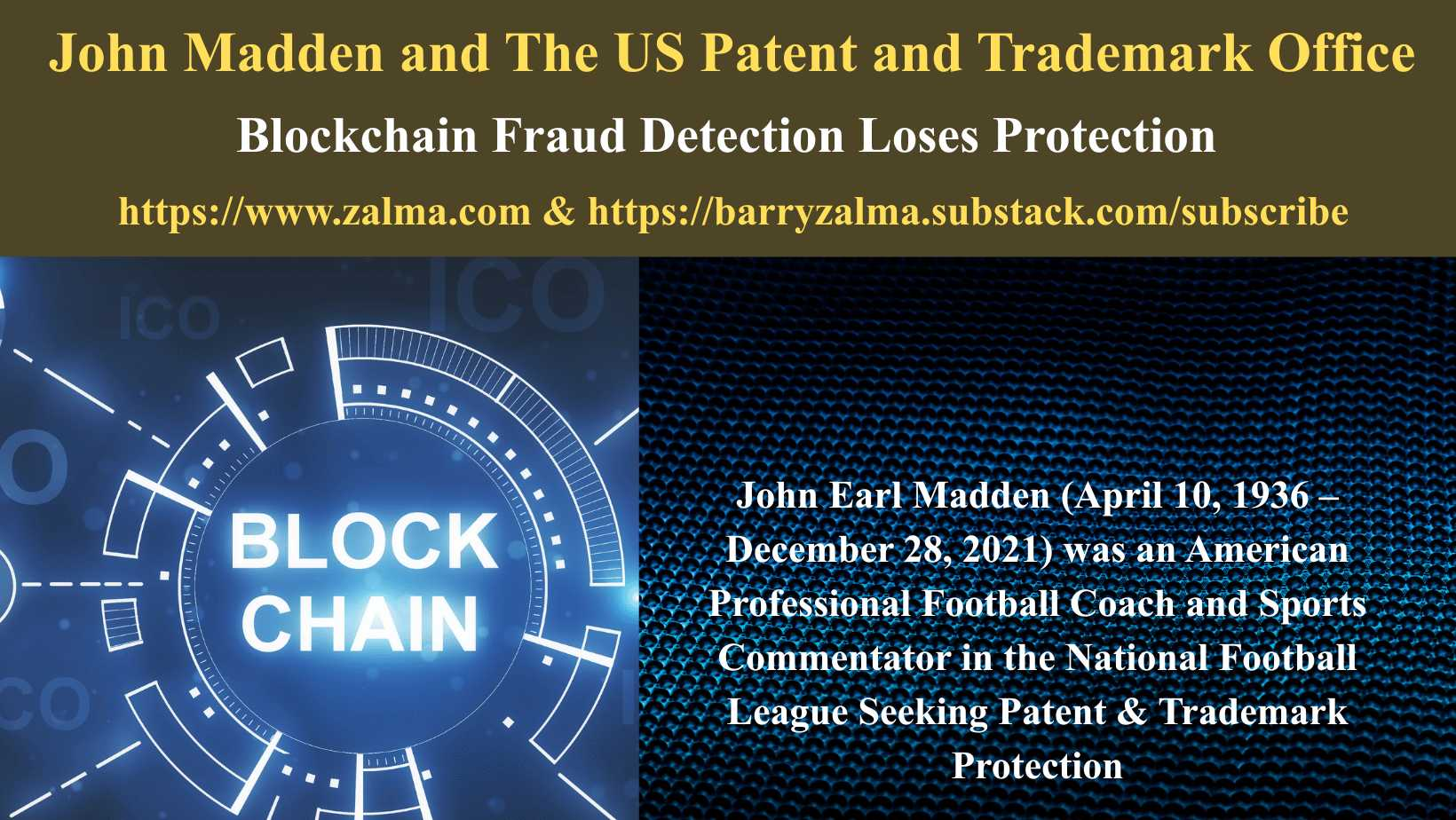
Blockchain Fraud Detection Loses Protection
Posted on October 22, 2026 by Barry Zalma
John Earl Madden (April 10, 1936 – December 28, 2021) was an American Professional Football Coach and Sports Commentator in the National Football League Seeking Patent & Trademark Protection
BLOCKCHAIN FRAUD
Mr. Madden was more than football. He was working to establish a program called “Fraud Protection Systems, Methods, and Computer Programs for Blockchain Financial Transactions.”
In Ex parte John Madden, Appeal 2026-001497, Application 18/495,506, Technology Center 3600, United States Patent and Trademark Office, Patent Trial and Appeal Board (October 14, 2026)
The Examiner rejected claims several numbered claims under 35 U.S.C. § 101 as directed to an abstract idea without significantly more.
THE LAW
Section 101 makes patentable any new and useful process, machine, manufacture, or composition of matter.Laws of nature, natural phenomena, and abstract ideas are implicitly excluded.
THE PATENT TRIAL AND ...
Sovereign Immunity Defeats Suit Against Police Officers
Post 4866
Posted on October 21, 2026 by Barry Zalma
In Chad Lightfoot, et al. v. Progressive Direct Insurance Company, et al., Civil Action No. 26-434, United States District Court, E.D. Louisiana (October 9, 2026) Chad Lightfoot was involved in an Orleans Parish automobile accident in 2011 and filed claims with several insurers, including Progressive.
After a related civil dispute, Progressive counsel allegedly submitted a false affidavit stating that Lightfoot had fraudulently received a $50,000 payment. A New Orleans police detective relied on the affidavit to obtain an arrest warrant, and Louisiana State Police Lieutenant Alan Arcana allegedly reported that Lightfoot had received the payment. Lightfoot was arrested in 2015 and charged with theft, insurance fraud, and perjury.
Plaintiffs alleged that no record of the payment existed and that the criminal charges were dismissed on October 15, 2024.
Lightfoot and Geralyn Hawkins filed suit in October 2025 and ...