
Kona Coffee Must be From the Big Island of Hawaii
Barry Zalma
Jun 13, 2023
Read the full article at https://lnkd.in/gDBUbBWf and see the full video at https://lnkd.in/g5Wwz6Tc and at https://lnkd.in/gdXBrwfA and at https://zalma.com/blog plus more than 4500 posts.
L&K Coffee claimed its various insurance companies erroneously denied coverage to defend it against a Lanham Act false-advertising lawsuit brought by Hawaiian coffee growers. The district court concluded the applicable insurance policies did not obligate a defense and entered summary judgment in the insurance companies’ favor.
In L&K Coffee LLC, dba Magnum Roastery; Kevin Kihnke v. LM Insurance Corporation; Liberty Insurance Corporation; Selective Way Insurance Company; Valley Forge Insurance Company; Continental Casualty Company, No. 22-1727, United States Court of Appeals, Sixth Circuit (June 1, 2023) the Sixth Circuit resolved the coverage dispute.
FACTS
L&K Coffee, LLC, a Michigan-based company, roasts and sells coffee products throughout the United States. Defendants are insurance companies from whom L&K purchased general commercial liability and umbrella insurance policies.
Coffee growers from the Kona region of the Island of Hawai’i sued L&K and other coffee companies for “false designation of origin, false advertising, and unfair competition” in violation of the Lanham Act, 15 U.S.C. § 1125(a), in the Western District of Washington. These “Kona Plaintiffs” alleged that the defendants falsely designated the origin of the coffee they branded and distributed as “Kona” coffee “when most of the coffee beans contained in the coffee products were sourced from other regions of the world.”
The Kona Plaintiffs’ operative complaint summarized their contentions as to L&K as follows: “L&K falsely designates the geographic origin of its “Kona” coffee products with the prominent placement of KONA on the front of the packaging.”
The deceptive marketing was alleged to be designed to mislead consumers into believing that L&K’s Magnum Exotics “Kona” products contain coffee from the Kona District, when the coffee products actually do not contain a significant amount of Kona coffee, if any. The plaintiffs also alleged that L&K deliberately misled the consumer into believing that L&K’s Magnum Exotics coffee products contain significant amounts of premium Kona coffee beans in order to justify the high price L&K charges for what is actually ordinary commodity coffee.
L&K asked the insurance companies to defend and indemnify them in that matter under the policies’ “personal and advertising injury” coverage. Personal and advertising injury, in pertinent part, is defined as an “injury . . . arising out of” (1) a publication that “disparages a person’s or organization’s goods, products or services,” or (2) “[i]nfringing upon another’s . . . slogan in your advertisement.” Based on this language and the Kona Plaintiffs’ allegations, the insurance companies denied coverage because, as one insurer put it, “none of the offenses in the definition of ‘personal and advertising injury’ include false advertising, and none of the allegations in the complaint fall within any of the offenses in the definition.”
ANALYSIS
The duty of an insurance company to provide a defense depends upon the allegations in the complaint and extends to allegations which even arguably come within the policy coverage. An insurer’s duty to defend does not depend solely upon the terminology used in a plaintiff’s pleadings. Rather, it is necessary to focus on the basis for the injury and not the nomenclature of the underlying claim in order to determine whether coverage exists.
The term “disparage” means an untrue statement directed towards another’s property. A disparagement claim requires a company to make false, derogatory, or disparaging communications about a competitor’s product.” (emphasis in the opinion)
The Kona Plaintiffs alleged L&K violated the Lanham Act’s prohibition on false designation of one’s own product. See 15 U.S.C. § 1125(a)(1). The Sixth Circuit concluded that this is not “disparagement.”
Upon review of the Kona Plaintiffs’ complaint, the Sixth Circuit Court agreed with the district court that the complaint does not set forth an arguable theory of recovery. In the Kona Plaintiffs’ own words, “only coffee grown on farms located within the Kona District of the Big Island of Hawaii . . . can be truthfully marketed, labeled, and sold as Kona coffee.” L&K violated the false designation of its product and that was not a covered cause of loss.
ZALMA OPINION
It never pays to lie to your customers. When doing so harms someone else you are subject to damages from those your lie harms. By falsely designating its product of “Kona” coffee when L&K claimed its cheap, generic coffee was “Kona” Coffee it was involved in a tort that was not covered by the policies of insurance.
(c) 2023 Barry Zalma & ClaimSchool, Inc.
Please tell your friends and colleagues about this blog and the videos and let them subscribe to the blog and the videos.
Subscribe and receive videos limited to subscribers of Excellence in Claims Handling at locals.com https://zalmaoninsurance.locals.com/subscribe.
Consider subscribing to my publications at substack at https://barryzalma.substack.com/publish/post/107007808
Go to Newsbreak.com https://www.newsbreak.com/@c/1653419?s=01
Barry Zalma, Esq., CFE, is available at http://www.zalma.com and [email protected]
Follow me on LinkedIn: www.linkedin.com/comm/mynetwork/discovery-see-all?usecase=PEOPLE_FOLLOWS&followMember=barry-zalma-esq-cfe-a6b5257
Write to Mr. Zalma at [email protected]; http://www.zalma.com; http://zalma.com/blog; daily articles are published at https://zalma.substack.com. Go to the podcast Zalma On Insurance at https://podcasters.spotify.com/pod/show/barry-zalma/support; Follow Mr. Zalma on Twitter at https://twitter.com/bzalma; Go to Barry Zalma videos at Rumble.com at https://rumble.com/c/c-262921; Go to Barry Zalma on YouTube- https://www.youtube.com/channel/UCysiZklEtxZsSF9DfC0Expg; https://creators.newsbreak.com/home/content/post; Go to the Insurance Claims Library – https://zalma.com/blog/insurance-claims-library.
Subscribe and receive videos limited to subscribers of Excellence in Claims Handling at locals.com https://lnkd.in/gfFKUaTf.
Follow me on LinkedIn: https://lnkd.in/guWk7gfM
Go to the Insurance Claims Library – https://lnkd.in/gWVSBde.
Please tell your friends and colleagues about this blog and the videos and let them subscribe to the blog and the videos.

Insurance Expert May Not Testify to Speculative and Contains Unsupported Conclusions.
Posted on September 18, 2026 by Barry Zalma
See the full video at and at https://rumble.com/v7fmifw-expert-may-only-testify-to-what-experience-supports.html
In Michele A. Over, and The Estate Of Paul R. Over v. State Farm Mutual Automobile Insurance Company, and State Farm Fire And Casualty Company, Civil Action No. 23-cv-02243-PAB-STV, United States District Court, D. Colorado (September 14, 2026) Michele and Paul Over sued State Farm Fire and State Farm Auto over hail-damage and stolen-vehicle claims.
The operative dispute concerned State Farm Auto’s motion to exclude or limit opinions from plaintiffs’ insurance-industry expert, Aaron Castillo. Castillo.
Law
The proponent of expert testimony must establish by a preponderance of the evidence that an expert is qualified and that the opinions are helpful, sufficiently grounded, and reliably derived and applied. Experience-based opinions must explain how the...
150 Months in Prison for Tax Fraud
Post 4846
Posted on September 17, 2026 by Barry Zalma
See the full video at https://lnkd.in/g8rh3JBX and https://lnkd.in/gmkdy-9C, In United States Of America v. Thomas Addaquay, Nos. 25-10609, 25-10611, United States Court of Appeals, Eleventh Circuit (September 9, 2026) the Eleventh Circuit affirmed all challenged convictions, the 150-month aggregate sentence, and the challenged $4,123,474.55 restitution award.
FACTS
In United States Of America v. Thomas Addaquay, United States Of America v. Thomas Addaquay, Nos. 25-10609, 25-10611, United States Court of Appeals, Eleventh Circuit (September 9, 2026) the Eleventh Circuit affirmed all challenged convictions, the 150-month aggregate sentence, and the challenged $4,123,474.55 restitution award.
FACTS
Thomas Addaquay controlled United Consolidated Accounting and Business Services (UC), nominally a check-cashing business.
The government proved a three-stage tax-refund scheme that converted the resulting refund checks into usable funds through ...
Major Fraud Perpetrator Asserts Fifth Amendment Privilege to Avoid Prosecution
Post 5489
Posted on September 14, 2026 by Barry Zalma
Fraudster Refuses to Answer Questions About His Alleged Fraud
See the full video at https://lnkd.in/gvicAMDr and at https://lnkd.in/gvicAMDr
In Great American Insurance Co. v. Gemstone Property Management, LLC, et al., No. 23-cv-9100 (LJL), United States District Court, S.D. New York (September 8, 2026) Great American Insurance Company alleged that it was defrauded through a scheme in which Subin Associates, LLP recruited individuals to stage construction-site injuries, arranged unnecessary medical treatment and litigation funding, and pursued fraudulent personal-injury claims.
Luis Manuel Garcia Salcedo, resulted in a $6 million settlement. Non-party Jose Hernandez allegedly worked as an assistant manager at Subin, operated Hernandez Associates, and owned litigation-funding companies that shared office space with Subin and provided services to its clients.
After Great American ...
Plaintiff’s Reading of the Policy is Plaintiff’s Reasonable Allegations
Posted on October 19, 2026 by Barry Zalma
Post 4868
CLASS ACTION THAT STATES A SIMPLE CLEAR AND PLAUSIBLE CAUSE OF ACTION SURVIVES
In Sheila Marino v. Farmers New World Life Insurance Company, No. 2:25-cv-02200-JNW, United States District Court, W.D. Washington, Seattle (October 13, 2026) defendant Farmers New World Life Insurance Company’s (“FNWL”) moved to dismiss Plaintiff Sheila Marino’s putative class action involving flexible universal life insurance.
Marino filed a putative class action in King County Superior Court alleging: (1) breach of contract, (2) breach of the implied covenant of good faith and fair dealing, and (3) violation of the Washington Consumer Protection Act (CPA).
She pleaded two theories: an “overcharge” theory and an “underpayment of interest” theory asked the Court to take judicial notice of historical Federal Funds Effective Rates.
THE LAW
Pleading Standard.
To survive a Rule 12(b)(6) motion, a ...

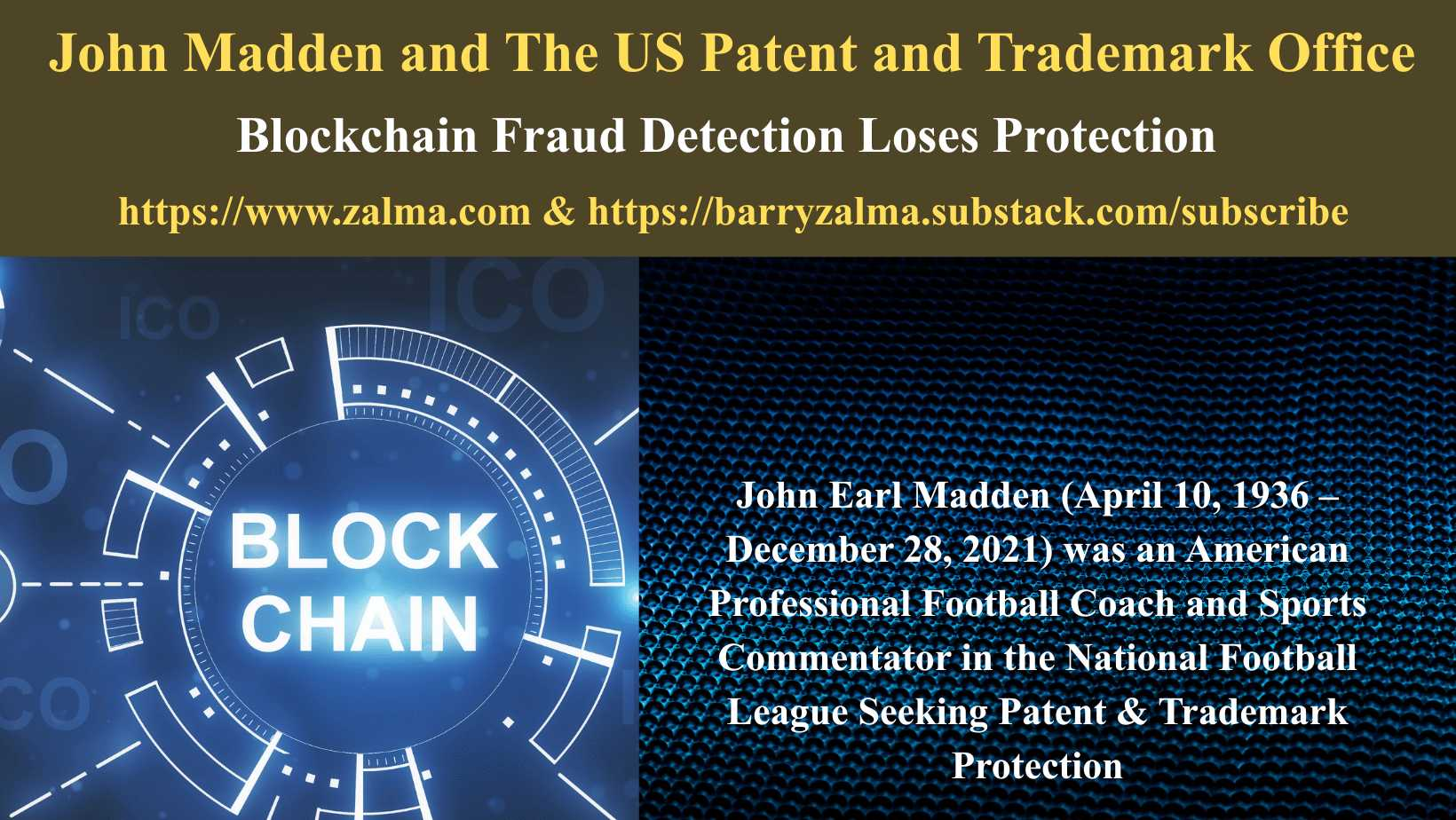
Blockchain Fraud Detection Loses Protection
Posted on October 22, 2026 by Barry Zalma
John Earl Madden (April 10, 1936 – December 28, 2021) was an American Professional Football Coach and Sports Commentator in the National Football League Seeking Patent & Trademark Protection
BLOCKCHAIN FRAUD
Mr. Madden was more than football. He was working to establish a program called “Fraud Protection Systems, Methods, and Computer Programs for Blockchain Financial Transactions.”
In Ex parte John Madden, Appeal 2026-001497, Application 18/495,506, Technology Center 3600, United States Patent and Trademark Office, Patent Trial and Appeal Board (October 14, 2026)
The Examiner rejected claims several numbered claims under 35 U.S.C. § 101 as directed to an abstract idea without significantly more.
THE LAW
Section 101 makes patentable any new and useful process, machine, manufacture, or composition of matter.Laws of nature, natural phenomena, and abstract ideas are implicitly excluded.
THE PATENT TRIAL AND ...
Sovereign Immunity Defeats Suit Against Police Officers
Post 4866
Posted on October 21, 2026 by Barry Zalma
In Chad Lightfoot, et al. v. Progressive Direct Insurance Company, et al., Civil Action No. 26-434, United States District Court, E.D. Louisiana (October 9, 2026) Chad Lightfoot was involved in an Orleans Parish automobile accident in 2011 and filed claims with several insurers, including Progressive.
After a related civil dispute, Progressive counsel allegedly submitted a false affidavit stating that Lightfoot had fraudulently received a $50,000 payment. A New Orleans police detective relied on the affidavit to obtain an arrest warrant, and Louisiana State Police Lieutenant Alan Arcana allegedly reported that Lightfoot had received the payment. Lightfoot was arrested in 2015 and charged with theft, insurance fraud, and perjury.
Plaintiffs alleged that no record of the payment existed and that the criminal charges were dismissed on October 15, 2024.
Lightfoot and Geralyn Hawkins filed suit in October 2025 and ...