
RICO Judgment Allows Disgorgement Damages
DISGORGEMENT IS AKIN TO EXEMPLARY DAMAGES
Read the full article at https://lnkd.in/gnjVk8iP and see the full video at https://lnkd.in/gwvZMpi2 and at https://lnkd.in/gzJykrf6 and at https://zalma.cm/blog plus more than 4300 posts.
In Diane Creel and Lynn Creel v. Dr. Says, LLC, et al., Civil Action No. 4:18-CV-00615, United States District Court, E.D. Texas, Sherman Division (September 27, 2022) the plaintiffs obtained a verdict against Defendants Dr. Yupo Jesse Chang; MD Reliance, Inc.; Universal Physicians, PA; Dr. Says, LLC; Office Winsome, LLC; and Yung Husan Yao (aka Angela Yao) for violations of the civil Racketeer Influenced and Corrupt Organization Act (“RICO”) and RICO conspiracy. The Court, after the verdict, needs to enter its findings of fact and conclusions of law regarding equitable disgorgement.
FINDINGS OF FACT
Plaintiff Lynn Creel (“Lynn”) accompanied his wife, Plaintiff Diane Creel (“Diane”) (collectively, “the Creels”), to the Behavioral Hospital of Bellaire (“BHB”) in August 2017. The Creels arrived at BHB planning to receive information on the hospital’s advertised “outpatient group women-centric grief counseling.”
Upon the nurse’s return, the Creels said they were leaving because they did not like the treatment plans that BHB had offered. The nurse informed the Creels that they were not allowed to leave because BHB had “filed an emergency warrant for [Diane’s] detention” and Diane would be placed under a 72-hour hold. The Creels then realized that the BHB medical staff had locked both the door out the front of the building and the door to the intake room. Diane was taken to the psychiatric unit against her will. BHB did not permit Lynn to visit Diane in person. In all this time, neither Lynn nor Diane ever saw the warrant for her detainment or even a shred of paperwork.
The Defendants’ Scheme
The scheme underlying the Creels’ experience began with the business activity of Dr. Yupo Jesse Chang (“Chang”), a family physician who has spent much of his career managing other medical practices. As Chang’s only notary, Yao kept a detailed notary book. The physician recommending commitment of a patient signed off on the notarized documents-but the physician was never physically in front of Yao, the notary, when he or she signed the document.
The notary documents reveal that in just three days between, August 6, and August 10, 2017, a psychiatrist employed by BHB signed applications for the involuntary commitment of twelve different patients.
The Lawsuit
Twelve plaintiffs sued twenty-two defendants, alleging various causes of action based upon their involuntary confinement and stay at BHB. The jury found that Defendants, (1) were employed or associated with a RICO enterprise (2) had participated, either directly or indirectly, in the conduct of the affairs of the enterprise, and (3) had participated through a pattern of racketeering activity. The jury assessed Plaintiffs’ compensatory damages at $300,000.00. The jury also found that all Defendants conspired together to violate RICO.
The jury awarded Diane damages in the amounts of: (1) $75,000.00 for physical pain and mental anguish sustained in the past; (2) $50,000.00 for physical pain and mental anguish that, in reasonable probability, Diane will sustain in the future; (3) $85,500.00 for loss of earning capacity sustained in the past; (4) $104,000.00 for loss of earning capacity that, in reasonable probability, Diane will sustain in the future; (5) $15,000.00 for medical care expenses incurred in the past; and (6) $50,000.00 for medical care expenses that, in reasonable probability, Diane will incur in the future.
Specifically, the Court upheld the jury’s verdict against Defendants for violations of RICO and RICO and is now dealing with disgorgement.
Equitable Disgorgement
Plaintiffs have long pleaded and disclosed a claim for equitable disgorgement in this case. The evidence attributed to equitable disgorgement mostly involves the medical documents that Yao falsely notarized. In January 2017 alone there were 276 documented applications for involuntary patient commitments sent through one of Chang’s companies.
Defendants produced no evidence to suggest they would change their activities following the lawsuit. Despite having had to pay back Medicare and private insurance companies for improper billings, Chang was still conducting his business affairs in the same manner.
The jury awarded $1,320,500 equitable disgorgement.
CONCLUSIONS OF LAW
A claim for disgorgement under the civil RICO statute is an equitable remedy. The jury’s finding on equitable disgorgement under civil RICO is an advisory opinion. The equitable nature of disgorgement requires a court to enter findings of fact and conclusions of law for any amount of the award to stand.
Disgorgement of ill-gotten gains is closely analogous to the equitable remedy of exemplary damages, as the principal purpose is not simply to punish the offending parties for having conspired to make the illicit profits but to convey a strong message, to the conspirators and to third parties alike, that there is yet another disincentive to engaging in such proscribed conduct.
Prevent and Restrain Future Unlawful Conduct
The Court found that the disgorgement in this case is properly sought to “prevent and restrain” Defendants from continuing the unlawful conduct. The conduct that led to this lawsuit was egregious. As previously discussed, in calendar year 2017 alone, hospitals that had contracted with Chang filed 3,955 applications “to hold human beings in psychiatric hospitals against their will.” Chang and Yao were aware this egregious activity was unlawful.
An award of disgorgement of Defendants’ ill-gotten gains will serve to prevent and restrain future illegal conduct. Moreover, the Court found that the jury awarded disgorgement for the purpose of preventing and restraining Defendants’ future conduct.
Calculation of Disgorgement
Before the jury deliberated, Plaintiffs’ most aggressive request for disgorgement was for the jury to multiply $75 by the number of detention warrants in Yao’s notary record for 2017 (3,955). In theory, this would result in a sum for just under $300,000. Inexplicably, however, the jury awarded more than four times that-presumably because it was outraged at Defendants’ conduct.
The Court noted that it was not bound by what the Plaintiffs requested from the jury for disgorgement, just as it is not bound by what the jury awarded. The complex nature of the illegal enterprise in the present matter complicates the calculation of disgorgement.
The Court recognized that Defendants may very well have secured ill-gotten gains that meet or exceed the $1,350,500 awarded by the jury. But there is no evidence of profits that would support such an award. While the Court agreed with Plaintiffs that “[t]here was overwhelming evidence of interactions and communications among [D]efendants showing a common purpose to defraud,” this is not enough.
For the purposes of restraining Defendants’ future conduct, the Court multiplied the cost of a telemedicine visit by Yao’s 3,955 notary book entries from 2017 to calculate Defendants’ profits causally related to their elaborate enterprise. For each telemedicine visit involving involuntary detention, Chang received $75, which comprises a $45 base fee, $5 patient fee, and $25 warrant fee. Multiplying $75 by 3,955, the Court found that the total profit equals $296,625.
Plaintiffs presented no evidence of any other profits derived by Defendants through unlawful conduct that violated RICO, which would support a greater award of disgorgement. For all these reasons, the Court concludes Plaintiffs are entitled to recover from Defendants equitable disgorgement of profits in the sum of $296,625.
ZALMA OPINION
The conduct of BHB and the physicians and nurses involved in this scheme were egregious and used the law to kidnap patients for profit. The disgorgement was a needed addition to the RICO damages to deter future conduct. Since these scofflaws billed Medicare and insurers for the alleged treatment – even if repaid to the insurers and the government – they were perpetrating a fraud that was proved beyond a preponderance. Since, as the court explained, the defendants are still confining people against their will the court should have referred the defendants to the Department of Justice for prosecution.
(c) 2022 Barry Zalma & ClaimSchool, Inc.
Barry Zalma, Esq., CFE, now limits his practice to service as an insurance consultant specializing in insurance coverage, insurance claims handling, insurance bad faith and insurance fraud almost equally for insurers and policyholders. He practiced law in California for more than 44 years as an insurance coverage and claims handling lawyer and more than 54 years in the insurance business.
He is available at http://www.zalma.com and [email protected] and receive videos limited to subscribers of Excellence in Claims Handling at locals.com https://zalmaoninsurance.locals.com/subscribe. Subscribe to Excellence in Claims Handling at https://barryzalma.substack.com/welcome. Now available Barry Zalma’s newest book, The Tort of Bad Faith, available here. The new book is available as a Kindle book, a paperback or as a hard cover.
Write to Mr. Zalma at [email protected]; http://www.zalma.com; http://zalma.com/blog; daily articles are published at https://zalma.substack.com.
Go to the podcast Zalma On Insurance at https://anchor.fm/barry-zalma; Follow Mr. Zalma on Twitter at https://twitter.com/bzalma; Go to Barry Zalma videos at Rumble.com at https://rumble.com/c/c-262921; Go to Barry Zalma on YouTube- https://www.youtube.com/channel/UCysiZklEtxZsSF9DfC0Expg; Go to the Insurance Claims Library – https://zalma.com/blog/insurance-claims-library

Insurance Expert May Not Testify to Speculative and Contains Unsupported Conclusions.
Posted on September 18, 2026 by Barry Zalma
See the full video at and at https://rumble.com/v7fmifw-expert-may-only-testify-to-what-experience-supports.html
In Michele A. Over, and The Estate Of Paul R. Over v. State Farm Mutual Automobile Insurance Company, and State Farm Fire And Casualty Company, Civil Action No. 23-cv-02243-PAB-STV, United States District Court, D. Colorado (September 14, 2026) Michele and Paul Over sued State Farm Fire and State Farm Auto over hail-damage and stolen-vehicle claims.
The operative dispute concerned State Farm Auto’s motion to exclude or limit opinions from plaintiffs’ insurance-industry expert, Aaron Castillo. Castillo.
Law
The proponent of expert testimony must establish by a preponderance of the evidence that an expert is qualified and that the opinions are helpful, sufficiently grounded, and reliably derived and applied. Experience-based opinions must explain how the...
150 Months in Prison for Tax Fraud
Post 4846
Posted on September 17, 2026 by Barry Zalma
See the full video at https://lnkd.in/g8rh3JBX and https://lnkd.in/gmkdy-9C, In United States Of America v. Thomas Addaquay, Nos. 25-10609, 25-10611, United States Court of Appeals, Eleventh Circuit (September 9, 2026) the Eleventh Circuit affirmed all challenged convictions, the 150-month aggregate sentence, and the challenged $4,123,474.55 restitution award.
FACTS
In United States Of America v. Thomas Addaquay, United States Of America v. Thomas Addaquay, Nos. 25-10609, 25-10611, United States Court of Appeals, Eleventh Circuit (September 9, 2026) the Eleventh Circuit affirmed all challenged convictions, the 150-month aggregate sentence, and the challenged $4,123,474.55 restitution award.
FACTS
Thomas Addaquay controlled United Consolidated Accounting and Business Services (UC), nominally a check-cashing business.
The government proved a three-stage tax-refund scheme that converted the resulting refund checks into usable funds through ...
Major Fraud Perpetrator Asserts Fifth Amendment Privilege to Avoid Prosecution
Post 5489
Posted on September 14, 2026 by Barry Zalma
Fraudster Refuses to Answer Questions About His Alleged Fraud
See the full video at https://lnkd.in/gvicAMDr and at https://lnkd.in/gvicAMDr
In Great American Insurance Co. v. Gemstone Property Management, LLC, et al., No. 23-cv-9100 (LJL), United States District Court, S.D. New York (September 8, 2026) Great American Insurance Company alleged that it was defrauded through a scheme in which Subin Associates, LLP recruited individuals to stage construction-site injuries, arranged unnecessary medical treatment and litigation funding, and pursued fraudulent personal-injury claims.
Luis Manuel Garcia Salcedo, resulted in a $6 million settlement. Non-party Jose Hernandez allegedly worked as an assistant manager at Subin, operated Hernandez Associates, and owned litigation-funding companies that shared office space with Subin and provided services to its clients.
After Great American ...
No Breach of Contract no Bad Faith
Post 4568
Posted on October 23, 2026 by Barry Zalma
A Party Cannot Designate One Witness While Submitting An Undifferentiated Product Of That Witness And An Undesignated Collaborator.
Post 4568
In Dustin Cain; Amanda Cain v. State Farm Fire and Casualty Company, No. 25-60442, United States Court of Appeals, Fifth Circuit (October 16, 2026) Dustin and Amanda Cain sought homeowners’ insurance benefits after a tree fell on their Mississippi home on August 27, 2022. State Farm concluded that the tree caused only a roof puncture and that other damage resulted from excluded long-term conditions. It paid $10,042.90 and later an additional $3,130.08.
The Cains relied on an engineering report and contractor estimate asserting substantially greater damage, sued for breach of contract and related relief, and designated Sean Fee as their sole expert. Fee’s report and a later repair estimate were jointly authored with Jim Irmiter, but neither document identified which opinions, work, or ...

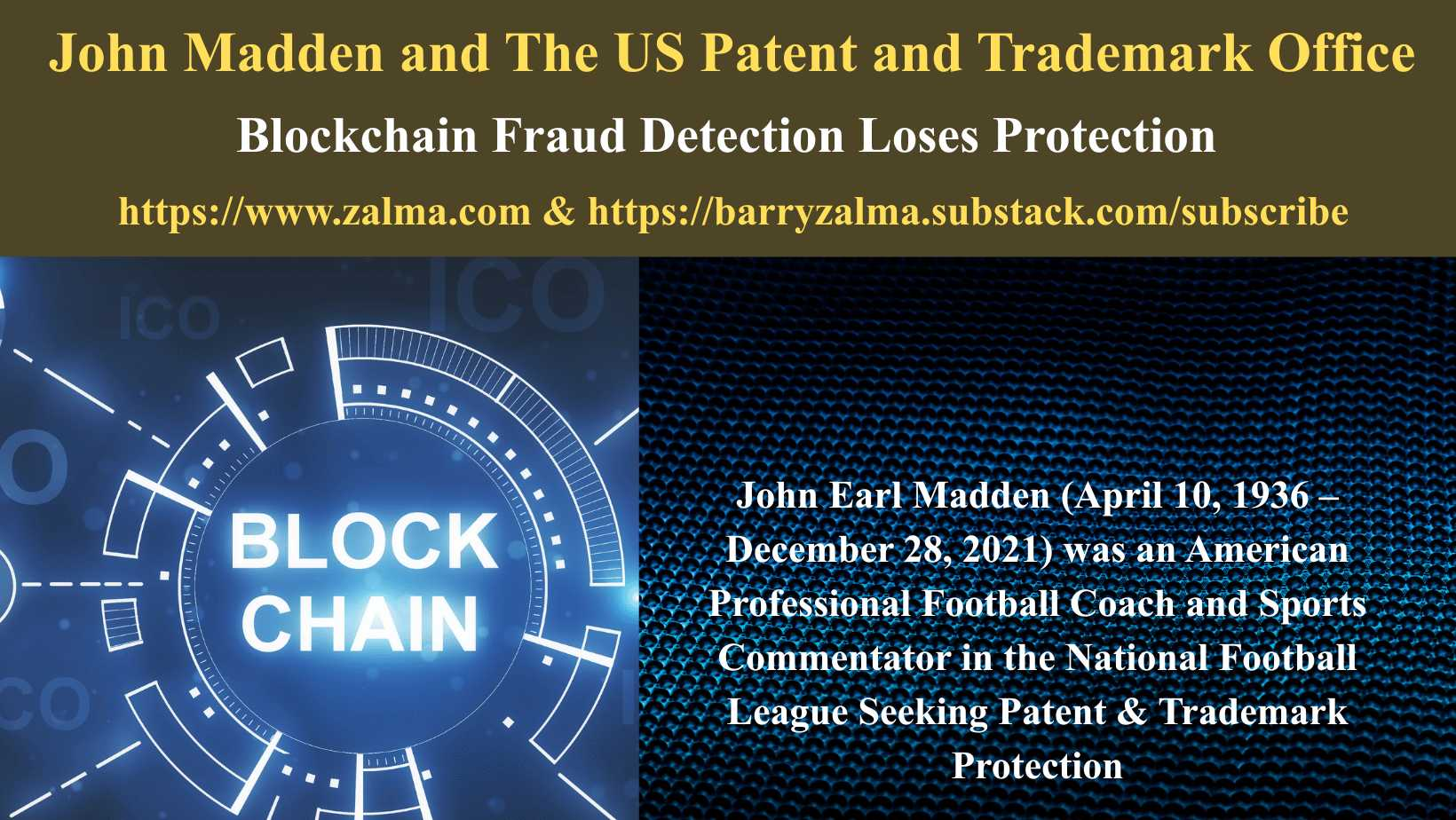
Blockchain Fraud Detection Loses Protection
Posted on October 22, 2026 by Barry Zalma
John Earl Madden (April 10, 1936 – December 28, 2021) was an American Professional Football Coach and Sports Commentator in the National Football League Seeking Patent & Trademark Protection
BLOCKCHAIN FRAUD
Mr. Madden was more than football. He was working to establish a program called “Fraud Protection Systems, Methods, and Computer Programs for Blockchain Financial Transactions.”
In Ex parte John Madden, Appeal 2026-001497, Application 18/495,506, Technology Center 3600, United States Patent and Trademark Office, Patent Trial and Appeal Board (October 14, 2026)
The Examiner rejected claims several numbered claims under 35 U.S.C. § 101 as directed to an abstract idea without significantly more.
THE LAW
Section 101 makes patentable any new and useful process, machine, manufacture, or composition of matter.Laws of nature, natural phenomena, and abstract ideas are implicitly excluded.
THE PATENT TRIAL AND ...
Sovereign Immunity Defeats Suit Against Police Officers
Post 4866
Posted on October 21, 2026 by Barry Zalma
In Chad Lightfoot, et al. v. Progressive Direct Insurance Company, et al., Civil Action No. 26-434, United States District Court, E.D. Louisiana (October 9, 2026) Chad Lightfoot was involved in an Orleans Parish automobile accident in 2011 and filed claims with several insurers, including Progressive.
After a related civil dispute, Progressive counsel allegedly submitted a false affidavit stating that Lightfoot had fraudulently received a $50,000 payment. A New Orleans police detective relied on the affidavit to obtain an arrest warrant, and Louisiana State Police Lieutenant Alan Arcana allegedly reported that Lightfoot had received the payment. Lightfoot was arrested in 2015 and charged with theft, insurance fraud, and perjury.
Plaintiffs alleged that no record of the payment existed and that the criminal charges were dismissed on October 15, 2024.
Lightfoot and Geralyn Hawkins filed suit in October 2025 and ...