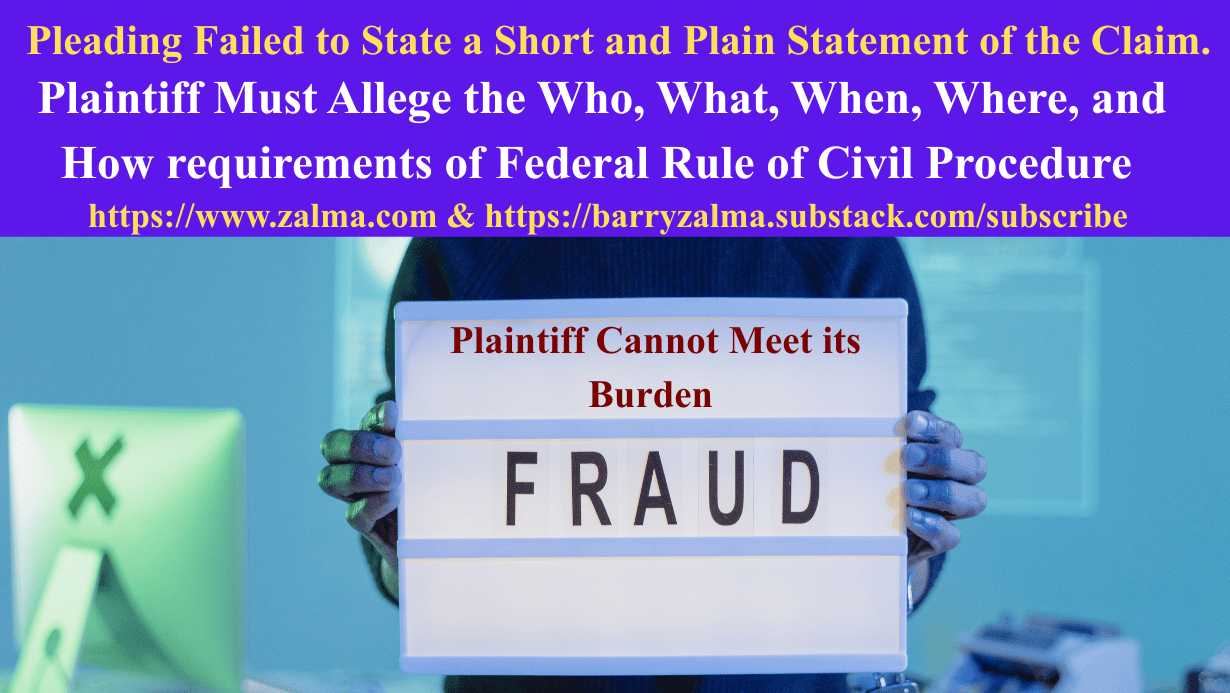

Plaintiff Must Allege the Who, What, When, Where, and How requirements of Federal Rule of Civil Procedure
Post 4573
Posted on October 30, 2026 by Barry Zalma
In Texoma Cowboy Church, Inc v. Church Mutual Insurance Company, S.I., Civil Action No. 7:26-CV-00062-O, United States District Court, N.D. Texas, Wichita Falls Division (October 22, 2026) Plaintiff Texoma Cowboy Church, Inc. was insured by Defendant Church Mutual Insurance Company, S.I. under a policy covering its property at 919 U.S. Hwy 281, Wichita Falls, Texas, from May 28, 2024, to May 28, 2025. The policy carried a $309,250.50 deductible for windstorm and/or hail coverage.
FACTS
On or about April 5, 2025, a hail and windstorm allegedly damaged the property. ProNet confirmed hail impact on April 5, 2025, producing dents and panel separations on the roofing, but found that water intrusion and interior damage predated the storm. Defendant also obtained a third-party contractor bid.
After deductible and depreciation, it paid $626,607.67. Plaintiff contended the estimate and payment undervalued the claim by ignoring the full scope of damages identified by Lupfer and ProNet.
The Original Petition asserted eight causes of action:
1. anticipatory breach and breach of contract;
2. breach of the duty of good faith and fair dealing;
3. deceptive trade practices and unconscionable conduct;
4. violations of Texas Insurance Code Chapter 542 (Prompt Payment of Claims Act);
5. unfair insurance practices;
6. negligent misrepresentation;
7. fraud; and
8. conspiracy.
Defendant moved under Rule 12(b)(6) to dismiss the fraud, negligent misrepresentation, gross negligence, and conspiracy claims.
Law / Legal Standard
Rule 8(a) requires a short and plain statement of the claim. Federal cases require facial plausibility: factual content allowing a reasonable inference of liability, not mere possibility or labels and conclusions.
On a Rule 12(b)(6) motion, the court accepts well-pleaded facts as true.
Fraud and negligent misrepresentation claims under the Texas Insurance Code must satisfy Rule 9(b)’s particularity requirement: the “who, what, when, where, and how” of the alleged fraud or misrepresentation.
Economic loss (independent injury) rule under Texas law bars tort recovery for losses that are the subject matter of a contract.
An expression of opinion about monetary value (e.g., an insurance estimate).
Gross negligence under Texas Civil Practice & Remedies Code § 41.001(11) requires (1) an act or omission involving an extreme degree of risk when viewed objectively.
Civil conspiracy under Texas law requires: a combination of two or more persons; an object to accomplish an unlawful purpose or a lawful purpose by unlawful means; a meeting of the minds; an unlawful overt act by one member; and proximate injury. Conspiracy liability depends on an underlying tort.
In cases involving misrepresentation or fraud under the Texas Insurance Code, plaintiffs must meet the ‘who, what, when, where, and how’ requirements of Federal Rule of Civil Procedure 9(b).
DISCUSSION AND ANALYSIS
Fraud and Negligent Misrepresentation.
The Petition offers only bare, conclusory assertions (e.g., that Defendant “individually and/or through its agent(s) committed fraud” or “made the representation(s)/assurances” with intent that Plaintiff rely on them).
Gross Negligence.
The dispute is an ordinary insurance valuation disagreement, not something involving death, grievous injury, or financial ruin) or actual subjective awareness of such a risk with conscious indifference.
CONCLUSION
Because Rule 9(b) requires Plaintiff to “state with particularity the circumstances constituting fraud or mistake,” a party must do more than offer mere conclusory allegations. Plaintiff’s claim for negligent misrepresentation fares no better. Like its claim for fraud, Plaintiff must establish in its Petition the who, what, when, where, why, and how of the negligent misrepresentation alleged.
The Court granted Defendant’s Motion to Dismiss.
For the forgoing reasons it is ordered that Plaintiff’s claims of (1) fraud, (2) negligent misrepresentation, (3) gross negligence, and (4) conspiracy against Defendant are Dismissed with prejudice. Plaintiff’s Petition provides no articulable facts to reveal a subjective awareness on Defendant’s part. Because Plaintiff cannot meet its burden, its gross negligence claim is dismissed with prejudice.
Zalma Opinion
When a public adjuster, ProNet, confirmed hail impact but found that water intrusion and interior damage predated the storm. The insurer paid what its investigation established and then the Church sued for fraud and other complex causes of action but failed to do so with sufficient facts and the suit was dismissed. Federal cases require facial plausibility: factual content allowing a reasonable inference of liability, not mere possibility or labels and conclusions.
(c) 2026 Barry Zalma & ClaimSchool, Inc.
Please tell your friends and colleagues about this blog and the videos and let them subscribe to the blog and the videos.
Subscribe to my substack at https://barryzalma.substack.com/subscribe
Go to X @bzalma; Go to Barry Zalma videos at Rumble.com at https://rumble.com/account/content?type=all; Go to Barry Zalma on YouTube- https://www.youtube.com/channel/UCysiZklEtxZsSF9DfC0Expg; Go to the Insurance Claims Library – https://lnkd.in/gwEYk.
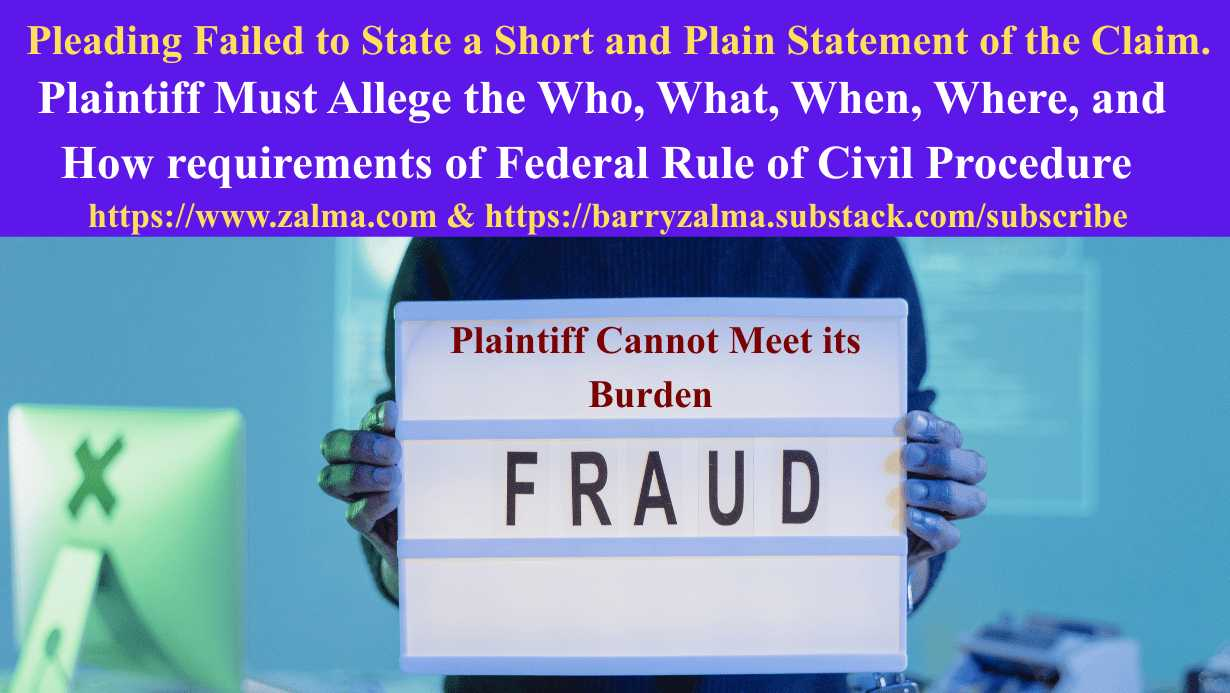
Insurance Expert May Not Testify to Speculative and Contains Unsupported Conclusions.
Posted on September 18, 2026 by Barry Zalma
See the full video at and at https://rumble.com/v7fmifw-expert-may-only-testify-to-what-experience-supports.html
In Michele A. Over, and The Estate Of Paul R. Over v. State Farm Mutual Automobile Insurance Company, and State Farm Fire And Casualty Company, Civil Action No. 23-cv-02243-PAB-STV, United States District Court, D. Colorado (September 14, 2026) Michele and Paul Over sued State Farm Fire and State Farm Auto over hail-damage and stolen-vehicle claims.
The operative dispute concerned State Farm Auto’s motion to exclude or limit opinions from plaintiffs’ insurance-industry expert, Aaron Castillo. Castillo.
Law
The proponent of expert testimony must establish by a preponderance of the evidence that an expert is qualified and that the opinions are helpful, sufficiently grounded, and reliably derived and applied. Experience-based opinions must explain how the...
150 Months in Prison for Tax Fraud
Post 4846
Posted on September 17, 2026 by Barry Zalma
See the full video at https://lnkd.in/g8rh3JBX and https://lnkd.in/gmkdy-9C, In United States Of America v. Thomas Addaquay, Nos. 25-10609, 25-10611, United States Court of Appeals, Eleventh Circuit (September 9, 2026) the Eleventh Circuit affirmed all challenged convictions, the 150-month aggregate sentence, and the challenged $4,123,474.55 restitution award.
FACTS
In United States Of America v. Thomas Addaquay, United States Of America v. Thomas Addaquay, Nos. 25-10609, 25-10611, United States Court of Appeals, Eleventh Circuit (September 9, 2026) the Eleventh Circuit affirmed all challenged convictions, the 150-month aggregate sentence, and the challenged $4,123,474.55 restitution award.
FACTS
Thomas Addaquay controlled United Consolidated Accounting and Business Services (UC), nominally a check-cashing business.
The government proved a three-stage tax-refund scheme that converted the resulting refund checks into usable funds through ...
Major Fraud Perpetrator Asserts Fifth Amendment Privilege to Avoid Prosecution
Post 5489
Posted on September 14, 2026 by Barry Zalma
Fraudster Refuses to Answer Questions About His Alleged Fraud
See the full video at https://lnkd.in/gvicAMDr and at https://lnkd.in/gvicAMDr
In Great American Insurance Co. v. Gemstone Property Management, LLC, et al., No. 23-cv-9100 (LJL), United States District Court, S.D. New York (September 8, 2026) Great American Insurance Company alleged that it was defrauded through a scheme in which Subin Associates, LLP recruited individuals to stage construction-site injuries, arranged unnecessary medical treatment and litigation funding, and pursued fraudulent personal-injury claims.
Luis Manuel Garcia Salcedo, resulted in a $6 million settlement. Non-party Jose Hernandez allegedly worked as an assistant manager at Subin, operated Hernandez Associates, and owned litigation-funding companies that shared office space with Subin and provided services to its clients.
After Great American ...
In the Prudential Insurance Company Of America v. Carol Gardina and George Gardina, No. 6:23-cv-1125-JSS-DCI, United States District Court, M.D. Florida, Orlando Division (October 22, 2026) Plaintiff sued Defendants for numerous causes of action stemming from its allegations that Defendants fraudulently collected benefits under their long-term care insurance policies.
Plaintiff's case proceeded to a nine-day jury trial, after which the jury found Defendants liable for fraudulent misrepresentation, fraudulent concealment, and civil conspiracy. The jury found Defendant Carol Gardina liable to Plaintiff for $1,930,129 in compensatory damages and Defendant George Gardina liable to Plaintiff for $12,496 in compensatory damages and $20 in punitive damages. Thereafter, the court entered judgment in Plaintiff's favor and awarded Plaintiff $1,930,129 in compensatory damages from Defendant Carol Gardina and $12,496 in compensatory damages and $20 in punitive damages from Defendant George Gardina.
THE APPEAL
Defendants ...
Plaintiff Must Allege the Who, What, When, Where, and How requirements of Federal Rule of Civil Procedure
Post 4573
Posted on October 30, 2026 by Barry Zalma
In Texoma Cowboy Church, Inc v. Church Mutual Insurance Company, S.I., Civil Action No. 7:26-CV-00062-O, United States District Court, N.D. Texas, Wichita Falls Division (October 22, 2026) Plaintiff Texoma Cowboy Church, Inc. was insured by Defendant Church Mutual Insurance Company, S.I. under a policy covering its property at 919 U.S. Hwy 281, Wichita Falls, Texas, from May 28, 2024, to May 28, 2025. The policy carried a $309,250.50 deductible for windstorm and/or hail coverage.
FACTS
On or about April 5, 2025, a hail and windstorm allegedly damaged the property. ProNet confirmed hail impact on April 5, 2025, producing dents and panel separations on the roofing, but found that water intrusion and interior damage predated the storm. Defendant also obtained a third-party contractor bid.
After deductible and depreciation, it paid $626,607.67. Plaintiff contended the estimate and ...
Plaintiff Must Allege the Who, What, When, Where, and How requirements of Federal Rule of Civil Procedure
Post 4573
Posted on October 30, 2026 by Barry Zalma
In Texoma Cowboy Church, Inc v. Church Mutual Insurance Company, S.I., Civil Action No. 7:26-CV-00062-O, United States District Court, N.D. Texas, Wichita Falls Division (October 22, 2026) Plaintiff Texoma Cowboy Church, Inc. was insured by Defendant Church Mutual Insurance Company, S.I. under a policy covering its property from May 28, 2024, to May 28, 2025.
FACTS
On or about April 5, 2025, a hail and windstorm allegedly damaged the property.
After deductible and depreciation, it paid $626,607.67.
1. The Original Petition asserted eight causes of action:
2. anticipatory breach and breach of contract;
3. breach of the duty of good faith and fair dealing;
4. deceptive trade practices and unconscionable conduct;
violations of Texas Insurance Code Chapter 542 (Prompt Payment of Claims Act);
5. unfair insurance practices;
6. negligent misrepresentation;...