

Title Insurance Only Insures Real Property
Posted on October 13, 2026 by Barry Zalma
When a Seller Advised it Could Not Obtain Title to the Home Fraud Can’t be Proved
A Manufactured Home is Personal Property Until it Becomes Real Property
Post 4862
In Dale Johnson and Rose Johnson, Husband and Wife v. Stewart Title Guaranty Co., and Lennar Mortgage, LLC; Low Va Rates, LLC; Sandpoint Title Insurance, Inc.; Village Capital & Investment, LLC; and David Cassel, Engineer Agent; and Unknown Does 1-50, inclusively, No. 53126, Court of Appeals of Idaho (October 9, 2026) Dale and Rose Johnson purchased Idaho real property in 2012 with a manufactured home on it. Their purchase addendum acknowledged that the seller could not obtain title to the home, that evidence of title and an ALTA-7 endorsement might not be available, and that they accepted the home “as is.”
In 2020, after a HELOC application was denied, the Johnsons learned that the home had been wrecked and decertified in 2004 and that its 2006 conversion to real property relied on an invalid Manufacturer’s Certificate of Origin and decertified HUD labels.
Stewart Title denied coverage because its policy insured title to real property, not personal property, and Schedule B expressly excepted losses arising from the 2006 Statement of Intent. The district court granted Stewart Title summary judgment and dismissed or denied the Johnsons’ remaining claims and motions.
LAW
Summary judgment is proper when no genuine issue of material fact exists and the movant is entitled to judgment as a matter of law. Under Idaho Code § 63-304, a manufactured home remains personal property unless statutory requirements for conversion to real property are satisfied, including recording a valid statement of intent.
Fraud must be pleaded with particularity. Declaratory relief requires a definite, concrete dispute between parties with adverse legal interests, and appellate issues generally must be preserved below and supported by argument and authority.
DISCUSSION
The Johnsons argued that disputed facts precluded summary judgment, that the policy covered fraud and forgery affecting the home, that omitted underwriting language made the policy ambiguous, and that an ALTA endorsement should have supplied coverage.
They also sought declaratory relief concerning the home’s property status, challenged dismissal of fraud, alleged judicial bias, and requested leave to pursue constructive fraud. Stewart Title responded that the policy covered only the described land and legally qualifying improvements, that the home never became real property because the 2006 conversion was invalid.
ANALYSIS
The record, when reviewed as a whole, supports the district court's conclusion that Stewart Title demonstrated there was no genuine issue of material fact regarding the Johnsons' breach of contract claim and request for declaratory relief. The burden of proof then shifted to the Johnsons to present facts that would create a genuine issue of material fact on those remaining claims (rather than on previously dismissed claims). The Johnsons failed to do so.
The Court of Appeals held that the policy was unambiguous and afforded no coverage on two independent grounds. First, the Johnsons’ own theory—that the 2006 conversion was legally invalid—meant the manufactured home remained personal property, outside a policy covering the land and affixed improvements that by law constitute real property.
The district court properly found two bases to conclude that the Johnsons failed to establish a genuine issue of material fact on their breach of contract claim.
The district court noted that, at the time of purchase, the Johnsons signed an addendum acknowledging that the seller could not obtain title to the manufactured home and that evidence of title and title insurance . may not be available nor issued on the manufactured home. The district court concluded that because the policy covered real property, and not personal property, there was no coverage for the Johnsons' claims.
The Johnsons' identified no defect in that title. Second, even if the home had become real property, the policy broadly excluded losses arising “by reason of” the 2006 Statement of Intent, and the claimed loss depended entirely on that instrument and its supporting documents.
The fraud claim was inadequately particularized and, alternatively, abandoned when omitted from the amended pleading.
CONCLUSION
The Court of Appeals affirmed summary judgment for Stewart Title, the denial of Rule 60(b) relief, and the denial of reconsideration.
The Court of Appeal affirmed the district court's judgment granting summary judgment in favor of Stewart Title, the denial of the Johnsons' I.R.C.P. 60(b) motion, and the denial of the Johnsons' motion to reconsider. Costs and attorney fees on appeal are awarded to Stewart Title.
ZALMA OPINION
Title insurance is a special kind of insurance and only insures real property and the rights to that property. To sue a title insurer there must be an unknown defect in title. In this case the plaintiffs were advised of the lack of title and bought the property as is with full knowledge and then tried to sue the insurer for not protecting them from their as is purchase. The district court concluded that because the policy covered real property, and not personal property, there was no coverage for the Johnsons' claims.
(c) 2026 Barry Zalma & ClaimSchool, Inc.
Please tell your friends and colleagues about this blog and the videos and let them subscribe to the blog and the videos.
Subscribe to my substack at https://barryzalma.substack.com/subscribe
Go to X @bzalma; Go to Barry Zalma videos at Rumble.com at https://rumble.com/account/content?type=all; Go to Barry Zalma on YouTube- https://www.youtube.com/channel/UCysiZklEtxZsSF9DfC0Expg; Go to the Insurance Claims Library – https://lnkd.in/gwEYk.
Insurance Expert May Not Testify to Speculative and Contains Unsupported Conclusions.
Posted on September 18, 2026 by Barry Zalma
See the full video at and at https://rumble.com/v7fmifw-expert-may-only-testify-to-what-experience-supports.html
In Michele A. Over, and The Estate Of Paul R. Over v. State Farm Mutual Automobile Insurance Company, and State Farm Fire And Casualty Company, Civil Action No. 23-cv-02243-PAB-STV, United States District Court, D. Colorado (September 14, 2026) Michele and Paul Over sued State Farm Fire and State Farm Auto over hail-damage and stolen-vehicle claims.
The operative dispute concerned State Farm Auto’s motion to exclude or limit opinions from plaintiffs’ insurance-industry expert, Aaron Castillo. Castillo.
Law
The proponent of expert testimony must establish by a preponderance of the evidence that an expert is qualified and that the opinions are helpful, sufficiently grounded, and reliably derived and applied. Experience-based opinions must explain how the...
150 Months in Prison for Tax Fraud
Post 4846
Posted on September 17, 2026 by Barry Zalma
See the full video at https://lnkd.in/g8rh3JBX and https://lnkd.in/gmkdy-9C, In United States Of America v. Thomas Addaquay, Nos. 25-10609, 25-10611, United States Court of Appeals, Eleventh Circuit (September 9, 2026) the Eleventh Circuit affirmed all challenged convictions, the 150-month aggregate sentence, and the challenged $4,123,474.55 restitution award.
FACTS
In United States Of America v. Thomas Addaquay, United States Of America v. Thomas Addaquay, Nos. 25-10609, 25-10611, United States Court of Appeals, Eleventh Circuit (September 9, 2026) the Eleventh Circuit affirmed all challenged convictions, the 150-month aggregate sentence, and the challenged $4,123,474.55 restitution award.
FACTS
Thomas Addaquay controlled United Consolidated Accounting and Business Services (UC), nominally a check-cashing business.
The government proved a three-stage tax-refund scheme that converted the resulting refund checks into usable funds through ...
Major Fraud Perpetrator Asserts Fifth Amendment Privilege to Avoid Prosecution
Post 5489
Posted on September 14, 2026 by Barry Zalma
Fraudster Refuses to Answer Questions About His Alleged Fraud
See the full video at https://lnkd.in/gvicAMDr and at https://lnkd.in/gvicAMDr
In Great American Insurance Co. v. Gemstone Property Management, LLC, et al., No. 23-cv-9100 (LJL), United States District Court, S.D. New York (September 8, 2026) Great American Insurance Company alleged that it was defrauded through a scheme in which Subin Associates, LLP recruited individuals to stage construction-site injuries, arranged unnecessary medical treatment and litigation funding, and pursued fraudulent personal-injury claims.
Luis Manuel Garcia Salcedo, resulted in a $6 million settlement. Non-party Jose Hernandez allegedly worked as an assistant manager at Subin, operated Hernandez Associates, and owned litigation-funding companies that shared office space with Subin and provided services to its clients.
After Great American ...
Posted on November 20, 2026 by Barry Zalma
Probation Condition Must be Reasonably Directed at Curbing Future Criminality
Post 4584
While Probation Conditions Need Not Be Strictly Tied To The Precise Crime Committed, They Do Need To Be Reasonably Directed At Curbing The Defendant’s Future Criminality
In The People v. Nicolas Arpa, A174751, California Court of Appeals, First District, Third Division (November 19, 2026) Nicolas Arpa was charged in San Mateo County with five counts of insurance fraud, attempted grand theft by an employee or agent of $950 or more, grand theft by an employee or agent of $950 or more, and forgery.
He pled no contest to one count of insurance fraud (count 2) and to grand theft (count 5). His sentencing brief said he had suffered significant financial distress and felt remorse. It also said he no longer works in insurance and had made full restitution.
The trial court suspended the sentence and imposed two years of formal probation. One probation condition required him to abstain from using...
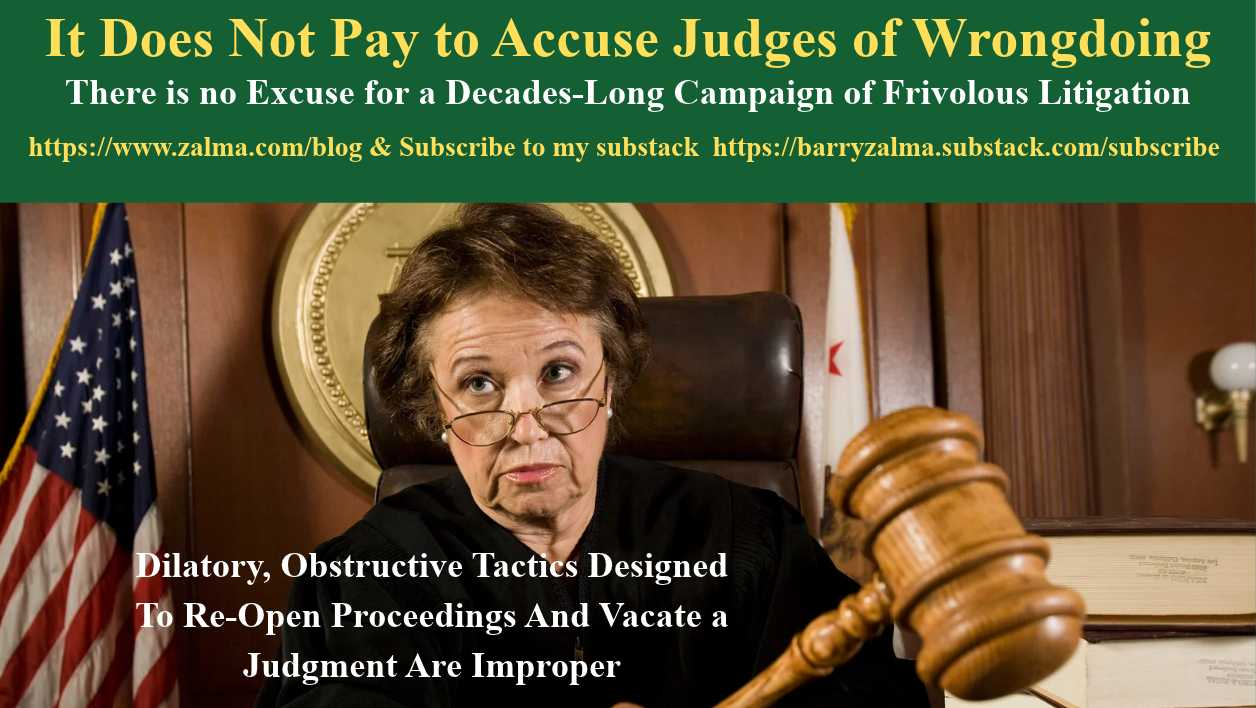
Dilatory, Obstructive Tactics Designed To Re-Open Proceedings And Vacate a Judgment Are Improper
Post 4583
In Three S Delaware, Inc. & Scott R. Steele v. Dataquick Information Systems, Inc. & Maxar Technologies, Inc., Civil Action No. 25-18991 (RK) (TJB), United States District Court, D. New Jersey (November 16, 2026) Three S Delaware (“3SD”) licensed real estate databases from a California company named DataQuick. A newly formed Delaware DataQuick bought the California DataQuick’s assets. The arbitrator later found that the sale included the 1996 license.
Delaware DataQuick sued 3SD in California. 3SD moved to compel arbitration and then counterclaimed. In May 2005, Steele and his counsel walked out of the merits hearing, and the arbitrator proceeded without them. He awarded about $6.17 million to DataQuick.
MARYLAND PROCEEDINGS:
The D. Md. (Judge Motz) confirmed the award, except for attorney’s fees. 3SD obtained a supersedeas bond of about $7.46 million from Federal Insurance Company. The Fourth Circuit affirmed in 2007.
Later ...
Insured’s Failure to Report Claim Before Expiration Defeats Claim
Post 4582
Posted on November 18, 2026 by Barry Zalma
In Diversified Restaurant Group, LLC, et al v. Houston Casualty Company, et al., No. 25-cv-02344-EMC, United States District Court, N.D. California (October 7, 2026) Diversified Restaurant Group and Golden Gate Bell (the “Insureds”) own or operate restaurants, including a Taco Bell in Antioch, California. Houston Casualty Company (HCC) issued them identical “claims made and reported” Employment Practices Liability (EPL) policies for 2022 and 2023. The 2022 policy ran from January 1, 2022 to January 1, 2023.
For the policy to apply, a covered claim had to be made during the policy period and reported to HCC within 30 days after it ended, which here was January 30, 2023. On about December 10, 2022, an underage employee reported alleged sexual misconduct.
On December 14, 2022, the employee’s counsel (Wilshire Law Firm) sent a letter to the Taco Bell. The letter referred to an “accident” on a stated date at a...