

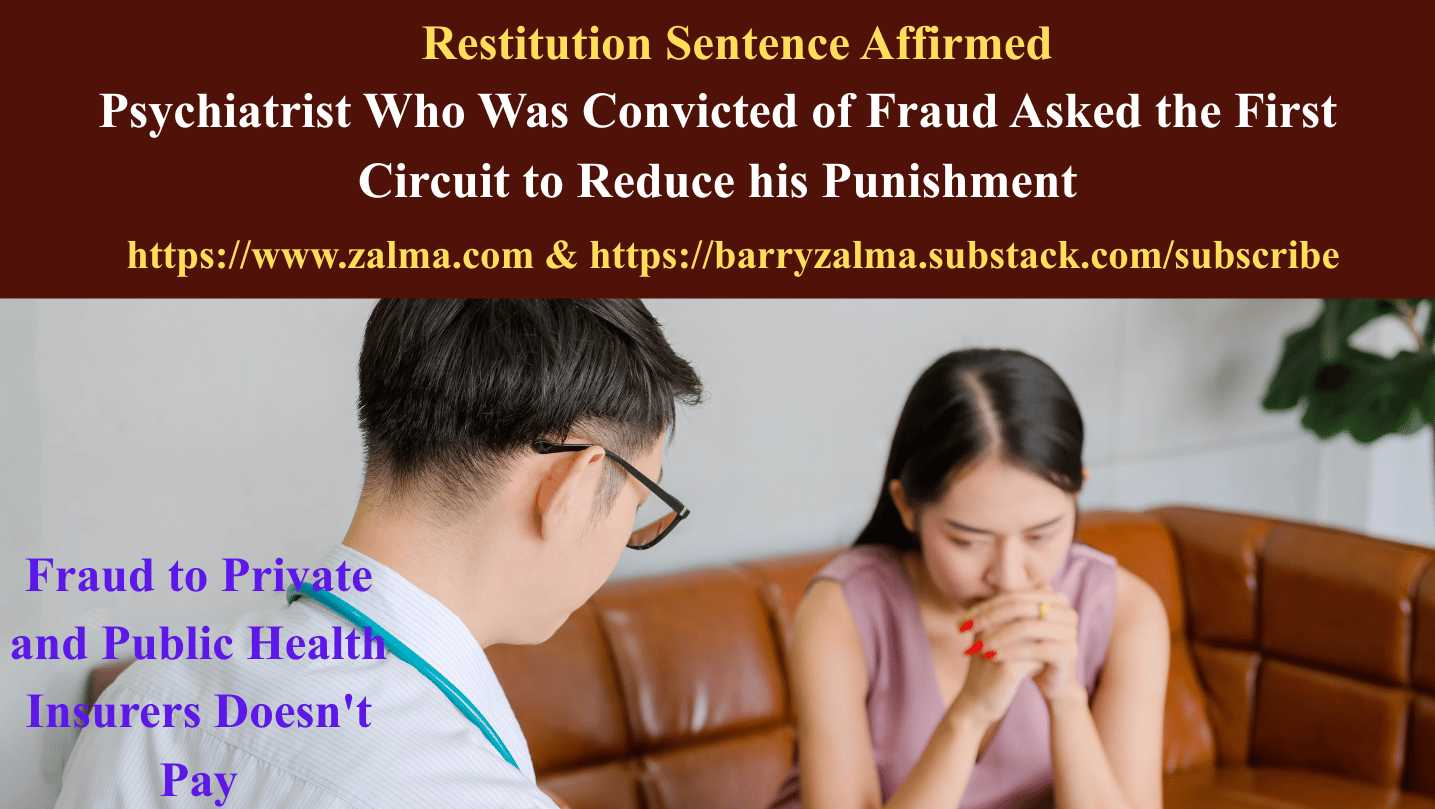
Psychiatrist Who Was Convicted of Fraud Asked the First Circuit to Reduce his Punishment
Post 4851
Posted on September 24, 2026 by Barry Zalma
Fraud to Private and Public Health Insurers Doesn’t Pay
In United States v. Gustavo Kinrys, Nos. 24-1592, 24-1716, United States Court of Appeals, First Circuit (September 21, 2026) Gustavo Kinrys, a Massachusetts psychiatrist, submitted fraudulent claims to private and public health insurers from 2015 through 2018, including bills for more than 1,000 sessions when he or the purported patient was outside the country. When insurers requested supporting records, he delayed through a fictitious office manager and created false documentation.
A jury convicted Kinrys on fourteen counts. The district court imposed a 99-month sentence, calculated intended loss at slightly more than $19 million based on billed amounts, ordered $6,537,309.59 in restitution, and ordered $6,527,391.19 in forfeiture.
At sentencing, the district court calculated Kinrys’s base offense level to be seven and then added twenty-eight levels-worth of enhancements, including a twenty-level enhancement for the loss amount. This yielded a recommended guideline range of 168 to 210 months for the first seven counts of conviction, and sixty months for the remaining counts. The district court sentenced Kinrys to ninety-nine months in prison on the first seven counts and sixty concurrent months in prison on the remaining counts. It also required Kinrys to pay $6,537,309.59 in restitution and $6,527,391.19 in criminal forfeiture.
LAW:
Under U.S.S.G. § 2B1.1(b)(1), loss is the greater of actual or intended loss. When a scheme is rife with fraud, the billed amount is prima facie evidence of intended loss; the defendant may rebut it with evidence that he intended to obtain less, but the government retains the ultimate burden to prove the enhancement by a preponderance of the evidence. Subjective intent is reviewed for clear error.
Under the Mandatory Victims Restitution Act, restitution compensates victims for actual losses caused by fraud and may not produce a windfall; distinct civil claims against victims are not adjudicated at a criminal restitution hearing.
DISCUSSION:
Kinrys argued that intended loss should equal the roughly $8.3 million he expected under negotiated in-network reimbursement rates rather than the more than $19 million billed, reducing the enhancement from twenty to eighteen levels. He relied on his provider contracts and failure to collect co-pays. He also argued that restitution should be reduced by allegedly legitimate claims for which insurers had not paid him.
ANALYSIS:
The First Circuit held that the district court did not clearly err in using billed amounts. Although Kinrys’s in-network status supported his position, other evidence supported an intent to obtain as much as possible: he sued insurers for billed charges and greater damages, sometimes received full billed amounts, retained payments exceeding contract rates, and offered no contrary evidence at sentencing beyond counsel’s argument.
His failure to collect co-pays was not persuasive because collection could have exposed the scheme or discouraged patients. The restitution offset also failed because the order included only fraudulent claims, while the unpaid claims were separate, disputed reimbursement requests affected by unmet preauthorization or documentation requirements. Any entitlement to those payments belonged in a civil or administrative proceeding, not the restitution hearing.
CONCLUSION:
The First Circuit affirmed both the intended-loss calculation and the restitution order.
A criminal restitution hearing, where distinct, unrelated, and contested billing is not before the court, is not the proper venue to resolve such claims. Accordingly, the First Circuit affirmed the district court’s decision to decline offsetting the restitution order based on Kinrys’s allegedly legitimate claims.
ZALMA OPINION
Psychiatrist convicted of insurance fraud and ordered to make restitution tried to reduce the order or eliminate it unsuccessfully to the First Circuit Court of Appeal. His crime was obvious, the amount he obtained from defrauded insurers and the government was proved by the DOJ and the trial court’s decision was affirmed.
(c) 2026 Barry Zalma & ClaimSchool, Inc.
Please tell your friends and colleagues about this blog and the videos and let them subscribe to the blog and the videos.
Subscribe to my substack at https://barryzalma.substack.com/subscribe
Go to X @bzalma; Go to Barry Zalma videos at Rumble.com at https://rumble.com/account/content?type=all; Go to Barry Zalma on YouTube- https://www.youtube.com/channel/UCysiZklEtxZsSF9DfC0Expg; Go to the Insurance Claims Library – https://lnkd.in/gwEYk.
Insurance Expert May Not Testify to Speculative and Contains Unsupported Conclusions.
Posted on September 18, 2026 by Barry Zalma
See the full video at and at https://rumble.com/v7fmifw-expert-may-only-testify-to-what-experience-supports.html
In Michele A. Over, and The Estate Of Paul R. Over v. State Farm Mutual Automobile Insurance Company, and State Farm Fire And Casualty Company, Civil Action No. 23-cv-02243-PAB-STV, United States District Court, D. Colorado (September 14, 2026) Michele and Paul Over sued State Farm Fire and State Farm Auto over hail-damage and stolen-vehicle claims.
The operative dispute concerned State Farm Auto’s motion to exclude or limit opinions from plaintiffs’ insurance-industry expert, Aaron Castillo. Castillo.
Law
The proponent of expert testimony must establish by a preponderance of the evidence that an expert is qualified and that the opinions are helpful, sufficiently grounded, and reliably derived and applied. Experience-based opinions must explain how the...
150 Months in Prison for Tax Fraud
Post 4846
Posted on September 17, 2026 by Barry Zalma
See the full video at https://lnkd.in/g8rh3JBX and https://lnkd.in/gmkdy-9C, In United States Of America v. Thomas Addaquay, Nos. 25-10609, 25-10611, United States Court of Appeals, Eleventh Circuit (September 9, 2026) the Eleventh Circuit affirmed all challenged convictions, the 150-month aggregate sentence, and the challenged $4,123,474.55 restitution award.
FACTS
In United States Of America v. Thomas Addaquay, United States Of America v. Thomas Addaquay, Nos. 25-10609, 25-10611, United States Court of Appeals, Eleventh Circuit (September 9, 2026) the Eleventh Circuit affirmed all challenged convictions, the 150-month aggregate sentence, and the challenged $4,123,474.55 restitution award.
FACTS
Thomas Addaquay controlled United Consolidated Accounting and Business Services (UC), nominally a check-cashing business.
The government proved a three-stage tax-refund scheme that converted the resulting refund checks into usable funds through ...
Major Fraud Perpetrator Asserts Fifth Amendment Privilege to Avoid Prosecution
Post 5489
Posted on September 14, 2026 by Barry Zalma
Fraudster Refuses to Answer Questions About His Alleged Fraud
See the full video at https://lnkd.in/gvicAMDr and at https://lnkd.in/gvicAMDr
In Great American Insurance Co. v. Gemstone Property Management, LLC, et al., No. 23-cv-9100 (LJL), United States District Court, S.D. New York (September 8, 2026) Great American Insurance Company alleged that it was defrauded through a scheme in which Subin Associates, LLP recruited individuals to stage construction-site injuries, arranged unnecessary medical treatment and litigation funding, and pursued fraudulent personal-injury claims.
Luis Manuel Garcia Salcedo, resulted in a $6 million settlement. Non-party Jose Hernandez allegedly worked as an assistant manager at Subin, operated Hernandez Associates, and owned litigation-funding companies that shared office space with Subin and provided services to its clients.
After Great American ...
ZIFL – Volume 30, Issue 20 Subscribe to ZIFL here https://lnkd.in/gfpn78FM
Posted on October 15, 2026 by Barry Zalma
THE SOURCE FOR THE INSURANCE FRAUD PROFESSIONAL
Zalma’s Insurance Fraud Letter (ZIFL) continues its 30th year of publication dedicated to those involved in reducing the effect of insurance fraud.
ZIFL is published 24 times a year is written by Barry Zalma.
It is provided FREE to anyone who visits the site at https://lnkd.in/gVT5G9s
Six Insane Fraud Schemes the Trump Administration Has Uncovered Stealing from the taxpayer has now become a multi-billion-dollar industry in America. Obamacare has been a magnet for scammers.
Florida Insurance Agent Pleads Guilty in $300,000 Premium Finance Scheme
Daniel Raney, 41, who managed Raney Insurance and Raney Ventures in Pensacola, was arrested after AFCO Direct.
RIFE WITH FRAUD ALLOWS DEMANDS TO ESTABLISH RESTITUTION
Six Insane Fraud Schemes the Trump Administration Has Uncovered
Stealing from the taxpayer has now become a multi-billion-dollar industry in America – and the ...
Sentence for Stealing from Veterans Administration Reasonably Considers State Insurance Fraud & Arson Convictions
Post 4863
Posted on October 14, 2026 by Barry Zalma
In United States Of America v. Anthony Curtis Brewer, No. 26-10745, United States Court of Appeals, Eleventh Circuit (October 8, 2026) Anthony Curtis Brewer became the fiduciary for an incapacitated recipient of Department of Veterans Affairs survivor benefits and agreed to use her funds solely for her care and support without commingling them with his own.
The VA determined that he misused $67,232.33 and removed him as fiduciary in 2022. Brewer pleaded guilty to theft of more than $1,000 in government property under 18 U.S.C. § 641. At sentencing, the district court attributed $53,567 in loss to him, producing an advisory Guidelines range of 15 to 21 months.
Citing the victim’s vulnerability, Brewer’s attempts to avoid responsibility, and his other fraudulent conduct — including state convictions for arson and insurance fraud — the court ...
Title Insurance Only Insures Real Property
Posted on October 13, 2026 by Barry Zalma
When a Seller Advised it Could Not Obtain Title to the Home Fraud Can’t be Proved
A Manufactured Home is Personal Property Until it Becomes Real Property
Post 4862
In Dale Johnson and Rose Johnson, Husband and Wife v. Stewart Title Guaranty Co., and Lennar Mortgage, LLC; Low Va Rates, LLC; Sandpoint Title Insurance, Inc.; Village Capital & Investment, LLC; and David Cassel, Engineer Agent; and Unknown Does 1-50, inclusively, No. 53126, Court of Appeals of Idaho (October 9, 2026) Dale and Rose Johnson purchased Idaho real property in 2012 with a manufactured home on it. Their purchase addendum acknowledged that the seller could not obtain title to the home, that evidence of title and an ALTA-7 endorsement might not be available, and that they accepted the home “as is.”
In 2020, after a HELOC application was denied, the Johnsons learned that the home had been wrecked and decertified in 2004 and that its 2006 conversion to real ...