
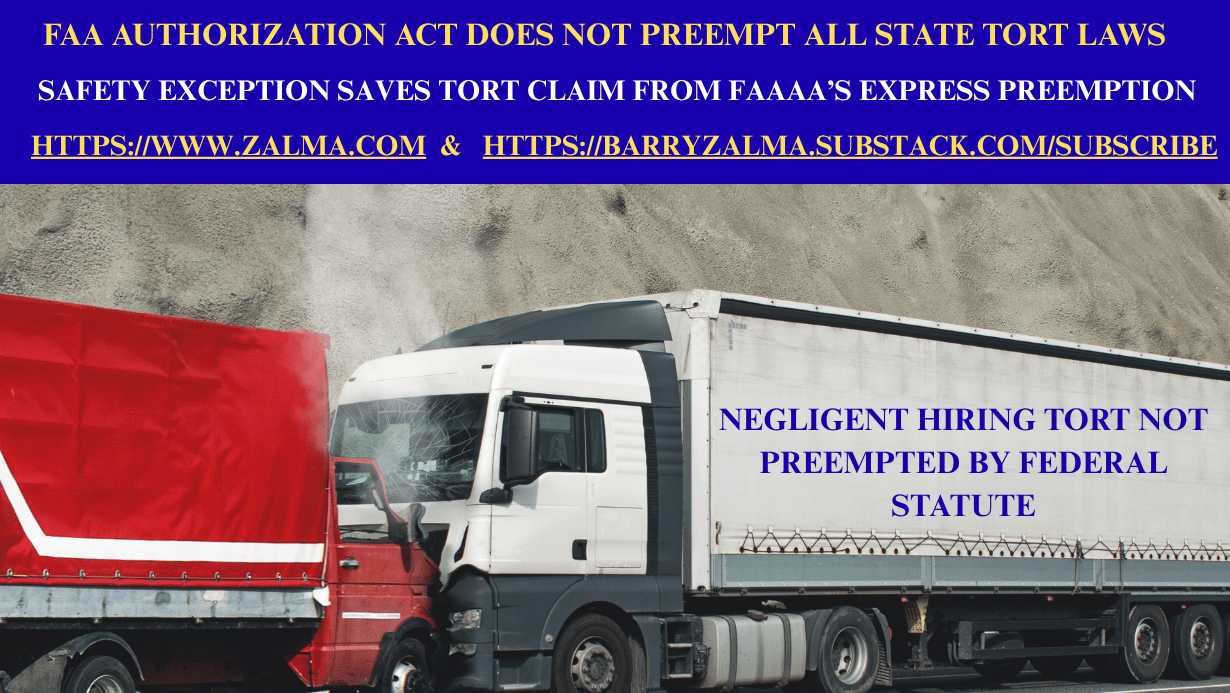
Negligent Hiring Tort not Preempted by Federal Statute
Read the full article at https://www.linkedin.com/pulse/faa-authorization-act-does-preempt-all-state-tort-zalma-esq-cfe-6jkvc and at https://zalma.com/blog plus more than 5350 posts.
In Shawn Montgomery v. Caribe Transport II, LLC, et al., 608 U.S.__ No. 24-1238, United States Supreme Court (May 14, 2026) Shawn Montgomery suffered severe and permanent injuries when his tractor trailer was struck by a truck driven by Yosniel Varela-Mojena while Varela-Mojena was transporting plastic pots through Illinois for Caribe Transport II, LLC. C.H. Robinson Worldwide, Inc., acting as a transportation broker, had arranged the shipment.
Montgomery sued the driver, the motor carrier, the broker, and related entities, alleging that C.H. Robinson negligently hired Varela-Mojena and Caribe Transport despite safety information that allegedly showed Caribe Transport posed an unreasonable risk of crashes and injury.
LAW
The Federal Aviation Administration Authorization Act preempts state laws having the force and effect of law that are related to a price, route, or service of a motor carrier, broker, or freight forwarder with respect to the transportation of property. The Act also contains a safety exception providing that the preemption provision shall not restrict the safety regulatory authority of a State with respect to motor vehicles.
State common-law duties and standards of care can constitute safety regulatory authority, and negligent-hiring doctrine imposes a duty of reasonable care when selecting a contractor for work that creates a risk of physical harm.
DISCUSSION
The Supreme Court assumed for purposes of analysis that Montgomery’s negligent-hiring claim might otherwise fall within the FAAAA’s express preemption clause but held that the safety exception saves the claim. The Court reasoned that the phrase “with respect to motor vehicles” should be given its ordinary meaning, including claims that concern or regard vehicles used in transportation.
Because Montgomery’s claim challenged C.H. Robinson’s selection of a carrier whose trucks would transport the goods, and because the alleged negligence related to motor-vehicle safety risks, the claim concerned motor vehicles within the meaning of the safety exception.
ANALYSIS
The Federal Government began regulating the trucking industry in 1935. The Interstate Commerce Commission (ICC) initially regulated rates and services of motor carriers “‘in the public interest.'” But the ICC’s interventions “inhibit[ed] market entry [and] carrier growth,” creating “some operating inefficiencies and some anticompetitive pricing.” Its regulation also stifled brokers’ development. Congress enacted the Motor Carrier Act of 1980 to deregulate aspects of the industry. The Motor Carrier Act eased entry requirements, reduced collective rate making, and encouraged greater flexibility in pricing.
SCOTUS rejected C.H. Robinson’s arguments that Montgomery’s interpretation would swallow the preemption rule, create surplusage, or improperly extend the exception to brokers. The safety exception does not save every claim related to transportation services; it saves only claims involving state safety regulation concerning motor vehicles. Nor did the Court view the absence of a safety exception in the Act’s intrastate-broker provision as sufficient reason to narrow the text of subsection 14501(c)(2)(A).
Justice Kavanaugh’s concurrence emphasized that the case was close, noting competing statutory-context arguments, but concluded that Congress likely did not use indirect language in an economic-deregulation statute to eliminate state tort remedies against brokers who negligently select unsafe motor carriers.
CONCLUSIONS
The holding is that state negligent-hiring claims against transportation brokers are not barred by the FAAAA when they fall within the Act’s safety exception because they concern motor-vehicle safety.
The decision preserves state tort authority over broker conduct connected to the selection of unsafe motor carriers while leaving ordinary economic regulation of broker prices, routes, and services subject to federal preemption.
ZALMA OPINION
Although federal Regulations try to control everything they are directed at, when the language of the statute seemed clear SCOTUS found that the Act it was asked to rule upon also contains a safety exception providing that the preemption provision shall not restrict the safety regulatory authority of a State with respect to motor vehicles. Shawn Montgomery sued for the negligent hiring of the driver who negligently caused his injury and SCOTUS found that the statute did not preempt the states right to allow the negligent hiring claim brought by Shawn Montgomery for his injuries.
(c) 2026 Barry Zalma & ClaimSchool, Inc.
Please tell your friends and colleagues about this blog and the videos and let them subscribe to the blog and the videos.
Subscribe to my substack at https://gbarryzalma.substack.com/subscribe
Go to X @bzalma; Go to Barry Zalma videos at Rumble.com at https://rumble.com/account/content?type=all; Go to Barry Zalma on YouTube- https://Cwww.youtube.com/channel/UCysiZklEtxZsSF9DfC0Expg; Go to the InsuranceClaims Library – https://lnkd.in/gwEYk.
Insurance Expert May Not Testify to Speculative and Contains Unsupported Conclusions.
Posted on September 18, 2026 by Barry Zalma
See the full video at and at https://rumble.com/v7fmifw-expert-may-only-testify-to-what-experience-supports.html
In Michele A. Over, and The Estate Of Paul R. Over v. State Farm Mutual Automobile Insurance Company, and State Farm Fire And Casualty Company, Civil Action No. 23-cv-02243-PAB-STV, United States District Court, D. Colorado (September 14, 2026) Michele and Paul Over sued State Farm Fire and State Farm Auto over hail-damage and stolen-vehicle claims.
The operative dispute concerned State Farm Auto’s motion to exclude or limit opinions from plaintiffs’ insurance-industry expert, Aaron Castillo. Castillo.
Law
The proponent of expert testimony must establish by a preponderance of the evidence that an expert is qualified and that the opinions are helpful, sufficiently grounded, and reliably derived and applied. Experience-based opinions must explain how the...
150 Months in Prison for Tax Fraud
Post 4846
Posted on September 17, 2026 by Barry Zalma
See the full video at https://lnkd.in/g8rh3JBX and https://lnkd.in/gmkdy-9C, In United States Of America v. Thomas Addaquay, Nos. 25-10609, 25-10611, United States Court of Appeals, Eleventh Circuit (September 9, 2026) the Eleventh Circuit affirmed all challenged convictions, the 150-month aggregate sentence, and the challenged $4,123,474.55 restitution award.
FACTS
In United States Of America v. Thomas Addaquay, United States Of America v. Thomas Addaquay, Nos. 25-10609, 25-10611, United States Court of Appeals, Eleventh Circuit (September 9, 2026) the Eleventh Circuit affirmed all challenged convictions, the 150-month aggregate sentence, and the challenged $4,123,474.55 restitution award.
FACTS
Thomas Addaquay controlled United Consolidated Accounting and Business Services (UC), nominally a check-cashing business.
The government proved a three-stage tax-refund scheme that converted the resulting refund checks into usable funds through ...
Major Fraud Perpetrator Asserts Fifth Amendment Privilege to Avoid Prosecution
Post 5489
Posted on September 14, 2026 by Barry Zalma
Fraudster Refuses to Answer Questions About His Alleged Fraud
See the full video at https://lnkd.in/gvicAMDr and at https://lnkd.in/gvicAMDr
In Great American Insurance Co. v. Gemstone Property Management, LLC, et al., No. 23-cv-9100 (LJL), United States District Court, S.D. New York (September 8, 2026) Great American Insurance Company alleged that it was defrauded through a scheme in which Subin Associates, LLP recruited individuals to stage construction-site injuries, arranged unnecessary medical treatment and litigation funding, and pursued fraudulent personal-injury claims.
Luis Manuel Garcia Salcedo, resulted in a $6 million settlement. Non-party Jose Hernandez allegedly worked as an assistant manager at Subin, operated Hernandez Associates, and owned litigation-funding companies that shared office space with Subin and provided services to its clients.
After Great American ...
Alleged Defamatory Statements Must be Of and Concerning Plaintiffs
Posted on October 16, 2026 by Barry Zalma
To Prove Defamation the Statement Must be Of and Concerning the Plaintiffs
Post 4867
In Michael Moloney and Sergio Cantu v. United Services Automobile Association, No. 04-25-00519-CV, Court of Appeals of Texas, Fourth District, San Antonio (October 14, 2026) Michael Moloney and Sergio Cantu appealed from the trial court’s granting of a traditional motion for summary judgment in favor of United Services Automobile Association (“USAA”) on their defamation claim.
BACKGROUND
Moloney and Cantu sued USAA for defamation, alleging that they are the principals of Informed Roofing & Restoration, LLC (“Informed Roofing”), which is primarily engaged in the residential roofing repair and replacement business, and that an employee or agent of USAA had made false and defamatory statements to the San Antonio Police Department (“SAPD”) concerning them.
Specifically, Moloney and Cantu alleged that an employee of ...
ZIFL – Volume 30, Issue 20 Subscribe to ZIFL here https://lnkd.in/gfpn78FM
Posted on October 15, 2026 by Barry Zalma
THE SOURCE FOR THE INSURANCE FRAUD PROFESSIONAL
Zalma’s Insurance Fraud Letter (ZIFL) continues its 30th year of publication dedicated to those involved in reducing the effect of insurance fraud.
ZIFL is published 24 times a year is written by Barry Zalma.
It is provided FREE to anyone who visits the site at https://lnkd.in/gVT5G9s
Six Insane Fraud Schemes the Trump Administration Has Uncovered Stealing from the taxpayer has now become a multi-billion-dollar industry in America. Obamacare has been a magnet for scammers.
Florida Insurance Agent Pleads Guilty in $300,000 Premium Finance Scheme
Daniel Raney, 41, who managed Raney Insurance and Raney Ventures in Pensacola, was arrested after AFCO Direct.
RIFE WITH FRAUD ALLOWS DEMANDS TO ESTABLISH RESTITUTION
Six Insane Fraud Schemes the Trump Administration Has Uncovered
Stealing from the taxpayer has now become a multi-billion-dollar industry in America – and the ...
Sentence for Stealing from Veterans Administration Reasonably Considers State Insurance Fraud & Arson Convictions
Post 4863
Posted on October 14, 2026 by Barry Zalma
In United States Of America v. Anthony Curtis Brewer, No. 26-10745, United States Court of Appeals, Eleventh Circuit (October 8, 2026) Anthony Curtis Brewer became the fiduciary for an incapacitated recipient of Department of Veterans Affairs survivor benefits and agreed to use her funds solely for her care and support without commingling them with his own.
The VA determined that he misused $67,232.33 and removed him as fiduciary in 2022. Brewer pleaded guilty to theft of more than $1,000 in government property under 18 U.S.C. § 641. At sentencing, the district court attributed $53,567 in loss to him, producing an advisory Guidelines range of 15 to 21 months.
Citing the victim’s vulnerability, Brewer’s attempts to avoid responsibility, and his other fraudulent conduct — including state convictions for arson and insurance fraud — the court ...