

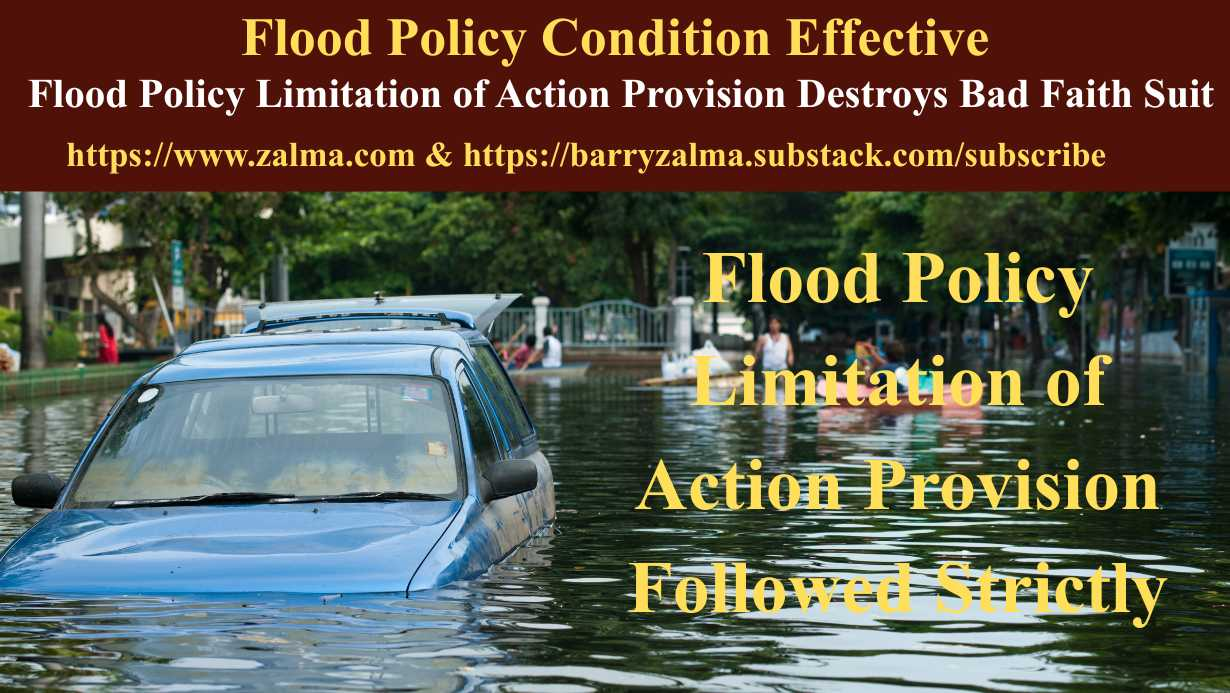
Flood Policy Limitation of Action Provision Destroys Bad Faith Suit
Post number 5376
Flood Policy Limitation of Action Provision Followed Strictly
Posted on June 19, 2026 by Barry Zalma
In Wayne Gularte, et al. v. Wright National Flood Insurance Company, No. 5:26-cv-01426-PCP, United States District Court, N.D. California (June 15, 2026) Wayne and Doris Gularte alleged that their property sustained flood damage between January 17 and March 23, 2023. They submitted claims to Wright National Flood Insurance Company, which paid part of the claim but denied additional claimed structural losses by email on June 18, 2023.
The Gularte plaintiffs filed suit in state court on December 30, 2025, seeking $12,500 for unpaid structural losses. Wright removed the action to federal court and moved to dismiss.
LAW:
A complaint in Federal Court must plead enough facts to state a plausible claim for relief under Federal Rule of Civil Procedure 8(a)(2), and dismissal under Rule 12(b)(6) is appropriate when the complaint lacks a cognizable legal theory or sufficient supporting facts.
Under the National Flood Insurance Program and Standard Flood Insurance Policies, an insured must sue within one year after the insurer mails notice of disallowance.
DISCUSSION:
Wright showed that it issued the relevant flood policy through the NFIP and submitted the policy terms and denial letter with its motion. Because the complaint challenged the denial of insurance benefits, the court found those documents incorporated by reference and considered them without converting the motion into one for summary judgment.
“Only when the plaintiff pleads itself out of court—that is, admits all the ingredients of an impenetrable defense—may a complaint that otherwise states a claim be dismissed under Rule 12(b)(6).” Durnford v. MusclePharm Corp., 907 F.3d 595, 604 (9th Cir. 2018).
ANALYSIS:
The court concluded that the claim was untimely. Wright denied the disputed portion of the claim on June 18, 2023, but plaintiffs did not file suit until December 30, 2025, more than one year after the denial. Because the incorporated materials made the limitations bar apparent, plaintiffs had pleaded themselves outside the available period for suit.
CONCLUSION:
The court granted Wright National Flood Insurance Company’s motion to dismiss because the insureds filed suit well outside the one-year limitations period governing SFIP claim disputes. When a motion to dismiss is based on the running of the statute of limitations, it can be granted only if the assertions of the complaint, read with the required liberality, would not permit the plaintiff to prove that the statute was tolled or that the claims were timely.
ANALYSIS
Wright participated in the United States Government’s National Flood Insurance Program (NFIP), which allows it to issue Standard Flood Insurance Policies (SFIPs) on behalf of the federal government. It submits several exhibits along with its motion, including a document confirming coverage of plaintiffs’ property under the NFIP, the terms of an SFIP, and a copy of the denial letter sent to plaintiffs. Because plaintiffs’ complaint alleges an unlawful denial of their insurance claim, it necessarily relies on the terms of the policy and the insurer’s denial letter.
If an insurer denies a claim, SFIP policyholders must file any action within one year of the mailing of the notice of disallowance. The record before the Court demonstrated that plaintiffs filed the action over a year and a half after their claim was denied. Since the complaint includes no allegations from which the Court could conclude that plaintiffs were excused from filing their lawsuit within one year of the denial. Their claim was, therefore,time-barred.
The USDC granted Defendant’s motion to dismiss.
ZALMA OPINION
Every insurance policy insuring against the risk of loss of real or personal property or damage caused by flood, contain a private limitation of action provision. NFPA policies contain a one-year private limitation of action from the date of denial. Gularte, by its complaint, filed the action more than one year after the denial and established the suit was time barred.
(c) 2026 Barry Zalma & ClaimSchool, Inc.
Please tell your friends and colleagues about this blog and the videos and let them subscribe to the blog and the videos.
Subscribe to my substack at https://gbarryzalma.substack.com/subscribe
Go to X @bzalma; Go to Barry Zalma videos at Rumble.com at https://rumble.com/account/content?type=all; Go to Barry Zalma on YouTube- https://Cwww.youtube.com/channel/UCysiZklEtxZsSF9DfC0Expg; Go to the InsuranceClaims Library – https://lnkd.in/gwEYk.
Insurance Expert May Not Testify to Speculative and Contains Unsupported Conclusions.
Posted on September 18, 2026 by Barry Zalma
See the full video at and at https://rumble.com/v7fmifw-expert-may-only-testify-to-what-experience-supports.html
In Michele A. Over, and The Estate Of Paul R. Over v. State Farm Mutual Automobile Insurance Company, and State Farm Fire And Casualty Company, Civil Action No. 23-cv-02243-PAB-STV, United States District Court, D. Colorado (September 14, 2026) Michele and Paul Over sued State Farm Fire and State Farm Auto over hail-damage and stolen-vehicle claims.
The operative dispute concerned State Farm Auto’s motion to exclude or limit opinions from plaintiffs’ insurance-industry expert, Aaron Castillo. Castillo.
Law
The proponent of expert testimony must establish by a preponderance of the evidence that an expert is qualified and that the opinions are helpful, sufficiently grounded, and reliably derived and applied. Experience-based opinions must explain how the...
150 Months in Prison for Tax Fraud
Post 4846
Posted on September 17, 2026 by Barry Zalma
See the full video at https://lnkd.in/g8rh3JBX and https://lnkd.in/gmkdy-9C, In United States Of America v. Thomas Addaquay, Nos. 25-10609, 25-10611, United States Court of Appeals, Eleventh Circuit (September 9, 2026) the Eleventh Circuit affirmed all challenged convictions, the 150-month aggregate sentence, and the challenged $4,123,474.55 restitution award.
FACTS
In United States Of America v. Thomas Addaquay, United States Of America v. Thomas Addaquay, Nos. 25-10609, 25-10611, United States Court of Appeals, Eleventh Circuit (September 9, 2026) the Eleventh Circuit affirmed all challenged convictions, the 150-month aggregate sentence, and the challenged $4,123,474.55 restitution award.
FACTS
Thomas Addaquay controlled United Consolidated Accounting and Business Services (UC), nominally a check-cashing business.
The government proved a three-stage tax-refund scheme that converted the resulting refund checks into usable funds through ...
Major Fraud Perpetrator Asserts Fifth Amendment Privilege to Avoid Prosecution
Post 5489
Posted on September 14, 2026 by Barry Zalma
Fraudster Refuses to Answer Questions About His Alleged Fraud
See the full video at https://lnkd.in/gvicAMDr and at https://lnkd.in/gvicAMDr
In Great American Insurance Co. v. Gemstone Property Management, LLC, et al., No. 23-cv-9100 (LJL), United States District Court, S.D. New York (September 8, 2026) Great American Insurance Company alleged that it was defrauded through a scheme in which Subin Associates, LLP recruited individuals to stage construction-site injuries, arranged unnecessary medical treatment and litigation funding, and pursued fraudulent personal-injury claims.
Luis Manuel Garcia Salcedo, resulted in a $6 million settlement. Non-party Jose Hernandez allegedly worked as an assistant manager at Subin, operated Hernandez Associates, and owned litigation-funding companies that shared office space with Subin and provided services to its clients.
After Great American ...
Alleged Defamatory Statements Must be Of and Concerning Plaintiffs
Posted on October 16, 2026 by Barry Zalma
To Prove Defamation the Statement Must be Of and Concerning the Plaintiffs
Post 4867
In Michael Moloney and Sergio Cantu v. United Services Automobile Association, No. 04-25-00519-CV, Court of Appeals of Texas, Fourth District, San Antonio (October 14, 2026) Michael Moloney and Sergio Cantu appealed from the trial court’s granting of a traditional motion for summary judgment in favor of United Services Automobile Association (“USAA”) on their defamation claim.
BACKGROUND
Moloney and Cantu sued USAA for defamation, alleging that they are the principals of Informed Roofing & Restoration, LLC (“Informed Roofing”), which is primarily engaged in the residential roofing repair and replacement business, and that an employee or agent of USAA had made false and defamatory statements to the San Antonio Police Department (“SAPD”) concerning them.
Specifically, Moloney and Cantu alleged that an employee of ...
ZIFL – Volume 30, Issue 20 Subscribe to ZIFL here https://lnkd.in/gfpn78FM
Posted on October 15, 2026 by Barry Zalma
THE SOURCE FOR THE INSURANCE FRAUD PROFESSIONAL
Zalma’s Insurance Fraud Letter (ZIFL) continues its 30th year of publication dedicated to those involved in reducing the effect of insurance fraud.
ZIFL is published 24 times a year is written by Barry Zalma.
It is provided FREE to anyone who visits the site at https://lnkd.in/gVT5G9s
Six Insane Fraud Schemes the Trump Administration Has Uncovered Stealing from the taxpayer has now become a multi-billion-dollar industry in America. Obamacare has been a magnet for scammers.
Florida Insurance Agent Pleads Guilty in $300,000 Premium Finance Scheme
Daniel Raney, 41, who managed Raney Insurance and Raney Ventures in Pensacola, was arrested after AFCO Direct.
RIFE WITH FRAUD ALLOWS DEMANDS TO ESTABLISH RESTITUTION
Six Insane Fraud Schemes the Trump Administration Has Uncovered
Stealing from the taxpayer has now become a multi-billion-dollar industry in America – and the ...
Sentence for Stealing from Veterans Administration Reasonably Considers State Insurance Fraud & Arson Convictions
Post 4863
Posted on October 14, 2026 by Barry Zalma
In United States Of America v. Anthony Curtis Brewer, No. 26-10745, United States Court of Appeals, Eleventh Circuit (October 8, 2026) Anthony Curtis Brewer became the fiduciary for an incapacitated recipient of Department of Veterans Affairs survivor benefits and agreed to use her funds solely for her care and support without commingling them with his own.
The VA determined that he misused $67,232.33 and removed him as fiduciary in 2022. Brewer pleaded guilty to theft of more than $1,000 in government property under 18 U.S.C. § 641. At sentencing, the district court attributed $53,567 in loss to him, producing an advisory Guidelines range of 15 to 21 months.
Citing the victim’s vulnerability, Brewer’s attempts to avoid responsibility, and his other fraudulent conduct — including state convictions for arson and insurance fraud — the court ...