


Post number 5374
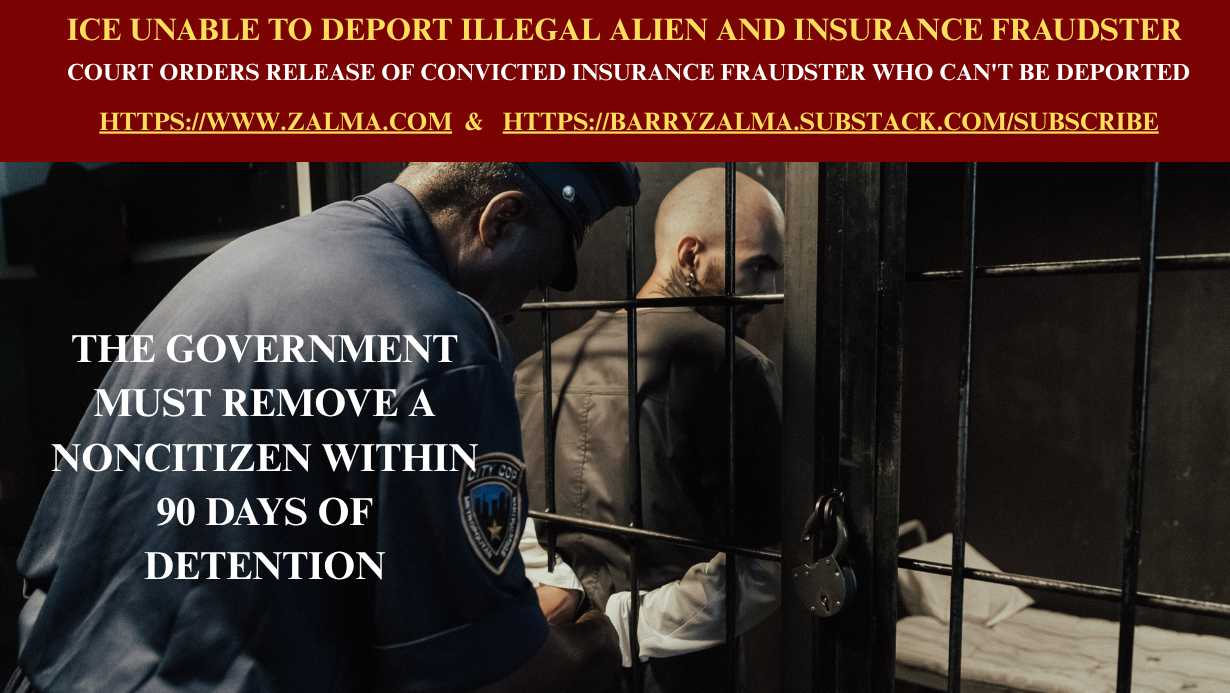
The Government Must Remove a Noncitizen Within 90 Days of Detention
In Jean Marcel Perez Garcia v. Warden, Florida Side South Detention Facility, et al., No. 2:26-cv-788-JES-DNF John E. Steele United States District Judge United States District Court, M.D. Florida, Fort Myers Division (June 10, 2026) Jean Marcel Perez Garcia, a Cuban citizen, entered the United States in 2003. After convictions for a drug offense and felony insurance fraud, he was ordered removed in 2018 but was later released under supervision.
ICE revoked that supervision in December 2025 and detained him again to execute the removal order. In February 2026, ICE transported him to the U.S.–Mexico border and sought to have him depart to Mexico, but he refused. ICE then continued to detain him for more than six months without showing that any country had agreed to accept him or that travel documents had been secured.
LAW
Under 8 U.S.C. § 1231(a)(1)(A), the government must remove a noncitizen within 90 days after the removal order becomes final, and detention is mandatory during that period. Under Zadvydas v. Davis, 533 U.S. 678 (2001), post-removal detention is presumptively reasonable for six months, but after that period the detainee may be released if there is no significant likelihood of removal in the reasonably foreseeable future. The government may extend the removal period under 8 U.S.C. § 1231(a)(1)(C) if the noncitizen acts to prevent removal, but only where the government can show the detainee actually obstructed a realistic removal process.
DISCUSSION
The government argued that Perez Garcia was not entitled to release because he thwarted removal by refusing to board transport for Mexico and by refusing to sign removal paperwork. The court rejected that argument. It found no evidence that Mexico had actually agreed to accept him, no proof that ICE had obtained or even sought travel documents, and no concrete removal plan to any country.
The record showed only that ICE brought him to the border and tried to induce him to “voluntarily” leave for Mexico. The court concluded that this did not amount to a lawful or realistic removal effort and did not trigger tolling under § 1231(a)(1)(C).
ANALYSIS
The court applied Zadvydas and held that once Perez Garcia showed he had been detained beyond six months, the burden shifted to the government to demonstrate a significant likelihood of removal in the reasonably foreseeable future. The government failed to meet that burden. The court emphasized that speculation that Mexico might eventually accept him was not enough. Nor could ICE rely on coercive pressure to force a “voluntary” crossing into a third country as a substitute for actual removal. Because there was no evidence of meaningful progress toward removal and no concrete plan, continued detention had become unreasonable and unauthorized.
CONCLUSION
In short, Respondents present no evidence showing any significant steps taken to remove Perez Garcia to Cuba or another country. Instead, the only effort at removal was a trip to the United States-Mexico border in an apparent attempt to coerce Perez Garcia into voluntarily departing to a country of which he is not a citizen.
Detaining a noncitizen and using the specter of continued detention to compel him to “voluntarily” depart by walking across the international border does not constitute removal; rather, it is an action designed to lead to the type of indefinite detention that Zadvydas sought to prevent. The Court also noted that it has been 128 days since the purported attempted removal to Mexico – far more than the 90 days contemplated by 8 U.S.C. § 1231(a)(1)(A), and Respondents admit that no further actions have been taken in the interim.
The court granted the habeas petition. It ordered Perez Garcia’s release within 24 hours, subject to an order of supervision. The court also noted that ICE could re-detain him in the future if removal became significantly likely in the reasonably foreseeable future.
ZALMA OPINION
The court, reluctantly granted Perez Garcia’s Habeas request because – although he was a criminal alien – ICE was unable to fulfill a deportation order and deport him. Thanks to that inability a convicted insurance fraudster was released into the country to commit more fraud until ICE could arrest, confine and deport him because the law does not allow them to keep him confined instead of deport him.
(c) 2026 Barry Zalma & ClaimSchool, Inc.
Please tell your friends and colleagues about this blog and the videos and let them subscribe to the blog and the videos.
Subscribe to my substack at https://gbarryzalma.substack.com/subscribe
Go to X @bzalma; Go to Barry Zalma videos at Rumble.com at https://rumble.com/account/content?type=all; Go to Barry Zalma on YouTube- https://Cwww.youtube.com/channel/UCysiZklEtxZsSF9DfC0Expg; Go to the InsuranceClaims Library – https://lnkd.in/gwEYk.
Insurance Expert May Not Testify to Speculative and Contains Unsupported Conclusions.
Posted on September 18, 2026 by Barry Zalma
See the full video at and at https://rumble.com/v7fmifw-expert-may-only-testify-to-what-experience-supports.html
In Michele A. Over, and The Estate Of Paul R. Over v. State Farm Mutual Automobile Insurance Company, and State Farm Fire And Casualty Company, Civil Action No. 23-cv-02243-PAB-STV, United States District Court, D. Colorado (September 14, 2026) Michele and Paul Over sued State Farm Fire and State Farm Auto over hail-damage and stolen-vehicle claims.
The operative dispute concerned State Farm Auto’s motion to exclude or limit opinions from plaintiffs’ insurance-industry expert, Aaron Castillo. Castillo.
Law
The proponent of expert testimony must establish by a preponderance of the evidence that an expert is qualified and that the opinions are helpful, sufficiently grounded, and reliably derived and applied. Experience-based opinions must explain how the...
150 Months in Prison for Tax Fraud
Post 4846
Posted on September 17, 2026 by Barry Zalma
See the full video at https://lnkd.in/g8rh3JBX and https://lnkd.in/gmkdy-9C, In United States Of America v. Thomas Addaquay, Nos. 25-10609, 25-10611, United States Court of Appeals, Eleventh Circuit (September 9, 2026) the Eleventh Circuit affirmed all challenged convictions, the 150-month aggregate sentence, and the challenged $4,123,474.55 restitution award.
FACTS
In United States Of America v. Thomas Addaquay, United States Of America v. Thomas Addaquay, Nos. 25-10609, 25-10611, United States Court of Appeals, Eleventh Circuit (September 9, 2026) the Eleventh Circuit affirmed all challenged convictions, the 150-month aggregate sentence, and the challenged $4,123,474.55 restitution award.
FACTS
Thomas Addaquay controlled United Consolidated Accounting and Business Services (UC), nominally a check-cashing business.
The government proved a three-stage tax-refund scheme that converted the resulting refund checks into usable funds through ...
Major Fraud Perpetrator Asserts Fifth Amendment Privilege to Avoid Prosecution
Post 5489
Posted on September 14, 2026 by Barry Zalma
Fraudster Refuses to Answer Questions About His Alleged Fraud
See the full video at https://lnkd.in/gvicAMDr and at https://lnkd.in/gvicAMDr
In Great American Insurance Co. v. Gemstone Property Management, LLC, et al., No. 23-cv-9100 (LJL), United States District Court, S.D. New York (September 8, 2026) Great American Insurance Company alleged that it was defrauded through a scheme in which Subin Associates, LLP recruited individuals to stage construction-site injuries, arranged unnecessary medical treatment and litigation funding, and pursued fraudulent personal-injury claims.
Luis Manuel Garcia Salcedo, resulted in a $6 million settlement. Non-party Jose Hernandez allegedly worked as an assistant manager at Subin, operated Hernandez Associates, and owned litigation-funding companies that shared office space with Subin and provided services to its clients.
After Great American ...
If Grounds For Dismissal Are Apparent From The Face Of The Complaint, A Court May Also Dismiss The Case on The Court’s Own Motion
Posted on October 5, 2026 by Barry Zalma
Pro Se Plaintiff Failed to Make a Short and Plain Statement
Post 4856
In Tak Lun Ng v. United Financial Casualty Company, No. 26-cv-03136-LJC, United States District Court, N.D. California (September 28, 2026) Tak Lun Ng, proceeding pro se, sued United Financial Casualty Company over a March 2, 2021 automobile accident and the insurer’s March 24, 2021 refusal to pay him.
He appeared to assert breach of contract, fraud, negligence, premises liability, product liability, and related theories. United removed the action from state court and moved to dismiss.
Ng missed that deadline but later filed several documents, including a motion for leave to amend, all of which the court reviewed.
LAW
Under Federal Rules of Civil Procedure, a complaint must provide a short and plain statement containing enough factual matter to state a facially plausible...
If Grounds For Dismissal Are Apparent From The Face Of The Complaint, A Court May Also Dismiss The Case on The Court’s Own Motion
Posted on October 5, 2026 by Barry Zalma
Pro Se Plaintiff Failed to Make a Short and Plain Statement
Post 4856
In Tak Lun Ng v. United Financial Casualty Company, No. 26-cv-03136-LJC, United States District Court, N.D. California (September 28, 2026) Tak Lun Ng, proceeding pro se, sued United Financial Casualty Company over a March 2, 2021 automobile accident and the insurer’s March 24, 2021 refusal to pay him.
He appeared to assert breach of contract, fraud, negligence, premises liability, product liability, and related theories. United removed the action from state court and moved to dismiss.
Ng missed that deadline but later filed several documents, including a motion for leave to amend, all of which the court reviewed.
LAW
Under Federal Rules of Civil Procedure, a complaint must provide a short and plain statement containing enough factual matter to state a facially plausible...
Employee Report of Fraud Results in Damages Suit After Qui Tam Suit Settled
No Statutory Hearing Right Arose Because No Dental Commission Complaint License Suspension, Revocation, Or Sanction Occurred.
Post 4855
Posted on October 2, 2026 by Barry Zalma
In Abbas Mohammadi et al. v. William M. Tong et al., No. AC 47598, Court of Appeals of Connecticut (September 29, 2026) Abbas Mohammadi owned and operated Columbia Dental, P.C., which provided dental services through multiple Connecticut offices; Columbia Oral Maxillofacial Imaging, LLC served as the billing entity.
From April 2012 to February 27, 2013, Columbia Dental employed Brittany Ames Mahoney as a dental assistant. During her employment, Mahoney claimed to have discovered certain billing irregularities, including, but not limited to, false and fraudulent reimbursement claims submitted to the Department of Social Services for services rendered to Medicaid beneficiaries. Mahoney filed a complaint and an affidavit in the United States District Court for the District of...