

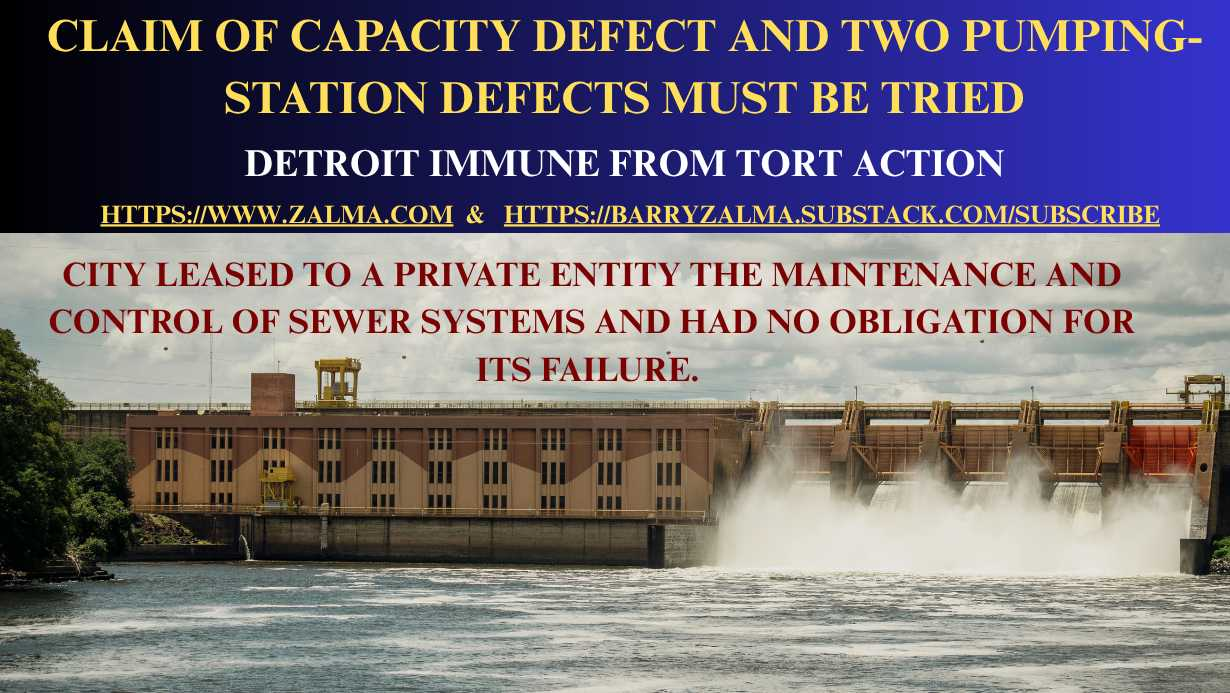
Detroit Immune From Tort Action
Post number 5367
City Leased to a Private Entity the Maintenance and Control of Sewer Systems and had no obligation for its failure.
In American Select Insurance Co., et al. v. Great Lakes Water Authority, et al., No. 23-cv-11942, United States District Court, E.D. Michigan, Southern Division (June 2, 2026) involved Plaintiff insurers who had paid claims to approximately 1,400 insured homeowners for flood damage caused by June 25–26, 2021 sewer overflows/backups in the Detroit metro area.
The insurers sued the City of Detroit, the Detroit Water and Sewerage Department (DWSD), and the Great Lakes Water Authority (GLWA) as subrogees, alleging three sewer-system defects: (1) insufficient overall system capacity to handle the storm, (2) defects at the Freud Pumping Station, and (3) defects at the Conner Creek Pumping Station.
FACTS
The Detroit Defendants historically operated the whole system, but under a 2015 40-year lease, GLWA assumed exclusive control, operation, and maintenance responsibility for the regional portion of the sewer system, including the pumping stations at issue.
Plaintiffs amended their complaint several times. In the Third Amended Complaint, they attempted to cure earlier pleading deficiencies by alleging a generally accepted design standard for combined sewer systems and asserting that the June 2021 rainfall did not exceed that standard.
LAW
Under Michigan’s Governmental Tort Liability Act (GTLA), governmental agencies are broadly immune from tort liability when engaged in a governmental function. Plaintiffs therefore had to plead facts bringing their claim within the Sewage Disposal System Event (SDSE) exception.
To invoke the SDSE exception, a plaintiff must plausibly allege:
1. the defendant was an appropriate governmental agency;
2. the sewage disposal system had a defect;
3. the agency knew or should have known of the defect;
4. the agency, having legal authority to do so, failed to take reasonable steps in a reasonable time to repair/correct/remedy the defect; and
5. the defect was a substantial proximate cause of the sewage disposal event and resulting damage.
Under the lease GLWA — not the City — had authority over defects in leased regional facilities.
DISCUSSION / ANALYSIS
Capacity Defect (Detroit Defendants)
The court held Plaintiffs had plausibly alleged a capacity defect. Unlike prior pleadings, the Third Amended Complaint identified a generally accepted capacity standard, alleged the storm rainfall stayed below that standard, and claimed Defendants knew of the deficiency and failed to expand system capacity.
Freud and Conner Creek Pumping Station Defects (Detroit Defendants)
As to the Detroit Defendants, the court found Plaintiffs could not satisfy the “legal authority” element of the SDSE exception. The lease transferred exclusive authority, control, and repair obligations for the leased regional facilities — including the Freud and Conner Creek stations — to GLWA.
GLWA’s Motion
For the capacity defect, the same reasoning that saved the claim against the Detroit Defendants also applied to GLWA — and perhaps more strongly, because the rainfall gauge was within GLWA’s service area.
To the extent GLWA tried to incorporate the Detroit Defendants’ arguments, those arguments did not fit GLWA because the core point was that GLWA, not the Detroit Defendants, held repair authority.
CONCLUSION
The court granted in part and denied in part the Detroit Defendants’ motion and denied GLWA’s motion entirely:
GLWA:
Motion denied in full, so Plaintiffs’ claims based on the capacity defect and the two pumping-station defects may proceed against GLWA.
Detroit
The Detroit Defendants’ motion to dismiss was DENIED with respect to the Capacity Defect and granted in all other respects; and the GLWA’s motion for judgment on the pleadings was denied in its entirety.
ZALMA OPINION
Because the complaint omitted three critical allegations to state a viable claim:
1. whether the system failed to meet generally accepted design standards for similarly-situated municipalities,
2. whether the storm was of a magnitude above or below the capacity that a system built to generally accepted standards could have handled; and
3. the how or why the system should have had an increased capacity.
GLWA must go to trial and the city is immune.
(c) 2026 Barry Zalma & ClaimSchool, Inc.
Please tell your friends and colleagues about this blog and the videos and let them subscribe to the blog and the videos.
Subscribe to my substack at https://gbarryzalma.substack.com/subscribe
Go to X @bzalma; Go to Barry Zalma videos at Rumble.com at https://rumble.com/account/content?type=all; Go to Barry Zalma on YouTube- https://Cwww.youtube.com/channel/UCysiZklEtxZsSF9DfC0Expg; Go to the InsuranceClaims Library – https://lnkd.in/gwEYk.
Insurance Expert May Not Testify to Speculative and Contains Unsupported Conclusions.
Posted on September 18, 2026 by Barry Zalma
See the full video at and at https://rumble.com/v7fmifw-expert-may-only-testify-to-what-experience-supports.html
In Michele A. Over, and The Estate Of Paul R. Over v. State Farm Mutual Automobile Insurance Company, and State Farm Fire And Casualty Company, Civil Action No. 23-cv-02243-PAB-STV, United States District Court, D. Colorado (September 14, 2026) Michele and Paul Over sued State Farm Fire and State Farm Auto over hail-damage and stolen-vehicle claims.
The operative dispute concerned State Farm Auto’s motion to exclude or limit opinions from plaintiffs’ insurance-industry expert, Aaron Castillo. Castillo.
Law
The proponent of expert testimony must establish by a preponderance of the evidence that an expert is qualified and that the opinions are helpful, sufficiently grounded, and reliably derived and applied. Experience-based opinions must explain how the...
150 Months in Prison for Tax Fraud
Post 4846
Posted on September 17, 2026 by Barry Zalma
See the full video at https://lnkd.in/g8rh3JBX and https://lnkd.in/gmkdy-9C, In United States Of America v. Thomas Addaquay, Nos. 25-10609, 25-10611, United States Court of Appeals, Eleventh Circuit (September 9, 2026) the Eleventh Circuit affirmed all challenged convictions, the 150-month aggregate sentence, and the challenged $4,123,474.55 restitution award.
FACTS
In United States Of America v. Thomas Addaquay, United States Of America v. Thomas Addaquay, Nos. 25-10609, 25-10611, United States Court of Appeals, Eleventh Circuit (September 9, 2026) the Eleventh Circuit affirmed all challenged convictions, the 150-month aggregate sentence, and the challenged $4,123,474.55 restitution award.
FACTS
Thomas Addaquay controlled United Consolidated Accounting and Business Services (UC), nominally a check-cashing business.
The government proved a three-stage tax-refund scheme that converted the resulting refund checks into usable funds through ...
Major Fraud Perpetrator Asserts Fifth Amendment Privilege to Avoid Prosecution
Post 5489
Posted on September 14, 2026 by Barry Zalma
Fraudster Refuses to Answer Questions About His Alleged Fraud
See the full video at https://lnkd.in/gvicAMDr and at https://lnkd.in/gvicAMDr
In Great American Insurance Co. v. Gemstone Property Management, LLC, et al., No. 23-cv-9100 (LJL), United States District Court, S.D. New York (September 8, 2026) Great American Insurance Company alleged that it was defrauded through a scheme in which Subin Associates, LLP recruited individuals to stage construction-site injuries, arranged unnecessary medical treatment and litigation funding, and pursued fraudulent personal-injury claims.
Luis Manuel Garcia Salcedo, resulted in a $6 million settlement. Non-party Jose Hernandez allegedly worked as an assistant manager at Subin, operated Hernandez Associates, and owned litigation-funding companies that shared office space with Subin and provided services to its clients.
After Great American ...
Denial Of Mental Health Diversion And Probation Condition Were Affirmed
Posted on October 9, 2026 by Barry Zalma
Post 4860
In The People v. Nicholas Daniel Stiles, A173483, A173646, California Court of Appeals, First District, Second Division (September 29, 2026) Nicholas Daniel Stiles pleaded no contest to one count of insurance fraud arising from his purchase of automobile insurance after a June 2021 collision, and to grand theft arising from an April 2024 incident at a 7-Eleven.
In both cases, the trial court suspended imposition of sentence and placed him on two years’ probation. Before the pleas, Stiles sought mental health diversion in both matters and filed a written motion seeking substitute appointed counsel. The diversion applications were denied, and the court never held a hearing on the motion.
LAW
Penal Code section 1001.36 permits pretrial mental health diversion when a defendant is eligible and suitable and the proposed treatment will meet the defendant’s specialized needs; denial is reviewed for ...
If Grounds For Dismissal Are Apparent From The Face Of The Complaint, A Court May Also Dismiss The Case on The Court’s Own Motion
Posted on October 5, 2026 by Barry Zalma
Pro Se Plaintiff Failed to Make a Short and Plain Statement
Post 4856
In Tak Lun Ng v. United Financial Casualty Company, No. 26-cv-03136-LJC, United States District Court, N.D. California (September 28, 2026) Tak Lun Ng, proceeding pro se, sued United Financial Casualty Company over a March 2, 2021 automobile accident and the insurer’s March 24, 2021 refusal to pay him.
He appeared to assert breach of contract, fraud, negligence, premises liability, product liability, and related theories. United removed the action from state court and moved to dismiss.
Ng missed that deadline but later filed several documents, including a motion for leave to amend, all of which the court reviewed.
LAW
Under Federal Rules of Civil Procedure, a complaint must provide a short and plain statement containing enough factual matter to state a facially plausible...
If Grounds For Dismissal Are Apparent From The Face Of The Complaint, A Court May Also Dismiss The Case on The Court’s Own Motion
Posted on October 5, 2026 by Barry Zalma
Pro Se Plaintiff Failed to Make a Short and Plain Statement
Post 4856
In Tak Lun Ng v. United Financial Casualty Company, No. 26-cv-03136-LJC, United States District Court, N.D. California (September 28, 2026) Tak Lun Ng, proceeding pro se, sued United Financial Casualty Company over a March 2, 2021 automobile accident and the insurer’s March 24, 2021 refusal to pay him.
He appeared to assert breach of contract, fraud, negligence, premises liability, product liability, and related theories. United removed the action from state court and moved to dismiss.
Ng missed that deadline but later filed several documents, including a motion for leave to amend, all of which the court reviewed.
LAW
Under Federal Rules of Civil Procedure, a complaint must provide a short and plain statement containing enough factual matter to state a facially plausible...