
Order Denying Insurer’s Motion to Dismiss Insured’s Third-Party Complaint Against Insurance Agency
Post number 5349
Insurance Agents Must Honestly Report Coverage In Policy Obtained
Read the full article at https://www.linkedin.com/pulse/bartender-shooting-customer-can-excluded-battery-zalma-esq-cfe-ngowc and at https://zalma.com/blog.
In Golden Bear Insurance Company v. SBD Enterprises, Inc. d/b/a America Wild West, SBD Enterprises, Inc. d/b/a America Wild West, Third-Party Plaintiff v. FMSI Upper Plains, L.C. d/b/a Revo Insurance Alliance, Nos. CV 25-71-BLG-DWM, CV 25-73-BLG-DWM. United States District Court, D. Montana, Billings Division (May 7, 2026)
FACTS
Two firearm-related incidents occurred at the America Wild West bar in Billings, Montana (Feb. 2023): (1) a patron (Xavier Buffalo) fatally shot Beau Harlan Beaumont in the parking lot after an altercation and removal from the bar; and (2) bartender David Simmons pointed a handgun at patrons Derek Coffman and Guadalupe Garza and fired at least once, striking no one.
Beaumont’s Estate, and Coffman/Garza, filed separate state-court suits against SBD Enterprises, Inc. (the bar operator) (the “Underlying Actions”). SBD tendered the suits to its insurer, Golden Bear Insurance Company, requesting defense and indemnity. Golden Bear denied coverage, invoking an assault-and-battery exclusion in the policy.
Golden Bear filed two federal declaratory judgment actions (May 2025) seeking rulings that it owes no duty to defend or indemnify. SBD counterclaimed against Golden Bear and impleaded the selling agency, FMSI Upper Plains, L.C. d/b/a Revo Insurance Alliance (“Revo”), alleging negligence and negligent misrepresentation if coverage is found lacking, and asserting Golden Bear is vicariously liable based on an alleged agency relationship with Revo. Golden Bear moved to dismiss under Rule 12(b)(6) (counterclaim) and to strike/dismiss the third-party complaint as improper under Rule 14(a).
LAW / RULES
Rule 12(b)(6) plausibility standard:
A claim must plead sufficient factual matter to state a plausible claim for relief; courts accept well-pled facts as true and draw reasonable inferences in the pleader’s favor.
Rule 8(a) pleading:
Requires a short and plain statement; courts may reject “shotgun pleadings” that obscure who did what, but minimal incorporation defects are not automatically fatal when the pleading is short and clear.
Montana insurance agency (procurement) framework:
Montana divides procurement into two steps.
(1) When the client solicits the agency to investigate/select among insurers, the agency acts as the client’s agent.
(2) Once the agency solicits and procures a specific policy from a particular insurer, the agency becomes the insurer’s agent for that procurement.
Rule 14(a) Impleader:
A defending party may implead a nonparty who is or may be liable for all or part of the claim against it. The third-party liability must be dependent on the outcome of the main claim and secondary/derivative—not merely factually related. Courts balance efficiency and consistent results against prejudice, complexity, and delay.
DISCUSSION / ANALYSIS
Counterclaim (agency/vicarious liability) survives Rule 12(b)(6):
Golden Bear argued SBD offered only conclusory allegations of an agency relationship with Revo. The court rejected a formalistic “incorporation” argument because the pleading was short, organized, and not a shotgun complaint.
Montana’s two-step procurement test supports plausibility:
Even if an agency acts for the insured in the initial “shopping” stage, SBD alleged Revo made representations about the specific insurance SBD was buying and about coverage for the types of claims later asserted. Those allegations plausibly imply Revo had solicited/procured the particular Golden Bear policy, placing the conduct in step two and thereby supporting an insurer–agent relationship.
Key pleaded facts the court relied on:
SBD told Revo it operated a bar selling alcohol and needed adequate insurance; Revo represented the purchased policy would cover general/liquor liability and the kinds of claims in the Underlying Actions; SBD relied on those representations. These are enough at the pleading stage to infer agency and vicarious-liability theories.
Although Revo could not be liable to Golden Bear in the coverage action, Revo may be liable to SBD for all or part of SBD’s exposure that results from an adverse coverage ruling. That makes the third-party claim sufficiently “dependent on” and “derivative of” the coverage determination for Rule 14 purposes.
The court acknowledged added complexity because the coverage issue may resolve at summary judgment while negligence claims may require more fact development. But the presence of SBD’s counterclaims already expands the case; early posture reduces delay concerns; neither side’s claims appeared frivolous. Efficiency and consistent results therefore outweigh prejudice.
CONCLUSION
The court denied Golden Bear’s motion to dismiss because SBD plausibly alleged an agency relationship between Revo and Golden Bear under Montana’s two-step procurement framework. The court also held SBD’s third-party negligence and negligent-misrepresentation claims against Revo are permissible under Rule 14(a) because they are contingent on, and derivative of, a no-coverage determination, and discretionary factors (efficiency, early timing, and lack of undue prejudice) favor impleader in this declaratory-judgment coverage dispute.
SBD Enterprises had alleged in its Third-Party Complaint against Golden Bear that “Revo was acting as Golden Bear’s agent in selling the [Golden Bear] Policy to SBD [Enterprises]” and that “Golden Bear is vicariously liable to SBD [Enterprises].”
Golden Bear unsuccessfully argued that these legal conclusions do not allege any specific conduct or agreement demonstrating the purported agency relationship between Revo and Golden Bear.
ZALMA OPINION
Golden Bear’s assault and battery exclusion would probably succeed at summary judgment establishing lack of coverage for shooting a customer in the insured’s bar. If the agent sold the policy as not having that exclusion, there could be a viable case against the purported agent and Golden Bear could be exposed by its agent’s misrepresentation. They tried a dismissal and failed and the case will be resolved at trial or motion practice.
(c) 2026 Barry Zalma & ClaimSchool, Inc.
Please tell your friends and colleagues about this blog and the videos and let them subscribe to the blog and the videos.
Subscribe to my substack at https://gbarryzalma.substack.com/subscribe
Go to X @bzalma; Go to Barry Zalma videos at Rumble.com at https://rumble.com/account/content?type=all; Go to Barry Zalma on YouTube- https://Cwww.youtube.com/channel/UCysiZklEtxZsSF9DfC0Expg; Go to the InsuranceClaims Library – https://lnkd.in/gwEYk.
Insurance Expert May Not Testify to Speculative and Contains Unsupported Conclusions.
Posted on September 18, 2026 by Barry Zalma
See the full video at and at https://rumble.com/v7fmifw-expert-may-only-testify-to-what-experience-supports.html
In Michele A. Over, and The Estate Of Paul R. Over v. State Farm Mutual Automobile Insurance Company, and State Farm Fire And Casualty Company, Civil Action No. 23-cv-02243-PAB-STV, United States District Court, D. Colorado (September 14, 2026) Michele and Paul Over sued State Farm Fire and State Farm Auto over hail-damage and stolen-vehicle claims.
The operative dispute concerned State Farm Auto’s motion to exclude or limit opinions from plaintiffs’ insurance-industry expert, Aaron Castillo. Castillo.
Law
The proponent of expert testimony must establish by a preponderance of the evidence that an expert is qualified and that the opinions are helpful, sufficiently grounded, and reliably derived and applied. Experience-based opinions must explain how the...
150 Months in Prison for Tax Fraud
Post 4846
Posted on September 17, 2026 by Barry Zalma
See the full video at https://lnkd.in/g8rh3JBX and https://lnkd.in/gmkdy-9C, In United States Of America v. Thomas Addaquay, Nos. 25-10609, 25-10611, United States Court of Appeals, Eleventh Circuit (September 9, 2026) the Eleventh Circuit affirmed all challenged convictions, the 150-month aggregate sentence, and the challenged $4,123,474.55 restitution award.
FACTS
In United States Of America v. Thomas Addaquay, United States Of America v. Thomas Addaquay, Nos. 25-10609, 25-10611, United States Court of Appeals, Eleventh Circuit (September 9, 2026) the Eleventh Circuit affirmed all challenged convictions, the 150-month aggregate sentence, and the challenged $4,123,474.55 restitution award.
FACTS
Thomas Addaquay controlled United Consolidated Accounting and Business Services (UC), nominally a check-cashing business.
The government proved a three-stage tax-refund scheme that converted the resulting refund checks into usable funds through ...
Major Fraud Perpetrator Asserts Fifth Amendment Privilege to Avoid Prosecution
Post 5489
Posted on September 14, 2026 by Barry Zalma
Fraudster Refuses to Answer Questions About His Alleged Fraud
See the full video at https://lnkd.in/gvicAMDr and at https://lnkd.in/gvicAMDr
In Great American Insurance Co. v. Gemstone Property Management, LLC, et al., No. 23-cv-9100 (LJL), United States District Court, S.D. New York (September 8, 2026) Great American Insurance Company alleged that it was defrauded through a scheme in which Subin Associates, LLP recruited individuals to stage construction-site injuries, arranged unnecessary medical treatment and litigation funding, and pursued fraudulent personal-injury claims.
Luis Manuel Garcia Salcedo, resulted in a $6 million settlement. Non-party Jose Hernandez allegedly worked as an assistant manager at Subin, operated Hernandez Associates, and owned litigation-funding companies that shared office space with Subin and provided services to its clients.
After Great American ...
Plaintiff’s Reading of the Policy is Plaintiff’s Reasonable Allegations
Posted on October 19, 2026 by Barry Zalma
Post 4868
CLASS ACTION THAT STATES A SIMPLE CLEAR AND PLAUSIBLE CAUSE OF ACTION SURVIVES
In Sheila Marino v. Farmers New World Life Insurance Company, No. 2:25-cv-02200-JNW, United States District Court, W.D. Washington, Seattle (October 13, 2026) defendant Farmers New World Life Insurance Company’s (“FNWL”) moved to dismiss Plaintiff Sheila Marino’s putative class action involving flexible universal life insurance.
Marino filed a putative class action in King County Superior Court alleging: (1) breach of contract, (2) breach of the implied covenant of good faith and fair dealing, and (3) violation of the Washington Consumer Protection Act (CPA).
She pleaded two theories: an “overcharge” theory and an “underpayment of interest” theory asked the Court to take judicial notice of historical Federal Funds Effective Rates.
THE LAW
Pleading Standard.
To survive a Rule 12(b)(6) motion, a ...

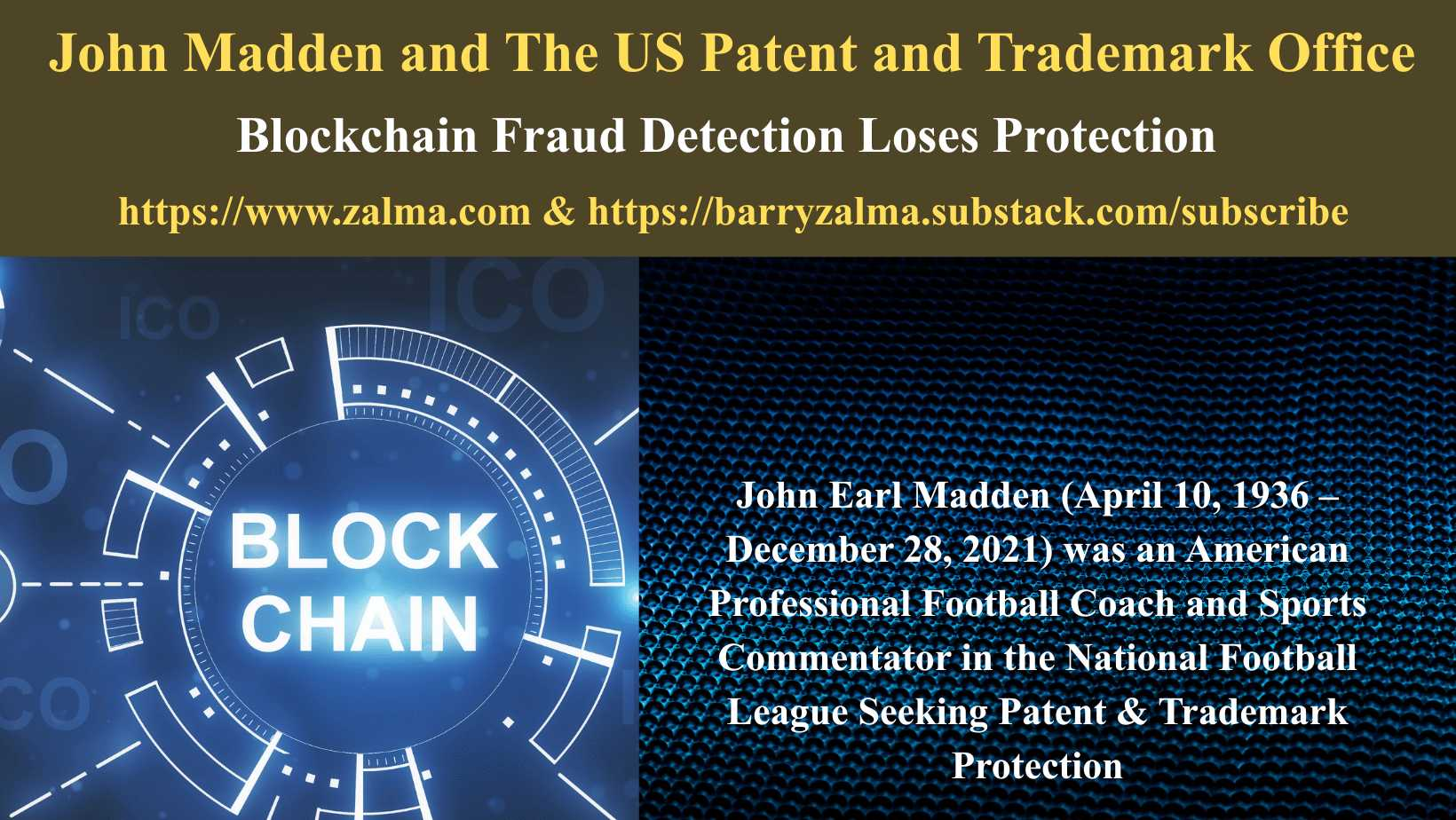
Blockchain Fraud Detection Loses Protection
Posted on October 22, 2026 by Barry Zalma
John Earl Madden (April 10, 1936 – December 28, 2021) was an American Professional Football Coach and Sports Commentator in the National Football League Seeking Patent & Trademark Protection
BLOCKCHAIN FRAUD
Mr. Madden was more than football. He was working to establish a program called “Fraud Protection Systems, Methods, and Computer Programs for Blockchain Financial Transactions.”
In Ex parte John Madden, Appeal 2026-001497, Application 18/495,506, Technology Center 3600, United States Patent and Trademark Office, Patent Trial and Appeal Board (October 14, 2026)
The Examiner rejected claims several numbered claims under 35 U.S.C. § 101 as directed to an abstract idea without significantly more.
THE LAW
Section 101 makes patentable any new and useful process, machine, manufacture, or composition of matter.Laws of nature, natural phenomena, and abstract ideas are implicitly excluded.
THE PATENT TRIAL AND ...
Sovereign Immunity Defeats Suit Against Police Officers
Post 4866
Posted on October 21, 2026 by Barry Zalma
In Chad Lightfoot, et al. v. Progressive Direct Insurance Company, et al., Civil Action No. 26-434, United States District Court, E.D. Louisiana (October 9, 2026) Chad Lightfoot was involved in an Orleans Parish automobile accident in 2011 and filed claims with several insurers, including Progressive.
After a related civil dispute, Progressive counsel allegedly submitted a false affidavit stating that Lightfoot had fraudulently received a $50,000 payment. A New Orleans police detective relied on the affidavit to obtain an arrest warrant, and Louisiana State Police Lieutenant Alan Arcana allegedly reported that Lightfoot had received the payment. Lightfoot was arrested in 2015 and charged with theft, insurance fraud, and perjury.
Plaintiffs alleged that no record of the payment existed and that the criminal charges were dismissed on October 15, 2024.
Lightfoot and Geralyn Hawkins filed suit in October 2025 and ...