

Posted on March 30, 2026 by Barry Zalma
Insurance Fraud, a Way to Reduce Violent Crime
Post number 5313
A Fictionalized True Crime Story of Insurance Fraud from an Expert who explains why Insurance Fraud is a “Heads I Win, Tails You Lose” situation for Insurers. The story helps to Understand How Insurance Fraud in America is Costing Everyone who Buys Insurance Thousands of Dollars Every year and Why Insurance Fraud is Safer and More Profitable for the Perpetrators than any Other Crime.
She Taught Her Customers The Swoop And Squat:
Recently the California Insurance Department’s Fraud Division arrested a young woman in Los Angeles County for operating an insurance fraud school. She advertised her classes in the “Penny Saver” an advertising sheet distributed free to the public and a print version of Facebook, X Craig’s list. She had operated for several years teaching methods of committing automobile insurance fraud. Only after a police officer enrolled in one of her classes was she arrested.
Her defense counsel suggested that she admit the school existed but that she had no criminal intent. It was her intent only to reduce violent crime in her neighborhood.
The teacher lived in a Latino barrio in East Los Angeles. An area racked with violent crime and gangs. The teacher would testify that robbers shot a close relative in the armed robbery of a convenience store. She felt helpless to change this situation.
She learned, as a result of an automobile accident, the ease with which her claim was paid. She recovered more money than she expected from the insurer with ease. They never verified any of her claims.
She became a student of insurance. She visited the local library and read everything she could. She applied for, and obtained a job as trainee adjuster. She learned to investigate claims. She learned that claims investigations required little effort.
With the knowledge she gained from her reading and employment with an insurer she started her school. The school would teach gang-bangers that robbing convenience stores was dangerous. Store owners shot back. Police tracked down and arrested armed robbers. The police showed no interest in insurance fraud. The money is easy and the work is safe.
She believed, correctly, that if a gang-banger learned how easy it was to steal from an insurance company he would never take the risk of robbing a convenience store or mugging innocent individuals. Every Tuesday and Thursday, she would gather thirty people in her living room and impart her insurance knowledge. She never, personally, participated in insurance fraud. She merely taught people how to do it.
She gathered names of physicians and chiropractors working in the barrio. These health care professionals had no qualms about producing false and fraudulent medical reports. They only wanted the face amount of the billing. She got from her fellow adjusters the names of attorneys who would not ask questions when claimants would appear in their office five times a year. For one third of the recovery they filed suit against anyone.
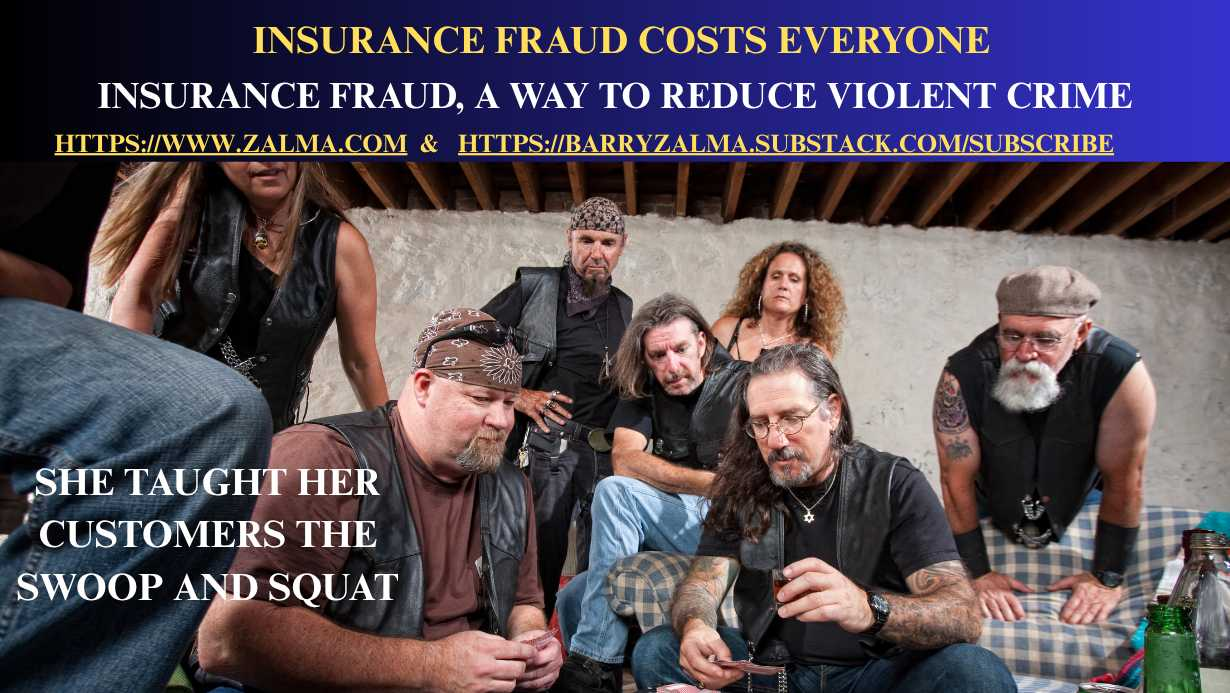
She taught her customers the swoop and squat:
a car with four passengers pulls in front of a Mercedes or Lincoln, stops short and is rear-ended. All four occupants of the vehicle make claim against the owner of the Mercedes for soft tissue injuries. She explained the uninsured motorist fraud where the claimant’ dents his vehicle by backing into a building or tree. The claimant then reports a hit and run automobile accident to his insurer.
She taught her students how to work together. One plays the insured and the other plays the claimant. She preached it was safer to switch roles regularly. She taught her classes how to pursue a slip and fall claim against a grocery or restaurant.
She taught it was important that before they fall there must be a spilled liquid to slip on.
She did role playing with each of her students. She helped them become familiar with the methods by which adjusters take recorded statements. She explained to each of her students that they should never lie to an adjuster. She explained that absolute truth was required. Only the facts of the accident and the injuries can be fabricated.
She taught each of the appropriate symptoms for a cervical sprain and a lumbosacral sprain or strain.
She explained to each of them the physical therapy that they must describe receiving [even though they would never receive any physical therapy] to convince the adjuster that they had treated with the doctor.
She taught how to negotiate with the adjuster and make the adjuster feel confident. She explained that if they could settle with the adjuster they would keep more of the fruits of the crime.
Her lessons were effective. She trained hundreds of gang bangers to be insurance claimants. All of them made a good living from insurance fraud. They found no reason to commit violent crimes. From the time her class started until her arrest the violent crime rate in the barrio went down twenty percent. Automobile insurance fraud, unknown to the defrauded insurers, in the barrio went up forty percent. The teacher was doing a service for her community. She charged her students for this service, but only enough to pay her rent and survive. She did not become wealthy from the school for insurance fraud. She believes she saved the lives of many convenience store clerks and gang bangers.
At her trial she explained to the judge and jury that she believed the court should honor her for her efforts to reduce violent crime. Punishment for preventing violent crimes, she argued, is inappropriate.
The argument was a good one but the judge applied the law and the teacher was sentenced to spend the next five years in state prison. Her students continue to make a good living making false insurance claims.
Adapted from my book “Insurance Fraud Costs Everyone” Available as a Kindle Book and Available as a Paperback
(c) 2026 Barry Zalma & ClaimSchool, Inc.
Please tell your friends and colleagues about this blog and the videos and let them subscribe to the blog and the videos.
Subscribe to my substack at https://barryzalma.substack.com/subscribe
Go to X @bzalma; Go to Barry Zalma videos at Rumble.com at https://rumble.com/account/content?type=all; Go to Barry Zalma on YouTube- https://www.youtube.com/channel/UCysiZklEtxZsSF9DfC0Expg; Go to the InsuranceClaims Library – https://lnkd.in/gwEYk.
Insurance Expert May Not Testify to Speculative and Contains Unsupported Conclusions.
Posted on September 18, 2026 by Barry Zalma
See the full video at and at https://rumble.com/v7fmifw-expert-may-only-testify-to-what-experience-supports.html
In Michele A. Over, and The Estate Of Paul R. Over v. State Farm Mutual Automobile Insurance Company, and State Farm Fire And Casualty Company, Civil Action No. 23-cv-02243-PAB-STV, United States District Court, D. Colorado (September 14, 2026) Michele and Paul Over sued State Farm Fire and State Farm Auto over hail-damage and stolen-vehicle claims.
The operative dispute concerned State Farm Auto’s motion to exclude or limit opinions from plaintiffs’ insurance-industry expert, Aaron Castillo. Castillo.
Law
The proponent of expert testimony must establish by a preponderance of the evidence that an expert is qualified and that the opinions are helpful, sufficiently grounded, and reliably derived and applied. Experience-based opinions must explain how the...
150 Months in Prison for Tax Fraud
Post 4846
Posted on September 17, 2026 by Barry Zalma
See the full video at https://lnkd.in/g8rh3JBX and https://lnkd.in/gmkdy-9C, In United States Of America v. Thomas Addaquay, Nos. 25-10609, 25-10611, United States Court of Appeals, Eleventh Circuit (September 9, 2026) the Eleventh Circuit affirmed all challenged convictions, the 150-month aggregate sentence, and the challenged $4,123,474.55 restitution award.
FACTS
In United States Of America v. Thomas Addaquay, United States Of America v. Thomas Addaquay, Nos. 25-10609, 25-10611, United States Court of Appeals, Eleventh Circuit (September 9, 2026) the Eleventh Circuit affirmed all challenged convictions, the 150-month aggregate sentence, and the challenged $4,123,474.55 restitution award.
FACTS
Thomas Addaquay controlled United Consolidated Accounting and Business Services (UC), nominally a check-cashing business.
The government proved a three-stage tax-refund scheme that converted the resulting refund checks into usable funds through ...
Major Fraud Perpetrator Asserts Fifth Amendment Privilege to Avoid Prosecution
Post 5489
Posted on September 14, 2026 by Barry Zalma
Fraudster Refuses to Answer Questions About His Alleged Fraud
See the full video at https://lnkd.in/gvicAMDr and at https://lnkd.in/gvicAMDr
In Great American Insurance Co. v. Gemstone Property Management, LLC, et al., No. 23-cv-9100 (LJL), United States District Court, S.D. New York (September 8, 2026) Great American Insurance Company alleged that it was defrauded through a scheme in which Subin Associates, LLP recruited individuals to stage construction-site injuries, arranged unnecessary medical treatment and litigation funding, and pursued fraudulent personal-injury claims.
Luis Manuel Garcia Salcedo, resulted in a $6 million settlement. Non-party Jose Hernandez allegedly worked as an assistant manager at Subin, operated Hernandez Associates, and owned litigation-funding companies that shared office space with Subin and provided services to its clients.
After Great American ...
Blockchain Fraud Detection Loses Protection
Posted on October 22, 2026 by Barry Zalma
John Earl Madden (April 10, 1936 – December 28, 2021) was an American Professional Football Coach and Sports Commentator in the National Football League Seeking Patent & Trademark Protection
BLOCKCHAIN FRAUD
Mr. Madden was more than football. He was working to establish a program called “Fraud Protection Systems, Methods, and Computer Programs for Blockchain Financial Transactions.”
In Ex parte John Madden, Appeal 2026-001497, Application 18/495,506, Technology Center 3600, United States Patent and Trademark Office, Patent Trial and Appeal Board (October 14, 2026)
The Examiner rejected claims several numbered claims under 35 U.S.C. § 101 as directed to an abstract idea without significantly more.
THE LAW
Section 101 makes patentable any new and useful process, machine, manufacture, or composition of matter.Laws of nature, natural phenomena, and abstract ideas are implicitly excluded.
THE PATENT TRIAL AND ...
Sovereign Immunity Defeats Suit Against Police Officers
Post 4866
Posted on October 21, 2026 by Barry Zalma
In Chad Lightfoot, et al. v. Progressive Direct Insurance Company, et al., Civil Action No. 26-434, United States District Court, E.D. Louisiana (October 9, 2026) Chad Lightfoot was involved in an Orleans Parish automobile accident in 2011 and filed claims with several insurers, including Progressive.
After a related civil dispute, Progressive counsel allegedly submitted a false affidavit stating that Lightfoot had fraudulently received a $50,000 payment. A New Orleans police detective relied on the affidavit to obtain an arrest warrant, and Louisiana State Police Lieutenant Alan Arcana allegedly reported that Lightfoot had received the payment. Lightfoot was arrested in 2015 and charged with theft, insurance fraud, and perjury.
Plaintiffs alleged that no record of the payment existed and that the criminal charges were dismissed on October 15, 2024.
Lightfoot and Geralyn Hawkins filed suit in October 2025 and ...
A Suit Filed Before the Claim Exists is Fatal
Post 4870
Posted on October 20, 2026 by Barry Zalma
In Louis Briggs v. Shaun Wimberly; Somerset Services, Inc.; And Wimberly & Associates, PLLC, and Louis Briggs v. Shaun Wimberly And Wimberly & Associates, PLLC Nos. 2024-CA-1471-MR, 2025-CA-1366-MR, Court of Appeals of Kentucky (October 9, 2026) Louis Briggs was arrested in 2014 after an incident with police and charged with several offenses, including third-degree assault.
Probable cause was found and an indictment was returned, but the charges were eventually dismissed. His attorney, Shaun Wimberly, then filed a federal civil rights suit for Briggs in a United States district court, which also asserted state-law claims. The district court dismissed most of the claims and declined to exercise jurisdiction over the remaining state-law claims. Briggs blamed Wimberly for the result, fired him, and appealed to the Sixth Circuit.
While the federal appeal was pending, Briggs filed a legal malpractice action against Wimberly in the Jefferson Circuit Court. The Sixth ...