
Bad Faith Suit Requires Specificity About What Was Unfair
Pro Se Plaintiff Needed a Lawyer
Post number 5292
See the video at https://lnkd.in/gEZFNq38 and at https://lnkd.in/gZXMPDRb, and at https://zalma.com/blog plus more than 5250.
In Sean Shurelds v. SAFECO Insurance Company of America, a/k/a Liberty Mutual, Civil Action No. 25-cv-1550, United States District Court, E.D. Pennsylvania (February 11, 2026) Plaintiff Sean Shurelds, acting pro se, filed suit against Safeco Insurance Company of America alleging bad faith insurance practices, fraudulent misrepresentation, and negligence with the USDC giving him several attempts to sufficiently allege facts to state a cause against SAFECO.
Shurelds had purchased a landlord protection policy for his Philadelphia property, which was in effect from November 28, 2023, to November 28, 2024. After his tenant abandoned the property and unauthorized occupants caused extensive damage, Shurelds submitted five insurance claims to Safeco. Safeco denied all of these claims, citing the damage as normal wear and tear. One claim was referred to law enforcement for alleged insurance fraud.
Law
The legal dispute centers on claims of statutory bad faith insurance practices under Pennsylvania law. Shurelds’ original complaint included additional claims for fraudulent misrepresentation and negligence, which were dismissed with prejudice by the court.
The case proceeded with only the statutory bad faith claim, and later Shurelds sought to add claims for emotional distress and slander; only these two were permitted to proceed. Ultimately, Shurelds filed a Second Amended Complaint asserting eight claims, but none for emotional distress or slander.
Discussion
Safeco moved to dismiss all claims in the Second Amended Complaint. The court reviewed the factual history, including the timeline of Shurelds’ insurance claims and Safeco’s responses. The court noted that Safeco’s denial of the claims was based on its assessment that the property damage resulted from normal wear and tear, not covered losses. The referral of one claim to a detective for suspected insurance fraud further complicated the dispute.
Analysis
The court found that Shurelds failed to state viable claims beyond statutory bad faith, and even that claim was insufficiently supported by facts.
To survive a motion to dismiss, a complaint must include sufficient factual matter, taken as true, to show that the claim is facially plausible. A claim has facial plausibility when the plaintiff pleads factual content that allows the court to draw the reasonable inference that the defendant is liable for the misconduct alleged.
Under Pennsylvania law, a party may recover certain damages if an insurer acted in bad faith. To establish a bad faith insurance claim under section 8371, a plaintiff must establish by clear and convincing evidence, (1) the insurer did not have a reasonable basis for denying benefits under the policy, and (2) that the insurer knew or recklessly disregarded its lack of a reasonable basis in denying the claim.
A plaintiff cannot merely say that an insurer acted unfairly but instead must describe with specificity what was unfair.
The Court gave Shurelds multiple opportunities to amend his complaint. Despite these opportunities, he has not raised anything suggesting a cognizable claim. Accordingly, the Court found that allowing any additional amendments is futile.
The court granted Safeco’s motion to dismiss in its entirety, dismissing the Second Amended Complaint with prejudice.
The decision underscores the importance of providing specific factual allegations and legal grounds when asserting insurance bad faith and related claims in federal court.
ZALMA OPINION
It has become axiomatic that a person not a lawyer who represents himself in litigation has a fool for a client. In this case, the USDC, trying to help the Plaintiff, gave him several attempts to amend the complaint to allege with sufficient specificity a viable bad faith claim. He failed and with patience of the USDC was exhausted and the case dismissed.
(c) 2026 Barry Zalma & ClaimSchool, Inc.
Please tell your friends and colleagues about this blog and the videos and let them subscribe to the blog and the videos.
Subscribe to my substack at https://barryzalma.substack.com/subscribe
Go to X @bzalma; Go to Barry Zalma videos at Rumble.com at https://rumble.com/account/content?type=all; Go to Barry Zalma on YouTube- https://www.youtube.com/channel/UCysiZklEtxZsSF9DfC0Expg; Go to the InsuranceClaims Library – https://lnkd.in/gwEYk.
Insurance Expert May Not Testify to Speculative and Contains Unsupported Conclusions.
Posted on September 18, 2026 by Barry Zalma
See the full video at and at https://rumble.com/v7fmifw-expert-may-only-testify-to-what-experience-supports.html
In Michele A. Over, and The Estate Of Paul R. Over v. State Farm Mutual Automobile Insurance Company, and State Farm Fire And Casualty Company, Civil Action No. 23-cv-02243-PAB-STV, United States District Court, D. Colorado (September 14, 2026) Michele and Paul Over sued State Farm Fire and State Farm Auto over hail-damage and stolen-vehicle claims.
The operative dispute concerned State Farm Auto’s motion to exclude or limit opinions from plaintiffs’ insurance-industry expert, Aaron Castillo. Castillo.
Law
The proponent of expert testimony must establish by a preponderance of the evidence that an expert is qualified and that the opinions are helpful, sufficiently grounded, and reliably derived and applied. Experience-based opinions must explain how the...
150 Months in Prison for Tax Fraud
Post 4846
Posted on September 17, 2026 by Barry Zalma
See the full video at https://lnkd.in/g8rh3JBX and https://lnkd.in/gmkdy-9C, In United States Of America v. Thomas Addaquay, Nos. 25-10609, 25-10611, United States Court of Appeals, Eleventh Circuit (September 9, 2026) the Eleventh Circuit affirmed all challenged convictions, the 150-month aggregate sentence, and the challenged $4,123,474.55 restitution award.
FACTS
In United States Of America v. Thomas Addaquay, United States Of America v. Thomas Addaquay, Nos. 25-10609, 25-10611, United States Court of Appeals, Eleventh Circuit (September 9, 2026) the Eleventh Circuit affirmed all challenged convictions, the 150-month aggregate sentence, and the challenged $4,123,474.55 restitution award.
FACTS
Thomas Addaquay controlled United Consolidated Accounting and Business Services (UC), nominally a check-cashing business.
The government proved a three-stage tax-refund scheme that converted the resulting refund checks into usable funds through ...
Major Fraud Perpetrator Asserts Fifth Amendment Privilege to Avoid Prosecution
Post 5489
Posted on September 14, 2026 by Barry Zalma
Fraudster Refuses to Answer Questions About His Alleged Fraud
See the full video at https://lnkd.in/gvicAMDr and at https://lnkd.in/gvicAMDr
In Great American Insurance Co. v. Gemstone Property Management, LLC, et al., No. 23-cv-9100 (LJL), United States District Court, S.D. New York (September 8, 2026) Great American Insurance Company alleged that it was defrauded through a scheme in which Subin Associates, LLP recruited individuals to stage construction-site injuries, arranged unnecessary medical treatment and litigation funding, and pursued fraudulent personal-injury claims.
Luis Manuel Garcia Salcedo, resulted in a $6 million settlement. Non-party Jose Hernandez allegedly worked as an assistant manager at Subin, operated Hernandez Associates, and owned litigation-funding companies that shared office space with Subin and provided services to its clients.
After Great American ...
Plaintiff’s Reading of the Policy is Plaintiff’s Reasonable Allegations
Posted on October 19, 2026 by Barry Zalma
Post 4868
CLASS ACTION THAT STATES A SIMPLE CLEAR AND PLAUSIBLE CAUSE OF ACTION SURVIVES
In Sheila Marino v. Farmers New World Life Insurance Company, No. 2:25-cv-02200-JNW, United States District Court, W.D. Washington, Seattle (October 13, 2026) defendant Farmers New World Life Insurance Company’s (“FNWL”) moved to dismiss Plaintiff Sheila Marino’s putative class action involving flexible universal life insurance.
Marino filed a putative class action in King County Superior Court alleging: (1) breach of contract, (2) breach of the implied covenant of good faith and fair dealing, and (3) violation of the Washington Consumer Protection Act (CPA).
She pleaded two theories: an “overcharge” theory and an “underpayment of interest” theory asked the Court to take judicial notice of historical Federal Funds Effective Rates.
THE LAW
Pleading Standard.
To survive a Rule 12(b)(6) motion, a ...

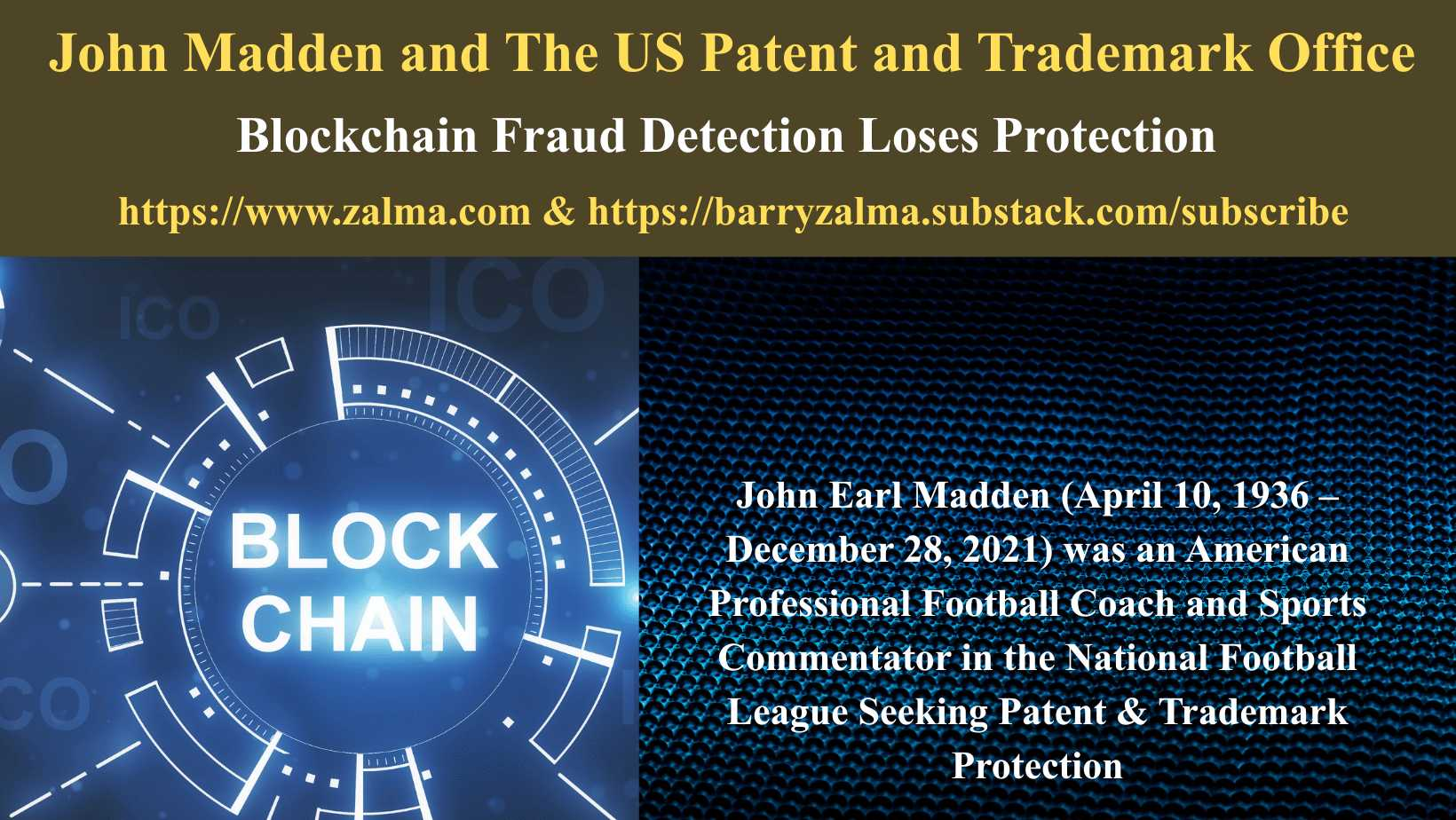
Blockchain Fraud Detection Loses Protection
Posted on October 22, 2026 by Barry Zalma
John Earl Madden (April 10, 1936 – December 28, 2021) was an American Professional Football Coach and Sports Commentator in the National Football League Seeking Patent & Trademark Protection
BLOCKCHAIN FRAUD
Mr. Madden was more than football. He was working to establish a program called “Fraud Protection Systems, Methods, and Computer Programs for Blockchain Financial Transactions.”
In Ex parte John Madden, Appeal 2026-001497, Application 18/495,506, Technology Center 3600, United States Patent and Trademark Office, Patent Trial and Appeal Board (October 14, 2026)
The Examiner rejected claims several numbered claims under 35 U.S.C. § 101 as directed to an abstract idea without significantly more.
THE LAW
Section 101 makes patentable any new and useful process, machine, manufacture, or composition of matter.Laws of nature, natural phenomena, and abstract ideas are implicitly excluded.
THE PATENT TRIAL AND ...
Sovereign Immunity Defeats Suit Against Police Officers
Post 4866
Posted on October 21, 2026 by Barry Zalma
In Chad Lightfoot, et al. v. Progressive Direct Insurance Company, et al., Civil Action No. 26-434, United States District Court, E.D. Louisiana (October 9, 2026) Chad Lightfoot was involved in an Orleans Parish automobile accident in 2011 and filed claims with several insurers, including Progressive.
After a related civil dispute, Progressive counsel allegedly submitted a false affidavit stating that Lightfoot had fraudulently received a $50,000 payment. A New Orleans police detective relied on the affidavit to obtain an arrest warrant, and Louisiana State Police Lieutenant Alan Arcana allegedly reported that Lightfoot had received the payment. Lightfoot was arrested in 2015 and charged with theft, insurance fraud, and perjury.
Plaintiffs alleged that no record of the payment existed and that the criminal charges were dismissed on October 15, 2024.
Lightfoot and Geralyn Hawkins filed suit in October 2025 and ...