

A Claim by Any Other Name is not a Claim
Post 5182
It is Imperative that Insured Report Potential Claim to Insurers
Read the full article at https://lnkd.in/gfbwAsxw, See the full video at https://lnkd.in/gea_hgB3 and at https://lnkd.in/ghZ7gjxy, and at https://zalma.com/blog plus more than 5150 posts.
In Jeffrey B. Scott v. Certain Underwriters At Lloyd’s, London, Subscribing To Policy No. B0901li1837279, RLI Insurance Company, Certain Underwriters At Lloyds, London And The Insurance Company, Subscribing To Policy No. B0180fn2102430, No. 24-12441, United States Court of Appeals, Eleventh Circuit (August 25, 2025) the court explained the need for a claim to obtain coverage.
Case Background:
This appeal arises from a coverage dispute under a Directors & Officers (D&O) insurance policy. Jeffrey B. Scott, the plaintiff-appellant, was terminated from his role as CEO, President, and Secretary of Gemini Financial Holdings, LLC in October 2019. Following his termination, Scott threatened legal action against Gemini, and Gemini sent him letters accusing him of misconduct and demanding the return of company property.
Insurance Policy:
The D&O insurance policy issued by Underwriters at Lloyd’s, London, provides coverage for directors, officers, and managers of Gemini. The policy defines a “Claim” as a “written demand for monetary damages, non-monetary, or injunctive relief against any of the Insureds”. It also provides coverage if the Chief Executive Officer, Chief Financial Officer, or Chief Actuary (or equivalent position) of the company gives “notice of circumstances . . . that may reasonably be expected to give rise” to a claim.
Legal Dispute:
Scott submitted a letter to Lloyd’s on November 23, 2019, entitled “Notice of Claim,” enclosing Gemini’s letters. Lloyd’s denied coverage, determining that no “Claim” against Scott had been made under the policy. Scott sued Lloyd’s for insurance coverage, but the district court dismissed the case. Scott’s arguments included that his documents reflected a “claim” or a “notice of circumstances” for a future claim.
Legal Principles:
In diversity cases arising under Florida law, a federal court is bound by the law articulated by the Florida Supreme Court. Unambiguous policy terms are interpreted according to their plain meaning as written.
If the Florida Supreme Court has not spoken on an issue, Florida District Court of Appeals decisions control absent persuasive indication that the Florida Supreme Court would rule otherwise. As a matter of Florida law, unambiguous policy terms are interpreted according to their plain meaning as written.
The letters cited by Scott do not contain a demand for relief against him. They explain why, in Gemini’s view, Scott was terminated and request that he preserve documents and return company equipment. The letters Gemini sent do not request monetary payment or legal remedies. Instead, they assert a cause for Scott’s termination and outline expectations for his post-employment conduct. Viewed in the light most favorable to Scott, these letters are anticipatory posturing for a future dispute-an intention to “[review] certain workplace conduct by [Scott].” But they are not present demands for relief.
Scott’s November 2019 letter did not identify circumstances that would lead to a claim against him. Instead, it mostly reflects his demands against Gemini over a putative wrongful termination. Scott was not one of the specified officers who could provide a notice of circumstances under the policy when he sent his November letter.
The district court correctly rejected Scott’s arguments that his documents reflected a “claim,” or, in the alternative, a “notice of circumstances” for a future claim.
Court’s Decision:
The district court held that no “Claim” as defined in the policy was made against Scott during the policy period and that Scott did not provide a “notice of circumstances” to trigger coverage. The court also noted that the letters from Gemini did not request monetary payment or legal remedies but instead asserted a cause for Scott’s termination and outlined expectations for his post-employment conduct. The Eleventh Circuit affirmed the USDC.
ZALMA OPINION
Insurance is nothing more than a contract like any other contract. It is interpreted by dealing with the usual meaning of the words used. Letters accusing a fired CEO of misconduct and demanding the return of company property was not a claim nor was the fired CEO’s request for detail was a “claim” as defined by the policy. The threat, if made to an intelligent corporate officer or insurance consultant should have resulted in a potential “claim” but the insured did not advise the insurers of the potential claim.
(c) 2025 Barry Zalma & ClaimSchool, Inc.
Please tell your friends and colleagues about this blog and the videos and let them subscribe to the blog and the videos.
Subscribe to my substack at https://barryzalma.substack.com/subscribe
Go to X @bzalma; Go to Barry Zalma videos at Rumble.com at https://rumble.com/account/content?type=all; Go to Barry Zalma on YouTube- https://www.youtube.com/channel/UCysiZklEtxZsSF9DfC0Expg; Go to the Insurance Claims Library – https://lnkd.in/gwEYk.
Insurance Expert May Not Testify to Speculative and Contains Unsupported Conclusions.
Posted on September 18, 2026 by Barry Zalma
See the full video at and at https://rumble.com/v7fmifw-expert-may-only-testify-to-what-experience-supports.html
In Michele A. Over, and The Estate Of Paul R. Over v. State Farm Mutual Automobile Insurance Company, and State Farm Fire And Casualty Company, Civil Action No. 23-cv-02243-PAB-STV, United States District Court, D. Colorado (September 14, 2026) Michele and Paul Over sued State Farm Fire and State Farm Auto over hail-damage and stolen-vehicle claims.
The operative dispute concerned State Farm Auto’s motion to exclude or limit opinions from plaintiffs’ insurance-industry expert, Aaron Castillo. Castillo.
Law
The proponent of expert testimony must establish by a preponderance of the evidence that an expert is qualified and that the opinions are helpful, sufficiently grounded, and reliably derived and applied. Experience-based opinions must explain how the...
150 Months in Prison for Tax Fraud
Post 4846
Posted on September 17, 2026 by Barry Zalma
See the full video at https://lnkd.in/g8rh3JBX and https://lnkd.in/gmkdy-9C, In United States Of America v. Thomas Addaquay, Nos. 25-10609, 25-10611, United States Court of Appeals, Eleventh Circuit (September 9, 2026) the Eleventh Circuit affirmed all challenged convictions, the 150-month aggregate sentence, and the challenged $4,123,474.55 restitution award.
FACTS
In United States Of America v. Thomas Addaquay, United States Of America v. Thomas Addaquay, Nos. 25-10609, 25-10611, United States Court of Appeals, Eleventh Circuit (September 9, 2026) the Eleventh Circuit affirmed all challenged convictions, the 150-month aggregate sentence, and the challenged $4,123,474.55 restitution award.
FACTS
Thomas Addaquay controlled United Consolidated Accounting and Business Services (UC), nominally a check-cashing business.
The government proved a three-stage tax-refund scheme that converted the resulting refund checks into usable funds through ...
Major Fraud Perpetrator Asserts Fifth Amendment Privilege to Avoid Prosecution
Post 5489
Posted on September 14, 2026 by Barry Zalma
Fraudster Refuses to Answer Questions About His Alleged Fraud
See the full video at https://lnkd.in/gvicAMDr and at https://lnkd.in/gvicAMDr
In Great American Insurance Co. v. Gemstone Property Management, LLC, et al., No. 23-cv-9100 (LJL), United States District Court, S.D. New York (September 8, 2026) Great American Insurance Company alleged that it was defrauded through a scheme in which Subin Associates, LLP recruited individuals to stage construction-site injuries, arranged unnecessary medical treatment and litigation funding, and pursued fraudulent personal-injury claims.
Luis Manuel Garcia Salcedo, resulted in a $6 million settlement. Non-party Jose Hernandez allegedly worked as an assistant manager at Subin, operated Hernandez Associates, and owned litigation-funding companies that shared office space with Subin and provided services to its clients.
After Great American ...
Plaintiff’s Reading of the Policy is Plaintiff’s Reasonable Allegations
Posted on October 19, 2026 by Barry Zalma
Post 4868
CLASS ACTION THAT STATES A SIMPLE CLEAR AND PLAUSIBLE CAUSE OF ACTION SURVIVES
In Sheila Marino v. Farmers New World Life Insurance Company, No. 2:25-cv-02200-JNW, United States District Court, W.D. Washington, Seattle (October 13, 2026) defendant Farmers New World Life Insurance Company’s (“FNWL”) moved to dismiss Plaintiff Sheila Marino’s putative class action involving flexible universal life insurance.
Marino filed a putative class action in King County Superior Court alleging: (1) breach of contract, (2) breach of the implied covenant of good faith and fair dealing, and (3) violation of the Washington Consumer Protection Act (CPA).
She pleaded two theories: an “overcharge” theory and an “underpayment of interest” theory asked the Court to take judicial notice of historical Federal Funds Effective Rates.
THE LAW
Pleading Standard.
To survive a Rule 12(b)(6) motion, a ...

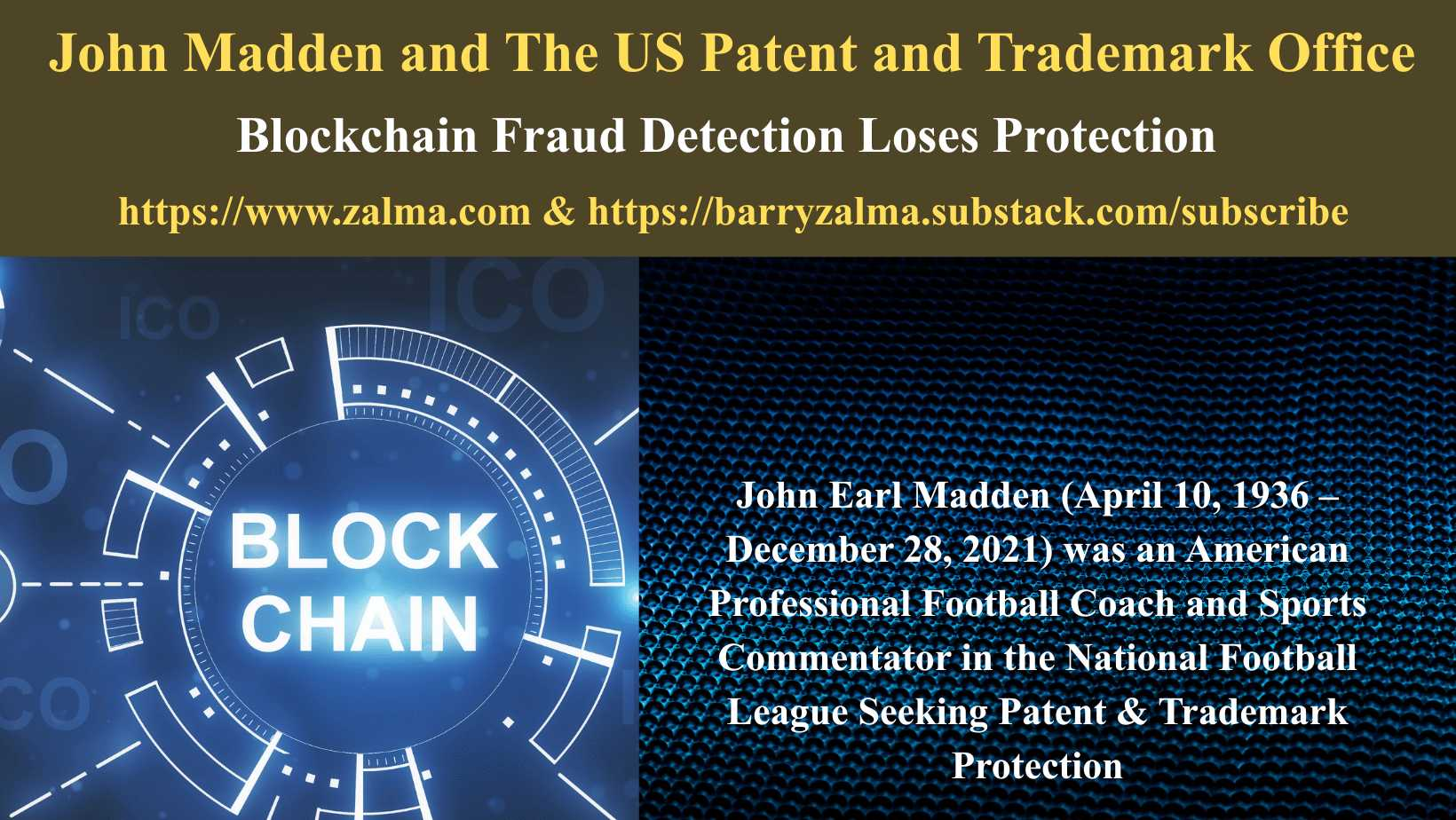
Blockchain Fraud Detection Loses Protection
Posted on October 22, 2026 by Barry Zalma
John Earl Madden (April 10, 1936 – December 28, 2021) was an American Professional Football Coach and Sports Commentator in the National Football League Seeking Patent & Trademark Protection
BLOCKCHAIN FRAUD
Mr. Madden was more than football. He was working to establish a program called “Fraud Protection Systems, Methods, and Computer Programs for Blockchain Financial Transactions.”
In Ex parte John Madden, Appeal 2026-001497, Application 18/495,506, Technology Center 3600, United States Patent and Trademark Office, Patent Trial and Appeal Board (October 14, 2026)
The Examiner rejected claims several numbered claims under 35 U.S.C. § 101 as directed to an abstract idea without significantly more.
THE LAW
Section 101 makes patentable any new and useful process, machine, manufacture, or composition of matter.Laws of nature, natural phenomena, and abstract ideas are implicitly excluded.
THE PATENT TRIAL AND ...
Sovereign Immunity Defeats Suit Against Police Officers
Post 4866
Posted on October 21, 2026 by Barry Zalma
In Chad Lightfoot, et al. v. Progressive Direct Insurance Company, et al., Civil Action No. 26-434, United States District Court, E.D. Louisiana (October 9, 2026) Chad Lightfoot was involved in an Orleans Parish automobile accident in 2011 and filed claims with several insurers, including Progressive.
After a related civil dispute, Progressive counsel allegedly submitted a false affidavit stating that Lightfoot had fraudulently received a $50,000 payment. A New Orleans police detective relied on the affidavit to obtain an arrest warrant, and Louisiana State Police Lieutenant Alan Arcana allegedly reported that Lightfoot had received the payment. Lightfoot was arrested in 2015 and charged with theft, insurance fraud, and perjury.
Plaintiffs alleged that no record of the payment existed and that the criminal charges were dismissed on October 15, 2024.
Lightfoot and Geralyn Hawkins filed suit in October 2025 and ...