

ACTUAL DAMAGES REQUIRED TO BREACH INSURANCE CONTRACT
Post 4972
Read the full article at https://lnkd.in/gNZ_-8UC, see the full video at https://lnkd.in/gvV2jrXj and at https://lnkd.in/g4B2WMZS and at https://zalma.com/blog plus more than 4950 posts.
Ira and Patricia Potovsky bought an insurance policy for long term care from Lincoln Benefit Life Company in 2002. They sued Lincoln after it denied them coverage. The district court dismissed the case because the complaint failed to allege damages.
Ira Potovsky; Patricia Potovsky v. Lincoln Benefit Life Company, No. 23-4130, United States Court of Appeals, Ninth Circuit (January 7, 2025) the Ninth Circuit applied the law.
BACKGROUND
The Potovskys’ policy covered “actual expenses incurred” for qualified long term care should one of them become “chronically ill”- which the policy defined as requiring “[s]ubstantial [s]upervision to protect [themselves] from threats to health and safety due to severe [c]ognitive [i]mpairment.” The policy only covered those who had been receiving qualifying care for ninety days or more and then submitted a claim for reimbursement.
Mrs. Potovsky began to experience mental decline in her eighties. Mr. Potovsky contacted Lincoln to begin filing a claim under the policy in September 2022, because he intended to hire a caregiver for Mrs. Potovsky. Out of caution, Mr. Potovsky first asked Lincoln for a determination of Mrs. Potovsky’s eligibility.
Lincoln denied the claim. In its denial letter, after summarizing the medical record, Lincoln determined: “The supervision does not rise to the level of Substantial Supervision secondary to severe Cognitive Impairment as per the policy definitions…. There is no clear indication that Ms. Potovsky requires supervision on a continuous basis ….
“While the medical documentation on file does support Ms. Potovsky has a Cognitive Impairment, there is nothing in the file to support the Cognitive Impairment is severe and requires Substantial Supervision. The claim will now be closed.”
Although the Potovskys internally appealed this denial, Lincoln’s decision was unchanged.
The Potovskys filed suit. The district court predicted “[t]he breach of contract claim ultimately may be better suited as an anticipatory breach claim, which the plaintiff’s opposition seems to suggest.” The Potovskys added a claim for anticipatory breach to their original suit. They claimed that Lincoln’s denial confirmed it would not perform under the contract, and that this repudiation excused any lack of additional performance. Lincoln moved to dismiss again because the anticipatory breach lacked the element of damages. The district court granted dismissal with prejudice.
ANALYSIS
The elements of a cause of action for breach of contract are (1) the existence of the contract, (2) plaintiff’s performance or excuse for nonperformance, (3) defendant’s breach, and (4) the resulting damages to the plaintiff. In short, the Potovskys failed to allege any recoverable damages, an essential element of a breach of contract claim. Damages are an element that must be proved to prevail on the merits of a contract claim.
Damages excluded from coverage by an insurance policy are typically not within the contemplation of the parties. The Potovskys’ only alleged damages are in the form of home health care services that Mrs. Potovsky would have received had Lincoln acknowledged her entitlement to be reimbursed for supervised care or in the form of the care provided by Mr. Potovsky.
Care given by family members is expressly exempted from the policy’s coverage.
Lincoln’s denial letter and its course of conduct were not inconsistent with an intent to enforce the right to wait until expenses were actually incurred.
The Potovskys’ two other claims-bad faith and elder abuse-cannot prevail without a predicate breach of contract.
ZALMA OPINION
People, and some lawyers, forget that an insurance policy is a contract. In this case the breach of contract claim failed because the Potovskys’ incurred no damage because Mr. Potovsky wanted assurance (or didn’t have the funds) before spending money to care for Mrs. Potovsky. The Potovskys’ incurred no damages and could not, therefore, prove a breach of contract and claims of bad faith.
(c) 2025 Barry Zalma & ClaimSchool, Inc.
Please tell your friends and colleagues about this blog and the videos and let them subscribe to the blog and the videos.
Subscribe to my substack at https://barryzalma.substack.com/subscribe
Go to X @bzalma; Go to Newsbreak.com https://www.newsbreak.com/@c/1653419?s=01; Go to Barry Zalma videos at Rumble.com at https://rumble.com/account/content?type=all; Go to Barry Zalma on YouTube- https://www.youtube.com/channel/UCysiZklEtxZsSF9DfC0Expg
Go to the Insurance Claims Library – https://lnkd.in/gwEYk
Insurance Expert May Not Testify to Speculative and Contains Unsupported Conclusions.
Posted on September 18, 2026 by Barry Zalma
See the full video at and at https://rumble.com/v7fmifw-expert-may-only-testify-to-what-experience-supports.html
In Michele A. Over, and The Estate Of Paul R. Over v. State Farm Mutual Automobile Insurance Company, and State Farm Fire And Casualty Company, Civil Action No. 23-cv-02243-PAB-STV, United States District Court, D. Colorado (September 14, 2026) Michele and Paul Over sued State Farm Fire and State Farm Auto over hail-damage and stolen-vehicle claims.
The operative dispute concerned State Farm Auto’s motion to exclude or limit opinions from plaintiffs’ insurance-industry expert, Aaron Castillo. Castillo.
Law
The proponent of expert testimony must establish by a preponderance of the evidence that an expert is qualified and that the opinions are helpful, sufficiently grounded, and reliably derived and applied. Experience-based opinions must explain how the...
150 Months in Prison for Tax Fraud
Post 4846
Posted on September 17, 2026 by Barry Zalma
See the full video at https://lnkd.in/g8rh3JBX and https://lnkd.in/gmkdy-9C, In United States Of America v. Thomas Addaquay, Nos. 25-10609, 25-10611, United States Court of Appeals, Eleventh Circuit (September 9, 2026) the Eleventh Circuit affirmed all challenged convictions, the 150-month aggregate sentence, and the challenged $4,123,474.55 restitution award.
FACTS
In United States Of America v. Thomas Addaquay, United States Of America v. Thomas Addaquay, Nos. 25-10609, 25-10611, United States Court of Appeals, Eleventh Circuit (September 9, 2026) the Eleventh Circuit affirmed all challenged convictions, the 150-month aggregate sentence, and the challenged $4,123,474.55 restitution award.
FACTS
Thomas Addaquay controlled United Consolidated Accounting and Business Services (UC), nominally a check-cashing business.
The government proved a three-stage tax-refund scheme that converted the resulting refund checks into usable funds through ...
Major Fraud Perpetrator Asserts Fifth Amendment Privilege to Avoid Prosecution
Post 5489
Posted on September 14, 2026 by Barry Zalma
Fraudster Refuses to Answer Questions About His Alleged Fraud
See the full video at https://lnkd.in/gvicAMDr and at https://lnkd.in/gvicAMDr
In Great American Insurance Co. v. Gemstone Property Management, LLC, et al., No. 23-cv-9100 (LJL), United States District Court, S.D. New York (September 8, 2026) Great American Insurance Company alleged that it was defrauded through a scheme in which Subin Associates, LLP recruited individuals to stage construction-site injuries, arranged unnecessary medical treatment and litigation funding, and pursued fraudulent personal-injury claims.
Luis Manuel Garcia Salcedo, resulted in a $6 million settlement. Non-party Jose Hernandez allegedly worked as an assistant manager at Subin, operated Hernandez Associates, and owned litigation-funding companies that shared office space with Subin and provided services to its clients.
After Great American ...
Posted on November 20, 2026 by Barry Zalma
Probation Condition Must be Reasonably Directed at Curbing Future Criminality
Post 4584
While Probation Conditions Need Not Be Strictly Tied To The Precise Crime Committed, They Do Need To Be Reasonably Directed At Curbing The Defendant’s Future Criminality
In The People v. Nicolas Arpa, A174751, California Court of Appeals, First District, Third Division (November 19, 2026) Nicolas Arpa was charged in San Mateo County with five counts of insurance fraud, attempted grand theft by an employee or agent of $950 or more, grand theft by an employee or agent of $950 or more, and forgery.
He pled no contest to one count of insurance fraud (count 2) and to grand theft (count 5). His sentencing brief said he had suffered significant financial distress and felt remorse. It also said he no longer works in insurance and had made full restitution.
The trial court suspended the sentence and imposed two years of formal probation. One probation condition required him to abstain from using...
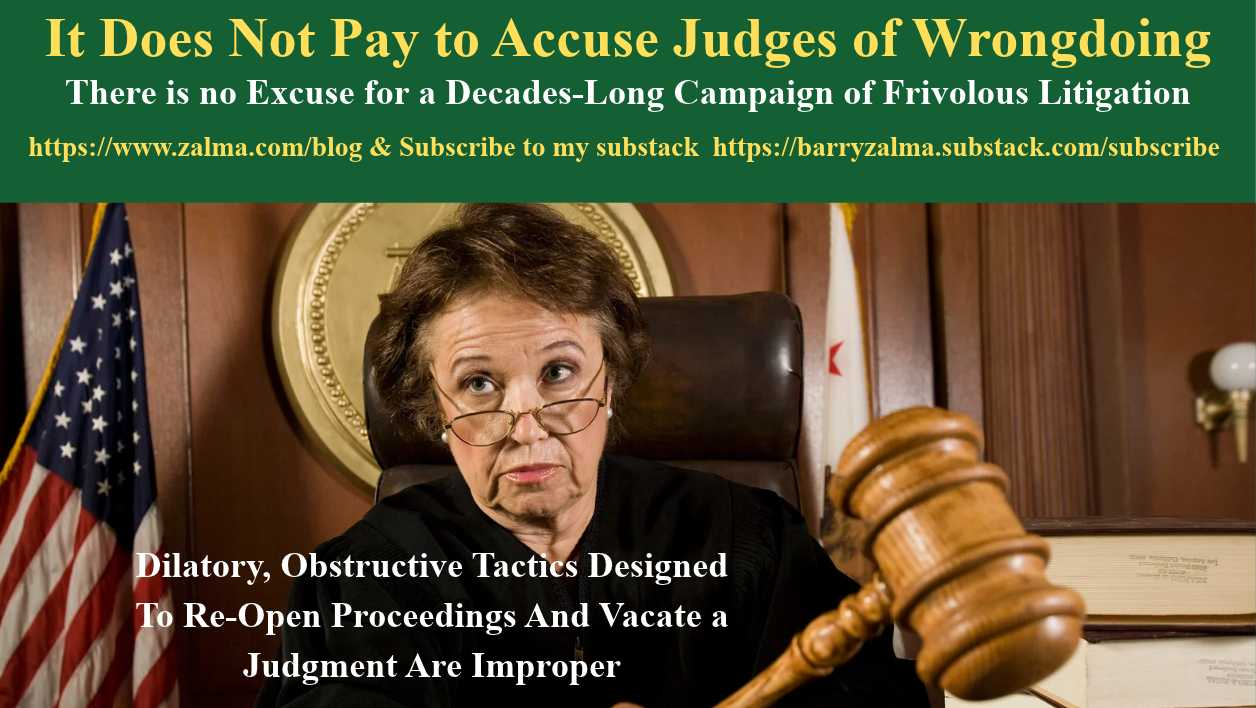
Dilatory, Obstructive Tactics Designed To Re-Open Proceedings And Vacate a Judgment Are Improper
Post 4583
In Three S Delaware, Inc. & Scott R. Steele v. Dataquick Information Systems, Inc. & Maxar Technologies, Inc., Civil Action No. 25-18991 (RK) (TJB), United States District Court, D. New Jersey (November 16, 2026) Three S Delaware (“3SD”) licensed real estate databases from a California company named DataQuick. A newly formed Delaware DataQuick bought the California DataQuick’s assets. The arbitrator later found that the sale included the 1996 license.
Delaware DataQuick sued 3SD in California. 3SD moved to compel arbitration and then counterclaimed. In May 2005, Steele and his counsel walked out of the merits hearing, and the arbitrator proceeded without them. He awarded about $6.17 million to DataQuick.
MARYLAND PROCEEDINGS:
The D. Md. (Judge Motz) confirmed the award, except for attorney’s fees. 3SD obtained a supersedeas bond of about $7.46 million from Federal Insurance Company. The Fourth Circuit affirmed in 2007.
Later ...
Insured’s Failure to Report Claim Before Expiration Defeats Claim
Post 4582
Posted on November 18, 2026 by Barry Zalma
In Diversified Restaurant Group, LLC, et al v. Houston Casualty Company, et al., No. 25-cv-02344-EMC, United States District Court, N.D. California (October 7, 2026) Diversified Restaurant Group and Golden Gate Bell (the “Insureds”) own or operate restaurants, including a Taco Bell in Antioch, California. Houston Casualty Company (HCC) issued them identical “claims made and reported” Employment Practices Liability (EPL) policies for 2022 and 2023. The 2022 policy ran from January 1, 2022 to January 1, 2023.
For the policy to apply, a covered claim had to be made during the policy period and reported to HCC within 30 days after it ended, which here was January 30, 2023. On about December 10, 2022, an underage employee reported alleged sexual misconduct.
On December 14, 2022, the employee’s counsel (Wilshire Law Firm) sent a letter to the Taco Bell. The letter referred to an “accident” on a stated date at a...