

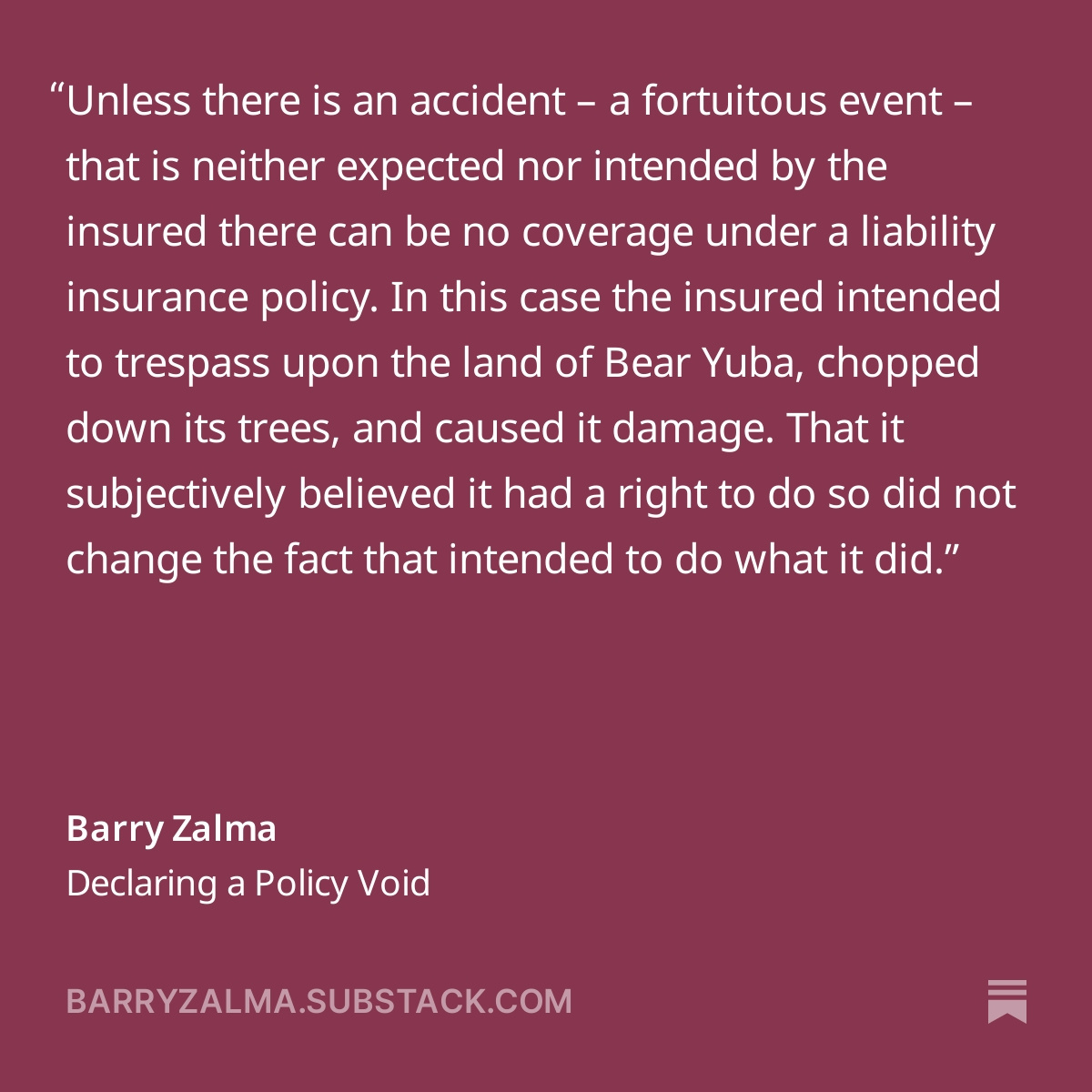
When a Policy Is Void
For Subscribers to Excellence in Claims Handling
You can Subscribe for only $5 a month to Excellence in Claims Handling at
https://barryzalma.substack.com/subscribe
A small portion of what was provided to subscribers.
In almost every policy of insurance, there is a clause declaring the policy void if the insured misrepresents or conceals material facts or commits fraud. For example:
We do not pay for bodily injury or property damage which is expected by, directed by, or intended by an insured. This exclusion does not apply to bodily injury that arises out of the use of reasonable force to protect people or property. (AAIS Form BP-200, (c) 1987 AAIS).
or:
This Coverage Form is void in any case of fraud by you at any time as it relates to this Coverage Form. It is also void if you or any other “insured,” at any time, intentionally conceal or misrepresent a material fact concerning: a. This Coverage Form; b. The covered “auto”; c. Your interest in the covered “auto”; or d. A claim under this Coverage Form. (Insurance Services Office form CA 00 01 01 87).
The policy wording requires that the insurer prove, not only that the insured misrepresented or concealed a material fact but must also prove that the insured did so with the intent to deceive.
Absent the rare confession it is often difficult to prove intentional deceit. The insured will usually claim that he or she was mistaken and had no intent to deceive. In more than 50 years of investigation of fraudulent insurance claims I only once received from an insured an under oath statement that the insured intentionally deceived the insurer and then, not in person, but by correcting false testimony in the transcript of an examination under oath.
If fraud or mutual mistake is an issue, insurers and insureds doing business in Oklahoma must resort to courts of general jurisdiction for a determination of contractual rights.[1] In Oklahoma, the Workers’ Compensation court does not have the right to rescind or declare a policy of Workers’ Compensation insurance void. However, where there is a misrepresentation with intent to deceive and the putative insured recognized the materiality of the misrepresentation the insurance policy is void from its inception.[2]
In Florida, Florida Statutes (2006), state in pertinent part: any insurance fraud shall void all coverage arising from the claim related to such fraud under the personal injury protection coverage of the insured person who committed the fraud.
In harmony with this statutory provision, the fraud provision in an insurance policy set forth: “any insurance fraud shall void all personal injury protection coverage arising from the claim with respect to the insured who committed the fraud” is appropriate and enforceable. [Bosem v. Commerce & Indus. Ins. Co., 35 So.3d 944 (Fla. App., 2010)]
Insurance Expert May Not Testify to Speculative and Contains Unsupported Conclusions.
Posted on September 18, 2026 by Barry Zalma
See the full video at and at https://rumble.com/v7fmifw-expert-may-only-testify-to-what-experience-supports.html
In Michele A. Over, and The Estate Of Paul R. Over v. State Farm Mutual Automobile Insurance Company, and State Farm Fire And Casualty Company, Civil Action No. 23-cv-02243-PAB-STV, United States District Court, D. Colorado (September 14, 2026) Michele and Paul Over sued State Farm Fire and State Farm Auto over hail-damage and stolen-vehicle claims.
The operative dispute concerned State Farm Auto’s motion to exclude or limit opinions from plaintiffs’ insurance-industry expert, Aaron Castillo. Castillo.
Law
The proponent of expert testimony must establish by a preponderance of the evidence that an expert is qualified and that the opinions are helpful, sufficiently grounded, and reliably derived and applied. Experience-based opinions must explain how the...
150 Months in Prison for Tax Fraud
Post 4846
Posted on September 17, 2026 by Barry Zalma
See the full video at https://lnkd.in/g8rh3JBX and https://lnkd.in/gmkdy-9C, In United States Of America v. Thomas Addaquay, Nos. 25-10609, 25-10611, United States Court of Appeals, Eleventh Circuit (September 9, 2026) the Eleventh Circuit affirmed all challenged convictions, the 150-month aggregate sentence, and the challenged $4,123,474.55 restitution award.
FACTS
In United States Of America v. Thomas Addaquay, United States Of America v. Thomas Addaquay, Nos. 25-10609, 25-10611, United States Court of Appeals, Eleventh Circuit (September 9, 2026) the Eleventh Circuit affirmed all challenged convictions, the 150-month aggregate sentence, and the challenged $4,123,474.55 restitution award.
FACTS
Thomas Addaquay controlled United Consolidated Accounting and Business Services (UC), nominally a check-cashing business.
The government proved a three-stage tax-refund scheme that converted the resulting refund checks into usable funds through ...
Major Fraud Perpetrator Asserts Fifth Amendment Privilege to Avoid Prosecution
Post 5489
Posted on September 14, 2026 by Barry Zalma
Fraudster Refuses to Answer Questions About His Alleged Fraud
See the full video at https://lnkd.in/gvicAMDr and at https://lnkd.in/gvicAMDr
In Great American Insurance Co. v. Gemstone Property Management, LLC, et al., No. 23-cv-9100 (LJL), United States District Court, S.D. New York (September 8, 2026) Great American Insurance Company alleged that it was defrauded through a scheme in which Subin Associates, LLP recruited individuals to stage construction-site injuries, arranged unnecessary medical treatment and litigation funding, and pursued fraudulent personal-injury claims.
Luis Manuel Garcia Salcedo, resulted in a $6 million settlement. Non-party Jose Hernandez allegedly worked as an assistant manager at Subin, operated Hernandez Associates, and owned litigation-funding companies that shared office space with Subin and provided services to its clients.
After Great American ...
ZIFL – Volume 30, Issue 20 Subscribe to ZIFL here https://lnkd.in/gfpn78FM
Posted on October 15, 2026 by Barry Zalma
THE SOURCE FOR THE INSURANCE FRAUD PROFESSIONAL
Zalma’s Insurance Fraud Letter (ZIFL) continues its 30th year of publication dedicated to those involved in reducing the effect of insurance fraud.
ZIFL is published 24 times a year is written by Barry Zalma.
It is provided FREE to anyone who visits the site at https://lnkd.in/gVT5G9s
Six Insane Fraud Schemes the Trump Administration Has Uncovered Stealing from the taxpayer has now become a multi-billion-dollar industry in America. Obamacare has been a magnet for scammers.
Florida Insurance Agent Pleads Guilty in $300,000 Premium Finance Scheme
Daniel Raney, 41, who managed Raney Insurance and Raney Ventures in Pensacola, was arrested after AFCO Direct.
RIFE WITH FRAUD ALLOWS DEMANDS TO ESTABLISH RESTITUTION
Six Insane Fraud Schemes the Trump Administration Has Uncovered
Stealing from the taxpayer has now become a multi-billion-dollar industry in America – and the ...
Sentence for Stealing from Veterans Administration Reasonably Considers State Insurance Fraud & Arson Convictions
Post 4863
Posted on October 14, 2026 by Barry Zalma
In United States Of America v. Anthony Curtis Brewer, No. 26-10745, United States Court of Appeals, Eleventh Circuit (October 8, 2026) Anthony Curtis Brewer became the fiduciary for an incapacitated recipient of Department of Veterans Affairs survivor benefits and agreed to use her funds solely for her care and support without commingling them with his own.
The VA determined that he misused $67,232.33 and removed him as fiduciary in 2022. Brewer pleaded guilty to theft of more than $1,000 in government property under 18 U.S.C. § 641. At sentencing, the district court attributed $53,567 in loss to him, producing an advisory Guidelines range of 15 to 21 months.
Citing the victim’s vulnerability, Brewer’s attempts to avoid responsibility, and his other fraudulent conduct — including state convictions for arson and insurance fraud — the court ...
Title Insurance Only Insures Real Property
Posted on October 13, 2026 by Barry Zalma
When a Seller Advised it Could Not Obtain Title to the Home Fraud Can’t be Proved
A Manufactured Home is Personal Property Until it Becomes Real Property
Post 4862
In Dale Johnson and Rose Johnson, Husband and Wife v. Stewart Title Guaranty Co., and Lennar Mortgage, LLC; Low Va Rates, LLC; Sandpoint Title Insurance, Inc.; Village Capital & Investment, LLC; and David Cassel, Engineer Agent; and Unknown Does 1-50, inclusively, No. 53126, Court of Appeals of Idaho (October 9, 2026) Dale and Rose Johnson purchased Idaho real property in 2012 with a manufactured home on it. Their purchase addendum acknowledged that the seller could not obtain title to the home, that evidence of title and an ALTA-7 endorsement might not be available, and that they accepted the home “as is.”
In 2020, after a HELOC application was denied, the Johnsons learned that the home had been wrecked and decertified in 2004 and that its 2006 conversion to real ...