

A Dog That Lives at a House is not a Part of the Property
Post 4859
Read the full article at https://lnkd.in/gQvs8U8P, see the full video at https://lnkd.in/gn5RCZ7F and at https://lnkd.in/ge3Ekfe5, and at https://zalma.com/blog plus more than 4850 posts.
Lana Sloan appealed from summary judgment entered in favor of Farm Bureau Town and Country Insurance Company of Missouri (“Farm Bureau”) while she sought medical payments for injuries she received from a less than obedient and loving dog.
In Lana Sloan v. Farm Bureau Town And Country Insurance Company Of Missouri, and Jesse Clark, Joseph Webb, and Bobbette Webb, No. SD37751, Court of Appeals of Missouri, Southern District, In Division (August 15, 2024) summary judgment established a dog was not a part of the premises.
BACKGROUND
Joseph Webb owns residential property insured by Farm Bureau. Webb leased the insured premises to Jesse Clark, who owns a dog. Webb neither owns nor cares for the dog. Clark’s dog bit Sloan while she was walking on a public roadway not on the insured premises.
The Farm Bureau policy provides coverage for medical payments to non-insureds when such person sustains bodily injury on an insured premises with the permission of any insured, or elsewhere, if the bodily injury: Arises out of a condition on the insured premises.
The only dispute was whether Sloan’s injuries arose out of a condition on the insured premises. The circuit court found the dog was not a condition on the insured premises.
APPLICABLE LAW
The statutes allow penalties to be assessed against an insurer when it refuses to make payment, upon demand and in accordance with the policy, vexatiously, willfully, and without reasonable cause. Where an insurer had no duty to pay under the insurance policy, there cannot be a claim for vexatious refusal to pay.
DISCUSSION
It is apparent that “premises” contemplates the land. A dog, whether permanently kenneled or tethered on the property, is not a part of the premises.
There is a serious distinction between real property and domestic animals kept on that property. The Court of Appeals concluded that Sloan’s injuries did not arise out of a condition on the insured premises.
ZALMA OPINION
A dog is a living breathing animal. It can live at a piece of real property, just like an owner or tenant may live at the premises but neither the owner, tenant, nor pets are part of the property. Sloan needed to prove that her injuries arose out of a condition of the insured premises but could not and the judgment, therefore, in favor of the insurer was affirmed.
(c) 2024 Barry Zalma & ClaimSchool, Inc.
Please tell your friends and colleagues about this blog and the videos and let them subscribe to the blog and the videos. Subscribe to my substack at https://lnkd.in/gmmzUVBy or subscribe to my substack at https://lnkd.in/gmmzUVBy, Go to X @bzalma; Go to the Insurance Claims Library – https://lnkd.in/gwEYk

Insurance Expert May Not Testify to Speculative and Contains Unsupported Conclusions.
Posted on September 18, 2026 by Barry Zalma
See the full video at and at https://rumble.com/v7fmifw-expert-may-only-testify-to-what-experience-supports.html
In Michele A. Over, and The Estate Of Paul R. Over v. State Farm Mutual Automobile Insurance Company, and State Farm Fire And Casualty Company, Civil Action No. 23-cv-02243-PAB-STV, United States District Court, D. Colorado (September 14, 2026) Michele and Paul Over sued State Farm Fire and State Farm Auto over hail-damage and stolen-vehicle claims.
The operative dispute concerned State Farm Auto’s motion to exclude or limit opinions from plaintiffs’ insurance-industry expert, Aaron Castillo. Castillo.
Law
The proponent of expert testimony must establish by a preponderance of the evidence that an expert is qualified and that the opinions are helpful, sufficiently grounded, and reliably derived and applied. Experience-based opinions must explain how the...
150 Months in Prison for Tax Fraud
Post 4846
Posted on September 17, 2026 by Barry Zalma
See the full video at https://lnkd.in/g8rh3JBX and https://lnkd.in/gmkdy-9C, In United States Of America v. Thomas Addaquay, Nos. 25-10609, 25-10611, United States Court of Appeals, Eleventh Circuit (September 9, 2026) the Eleventh Circuit affirmed all challenged convictions, the 150-month aggregate sentence, and the challenged $4,123,474.55 restitution award.
FACTS
In United States Of America v. Thomas Addaquay, United States Of America v. Thomas Addaquay, Nos. 25-10609, 25-10611, United States Court of Appeals, Eleventh Circuit (September 9, 2026) the Eleventh Circuit affirmed all challenged convictions, the 150-month aggregate sentence, and the challenged $4,123,474.55 restitution award.
FACTS
Thomas Addaquay controlled United Consolidated Accounting and Business Services (UC), nominally a check-cashing business.
The government proved a three-stage tax-refund scheme that converted the resulting refund checks into usable funds through ...
Major Fraud Perpetrator Asserts Fifth Amendment Privilege to Avoid Prosecution
Post 5489
Posted on September 14, 2026 by Barry Zalma
Fraudster Refuses to Answer Questions About His Alleged Fraud
See the full video at https://lnkd.in/gvicAMDr and at https://lnkd.in/gvicAMDr
In Great American Insurance Co. v. Gemstone Property Management, LLC, et al., No. 23-cv-9100 (LJL), United States District Court, S.D. New York (September 8, 2026) Great American Insurance Company alleged that it was defrauded through a scheme in which Subin Associates, LLP recruited individuals to stage construction-site injuries, arranged unnecessary medical treatment and litigation funding, and pursued fraudulent personal-injury claims.
Luis Manuel Garcia Salcedo, resulted in a $6 million settlement. Non-party Jose Hernandez allegedly worked as an assistant manager at Subin, operated Hernandez Associates, and owned litigation-funding companies that shared office space with Subin and provided services to its clients.
After Great American ...
Is Exhaustion Required to Seek Declaratory Relief From an Excess Insurer?
Post 4578
Posted on November 9, 2026 by Barry Zalma
In Fox Paine & Company, LLC, et al. v. Twin City Fire Insurance Company et al., S287404, 593 P.3d 832, 593 P.3d 838, 346 Cal.Rptr.3d 541, Supreme Court of California, (July 27, 2026) the Supreme Court noted that Insurance is sometimes procured in a series of layers, with an insured acquiring a primary insurance policy that provides an initial layer of coverage for loss or liability and an excess insurance policy or policies that provide additional coverage in the event the underlying coverage is exhausted. Usually, the first layer of coverage must be exhausted before the excess layers are available to the insured.
Exhaustion
Fox and Paine’s investment-firm dispute generated extensive litigation and competing insurance claims. Their insurance tower consisted of a $10 million primary policy and four $10 million excess layers.
The Fox Parties alleged that insurers paid their rivals, withheld information,...

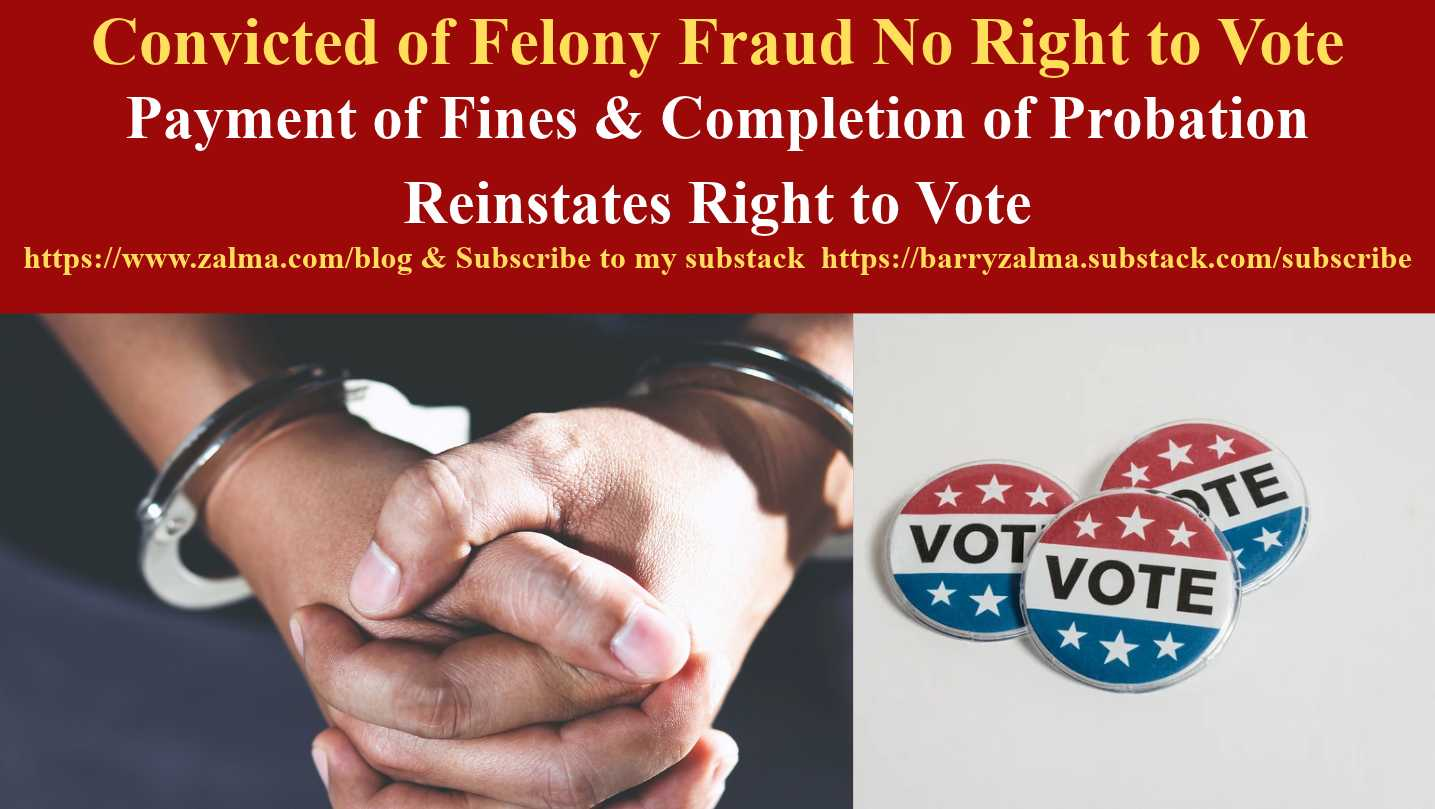
Payment of Fines & Completion of Probation Reinstates Right to Vote
Post 4576
Posted on November 5, 2026 by Barry Zalma
To Restore Voting Rights The Felon Must Pay Fines of $546.00
In Florida Supreme Court Mediator Ethics Advisory Committee, ETH F-26-377, No. F-26-377 (October 29, 2026) citizen unnamed and to Ron Desantis Governor, Cord Byrd the Secretary of State Florida Division of Elections provided an advisory opinion to a convicted felon about his right to vote:
To: [redacted] We received your request for an advisory opinion. You indicate that you have one or more felony convictions and request whether you are eligible to vote, including whether you have any outstanding legal financial obligations under section 98.0751, Florida Statutes, and, if so, a statement of the amount that must be paid to make you eligible to vote, and an explanation of how the amount was calculated.
The Division hereby responds to your request pursuant to its legal authority under section 106.23(2), Florida Statutes, and Florida ...

Administrative Review Permits the Agency to Apply its Expertise
Post 4574
In Erwin Jordan Castro Valdez v. Warden, Otay Mesa Detention Center, No. 26-cv-06147-BAS-JLB, United States District Court, S.D. California (October 30, 2026) Castro Valdez, a Cuban national paroled into the United States, was arrested on June 23, 2026, for alleged insurance fraud, grand theft, and making a false report to law enforcement. In his first habeas action, the district court ordered a bond hearing within fourteen days to determine whether the changed circumstances justified revoking his parole.
An Immigration Judge subsequently denied bond because of his pending state criminal case. Castro Valdez filed a second petition under 28 U.S.C. § 2241, challenging that determination and requesting immediate release without first appealing to the Board of Immigration Appeals (BIA).
LAW
According to the supplied text, § 2241 does not expressly require administrative exhaustion, but courts impose exhaustion as a prudential requirement. ...