
Insurer v. Insurer Disputes Should be Resolved by Mediation Rather Than Litigation
Barry Zalma
Jan 22, 2024
Read the full article at https://lnkd.in/gsGmB8HY, see the full video at https://lnkd.in/gXqr4hzR and at https://lnkd.in/gvgzk8MH, and at https://zalma.com/blog plus more than 4700 posts.
Post 4717
In an insurance coverage dispute that arose out of the tragic death of an employee on a construction site the Fifth Circuit was called upon to determine which insurer was obligated to deal with the claims of the family of the deceased employee because the insurers could not agree.
In Gemini Insurance Company v. Indemnity Insurance Company of North America, No. 23-20026, United States Court of Appeals, Fifth Circuit (January 12, 2024) the court dealt with the coverage disputes over which insurer is obligated to defend and or indemnify which person or entity.
BACKGROUND FACTS
ExxonMobil Corporation (“Exxon Mobil”) retained Bechtel Oil, Gas, and Chemicals, Inc. (“Bechtel”) as a general contractor to build a new hydrocarbon processing facility in Beaumont, Texas (the “Project”). As part of its contract with Bechtel, Exxon Mobil implemented an Owner Controlled Insurance Program (“OCIP”), which provided workers’ compensation and employers’ liability coverage to Bechtel and all of its subcontractors. Bechtel retained Echo Maintenance, L.L.C. (“Echo”) as a subcontractor to perform mechanical, structural, and piping work on the Project. Bechtel and Echo subsequently entered into a contract that incorporated the OCIP and required Echo to enroll in the program (the “Subcontract”). Both Bechtel and Echo were enrolled in the OCIP.
Indemnity’s Workers’ Compensation and Employers’ Liability Policies Issued Under The OCIP
Under the OCIP, Indemnity Insurance Company of North America (“Indemnity”) issued a workers’ compensation and employers’ liability insurance policy to Bechtel (“OCIP Policy”). Separately, Gemini Insurance Company (“Gemini”) issued a general commercial liability policy to Echo under which Bechtel was an additional insured.
Part Two the OCIP Policy sets forth the type of covered claim that Indemnity agreed to defend and indemnify Bechtel. The OCIP contained a VCEL Endorsement whose first provision explains that the endorsement “adds Voluntary Compensation Insurance to the policy,” and that the insurance applies to bodily injury by accident so long as it is “sustained by an employee included in the group of employees described in the Schedule” and “arise[s] out of and in the course of employment necessary or incidental to work in a state listed in the Schedule.”
Employers’ Liability Insurance
It defines “State of Employment” in relevant part as “Texas but only at the site indicated in the designated premises endorsement.”
Underlying Incident and Lawsuit
In December 2017, Ms. Espinoza was working as a pipefitter helper on the Project when she was struck by a piece of pipe and sustained fatal injuries. In response to the suit brought by her heirs, Bechtel sought coverage as an additional insured on the commercial general liability policy issued by Gemini to Echo and received a defense from Gemini under a reservation of rights.
Bechtel moved for summary judgment on the heirs suit because Exxon Mobil’s OCIP provided blanket workers’ compensation insurance and coverage to Bechtel and Echo, Intervenors’ sole remedy in accordance with Texas Labor Code was workers’ compensation benefits. The state court granted Bechtel’s motion for summary judgment.
DISCUSSION
The main issue was whether Ms. Espinoza was an “employee” of Bechtel within the terms of the OCIP policy. Reading the VCEL Endorsement together with Part Two, the Fifth Circuit concluded that the only reasonable interpretation was that the VCEL Endorsement expanded the definition of a Bechtel “employee.” The ordinary meaning of “employee” is someone who works in the service of another person (the employer) under an express or implied contract of hire, under which the employer has the right to control the details of work performance. The Fifth Circuit concluded that the VCEL Endorsement expanded the OCIP Policy’s definition of “employee” to include employees of Bechtel’s subcontractors, such as Ms. Espinoza.
THE DUTIES TO DEFEND AND INDEMNIFY
Duty to Defend
Ms. Espinoza was an employee of Echo, but also simultaneously working for Bechtel at the designated premises, thus satisfying the VCEL Endorsement. Ms. Espinoza was killed while working in the scope of her employment. The allegations, construed liberally, constitute a claim potentially within the OCIP policy. As a result Indemnity had a duty to defend Bechtel in the Underlying Litigation.
Duty to Indemnify
There is no dispute that Ms. Espinoza was an Echo employee, that Echo was a subcontractor of Bechtel, that Bechtel and Echo had a written contract, and that the work they performed was on a “designated premises” within the meaning of the OCIP Policy the workers’ compensation OCIP coverage applies. Bechtel “provided” workers’ compensation insurance to Echo when they executed the Subcontract. Accordingly, Indemnity has a duty to indemnify Bechtel as well.
Contractual and Equitable Subrogation
Because the district court concluded that Indemnity did not have a duty to defend or indemnify Gemini, it never addressed the substance of Gemini’s subrogation arguments. The Fifth Circuit reversed the district court’s grant of Indemnity’s motion for summary judgment and remanded the case back to the district court with instructions to:
1 grant Gemini’s motion for summary judgment on Indemnity’s duties to defend and indemnify under the Policy, and
2 consider the subrogation issues in the first instance.
ZALMA OPINION
Insurance policies must be dealt with as an entirety, no matter how extensive or complex. Once the court determined that Ms. Espinoza was an employee it resolved the dispute and found that Indemnity owed defense and indemnity to the defendants. The insurer’s should not have engaged in this litigation but worked out a resolution to the benefit of the insureds with the assistance of a mediator knowledgeable about insurance issues. Failing to do so, after the expenditure of discovery, a summary judgment and an appeal the obvious resulted a case where only one party was happy and there existed a possibility that much would be saved by an agreement between equals.
(c) 2024 Barry Zalma & ClaimSchool, Inc.
Please tell your friends and colleagues about this blog and the videos and let them subscribe to the blog and the videos.
Subscribe to my substack at https://barryzalma.substack.com/publish/post/107007808
Go to Newsbreak.com https://www.newsbreak.com/@c/1653419?s=01
Go to X @bzalma; Go to the podcast Zalma On Insurance at
; Go to Barry Zalma videos at Rumble.com at https://rumble.com/c/c-262921; Go to Barry Zalma on YouTube- https://www.youtube.com/channel/UCysiZklEtxZsSF9DfC0Expg; Go to the Insurance Claims Library – http://zalma.com/blog/insurance-claims-library.
Please tell your friends and colleagues about this blog and the videos and let them subscribe to the blog and the videos.
Go to X @bzalma; Go to Barry Zalma videos at Rumble.com at https://lnkd.in/gV9QJYH; Go to Newsbreak.com https://lnkd.in/g8azKc34; Subscribe to my substack at https://lnkd.in/gcZKhG6g
Go to the Insurance Claims Library – https://lnkd.in/gwEYkxD.

Insurance Expert May Not Testify to Speculative and Contains Unsupported Conclusions.
Posted on September 18, 2026 by Barry Zalma
See the full video at and at https://rumble.com/v7fmifw-expert-may-only-testify-to-what-experience-supports.html
In Michele A. Over, and The Estate Of Paul R. Over v. State Farm Mutual Automobile Insurance Company, and State Farm Fire And Casualty Company, Civil Action No. 23-cv-02243-PAB-STV, United States District Court, D. Colorado (September 14, 2026) Michele and Paul Over sued State Farm Fire and State Farm Auto over hail-damage and stolen-vehicle claims.
The operative dispute concerned State Farm Auto’s motion to exclude or limit opinions from plaintiffs’ insurance-industry expert, Aaron Castillo. Castillo.
Law
The proponent of expert testimony must establish by a preponderance of the evidence that an expert is qualified and that the opinions are helpful, sufficiently grounded, and reliably derived and applied. Experience-based opinions must explain how the...
150 Months in Prison for Tax Fraud
Post 4846
Posted on September 17, 2026 by Barry Zalma
See the full video at https://lnkd.in/g8rh3JBX and https://lnkd.in/gmkdy-9C, In United States Of America v. Thomas Addaquay, Nos. 25-10609, 25-10611, United States Court of Appeals, Eleventh Circuit (September 9, 2026) the Eleventh Circuit affirmed all challenged convictions, the 150-month aggregate sentence, and the challenged $4,123,474.55 restitution award.
FACTS
In United States Of America v. Thomas Addaquay, United States Of America v. Thomas Addaquay, Nos. 25-10609, 25-10611, United States Court of Appeals, Eleventh Circuit (September 9, 2026) the Eleventh Circuit affirmed all challenged convictions, the 150-month aggregate sentence, and the challenged $4,123,474.55 restitution award.
FACTS
Thomas Addaquay controlled United Consolidated Accounting and Business Services (UC), nominally a check-cashing business.
The government proved a three-stage tax-refund scheme that converted the resulting refund checks into usable funds through ...
Major Fraud Perpetrator Asserts Fifth Amendment Privilege to Avoid Prosecution
Post 5489
Posted on September 14, 2026 by Barry Zalma
Fraudster Refuses to Answer Questions About His Alleged Fraud
See the full video at https://lnkd.in/gvicAMDr and at https://lnkd.in/gvicAMDr
In Great American Insurance Co. v. Gemstone Property Management, LLC, et al., No. 23-cv-9100 (LJL), United States District Court, S.D. New York (September 8, 2026) Great American Insurance Company alleged that it was defrauded through a scheme in which Subin Associates, LLP recruited individuals to stage construction-site injuries, arranged unnecessary medical treatment and litigation funding, and pursued fraudulent personal-injury claims.
Luis Manuel Garcia Salcedo, resulted in a $6 million settlement. Non-party Jose Hernandez allegedly worked as an assistant manager at Subin, operated Hernandez Associates, and owned litigation-funding companies that shared office space with Subin and provided services to its clients.
After Great American ...
Plaintiff’s Reading of the Policy is Plaintiff’s Reasonable Allegations
Posted on October 19, 2026 by Barry Zalma
Post 4868
CLASS ACTION THAT STATES A SIMPLE CLEAR AND PLAUSIBLE CAUSE OF ACTION SURVIVES
In Sheila Marino v. Farmers New World Life Insurance Company, No. 2:25-cv-02200-JNW, United States District Court, W.D. Washington, Seattle (October 13, 2026) defendant Farmers New World Life Insurance Company’s (“FNWL”) moved to dismiss Plaintiff Sheila Marino’s putative class action involving flexible universal life insurance.
Marino filed a putative class action in King County Superior Court alleging: (1) breach of contract, (2) breach of the implied covenant of good faith and fair dealing, and (3) violation of the Washington Consumer Protection Act (CPA).
She pleaded two theories: an “overcharge” theory and an “underpayment of interest” theory asked the Court to take judicial notice of historical Federal Funds Effective Rates.
THE LAW
Pleading Standard.
To survive a Rule 12(b)(6) motion, a ...

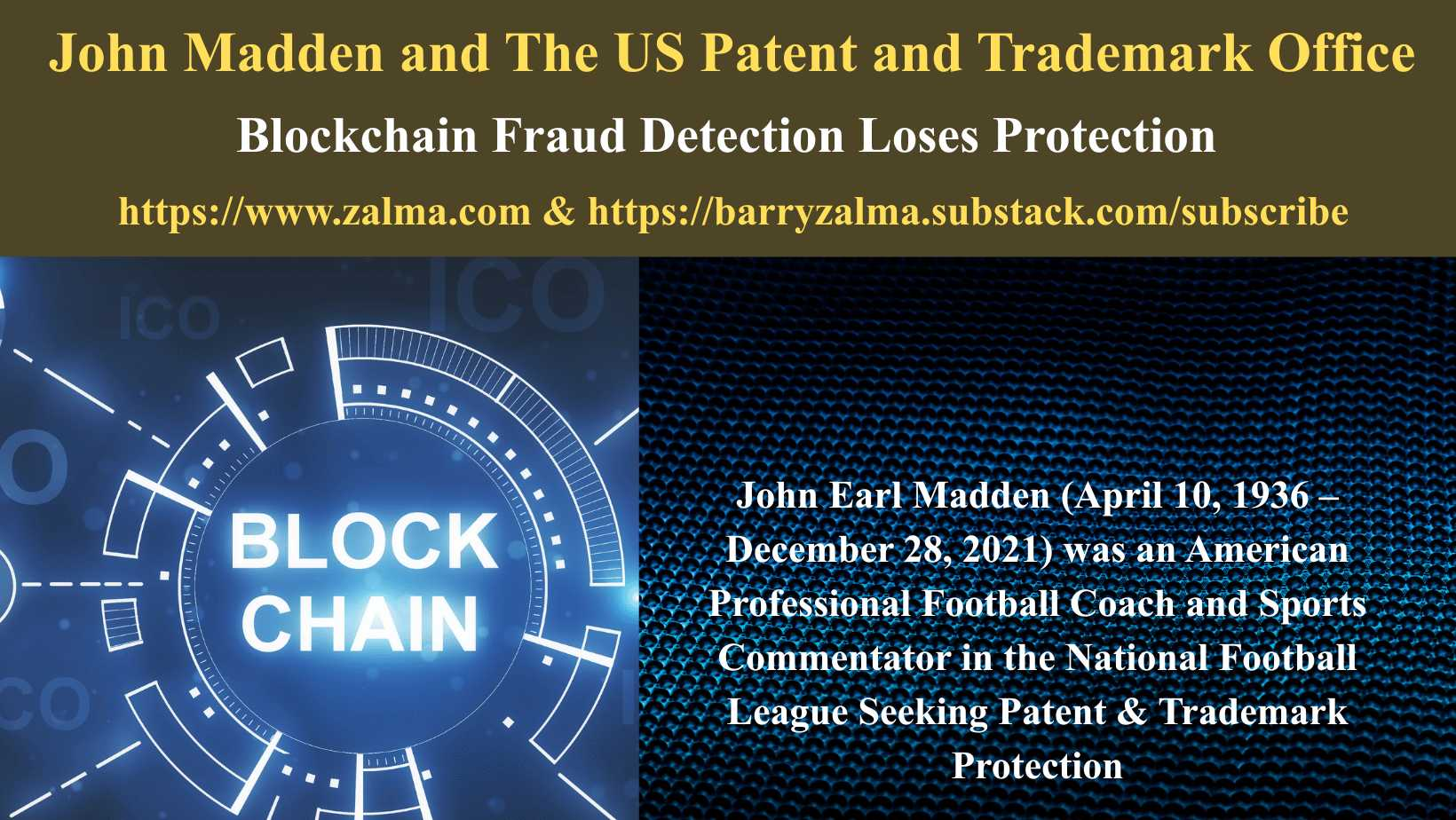
Blockchain Fraud Detection Loses Protection
Posted on October 22, 2026 by Barry Zalma
John Earl Madden (April 10, 1936 – December 28, 2021) was an American Professional Football Coach and Sports Commentator in the National Football League Seeking Patent & Trademark Protection
BLOCKCHAIN FRAUD
Mr. Madden was more than football. He was working to establish a program called “Fraud Protection Systems, Methods, and Computer Programs for Blockchain Financial Transactions.”
In Ex parte John Madden, Appeal 2026-001497, Application 18/495,506, Technology Center 3600, United States Patent and Trademark Office, Patent Trial and Appeal Board (October 14, 2026)
The Examiner rejected claims several numbered claims under 35 U.S.C. § 101 as directed to an abstract idea without significantly more.
THE LAW
Section 101 makes patentable any new and useful process, machine, manufacture, or composition of matter.Laws of nature, natural phenomena, and abstract ideas are implicitly excluded.
THE PATENT TRIAL AND ...
Sovereign Immunity Defeats Suit Against Police Officers
Post 4866
Posted on October 21, 2026 by Barry Zalma
In Chad Lightfoot, et al. v. Progressive Direct Insurance Company, et al., Civil Action No. 26-434, United States District Court, E.D. Louisiana (October 9, 2026) Chad Lightfoot was involved in an Orleans Parish automobile accident in 2011 and filed claims with several insurers, including Progressive.
After a related civil dispute, Progressive counsel allegedly submitted a false affidavit stating that Lightfoot had fraudulently received a $50,000 payment. A New Orleans police detective relied on the affidavit to obtain an arrest warrant, and Louisiana State Police Lieutenant Alan Arcana allegedly reported that Lightfoot had received the payment. Lightfoot was arrested in 2015 and charged with theft, insurance fraud, and perjury.
Plaintiffs alleged that no record of the payment existed and that the criminal charges were dismissed on October 15, 2024.
Lightfoot and Geralyn Hawkins filed suit in October 2025 and ...