
Bad Faith Judgements & Settlements are Punishment not Damages
Barry Zalma
Nov 8, 2023
Read the full article at https://lnkd.in/g5_pZzvP and see the full video at https://lnkd.in/gTvWeDRX and at https://lnkd.in/g7Ps4sUD, and at https://zalma.com/blog plus more than 4650 posts.
The Florida Supreme Court was asked to resolve a certified question from a lower court about whether a personal injury damages award must be reduced by a payment the plaintiff received to settle a bad faith claim against his uninsured motorist insurance carrier.
In Alberta S. Ellison v. Randy Willoughby, No. SC2021-1580, Supreme Court of Florida (November 2, 2023) the Supreme Court answered the questions posed.
FACTS
Respondent/plaintiff Randy Willoughby was badly injured in a car crash. After the accident, he sued Petitioner/defendant Alberta Ellison, bringing a vicarious liability claim based on Ellison’s co-ownership of the other car in the crash. Willoughby also sued his own uninsured motorist insurance carrier to recover policy benefits and for statutory bad faith damages. Willoughby and his insurer settled before trial for $4 million. The subsequent trial against Ellison resulted in a $30 million jury verdict for Willoughby. Ellison then asked the trial court to set off the $4 million insurance settlement against the damages award, but the court denied the motion.
The Second District Court of Appeal affirmed the denial of the set off request. It also certified this two-part question as one of great public importance.
1. Is a settlement payment made by an uninsured motorist insurer to settle a first-party bad faith claim subject to set off under section 768.041(2) or
2. a collateral source within the meaning of section 768.76?
The court answered no to both parts of the question, holding that neither statute authorized a set off in this case. The Second District explained that, writing on a blank slate, it would have found Ellison entitled to a set off under section 768.041(2), but it decided that the Supreme Court’s case law precluded that result.
Based on the parties’ arguments and the Supreme Court’s review of the record, the Supreme Court determined that Ellison did not ask the trial court for a set off under section 768.041(2) and refused to consider the issue.
The Supreme Court rephrased the question posed to it to read: “Is a settlement payment made by an uninsured motorist insurer to settle a first-party bad faith claim a collateral source within the meaning of section 768.76(2)(a)2.?”
Although Willoughby sued his uninsured motorist insurance carrier both for the $10,000 limit allowed under his policy and for bad faith damages, his $4 million insurance settlement was undifferentiated (as to claims and categories of damages). Subject to certain exceptions, section 768.76(1) mandates damage award reductions for sums that the plaintiff has received from “collateral sources.”
The Supreme Court noted that bad faith damages are not “benefits” for purposes of the collateral source definition in section 768.76(2)(a)2.
First-party bad faith claims like Willoughby’s are a creature of statute, not of the underlying insurance contract between the parties. In particular, the damages recoverable in an uninsured motorist insurance bad faith claim are set out in a statute to be “the total amount of the claimant’s damages, including the amount in excess of the policy limits, any interest on unpaid benefits, reasonable attorney’s fees and costs, and any damages caused by a violation of a law of this state.”
The Florida Supreme Court characterized statutory bad faith damages as a penalty. By “extracontractual,” the Supreme Court meant that first-party bad faith damages are over and above the amount owed pursuant to the express terms and conditions of the policy after all of the conditions precedent of the insurance policy in respect to payment are fulfilled.
The Supreme Court answered its rephrased question with a “no” and concluded that a settlement payment made by an uninsured motorist insurer to settle a first-party bad faith claim is not a collateral source and the judgment could not be offset.
ZALMA OPINION
The $30 Million verdict was not offset by the $4 Million bad faith settlement. Randy Willoughby was entitled to collect, if possible, the full $34 million in damages and punishment damages. The Supreme Court wisely concluded that punishment damages were not damages for bodily injury and could not be used to reduce the trial court’s verdict in the bodily injury suit.
(c) 2023 Barry Zalma & ClaimSchool, Inc.
Please tell your friends and colleagues about this blog and the videos and let them subscribe to the blog and the videos.
Subscribe to Excellence in Claims Handling at locals.com at https://zalmaoninsurance.locals.com/subscribe or at substack at https://barryzalma.substack.com/publish/post/107007808
Go to Newsbreak.com https://www.newsbreak.com/@c/1653419?s=01
Follow me on LinkedIn: http://www.linkedin.com/comm/mynetwork/discovery-see-all...
Daily articles are published at https://zalma.substack.com.
Go to the podcast Zalma On Insurance at https://podcasters.spotify.com/pod/show/barry-zalma/support; Go to Barry Zalma videos at Rumble.com at https://rumble.com/c/c-262921; Go to Barry Zalma on YouTube- https://www.youtube.com/channel/UCysiZklEtxZsSF9DfC0Expg; Go to the Insurance Claims Library – http://zalma.com/blog/insurance-claims-library.
Please tell your friends and colleagues about this blog and the videos and let them subscribe to the blog and the videos.
Subscribe to substack at https://lnkd.in/gcZKhG6g;
Go to Barry Zalma videos at Rumble.com at https://lnkd.in/g7-xSs2; Go to the Insurance Claims Library – https://lnkd.in/gwEYkxD.

Insurance Expert May Not Testify to Speculative and Contains Unsupported Conclusions.
Posted on September 18, 2026 by Barry Zalma
See the full video at and at https://rumble.com/v7fmifw-expert-may-only-testify-to-what-experience-supports.html
In Michele A. Over, and The Estate Of Paul R. Over v. State Farm Mutual Automobile Insurance Company, and State Farm Fire And Casualty Company, Civil Action No. 23-cv-02243-PAB-STV, United States District Court, D. Colorado (September 14, 2026) Michele and Paul Over sued State Farm Fire and State Farm Auto over hail-damage and stolen-vehicle claims.
The operative dispute concerned State Farm Auto’s motion to exclude or limit opinions from plaintiffs’ insurance-industry expert, Aaron Castillo. Castillo.
Law
The proponent of expert testimony must establish by a preponderance of the evidence that an expert is qualified and that the opinions are helpful, sufficiently grounded, and reliably derived and applied. Experience-based opinions must explain how the...
150 Months in Prison for Tax Fraud
Post 4846
Posted on September 17, 2026 by Barry Zalma
See the full video at https://lnkd.in/g8rh3JBX and https://lnkd.in/gmkdy-9C, In United States Of America v. Thomas Addaquay, Nos. 25-10609, 25-10611, United States Court of Appeals, Eleventh Circuit (September 9, 2026) the Eleventh Circuit affirmed all challenged convictions, the 150-month aggregate sentence, and the challenged $4,123,474.55 restitution award.
FACTS
In United States Of America v. Thomas Addaquay, United States Of America v. Thomas Addaquay, Nos. 25-10609, 25-10611, United States Court of Appeals, Eleventh Circuit (September 9, 2026) the Eleventh Circuit affirmed all challenged convictions, the 150-month aggregate sentence, and the challenged $4,123,474.55 restitution award.
FACTS
Thomas Addaquay controlled United Consolidated Accounting and Business Services (UC), nominally a check-cashing business.
The government proved a three-stage tax-refund scheme that converted the resulting refund checks into usable funds through ...
Major Fraud Perpetrator Asserts Fifth Amendment Privilege to Avoid Prosecution
Post 5489
Posted on September 14, 2026 by Barry Zalma
Fraudster Refuses to Answer Questions About His Alleged Fraud
See the full video at https://lnkd.in/gvicAMDr and at https://lnkd.in/gvicAMDr
In Great American Insurance Co. v. Gemstone Property Management, LLC, et al., No. 23-cv-9100 (LJL), United States District Court, S.D. New York (September 8, 2026) Great American Insurance Company alleged that it was defrauded through a scheme in which Subin Associates, LLP recruited individuals to stage construction-site injuries, arranged unnecessary medical treatment and litigation funding, and pursued fraudulent personal-injury claims.
Luis Manuel Garcia Salcedo, resulted in a $6 million settlement. Non-party Jose Hernandez allegedly worked as an assistant manager at Subin, operated Hernandez Associates, and owned litigation-funding companies that shared office space with Subin and provided services to its clients.
After Great American ...
Sentence for Stealing from Veterans Administration Reasonably Considers State Insurance Fraud & Arson Convictions
Post 4863
Posted on October 14, 2026 by Barry Zalma
In United States Of America v. Anthony Curtis Brewer, No. 26-10745, United States Court of Appeals, Eleventh Circuit (October 8, 2026) Anthony Curtis Brewer became the fiduciary for an incapacitated recipient of Department of Veterans Affairs survivor benefits and agreed to use her funds solely for her care and support without commingling them with his own.
The VA determined that he misused $67,232.33 and removed him as fiduciary in 2022. Brewer pleaded guilty to theft of more than $1,000 in government property under 18 U.S.C. § 641. At sentencing, the district court attributed $53,567 in loss to him, producing an advisory Guidelines range of 15 to 21 months.
Citing the victim’s vulnerability, Brewer’s attempts to avoid responsibility, and his other fraudulent conduct — including state convictions for arson and insurance fraud — the court ...
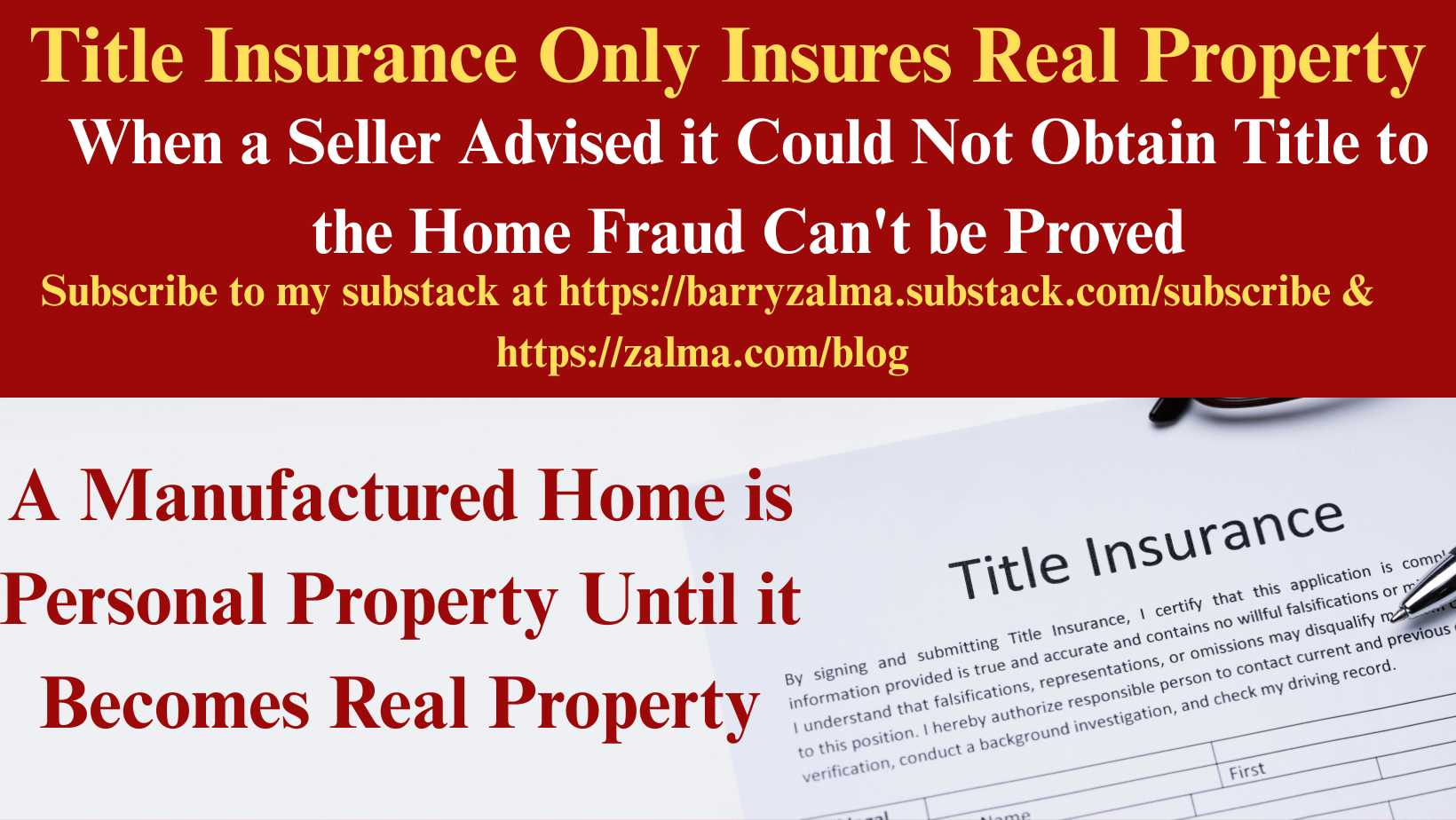
Title Insurance Only Insures Real Property
Posted on October 13, 2026 by Barry Zalma
When a Seller Advised it Could Not Obtain Title to the Home Fraud Can’t be Proved
A Manufactured Home is Personal Property Until it Becomes Real Property
Post 4862
In Dale Johnson and Rose Johnson, Husband and Wife v. Stewart Title Guaranty Co., and Lennar Mortgage, LLC; Low Va Rates, LLC; Sandpoint Title Insurance, Inc.; Village Capital & Investment, LLC; and David Cassel, Engineer Agent; and Unknown Does 1-50, inclusively, No. 53126, Court of Appeals of Idaho (October 9, 2026) Dale and Rose Johnson purchased Idaho real property in 2012 with a manufactured home on it. Their purchase addendum acknowledged that the seller could not obtain title to the home, that evidence of title and an ALTA-7 endorsement might not be available, and that they accepted the home “as is.”
In 2020, after a HELOC application was denied, the Johnsons learned that the home had been wrecked and decertified in 2004 and that its 2006 conversion to real ...
Denial Of Mental Health Diversion And Probation Condition Were Affirmed
Posted on October 9, 2026 by Barry Zalma
Post 4860
In The People v. Nicholas Daniel Stiles, A173483, A173646, California Court of Appeals, First District, Second Division (September 29, 2026) Nicholas Daniel Stiles pleaded no contest to one count of insurance fraud arising from his purchase of automobile insurance after a June 2021 collision, and to grand theft arising from an April 2024 incident at a 7-Eleven.
In both cases, the trial court suspended imposition of sentence and placed him on two years’ probation. Before the pleas, Stiles sought mental health diversion in both matters and filed a written motion seeking substitute appointed counsel. The diversion applications were denied, and the court never held a hearing on the motion.
LAW
Penal Code section 1001.36 permits pretrial mental health diversion when a defendant is eligible and suitable and the proposed treatment will meet the defendant’s specialized needs; denial is reviewed for ...