

Condo Association are Birthplaces of Litigation
Barry Zalma
Jul 13, 2023
Read the full article at https://lnkd.in/gCnipH7n and see the full video at https://lnkd.in/gsPvAR_v and at https://lnkd.in/gYrCqxW4 and at https://zalma.com/blog plus more than 4550 posts.
Plaintiff, Nationwide Mutual Insurance Company (Nationwide), brought a declaratory judgment action against insureds, Beverly Glen Homeowners’ Association (Association) and members of the board of directors asking the court to declare that Nationwide had no duty to defend or indemnify defendants against claims made by the Association residents in a derivative suit. The trial court granted Nationwide’s motion for judgment on the pleadings, finding that res judicata and collateral estoppel barred defendants from seeking a defense in the derivative suit where judgment rendered in a prior case determined that Nationwide had no duty to defend.
In Nationwide Mutual Insurance Company v. Beverly Glen Homeowners’ Association, et al, No. 3-22-0089, 2023 IL App (3d) 220089-U, Court of Appeals of Illinois, Third District (July 7, 2023)
BACKGROUND
This lawsuit arises out of an ongoing dispute between defendants and Teresa and Katarzyna Jagiello, two Association residents.
On April 14, 2020, the trial court granted Nationwide’s motion. It held that “There are no material issues of fact in dispute and it is clear, as a matter of law, that the lack of cooperation on the part of the insured and its counsel has relieved Nationwide of its duties under its policy …. Nationwide’s insured failed to cooperate with Nationwide, relieving Nationwide of its duties under the policy, and Nationwide owes nothing to its insured… for any legal services. As such, Nationwide owes neither a duty to defend nor indemnify its insured in this matter.”
ANALYSIS
Res Judicata and Collateral Estoppel
The doctrine of res judicata serves to bar actions in which: (1) there was a final judgment on the merits rendered by a court of competent jurisdiction; (2) there is an identity of cause of action; and (3) there is an identity of parties or their privies in both actions. Res judicata prevents the relitigation of issues that could have been decided in the first action along with those issues that were actually decided.
The directors of a Condo Association act as the arms of the Association and for all intents and purposes are one and the same. In other words, there exists a legal relationship in which the directors, acting within their corporate authority, bind the Association.
When a valid and final judgment rendered in an action extinguishes the plaintiff’s clam the claim extinguished includes all rights of the plaintiff to remedies against the defendant with respect to all or any part of the transaction, or series of connected transactions, out of which the action arose.
Res judicata is an equitable doctrine that should be applied only as fairness and justice require. It is intended to be used as a shield, not a sword. Nationwide is asserting the doctrine in a declaratory judgment action to obtain a no-duty-to-defend ruling. It is, contrary to defendants’ argument, attempting to use the doctrine as a shield in the underlying derivative suit. Under the circumstances, applying the doctrine to deny defendants coverage in the derivative suit would not be unfair or unjust. Defendants have refused to produce documents, ignored settlement agreements and court orders requiring them to do so, and failed to cooperate with Nationwide counsel in defending their actions.
In continuing to dispute it should come as no surprise to defendants that Nationwide would have no duty to defend or indemnify their actions.
The trial court did not err in granting the motion for declaratory judgment on the pleadings in insurer’s favor based on doctrines of res judicata and collateral estoppel where order entered in the prior case, finding that the insurer had no duty to defend or indemnify insured, involved identical cause of action and parties were in privity with parties in the underlying dispute.
ZALMA OPINION
The basic covenant of good faith and fair dealing requires that neither party to the policy may do anything to deprive the other of the benefits of the policy. When the condo association failed or refused to cooperate in the investigation of a claim a court found the insurer owed neither defense nor indemnity to the association because of the breach by the association. When a new set of directors sought defense of the continuation of the same dispute res judicata applied because the association was the entity involved regardless of who sits on the Board of Directors.
(c) 2023 Barry Zalma & ClaimSchool, Inc.
Please tell your friends and colleagues about this blog and the videos and let them subscribe to the blog and the videos.
Subscribe to Excellence in Claims Handling at locals.com https://zalmaoninsurance.locals.com/subscribe subscribe to my substack at https://barryzalma.substack.com/publish/post/107007808
Go to Newsbreak.com https://www.newsbreak.com/@c/1653419?s=01
Follow me on LinkedIn: www.linkedin.com/comm/mynetwork/discovery-see-all?usecase=PEOPLE_FOLLOWS&followMember=barry-zalma-esq-cfe-a6b5257
Go to the podcast Zalma On Insurance at https://podcasters.spotify.com/pod/show/barry-zalma/support; Follow Mr. Zalma on Twitter at https://twitter.com/bzalma; Go to Barry Zalma videos at Rumble.com at https://rumble.com/c/c-262921; Go to Barry Zalma on YouTube- https://www.youtube.com/channel/UCysiZklEtxZsSF9DfC0Expg; https://creators.newsbreak.com/home/content/post; Go to the Insurance Claims Library – https://zalma.com/blog/insurance-claims-library.
Please tell your friends and colleagues about this blog and the videos and let them subscribe to the blog and the videos.
Subscribe toExcellence in Claims Handling at locals.com https://lnkd.in/gfFKUaTf subscribe to my substack at https://lnkd.in/gcZKhG6g
Go to the Insurance Claims Library – https://lnkd.in/gWVSBde.

Insurance Expert May Not Testify to Speculative and Contains Unsupported Conclusions.
Posted on September 18, 2026 by Barry Zalma
See the full video at and at https://rumble.com/v7fmifw-expert-may-only-testify-to-what-experience-supports.html
In Michele A. Over, and The Estate Of Paul R. Over v. State Farm Mutual Automobile Insurance Company, and State Farm Fire And Casualty Company, Civil Action No. 23-cv-02243-PAB-STV, United States District Court, D. Colorado (September 14, 2026) Michele and Paul Over sued State Farm Fire and State Farm Auto over hail-damage and stolen-vehicle claims.
The operative dispute concerned State Farm Auto’s motion to exclude or limit opinions from plaintiffs’ insurance-industry expert, Aaron Castillo. Castillo.
Law
The proponent of expert testimony must establish by a preponderance of the evidence that an expert is qualified and that the opinions are helpful, sufficiently grounded, and reliably derived and applied. Experience-based opinions must explain how the...
150 Months in Prison for Tax Fraud
Post 4846
Posted on September 17, 2026 by Barry Zalma
See the full video at https://lnkd.in/g8rh3JBX and https://lnkd.in/gmkdy-9C, In United States Of America v. Thomas Addaquay, Nos. 25-10609, 25-10611, United States Court of Appeals, Eleventh Circuit (September 9, 2026) the Eleventh Circuit affirmed all challenged convictions, the 150-month aggregate sentence, and the challenged $4,123,474.55 restitution award.
FACTS
In United States Of America v. Thomas Addaquay, United States Of America v. Thomas Addaquay, Nos. 25-10609, 25-10611, United States Court of Appeals, Eleventh Circuit (September 9, 2026) the Eleventh Circuit affirmed all challenged convictions, the 150-month aggregate sentence, and the challenged $4,123,474.55 restitution award.
FACTS
Thomas Addaquay controlled United Consolidated Accounting and Business Services (UC), nominally a check-cashing business.
The government proved a three-stage tax-refund scheme that converted the resulting refund checks into usable funds through ...
Major Fraud Perpetrator Asserts Fifth Amendment Privilege to Avoid Prosecution
Post 5489
Posted on September 14, 2026 by Barry Zalma
Fraudster Refuses to Answer Questions About His Alleged Fraud
See the full video at https://lnkd.in/gvicAMDr and at https://lnkd.in/gvicAMDr
In Great American Insurance Co. v. Gemstone Property Management, LLC, et al., No. 23-cv-9100 (LJL), United States District Court, S.D. New York (September 8, 2026) Great American Insurance Company alleged that it was defrauded through a scheme in which Subin Associates, LLP recruited individuals to stage construction-site injuries, arranged unnecessary medical treatment and litigation funding, and pursued fraudulent personal-injury claims.
Luis Manuel Garcia Salcedo, resulted in a $6 million settlement. Non-party Jose Hernandez allegedly worked as an assistant manager at Subin, operated Hernandez Associates, and owned litigation-funding companies that shared office space with Subin and provided services to its clients.
After Great American ...
No Breach of Contract no Bad Faith
Post 4568
Posted on October 23, 2026 by Barry Zalma
A Party Cannot Designate One Witness While Submitting An Undifferentiated Product Of That Witness And An Undesignated Collaborator.
Post 4568
In Dustin Cain; Amanda Cain v. State Farm Fire and Casualty Company, No. 25-60442, United States Court of Appeals, Fifth Circuit (October 16, 2026) Dustin and Amanda Cain sought homeowners’ insurance benefits after a tree fell on their Mississippi home on August 27, 2022. State Farm concluded that the tree caused only a roof puncture and that other damage resulted from excluded long-term conditions. It paid $10,042.90 and later an additional $3,130.08.
The Cains relied on an engineering report and contractor estimate asserting substantially greater damage, sued for breach of contract and related relief, and designated Sean Fee as their sole expert. Fee’s report and a later repair estimate were jointly authored with Jim Irmiter, but neither document identified which opinions, work, or ...
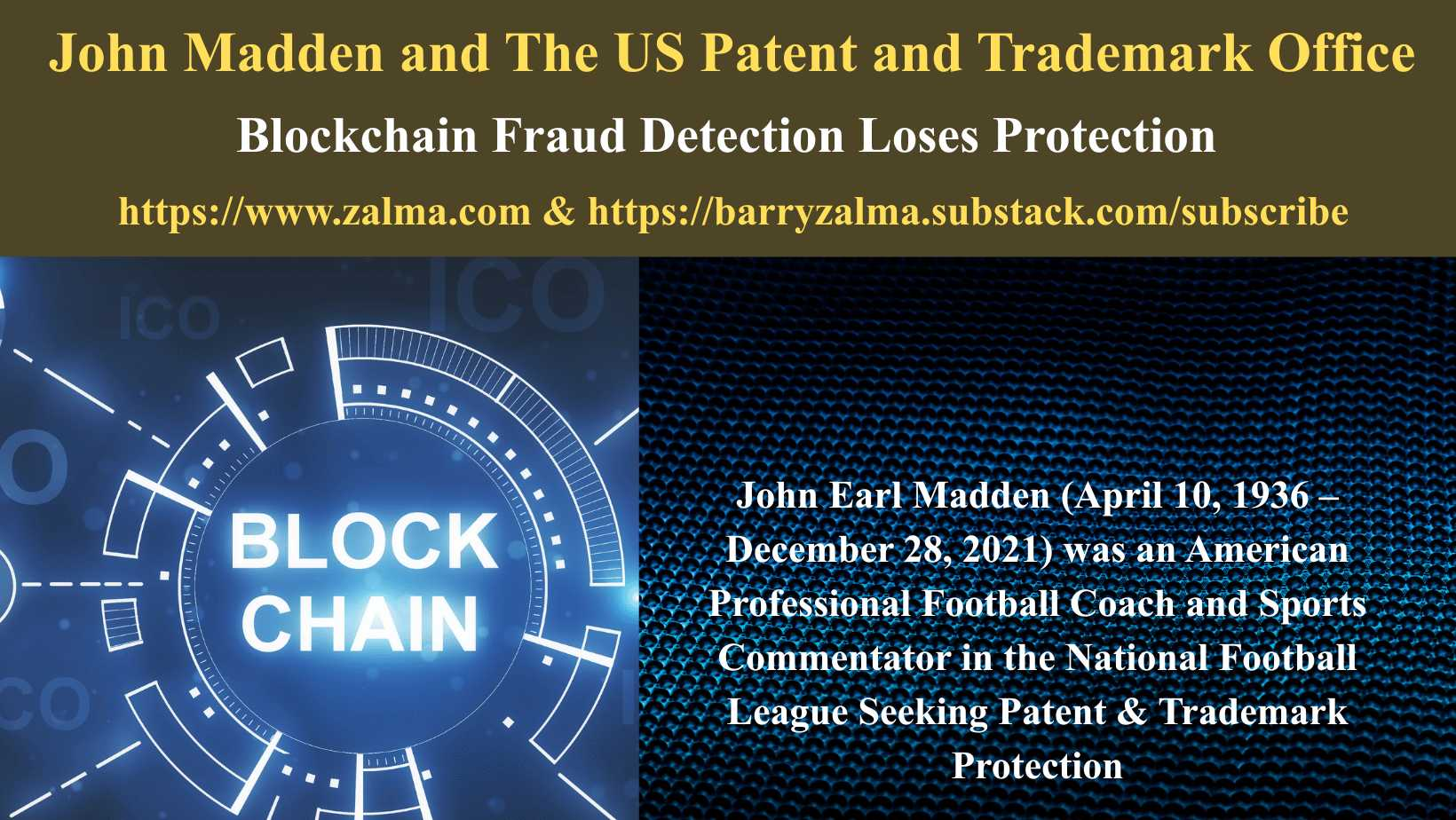
Blockchain Fraud Detection Loses Protection
Posted on October 22, 2026 by Barry Zalma
John Earl Madden (April 10, 1936 – December 28, 2021) was an American Professional Football Coach and Sports Commentator in the National Football League Seeking Patent & Trademark Protection
BLOCKCHAIN FRAUD
Mr. Madden was more than football. He was working to establish a program called “Fraud Protection Systems, Methods, and Computer Programs for Blockchain Financial Transactions.”
In Ex parte John Madden, Appeal 2026-001497, Application 18/495,506, Technology Center 3600, United States Patent and Trademark Office, Patent Trial and Appeal Board (October 14, 2026)
The Examiner rejected claims several numbered claims under 35 U.S.C. § 101 as directed to an abstract idea without significantly more.
THE LAW
Section 101 makes patentable any new and useful process, machine, manufacture, or composition of matter.Laws of nature, natural phenomena, and abstract ideas are implicitly excluded.
THE PATENT TRIAL AND ...
Sovereign Immunity Defeats Suit Against Police Officers
Post 4866
Posted on October 21, 2026 by Barry Zalma
In Chad Lightfoot, et al. v. Progressive Direct Insurance Company, et al., Civil Action No. 26-434, United States District Court, E.D. Louisiana (October 9, 2026) Chad Lightfoot was involved in an Orleans Parish automobile accident in 2011 and filed claims with several insurers, including Progressive.
After a related civil dispute, Progressive counsel allegedly submitted a false affidavit stating that Lightfoot had fraudulently received a $50,000 payment. A New Orleans police detective relied on the affidavit to obtain an arrest warrant, and Louisiana State Police Lieutenant Alan Arcana allegedly reported that Lightfoot had received the payment. Lightfoot was arrested in 2015 and charged with theft, insurance fraud, and perjury.
Plaintiffs alleged that no record of the payment existed and that the criminal charges were dismissed on October 15, 2024.
Lightfoot and Geralyn Hawkins filed suit in October 2025 and ...