

The Law & the Tort of Bad Faith
Barry Zalma
May 25, 2023
Posted on May 25, 2023 by Barry Zalma
See the full article at https://www.linkedin.com/pulse/law-unintended-consequences-barry-zalma-esq-cfe
The law of unintended consequences is not statutory. No state or federal government has enacted it into law. No executive has signed the law. It is, rather, a law of the nature of people. It is an adage or idiomatic warning that an intervention in a complex system always creates unanticipated and often undesirable outcomes.
General observation requires the hypothesis that actions of people, especially of governments, will always have effects that are unanticipated or unintended, has been proved. Economists and other social scientists have heeded its power for centuries. Regardless, for just as long, politicians, insurers and popular opinion have largely ignored the law of unintended consequences to their detriment.
There is no common-law duty for a court, especially in a heavily regulated sector of the economy like insurance to create new rules. Every court should be loathe to invent duties unmoored to any existing precedent. The law of unintended consequences counsels against it.
To find a good illustration of the law of unintended consequences, one need look no further than the Supreme Court’s decision in Williamson County Regional Planning Comm’n v. Hamilton Bank of Johnson City, 473 U.S. 172, 105 S.Ct. 3108, 87 L.Ed.2d 126 (1985). The Court’s actual holding was pedestrian: that Hamilton Bank’s takings claim was unripe because the bank had not exhausted its administrative remedies, specifically its right to ask the County for a variance to develop the property in the manner proposed. In dictum, however—dictum in the sense that the Court’s pronouncement was at that point unnecessary to its decision—the Court went on to say that the bank’s claim was “not yet ripe” for a “second reason. That reason too was couched in terms of exhaustion: that under state law “a property owner may bring an inverse condemnation action to obtain just compensation for an alleged taking of property”; and that, until the bank “has utilized that procedure, its takings claim is premature.” The Court’s implicit assurance, of course, was that once a plaintiff checks these boxes, it can bring its takings claim back to federal court.
That assurance proved illusory. State-court judgments are things to which the federal courts owe full faith and credit. That obligation means that takings claims litigated in state court cannot be relitigated in federal. Thus—by all appearances inadvertently— Williamson County all but guarantees that claimants will be unable to utilize the federal courts to enforce the Fifth Amendment’s just compensation guarantee against state and local governments. [Lumbard v. City of Ann Arbor, 913 F.3d 585 (6th Cir. 2019)]
The law of unintended consequences applies as much in jurisprudence as anywhere else; bending a rule to accommodate one litigant doesn’t always achieve better justice — sometimes it just sows confusion in anyone trying to figure out what a court might do in other cases in the future. A prudent court will take the lesson to leave rulemaking to the legislators and administrators, even when the outcome appears unjust. The orderly development of the law is not without rough patches, but it is better than living under the law of unintended consequences. [United States ex rel. Prather v. Brookdale Senior Living Cmtys., Inc., 892 F.3d 822 (6th Cir. 2018)]
In addition, as one dissenter said that the majority’s desire to cure all wrongs by eviscerating the doctrine of governmental immunity, while well-intentioned, is fraught with the law of unintended consequences. Depriving governmental officials of governmental immunity when making policy decisions, when making sentencing decisions, and when running the government would certainly cause most of us to rethink the traditional notion of public service. [Doe v. Dep’t of Corr., 323 Mich.App. 479, 917 N.W.2d 730 (Mich. App. 2018)]
Courts will often work strenuously to avoid making decisions that will result in difficulties in the future by application of the law of unintended consequences which causes more problems than the decision may cure. My opinion is that the well intentioned creation of the tort of bad faith helped one insured only to cost hundreds of millions of dollars, if not a few billion, to those unaware purchasers of insurance who must pay more in premiums than they would had the tort not been created by the California Supreme Court.
Adapted from my book It’s Time to Abolish The Tort of Bad Faith https://www.amazon.com/gp/product/B08RF1S2DP?pf_rd_r=M6RBTZK9KZABN6KCY5JM&pf_rd_p=5ae2c7f8-e0c6-4f35-9071-dc3240e894a8&pd_rd_r=3dbbb740-39d8-4f40-9983-b484c6d7d78a&pd_rd_w=4AX5G&pd_rd_wg=cgH0p&ref_=pd_gw_unk
(c) 2023 Barry Zalma & ClaimSchool, Inc.
Subscribe and receive videos limited to subscribers of Excellence in Claims Handling at locals.com https://zalmaoninsurance.locals.com/subscribe.
Consider subscribing to my publications at substack at https://barryzalma.substack.com/publish/post/107007808
Go to Newsbreak.com https://www.newsbreak.com/@c/1653419?s=01
Barry Zalma, Esq., CFE, is available at http://www.zalma.com and [email protected]
Follow me on LinkedIn: www.linkedin.com/comm/mynetwork/discovery-see-all?usecase=PEOPLE_FOLLOWS&followMember=barry-zalma-esq-cfe-a6b5257
Write to Mr. Zalma at [email protected]; http://www.zalma.com; http://zalma.com/blog; daily articles are published at https://zalma.substack.com. Go to the podcast Zalma On Insurance at https://podcasters.spotify.com/pod/show/barry-zalma/support; Follow Mr. Zalma on Twitter at https://twitter.com/bzalma; Go to Barry Zalma videos at Rumble.com at https://rumble.com/c/c-262921; Go to Barry Zalma on YouTube- https://www.youtube.com/channel/UCysiZklEtxZsSF9DfC0Expg; https://creators.newsbreak.com/home/content/post; Go to the Insurance Claims Library – https://zalma.com/blog/insurance-claims-library.

Insurance Expert May Not Testify to Speculative and Contains Unsupported Conclusions.
Posted on September 18, 2026 by Barry Zalma
See the full video at and at https://rumble.com/v7fmifw-expert-may-only-testify-to-what-experience-supports.html
In Michele A. Over, and The Estate Of Paul R. Over v. State Farm Mutual Automobile Insurance Company, and State Farm Fire And Casualty Company, Civil Action No. 23-cv-02243-PAB-STV, United States District Court, D. Colorado (September 14, 2026) Michele and Paul Over sued State Farm Fire and State Farm Auto over hail-damage and stolen-vehicle claims.
The operative dispute concerned State Farm Auto’s motion to exclude or limit opinions from plaintiffs’ insurance-industry expert, Aaron Castillo. Castillo.
Law
The proponent of expert testimony must establish by a preponderance of the evidence that an expert is qualified and that the opinions are helpful, sufficiently grounded, and reliably derived and applied. Experience-based opinions must explain how the...
150 Months in Prison for Tax Fraud
Post 4846
Posted on September 17, 2026 by Barry Zalma
See the full video at https://lnkd.in/g8rh3JBX and https://lnkd.in/gmkdy-9C, In United States Of America v. Thomas Addaquay, Nos. 25-10609, 25-10611, United States Court of Appeals, Eleventh Circuit (September 9, 2026) the Eleventh Circuit affirmed all challenged convictions, the 150-month aggregate sentence, and the challenged $4,123,474.55 restitution award.
FACTS
In United States Of America v. Thomas Addaquay, United States Of America v. Thomas Addaquay, Nos. 25-10609, 25-10611, United States Court of Appeals, Eleventh Circuit (September 9, 2026) the Eleventh Circuit affirmed all challenged convictions, the 150-month aggregate sentence, and the challenged $4,123,474.55 restitution award.
FACTS
Thomas Addaquay controlled United Consolidated Accounting and Business Services (UC), nominally a check-cashing business.
The government proved a three-stage tax-refund scheme that converted the resulting refund checks into usable funds through ...
Major Fraud Perpetrator Asserts Fifth Amendment Privilege to Avoid Prosecution
Post 5489
Posted on September 14, 2026 by Barry Zalma
Fraudster Refuses to Answer Questions About His Alleged Fraud
See the full video at https://lnkd.in/gvicAMDr and at https://lnkd.in/gvicAMDr
In Great American Insurance Co. v. Gemstone Property Management, LLC, et al., No. 23-cv-9100 (LJL), United States District Court, S.D. New York (September 8, 2026) Great American Insurance Company alleged that it was defrauded through a scheme in which Subin Associates, LLP recruited individuals to stage construction-site injuries, arranged unnecessary medical treatment and litigation funding, and pursued fraudulent personal-injury claims.
Luis Manuel Garcia Salcedo, resulted in a $6 million settlement. Non-party Jose Hernandez allegedly worked as an assistant manager at Subin, operated Hernandez Associates, and owned litigation-funding companies that shared office space with Subin and provided services to its clients.
After Great American ...
Plaintiff’s Reading of the Policy is Plaintiff’s Reasonable Allegations
Posted on October 19, 2026 by Barry Zalma
Post 4868
CLASS ACTION THAT STATES A SIMPLE CLEAR AND PLAUSIBLE CAUSE OF ACTION SURVIVES
In Sheila Marino v. Farmers New World Life Insurance Company, No. 2:25-cv-02200-JNW, United States District Court, W.D. Washington, Seattle (October 13, 2026) defendant Farmers New World Life Insurance Company’s (“FNWL”) moved to dismiss Plaintiff Sheila Marino’s putative class action involving flexible universal life insurance.
Marino filed a putative class action in King County Superior Court alleging: (1) breach of contract, (2) breach of the implied covenant of good faith and fair dealing, and (3) violation of the Washington Consumer Protection Act (CPA).
She pleaded two theories: an “overcharge” theory and an “underpayment of interest” theory asked the Court to take judicial notice of historical Federal Funds Effective Rates.
THE LAW
Pleading Standard.
To survive a Rule 12(b)(6) motion, a ...
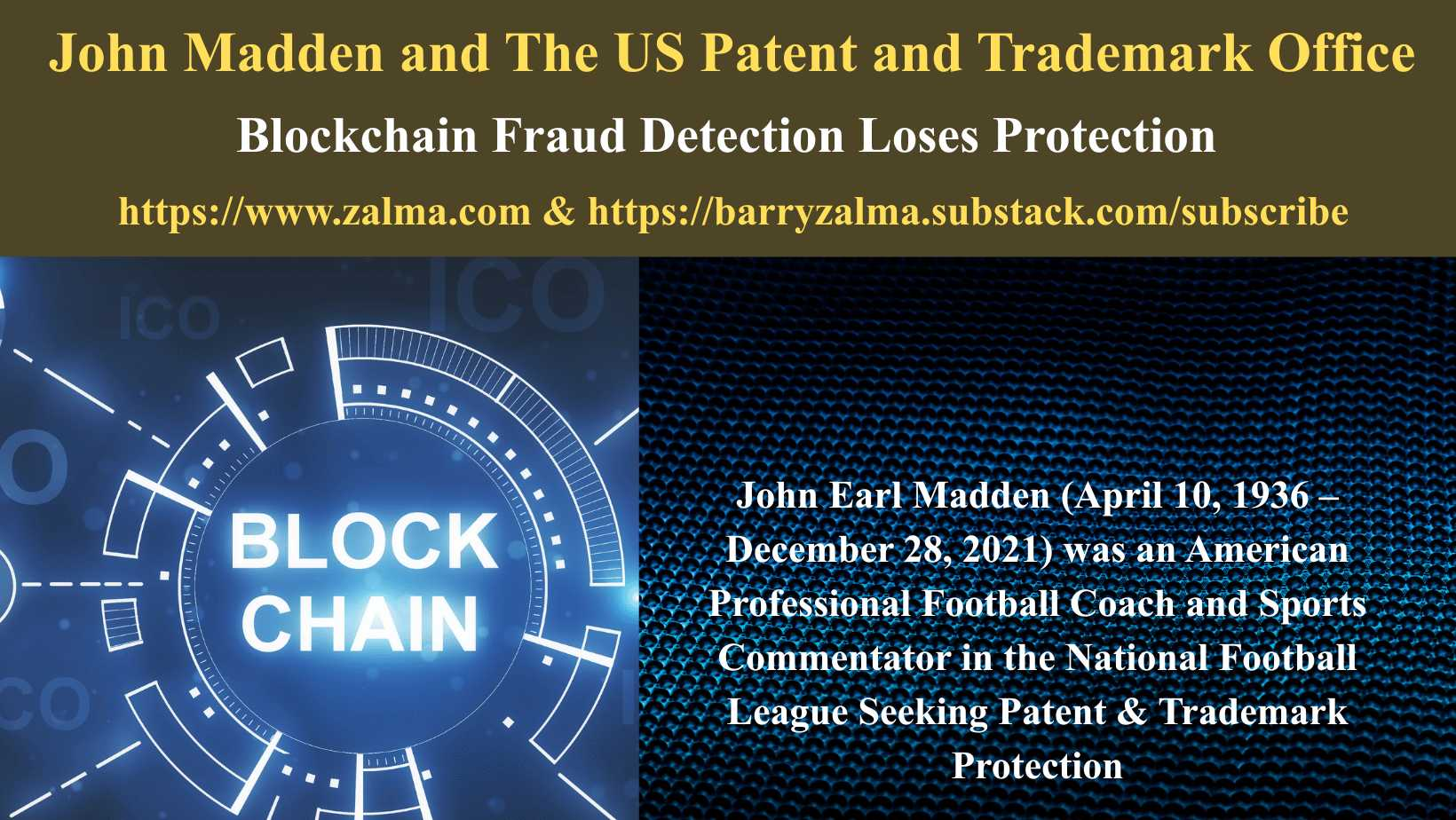
Blockchain Fraud Detection Loses Protection
Posted on October 22, 2026 by Barry Zalma
John Earl Madden (April 10, 1936 – December 28, 2021) was an American Professional Football Coach and Sports Commentator in the National Football League Seeking Patent & Trademark Protection
BLOCKCHAIN FRAUD
Mr. Madden was more than football. He was working to establish a program called “Fraud Protection Systems, Methods, and Computer Programs for Blockchain Financial Transactions.”
In Ex parte John Madden, Appeal 2026-001497, Application 18/495,506, Technology Center 3600, United States Patent and Trademark Office, Patent Trial and Appeal Board (October 14, 2026)
The Examiner rejected claims several numbered claims under 35 U.S.C. § 101 as directed to an abstract idea without significantly more.
THE LAW
Section 101 makes patentable any new and useful process, machine, manufacture, or composition of matter.Laws of nature, natural phenomena, and abstract ideas are implicitly excluded.
THE PATENT TRIAL AND ...
Sovereign Immunity Defeats Suit Against Police Officers
Post 4866
Posted on October 21, 2026 by Barry Zalma
In Chad Lightfoot, et al. v. Progressive Direct Insurance Company, et al., Civil Action No. 26-434, United States District Court, E.D. Louisiana (October 9, 2026) Chad Lightfoot was involved in an Orleans Parish automobile accident in 2011 and filed claims with several insurers, including Progressive.
After a related civil dispute, Progressive counsel allegedly submitted a false affidavit stating that Lightfoot had fraudulently received a $50,000 payment. A New Orleans police detective relied on the affidavit to obtain an arrest warrant, and Louisiana State Police Lieutenant Alan Arcana allegedly reported that Lightfoot had received the payment. Lightfoot was arrested in 2015 and charged with theft, insurance fraud, and perjury.
Plaintiffs alleged that no record of the payment existed and that the criminal charges were dismissed on October 15, 2024.
Lightfoot and Geralyn Hawkins filed suit in October 2025 and ...