

Fraud Investigation
Barry Zalma
May 24, 2023
Read the full article at https://lnkd.in/g8T__bBf and see the full video at https://lnkd.in/gZ-dGAZV and at https://lnkd.in/gPdbHKCr
and at https://zalma.com/blog plus more than 4500 posts.
The heart of any successful investigation of suspected insurance fraud is the insured’s statement. Its importance cannot be over emphasized, and it should be recorded electronically and then transcribed. The transcribed statement should then be sent to the insured to read, correct and sign.
The primary purpose of the statement is to establish and preserve the insured’s version of all aspects of the loss so that it will be difficult–hopefully, impossible–for the insured to change his version or attempt to explain away the inconsistencies, discrepancies, and misrepresentations that invariably arise as your investigation proceeds.
Insurers are compelled by statute and Regulation to maintain Special Fraud Investigative Units, publish and fulfill a detailed anti-fraud program and train all of their anti-fraud personnel. Compliance by insurers is less than constant across the industry. Some have effective fraud units while others simply identify one employee as their anti-fraud director although his or her work is almost totally adjusting claims and not investigating fraud. The expense of staffing and pursuing the anti-fraud efforts required by statute and regulation reduces the profits earned by the insurer and is believed to be offset by the lack of payment to fraud perpetrators. Of course, these efforts are also made difficult by the imposition of fair claims settlement practices regulations that require quick, complete, thorough investigations and fair treatment and prompt payment of insureds even when fraud is suspected. The two opposing sets of laws create a Catch-22 from which insurers find difficulty complying with both.[1]
Investigation techniques including, but not limited to, interviewing, photography of loss scenes, use of independent experts, use of private investigators and use of claims counsel all are part of the required thorough investigation.
Since exposing fraudulent activity, if it exists at all, is a goal of an insurance claims investigation that really wants to find a proper, honest and viable claim, accuracy is crucial. There must be no confusion about the circumstances of the loss, the items claimed, and the amount claimed–in short, all aspects of the suspected claim. It is more important to the claims person to find that the suspicious claim is, in fact, proper and remove all doubts. It is a successful claims investigation. Finding sufficient evidence of fraud to defeat a claim is important, but not as important as paying promptly a legitimate claim.
Obtaining a complete statement, the first time out is preferred because second and third truthful statements become more and more difficult to get as the investigation matures. The most obvious reason for this difficulty is that the insured becomes wary or suspicious of the repeated inquiries and will be reluctant to cooperate. The professional claims person will want the investigation to be accomplished quickly so that the insured will not realize what’s going on and take steps to cover his tracks.
Accuracy and completeness are also essential as a process of verification necessary to ascertain whether what the insured reports and claims is, in fact, true or false. Of course, verification is accomplished by contacting the various sources of the true information, such as retailers, prior carriers, agents, adjusters, and law enforcement agencies–all of which is covered.
The statement the claims person obtains may be relied on to pay a legitimate loss, to deny the claim because it was not caused by a peril insured against, to deny a claim because of attempted fraud by the insured, used as evidence to rescind the policy and/or defend against a civil suit by the insured, and because the statement itself is the most direct evidence of insurance fraud. The recorded statement may also be used in a criminal prosecution of the insured. The importance of the statement and the requirement that it be meticulously performed and transcribed is important and essential to each claims investigation.
[1] For detail consider Barry Zalma’s book California SIU Regulations 2020 available on amazon.com.
(c) 2023 Barry Zalma & ClaimSchool, Inc.
Subscribe and receive videos limited to subscribers of Excellence in Claims Handling at locals.com https://zalmaoninsurance.locals.com/subscribe.
Consider subscribing to my publications at substack at https://barryzalma.substack.com/publish/post/107007808
Go to Newsbreak.com https://www.newsbreak.com/@c/1653419?s=01
Barry Zalma, Esq., CFE, is available at http://www.zalma.com and [email protected]
Follow me on LinkedIn: www.linkedin.com/comm/mynetwork/discovery-see-all?usecase=PEOPLE_FOLLOWS&followMember=barry-zalma-esq-cfe-a6b5257
Write to Mr. Zalma at [email protected]; http://www.zalma.com; http://zalma.com/blog; daily articles are published at https://zalma.substack.com. Go to the podcast Zalma On Insurance at https://podcasters.spotify.com/pod/show/barry-zalma/support; Follow Mr. Zalma on Twitter at https://twitter.com/bzalma; Go to Barry Zalma videos at Rumble.com at https://rumble.com/c/c-262921; Go to Barry Zalma on YouTube- https://www.youtube.com/channel/UCysiZklEtxZsSF9DfC0Expg; https://creators.newsbreak.com/home/content/post; Go to the Insurance Claims Library – https://zalma.com/blog/insurance-claims-library.
Subscribe and receive videos limited to subscribers of Excellence in Claims Handling at locals.com https://lnkd.in/gfFKUaTf.
Consider subscribing to my publications at substack at https://lnkd.in/gcZKhG6g
Go to Newsbreak.com https://lnkd.in/g8azKc34
Write to Mr. Zalma at [email protected]; http://www.zalma.com; http://zalma.com/blog; daily articles are published at https://zalma.substack.com. Go to the podcast Zalma On Insurance at https://lnkd.in/gSwXaUhz; Follow Mr. Zalma on Twitter at https://twitter.com/bzalma; Go to Barry Zalma videos at Rumble.com at https://lnkd.in/gV9QJYH; Go to Barry Zalma on YouTube- https://lnkd.in/g2hGv88; https://lnkd.in/gAXsGjdi; Go to the Insurance Claims Library – https://lnkd.in/gWVSBde.

Insurance Expert May Not Testify to Speculative and Contains Unsupported Conclusions.
Posted on September 18, 2026 by Barry Zalma
See the full video at and at https://rumble.com/v7fmifw-expert-may-only-testify-to-what-experience-supports.html
In Michele A. Over, and The Estate Of Paul R. Over v. State Farm Mutual Automobile Insurance Company, and State Farm Fire And Casualty Company, Civil Action No. 23-cv-02243-PAB-STV, United States District Court, D. Colorado (September 14, 2026) Michele and Paul Over sued State Farm Fire and State Farm Auto over hail-damage and stolen-vehicle claims.
The operative dispute concerned State Farm Auto’s motion to exclude or limit opinions from plaintiffs’ insurance-industry expert, Aaron Castillo. Castillo.
Law
The proponent of expert testimony must establish by a preponderance of the evidence that an expert is qualified and that the opinions are helpful, sufficiently grounded, and reliably derived and applied. Experience-based opinions must explain how the...
150 Months in Prison for Tax Fraud
Post 4846
Posted on September 17, 2026 by Barry Zalma
See the full video at https://lnkd.in/g8rh3JBX and https://lnkd.in/gmkdy-9C, In United States Of America v. Thomas Addaquay, Nos. 25-10609, 25-10611, United States Court of Appeals, Eleventh Circuit (September 9, 2026) the Eleventh Circuit affirmed all challenged convictions, the 150-month aggregate sentence, and the challenged $4,123,474.55 restitution award.
FACTS
In United States Of America v. Thomas Addaquay, United States Of America v. Thomas Addaquay, Nos. 25-10609, 25-10611, United States Court of Appeals, Eleventh Circuit (September 9, 2026) the Eleventh Circuit affirmed all challenged convictions, the 150-month aggregate sentence, and the challenged $4,123,474.55 restitution award.
FACTS
Thomas Addaquay controlled United Consolidated Accounting and Business Services (UC), nominally a check-cashing business.
The government proved a three-stage tax-refund scheme that converted the resulting refund checks into usable funds through ...
Major Fraud Perpetrator Asserts Fifth Amendment Privilege to Avoid Prosecution
Post 5489
Posted on September 14, 2026 by Barry Zalma
Fraudster Refuses to Answer Questions About His Alleged Fraud
See the full video at https://lnkd.in/gvicAMDr and at https://lnkd.in/gvicAMDr
In Great American Insurance Co. v. Gemstone Property Management, LLC, et al., No. 23-cv-9100 (LJL), United States District Court, S.D. New York (September 8, 2026) Great American Insurance Company alleged that it was defrauded through a scheme in which Subin Associates, LLP recruited individuals to stage construction-site injuries, arranged unnecessary medical treatment and litigation funding, and pursued fraudulent personal-injury claims.
Luis Manuel Garcia Salcedo, resulted in a $6 million settlement. Non-party Jose Hernandez allegedly worked as an assistant manager at Subin, operated Hernandez Associates, and owned litigation-funding companies that shared office space with Subin and provided services to its clients.
After Great American ...
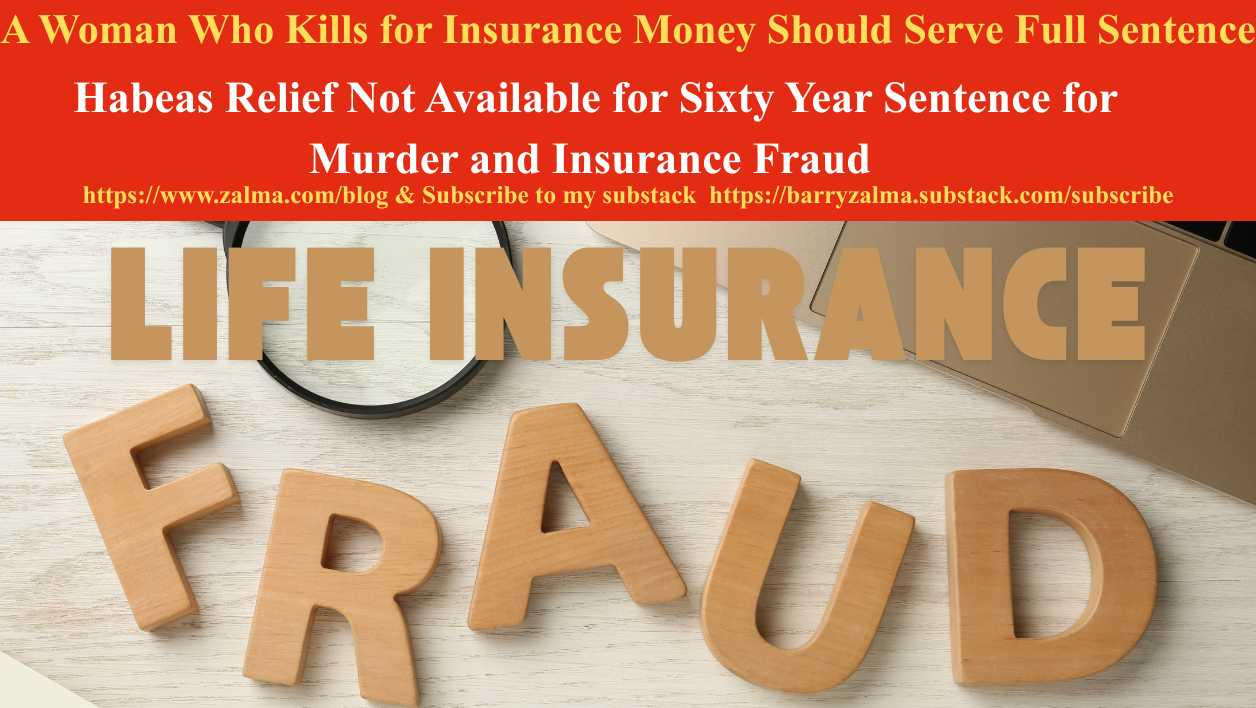
Habeas Relief Not Available for Sixty Year Sentence for Murder and Insurance Fraud
Post 4584
Posted on November 23, 2026 by Barry Zalma
The 60.5 Year Sentence Is Close To Being A Life Sentence For A Grown Woman.
In Tami Duvall v. State Of Indiana, No. 1:25-cv-01239-SEB-TAB, United States District Court, S.D. Indiana, Indianapolis Division (November 10, 2026) Tami Duvall was convicted by a jury in Bartholomew County of murdering her estranged husband, Alan Duvall, in August 2007. She was also convicted of insurance fraud and obstruction of justice.
Alan was first thought to have died of alcohol poisoning (BAC 0.436%). The autopsy also found a morphine level about 100 times a therapeutic dose and cyclobenzaprine about eight times a therapeutic dose. The couple had financial problems. Ms. Duvall had urged Alan to buy a $100,000 life insurance policy naming her as beneficiary shortly before his death. A bottle of Roxanol (liquid morphine) had gone missing from the nursing home where she worked as an aide.
Her total sentence was 60.5 years. ...
Posted on November 20, 2026 by Barry Zalma
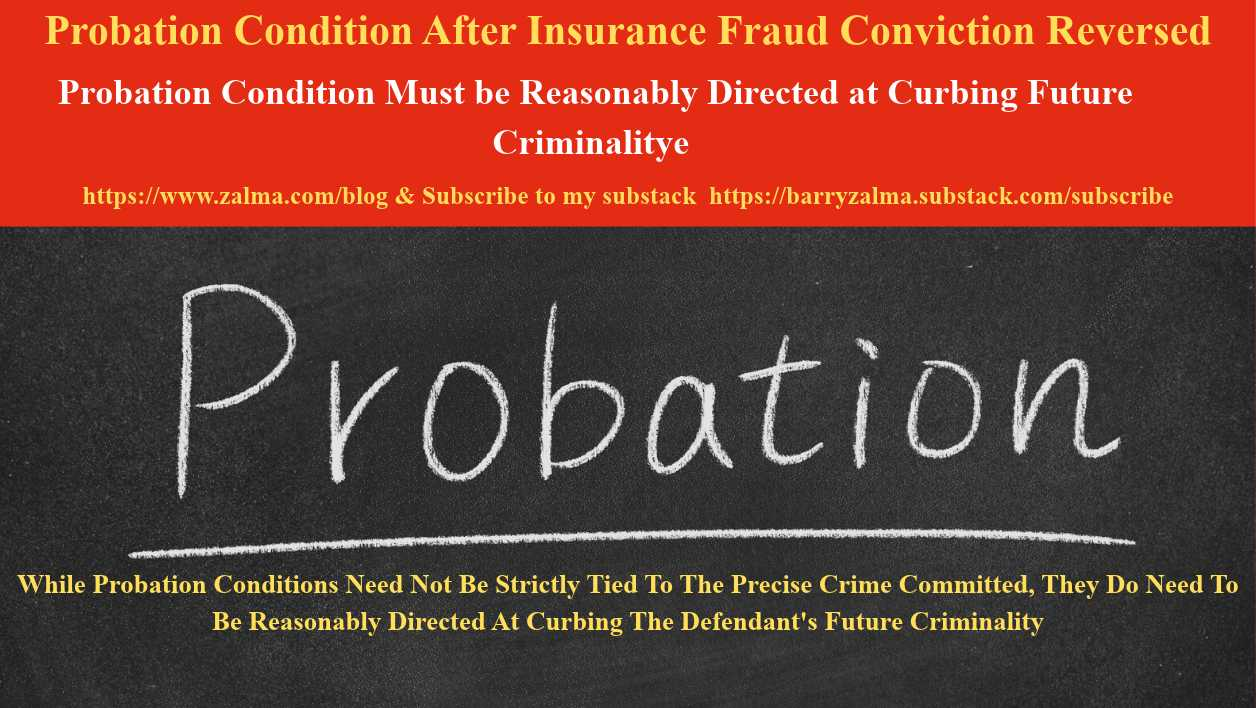
Probation Condition Must be Reasonably Directed at Curbing Future Criminality
Post 4584
While Probation Conditions Need Not Be Strictly Tied To The Precise Crime Committed, They Do Need To Be Reasonably Directed At Curbing The Defendant’s Future Criminality
In The People v. Nicolas Arpa, A174751, California Court of Appeals, First District, Third Division (November 19, 2026) Nicolas Arpa was charged in San Mateo County with five counts of insurance fraud, attempted grand theft by an employee or agent of $950 or more, grand theft by an employee or agent of $950 or more, and forgery.
He pled no contest to one count of insurance fraud (count 2) and to grand theft (count 5). His sentencing brief said he had suffered significant financial distress and felt remorse. It also said he no longer works in insurance and had made full restitution.
The trial court suspended the sentence and imposed two years of formal probation. One probation condition required him to abstain from using...
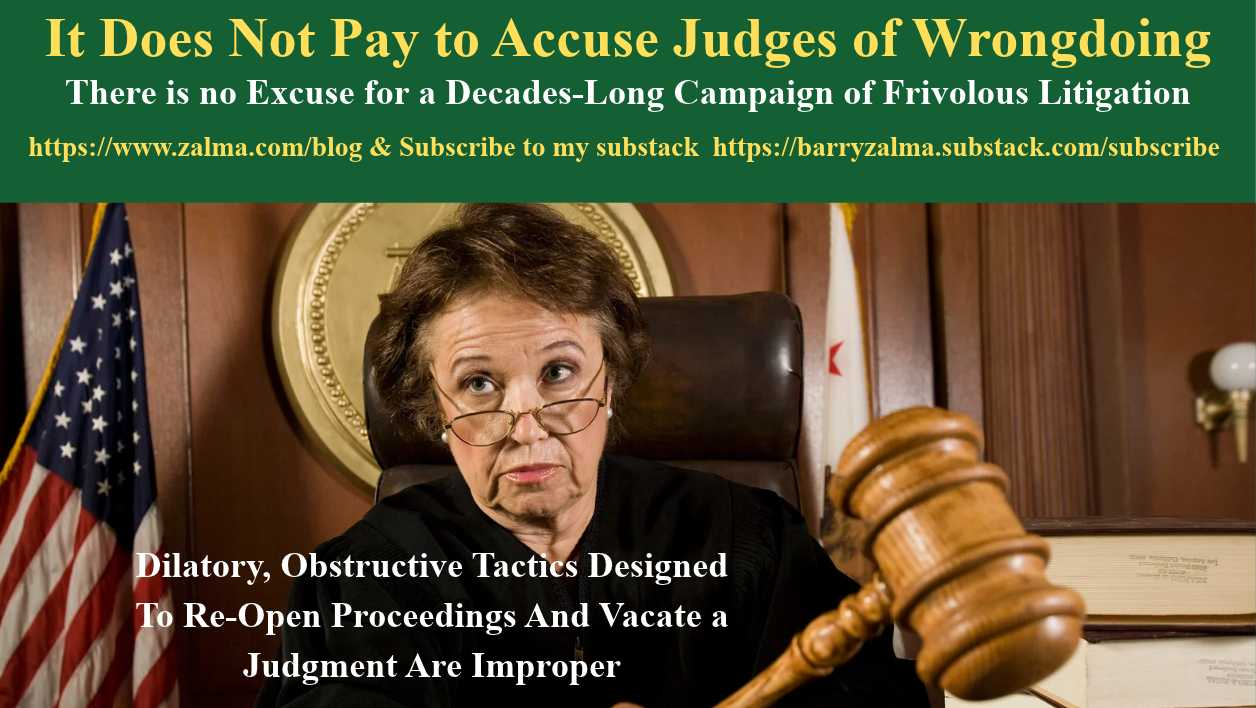
Dilatory, Obstructive Tactics Designed To Re-Open Proceedings And Vacate a Judgment Are Improper
Post 4583
In Three S Delaware, Inc. & Scott R. Steele v. Dataquick Information Systems, Inc. & Maxar Technologies, Inc., Civil Action No. 25-18991 (RK) (TJB), United States District Court, D. New Jersey (November 16, 2026) Three S Delaware (“3SD”) licensed real estate databases from a California company named DataQuick. A newly formed Delaware DataQuick bought the California DataQuick’s assets. The arbitrator later found that the sale included the 1996 license.
Delaware DataQuick sued 3SD in California. 3SD moved to compel arbitration and then counterclaimed. In May 2005, Steele and his counsel walked out of the merits hearing, and the arbitrator proceeded without them. He awarded about $6.17 million to DataQuick.
MARYLAND PROCEEDINGS:
The D. Md. (Judge Motz) confirmed the award, except for attorney’s fees. 3SD obtained a supersedeas bond of about $7.46 million from Federal Insurance Company. The Fourth Circuit affirmed in 2007.
Later ...