
NEITHER BATTERY NOR FAILURE TO REMOVE INTOXICATED PATRON IS AN OCCURRENCE
Barry Zalma
Read the full article at https://lnkd.in/g6qM7UCj and see the full video at https://lnkd.in/gmkAMpUy and at https://lnkd.in/gefWVnqw and at https://zalma.com/blog plus more than 4400 posts.
In Crum & Forster Specialty Insurance Company v. Spike’s Pub & Grub, d/b/a Vincint Von Hart LLC, and Devin Elliott, No. 3:21-CV-1722-NJR, United States District Court, S.D. Illinois (January 4, 2023) Plaintiff Crum & Forster Specialty Insurance Company (“CFSIC”) sought an order declaring that it owes no duty to defend or indemnify Defendant Spike’s Pub & Grub, d/b/a Vincint Von Hart LLC (“Spike’s”), in a case pending in the Circuit Court of St. Clair County, Illinois.
BACKGROUND
Devin Elliott (“Elliott”) sued Spike’s Public House, LLC, d/b/a Spike’s Pub & Grub (the “Underlying Action”). In the Underlying Action, Elliott alleges that on March 18, 2021, Spike’s sold or gave alcoholic beverages to Corey Lyell, causing Lyell’s intoxication. While intoxicated, and as a result of his intoxication, Lyell attacked Elliott and stabbed him multiple times, inflicting severe injury upon Elliott.
Elliott alleged Spike’s was negligent under Illinois law for failing to keep security personnel on the premises, failing to remove intoxicated persons from its premises, failing to protect Elliott from reasonably foreseeable criminal activities committed by its patrons, and failing to establish procedures to maintain the safety of its invitees. Elliott also claimed Spike’s otherwise was careless and negligent in providing adequate security; alleged a claim against Spike’s under Illinois’s Dram Shop Act; and a claim for battery against Lyell.
AVAILABLE INSURANCE
Spike’s was insured under a Commercial General Liability policy issued by CFSIC (“the Policy”). The Policy had limits of liability of $1,000,000 Each Occurrence and a $2,000,000 General Aggregate limit. Spike’s sought coverage under the Policy for the claims asserted against it in the Underlying Action. CFSIC, however, advised Spike’s in writing that it owed no obligation to defend or indemnify Spike’s based on the terms of the Policy.
CFSIC filed a Complaint for Declaratory Judgment seeking a declaration that it has no duty to defend or indemnify Spike’s under the Policy. Both Spike’s and Elliott failed to answer the Complaint, and the Clerk of Court entered default pursuant to Federal Rule of Civil Procedure 55(a) as to both Defendants on July 22, 2022. CFSIC then moved for Default Judgment.
LEGAL STANDARD
Rule 55(a) requires the clerk to enter default when a party against whom a judgment for affirmative relief is sought has failed to plead or otherwise defend and that failure is shown by affidavit or otherwise.
DISCUSSION
In Illinois, like every other state, an insurance policy is a contract and the general rules governing the interpretation of other types of contracts also govern the interpretation of insurance policies.
A duty to defend arises if the allegations in the complaint fall within or potentially within the coverage of the policy. This is known as the “eight corners” rule: the court compares the four corners of the underlying complaint with the four corners of the insurance policy to determine whether facts alleged in the underlying complaint fall within or potentially within coverage. If they do, the insurer has a duty to defend.
Coverage Under CFSIC’s Policy
CFSIC first argued that no coverage exists for the allegations against Spike’s in the Underlying Complaint because the bodily injury alleged in the Underlying Complaint was not caused by an “occurrence” as that term is defined under Coverage A of the Policy.
By their default, Elliott and Spike’s have failed to dispute CFSIC’s contention that the Policy offers no coverage because the Underlying Complaint does not allege bodily injury or property damage from an “occurrence” as that term is defined in the Policy-i.e., an accident. Accordingly, the Court finds CFSIC is entitled to default judgment as to Count I of the Complaint for Declaratory Judgment.
Total Liquor Liability Exclusion
CFSIC alternatively argues that, even if the complaint contains sufficient allegations to support coverage, the Policy contains an exclusion that bars coverage. The Total Liquor Liability Exclusion of Coverage A of the Policy provides there is no coverage for “Bodily injury” or “property damage” for which any insured may be held liable by reason of:
Causing or contributing to the intoxication of any person;
The furnishing of alcoholic beverages to a person under the legal drinking age or under the influence of alcohol; or
Any statute, ordinance or regulation relating to the sale, gift, distribution or use of alcoholic beverages.”
CFSIC argues that the allegations in the Underlying Complaint fall squarely within the scope of the Policy’s Total Liquor Liability Exclusion. Thus, even if the Policy afforded coverage for the bodily injury alleged by Elliott under Coverage A, coverage would be precluded by operation of the exclusion.
Because the Total Liquor Liability Exclusion applies to bar any coverage provided by the Policy, CFSIC was entitled to default judgment as to Count II of the Complaint for Declaratory Judgment. CFSIC owed no duty to defend Spike’s in the Underlying Action.
Indemnification
CFSIC also asked the Court to declare that it has no duty to indemnify Spike’s. It is well established that the duty to indemnify is narrower than the duty to defend.
Because the Underlying Action remains pending in St. Clair County determining whether CFSIC has a duty to indemnify would require the USDC to adjudicate facts in the Underlying Action. Therefore, the Court denied that portion of CFSIC’s motion without prejudice.
ZALMA OPINION
Although the duty to defend is greater than the duty to indemnify, even when the USDC concluded that CFSIC owed no duty to defend, it refused to rule on the duty to indemnify because the trial of the underlying action might – if a miracle occurs – find a cause for the stabbing that is not excluded, as unlikely as that may be. CFSIC should, therefore, monitor the underlying case to protect its rights and to avoid collusion between the plaintiffs and the insured defendants.
(c) 2023 Barry Zalma & ClaimSchool, Inc.
Subscribe and receive videos limited to subscribers of Excellence in Claims Handling at locals.com https://lnkd.in/gfFKUaT(c) 2023 Barry Zalma & ClaimSchool, Inc.
Subscribe and receive videos limited to subscribers of Excellence in Claims Handling at locals.com https://zalmaoninsurance.locals.com/subscribe.
Go to substack at substack.com/refer/barryzalma Consider subscribing to my publications at substack at substack.com/refer/barryzalma
Barry Zalma, Esq., CFE, now limits his practice to service as an insurance consultant specializing in insurance coverage, insurance claims handling, insurance bad faith and insurance fraud almost equally for insurers and policyholders. He practiced law in California for more than 44 years as an insurance coverage and claims handling lawyer and more than 54 years in the insurance business. He is available at http://www.zalma.com and [email protected]
Write to Mr. Zalma at [email protected]; http://www.zalma.com; http://zalma.com/blog; daily articles are published at
Zalma on Insurance
Insurance, insurance claims, insurance law, and insurance fraud .
By Barry Zalma
. Go to the podcast Zalma On Insurance at https://anchor.fm/barry-zalma; Follow Mr. Zalma on Twitter at https://twitter.com/bzalma; Go to Barry Zalma videos at Rumble.com at https://rumble.com/c/c-262921; Go to Barry Zalma on YouTube- https://www.youtube.com/channel/UCysiZklEtxZsSF9DfC0Expg; Go to the Insurance Claims Library – https://zalma.com/blog/insurance-claims-libraryf.
Go to substack at https://lnkd.in/gEEnV7Dd Consider subscribing to my publications at substack at https://lnkd.in/gEEnV7Dd
Barry Zalma, Esq., CFE is available at http://www.zalma.com and [email protected]
Go to the Insurance Claims Library – https://lnkd.in/gWVSBde
Support Excellence in Claims Handling
By Barry Zalma · Launched 2 years ago
A series of writings and/or videos to help understand insurance, insurance claims, and becoming an insurance claims professional and who need to provide or receive competent and Excellence in Claims Handling.

Insurance Expert May Not Testify to Speculative and Contains Unsupported Conclusions.
Posted on September 18, 2026 by Barry Zalma
See the full video at and at https://rumble.com/v7fmifw-expert-may-only-testify-to-what-experience-supports.html
In Michele A. Over, and The Estate Of Paul R. Over v. State Farm Mutual Automobile Insurance Company, and State Farm Fire And Casualty Company, Civil Action No. 23-cv-02243-PAB-STV, United States District Court, D. Colorado (September 14, 2026) Michele and Paul Over sued State Farm Fire and State Farm Auto over hail-damage and stolen-vehicle claims.
The operative dispute concerned State Farm Auto’s motion to exclude or limit opinions from plaintiffs’ insurance-industry expert, Aaron Castillo. Castillo.
Law
The proponent of expert testimony must establish by a preponderance of the evidence that an expert is qualified and that the opinions are helpful, sufficiently grounded, and reliably derived and applied. Experience-based opinions must explain how the...
150 Months in Prison for Tax Fraud
Post 4846
Posted on September 17, 2026 by Barry Zalma
See the full video at https://lnkd.in/g8rh3JBX and https://lnkd.in/gmkdy-9C, In United States Of America v. Thomas Addaquay, Nos. 25-10609, 25-10611, United States Court of Appeals, Eleventh Circuit (September 9, 2026) the Eleventh Circuit affirmed all challenged convictions, the 150-month aggregate sentence, and the challenged $4,123,474.55 restitution award.
FACTS
In United States Of America v. Thomas Addaquay, United States Of America v. Thomas Addaquay, Nos. 25-10609, 25-10611, United States Court of Appeals, Eleventh Circuit (September 9, 2026) the Eleventh Circuit affirmed all challenged convictions, the 150-month aggregate sentence, and the challenged $4,123,474.55 restitution award.
FACTS
Thomas Addaquay controlled United Consolidated Accounting and Business Services (UC), nominally a check-cashing business.
The government proved a three-stage tax-refund scheme that converted the resulting refund checks into usable funds through ...
Major Fraud Perpetrator Asserts Fifth Amendment Privilege to Avoid Prosecution
Post 5489
Posted on September 14, 2026 by Barry Zalma
Fraudster Refuses to Answer Questions About His Alleged Fraud
See the full video at https://lnkd.in/gvicAMDr and at https://lnkd.in/gvicAMDr
In Great American Insurance Co. v. Gemstone Property Management, LLC, et al., No. 23-cv-9100 (LJL), United States District Court, S.D. New York (September 8, 2026) Great American Insurance Company alleged that it was defrauded through a scheme in which Subin Associates, LLP recruited individuals to stage construction-site injuries, arranged unnecessary medical treatment and litigation funding, and pursued fraudulent personal-injury claims.
Luis Manuel Garcia Salcedo, resulted in a $6 million settlement. Non-party Jose Hernandez allegedly worked as an assistant manager at Subin, operated Hernandez Associates, and owned litigation-funding companies that shared office space with Subin and provided services to its clients.
After Great American ...
Plaintiff’s Reading of the Policy is Plaintiff’s Reasonable Allegations
Posted on October 19, 2026 by Barry Zalma
Post 4868
CLASS ACTION THAT STATES A SIMPLE CLEAR AND PLAUSIBLE CAUSE OF ACTION SURVIVES
In Sheila Marino v. Farmers New World Life Insurance Company, No. 2:25-cv-02200-JNW, United States District Court, W.D. Washington, Seattle (October 13, 2026) defendant Farmers New World Life Insurance Company’s (“FNWL”) moved to dismiss Plaintiff Sheila Marino’s putative class action involving flexible universal life insurance.
Marino filed a putative class action in King County Superior Court alleging: (1) breach of contract, (2) breach of the implied covenant of good faith and fair dealing, and (3) violation of the Washington Consumer Protection Act (CPA).
She pleaded two theories: an “overcharge” theory and an “underpayment of interest” theory asked the Court to take judicial notice of historical Federal Funds Effective Rates.
THE LAW
Pleading Standard.
To survive a Rule 12(b)(6) motion, a ...

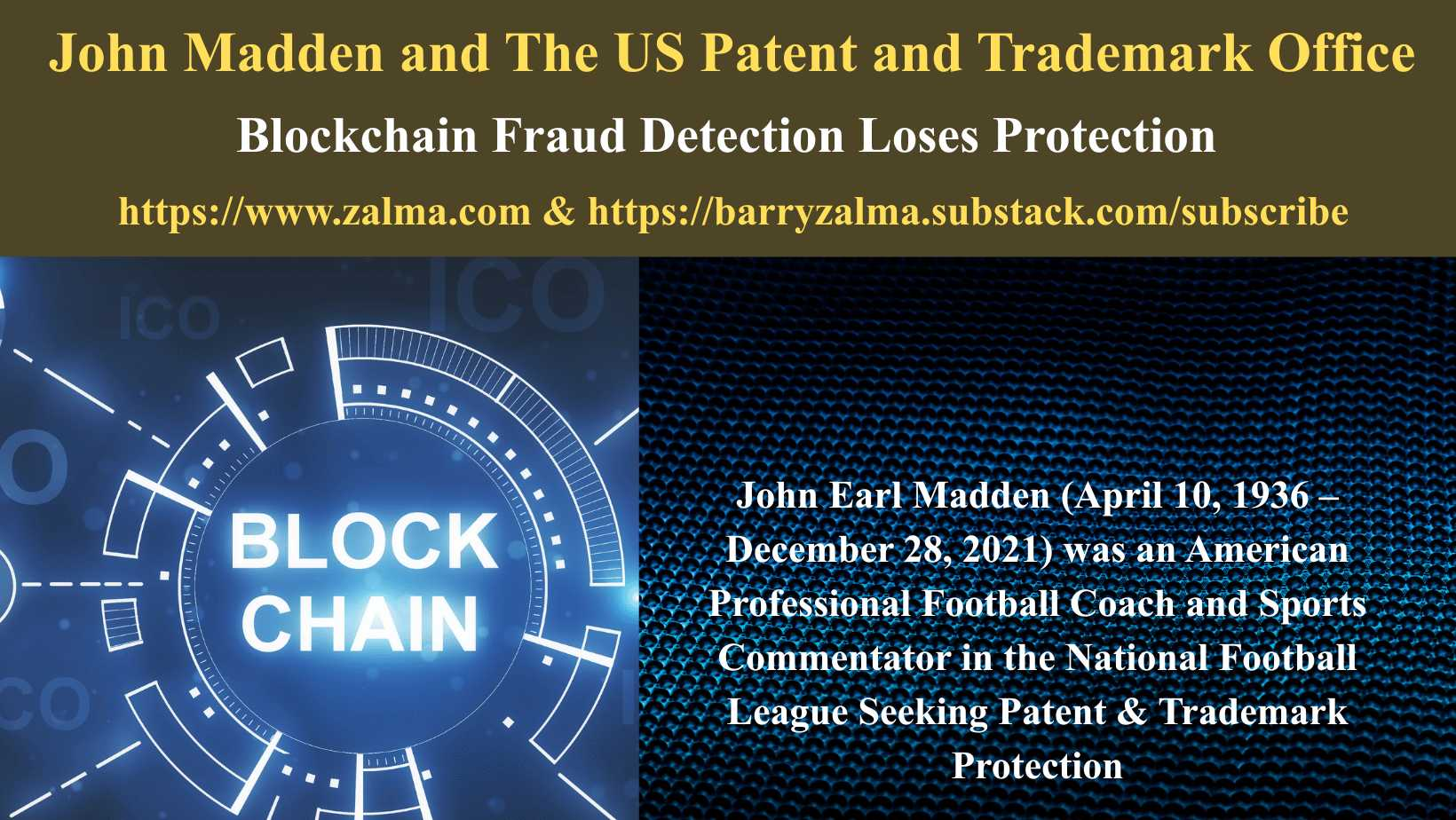
Blockchain Fraud Detection Loses Protection
Posted on October 22, 2026 by Barry Zalma
John Earl Madden (April 10, 1936 – December 28, 2021) was an American Professional Football Coach and Sports Commentator in the National Football League Seeking Patent & Trademark Protection
BLOCKCHAIN FRAUD
Mr. Madden was more than football. He was working to establish a program called “Fraud Protection Systems, Methods, and Computer Programs for Blockchain Financial Transactions.”
In Ex parte John Madden, Appeal 2026-001497, Application 18/495,506, Technology Center 3600, United States Patent and Trademark Office, Patent Trial and Appeal Board (October 14, 2026)
The Examiner rejected claims several numbered claims under 35 U.S.C. § 101 as directed to an abstract idea without significantly more.
THE LAW
Section 101 makes patentable any new and useful process, machine, manufacture, or composition of matter.Laws of nature, natural phenomena, and abstract ideas are implicitly excluded.
THE PATENT TRIAL AND ...
Sovereign Immunity Defeats Suit Against Police Officers
Post 4866
Posted on October 21, 2026 by Barry Zalma
In Chad Lightfoot, et al. v. Progressive Direct Insurance Company, et al., Civil Action No. 26-434, United States District Court, E.D. Louisiana (October 9, 2026) Chad Lightfoot was involved in an Orleans Parish automobile accident in 2011 and filed claims with several insurers, including Progressive.
After a related civil dispute, Progressive counsel allegedly submitted a false affidavit stating that Lightfoot had fraudulently received a $50,000 payment. A New Orleans police detective relied on the affidavit to obtain an arrest warrant, and Louisiana State Police Lieutenant Alan Arcana allegedly reported that Lightfoot had received the payment. Lightfoot was arrested in 2015 and charged with theft, insurance fraud, and perjury.
Plaintiffs alleged that no record of the payment existed and that the criminal charges were dismissed on October 15, 2024.
Lightfoot and Geralyn Hawkins filed suit in October 2025 and ...