

Health Care Providers Created Fraudulent Billing for Covid Instant Tests
Read the full article at https://www.linkedin.com/pulse/insurer-sues-fraudsters-barry-zalma-esq-cfe and see the full video at https://rumble.com/v1ll4ep-insurer-sues-fraudsters.html and at
and at https://zalma.com/blog plus more than 4300 posts.
In OPEN MRI AND IMAGING OF RP VESTIBULAR DIAGNOSTICS, P.A. v. HORIZON BLUE CROSS BLUE SHIELD OF NEW JERSEY, Civ. No. 21-10991 (WJM), United States District Court, D. New Jersey (September 19, 2022) an insurer sued for not paying bills cross-claimed for fraud damages and violation of the the New Jersey Insurance Frauds Prevent Act (IFPA).
Open MRI and Imaging of RP Vestibular Diagnostics, P.A. sued Horizon Blue Cross Blue Shield of New Jersey (“Horizon”) for violations of the Employee Retirement Income Security Act of 1974 (“ERISA”), 29 U.S.C. § 1001 et seq., based on Horizon’s alleged failure to pay insurance claims for COVID-19 rapid testing.
Horizon’s operative pleading, which the Court refers to as the Second Amended Consolidated Counterclaim and Third-Party Complaint, asserts twelve counts for violations of the common law and the New Jersey Insurance Fraud Prevention Act, N.J.S.A. 17:33A-1, et seq., based on an alleged scheme to defraud Horizon. Horizon brings its claims against Plaintiff/Counterclaim Defendant Open MRI et al (collectively, the “Third-Party Defendants”).
BACKGROUND
Horizon is an insurance company with its principal place of business in Newark, New Jersey. It provides healthcare benefits for insured subscribers pursuant to a variety of healthcare plans and policies issued or administered throughout the state.
Open MRI and others are medical practices all located in Rochelle Park, New Jersey.
The Alleged Scheme to Defraud Horizon
In April of 2020, as the novel COVID-19 virus spread throughout the United States, Open began offering rapid COVID-19 tests to members of the public at their joint practice location. Overall, these rapid test “appointments” at Open MRI as reported by Horizon members, were very brief, taking no longer than five minutes and involved little to no interaction with a licensed physician. Open MRI charged patients $35 at the time of service and then submitted claims to Horizon for further payment.
To submit a health insurance claim, healthcare providers must complete standard billing forms. The billing forms require providers to use specific numeric codes that describe the services for which the provider seeks payment. Federal regulations designate the standard code systems that providers use in order to ensure that health insurance claims are processed efficiently and consistently. In turn, insurance companies like Horizon rely on providers to input codes that most appropriately and accurately describe the services provided to patients so that the insurer can adjudicate claims and secure reimbursement pursuant to the patient’s health benefits plan.
According to Horizon, from April of 2020 onward, the cross-defendants submitted insurance claims seeking grossly inflated billed charges for medical services that were performed unlawfully or not performed at all, and that were unnecessary or inappropriate to administering rapid COVID-19 tests.
Billing for Services Rendered Unlawfully
From April of 2020 through September of 2020, the cross-defendants were not certified as “Authorized Laboratories” under the Comprehensive Laboratory Improvement Act (“CLIA”), and thus were not permitted to administer rapid COVID-19 tests. Nonetheless the cross defendants, administered rapid COVID-19 tests to patients and then submitted claims to Horizon for reimbursement. Horizon ultimately paid more than $140,000, and these claims for services that were rendered unlawfully.
Billing for Services That Were Not Rendered
Each time the cross-defendants submitted a claim for a rapid COVID-19 test rendered on a Horizon member, they also billed for “specimen handling,” which requires the sample collected for testing to be transferred from the provider’s office to a laboratory. Rapid COVID-19 tests, however, do not require transfer of the patients’ specimens to a laboratory for testing because they are “point of care tests” performed in the provider’s office. Yet, the cross-defendants knowingly submitted claims for “specimen handling” services that never occurred and were unnecessary in administering rapid tests. Horizon collectively paid them more than $7,000 on these claims.
Additionally, each time the cross-defendants submitted a claim for a rapid COVID-19 test rendered on a Horizon member, they also billed for moderate- and high-level evaluation and management (“E&M”) services. These moderate- and high-level E&M billing codes are to be used where a healthcare provider spends thirty to sixty minutes face-to-face with a patient, takes a detailed medical history and performs a detailed examination, and utilizes medical decision making of low, moderate, or high complexity. Even though Horizon members’ minutes-long encounters for a rapid COVID-19 test involved only a temperature check, a few “prescreen” questions, and a nasal swab, and cross-defendants nonetheless billed Horizon for more significant E&M services that were not actually rendered. Horizon collectively paid them in excess of $300,000 on these claims.
Horizon’s Claims Against the Third-Party Defendants
Horizon asserts twelve causes of action against the Third-Party Defendants all involving illegal or fraudulent billing.
DISCUSSION
A claim for common law fraud resembles a private action brought by an insurance company under the IFPA, but because the IFPA New Jersey Insurance Frauds Prevent Act (IFPA) sweeps more broadly than common law fraud plaintiffs are required to establish fewer elements when alleging fraud in violation of the statute. Unlike common law fraud, the IFPA does not require proof of reliance on the false statement or resultant damages, nor proof of intent to deceive. A plaintiff need only establish that (1) defendant presented false or misleading information in connection with submitting an insurance claim; (2) defendant knew the information was false or misleading; and (3) information was material to a claim for reimbursement under an insurance policy.
Horizon has pleaded ample details of the who, what, when, where, and how of the underlying fraudulent scheme to state a claim for common law fraud and violations of the IFPA.
ZALMA OPINION
Horizon should be commended for using the IFPA to defeat fraud related to alleged COVID-19 testing and medical treatment that was neither rendered nor necessary. The group of testers and physicians had the unmitigated gall to sue for payment of claims that they new or should have known were not appropriate, were provided by unlicensed professionals and were were inflated billing for 30 minutes face to face with a patient when they never spent more than 5 minutes if any time at all. Fraud will only be defeated or deterred if the profit motive is taken from the act and hopefully the evidence collected in this civil action is also evidence of multiple crimes.
(c) 2022 Barry Zalma & ClaimSchool, Inc.
Barry Zalma, Esq., CFE, now limits his practice to service as an insurance consultant specializing in insurance coverage, insurance claims handling, insurance bad faith and insurance fraud almost equally for insurers and policyholders. He practiced law in California for more than 44 years as an insurance coverage and claims handling lawyer and more than 54 years in the insurance business. He is available at http://www.zalma.com and [email protected] and receive videos limited to subscribers of Excellence in Claims Handling at locals.com https://zalmaoninsurance.locals.com/subscribe.Subscribe to Excellence in Claims Handling at https://barryzalma.substack.com/welcome.Now available Barry Zalma’s newest book, The Tort of Bad Faith, available here. The new book is available as a Kindle book, a paperback or as a hard cover.
Write to Mr. Zalma at [email protected]; http://www.zalma.com; http://zalma.com/blog; daily articles are published at https://zalma.substack.com. Go to the podcast Zalma On Insurance at https://anchor.fm/barry-zalma; Follow Mr. Zalma on Twitter at https://twitter.com/bzalma; Go to Barry Zalma videos at Rumble.com at https://rumble.com/c/c-262921; Go to Barry Zalma on YouTube- https://www.youtube.com/channel/UCysiZklEtxZsSF9DfC0Expg; Go to the Insurance Claims Library – https://zalma.com/blog/insurance-claims-library

Insurance Expert May Not Testify to Speculative and Contains Unsupported Conclusions.
Posted on September 18, 2026 by Barry Zalma
See the full video at and at https://rumble.com/v7fmifw-expert-may-only-testify-to-what-experience-supports.html
In Michele A. Over, and The Estate Of Paul R. Over v. State Farm Mutual Automobile Insurance Company, and State Farm Fire And Casualty Company, Civil Action No. 23-cv-02243-PAB-STV, United States District Court, D. Colorado (September 14, 2026) Michele and Paul Over sued State Farm Fire and State Farm Auto over hail-damage and stolen-vehicle claims.
The operative dispute concerned State Farm Auto’s motion to exclude or limit opinions from plaintiffs’ insurance-industry expert, Aaron Castillo. Castillo.
Law
The proponent of expert testimony must establish by a preponderance of the evidence that an expert is qualified and that the opinions are helpful, sufficiently grounded, and reliably derived and applied. Experience-based opinions must explain how the...
150 Months in Prison for Tax Fraud
Post 4846
Posted on September 17, 2026 by Barry Zalma
See the full video at https://lnkd.in/g8rh3JBX and https://lnkd.in/gmkdy-9C, In United States Of America v. Thomas Addaquay, Nos. 25-10609, 25-10611, United States Court of Appeals, Eleventh Circuit (September 9, 2026) the Eleventh Circuit affirmed all challenged convictions, the 150-month aggregate sentence, and the challenged $4,123,474.55 restitution award.
FACTS
In United States Of America v. Thomas Addaquay, United States Of America v. Thomas Addaquay, Nos. 25-10609, 25-10611, United States Court of Appeals, Eleventh Circuit (September 9, 2026) the Eleventh Circuit affirmed all challenged convictions, the 150-month aggregate sentence, and the challenged $4,123,474.55 restitution award.
FACTS
Thomas Addaquay controlled United Consolidated Accounting and Business Services (UC), nominally a check-cashing business.
The government proved a three-stage tax-refund scheme that converted the resulting refund checks into usable funds through ...
Major Fraud Perpetrator Asserts Fifth Amendment Privilege to Avoid Prosecution
Post 5489
Posted on September 14, 2026 by Barry Zalma
Fraudster Refuses to Answer Questions About His Alleged Fraud
See the full video at https://lnkd.in/gvicAMDr and at https://lnkd.in/gvicAMDr
In Great American Insurance Co. v. Gemstone Property Management, LLC, et al., No. 23-cv-9100 (LJL), United States District Court, S.D. New York (September 8, 2026) Great American Insurance Company alleged that it was defrauded through a scheme in which Subin Associates, LLP recruited individuals to stage construction-site injuries, arranged unnecessary medical treatment and litigation funding, and pursued fraudulent personal-injury claims.
Luis Manuel Garcia Salcedo, resulted in a $6 million settlement. Non-party Jose Hernandez allegedly worked as an assistant manager at Subin, operated Hernandez Associates, and owned litigation-funding companies that shared office space with Subin and provided services to its clients.
After Great American ...
Plaintiff’s Reading of the Policy is Plaintiff’s Reasonable Allegations
Posted on October 19, 2026 by Barry Zalma
Post 4868
CLASS ACTION THAT STATES A SIMPLE CLEAR AND PLAUSIBLE CAUSE OF ACTION SURVIVES
In Sheila Marino v. Farmers New World Life Insurance Company, No. 2:25-cv-02200-JNW, United States District Court, W.D. Washington, Seattle (October 13, 2026) defendant Farmers New World Life Insurance Company’s (“FNWL”) moved to dismiss Plaintiff Sheila Marino’s putative class action involving flexible universal life insurance.
Marino filed a putative class action in King County Superior Court alleging: (1) breach of contract, (2) breach of the implied covenant of good faith and fair dealing, and (3) violation of the Washington Consumer Protection Act (CPA).
She pleaded two theories: an “overcharge” theory and an “underpayment of interest” theory asked the Court to take judicial notice of historical Federal Funds Effective Rates.
THE LAW
Pleading Standard.
To survive a Rule 12(b)(6) motion, a ...

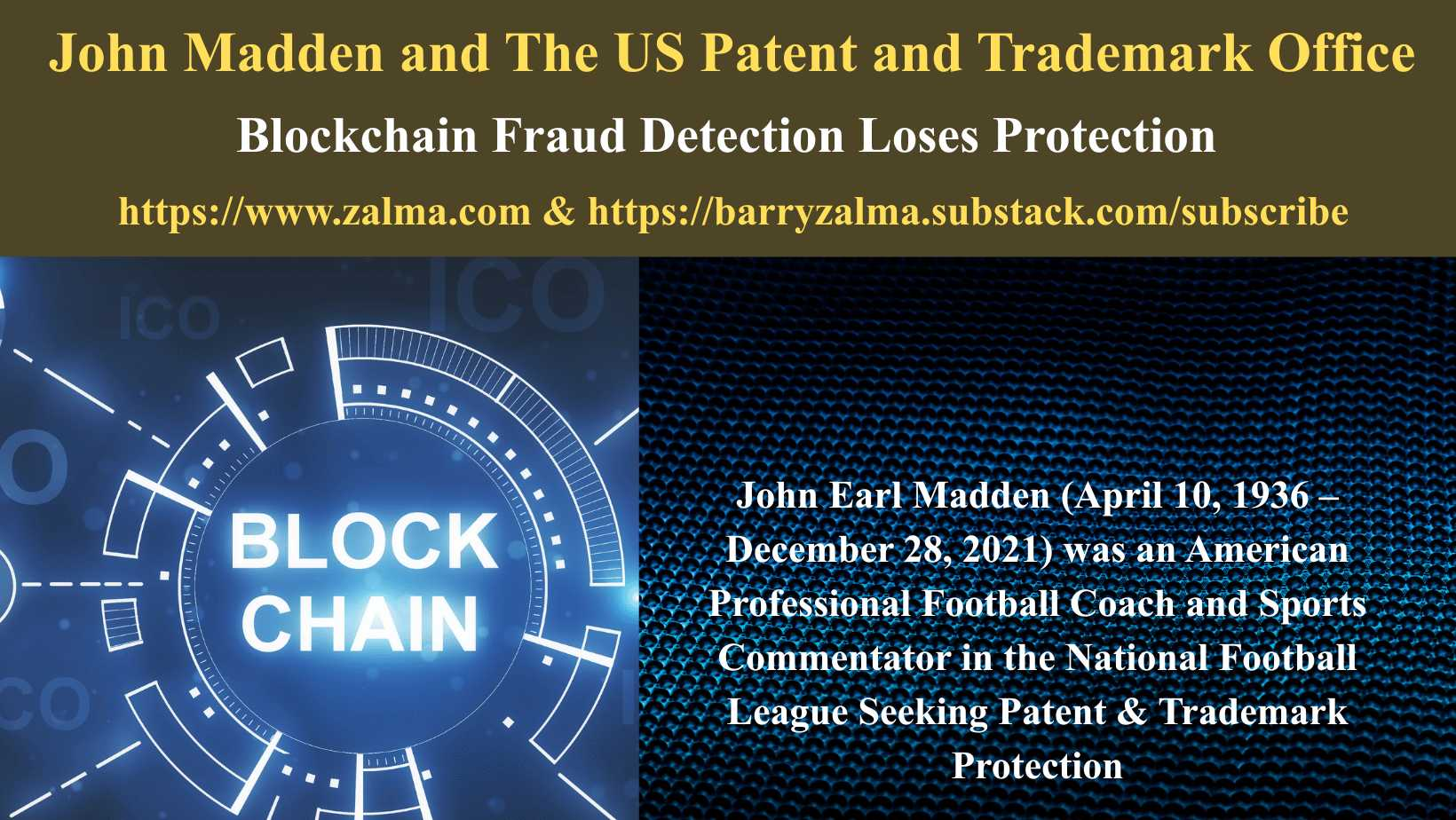
Blockchain Fraud Detection Loses Protection
Posted on October 22, 2026 by Barry Zalma
John Earl Madden (April 10, 1936 – December 28, 2021) was an American Professional Football Coach and Sports Commentator in the National Football League Seeking Patent & Trademark Protection
BLOCKCHAIN FRAUD
Mr. Madden was more than football. He was working to establish a program called “Fraud Protection Systems, Methods, and Computer Programs for Blockchain Financial Transactions.”
In Ex parte John Madden, Appeal 2026-001497, Application 18/495,506, Technology Center 3600, United States Patent and Trademark Office, Patent Trial and Appeal Board (October 14, 2026)
The Examiner rejected claims several numbered claims under 35 U.S.C. § 101 as directed to an abstract idea without significantly more.
THE LAW
Section 101 makes patentable any new and useful process, machine, manufacture, or composition of matter.Laws of nature, natural phenomena, and abstract ideas are implicitly excluded.
THE PATENT TRIAL AND ...
Sovereign Immunity Defeats Suit Against Police Officers
Post 4866
Posted on October 21, 2026 by Barry Zalma
In Chad Lightfoot, et al. v. Progressive Direct Insurance Company, et al., Civil Action No. 26-434, United States District Court, E.D. Louisiana (October 9, 2026) Chad Lightfoot was involved in an Orleans Parish automobile accident in 2011 and filed claims with several insurers, including Progressive.
After a related civil dispute, Progressive counsel allegedly submitted a false affidavit stating that Lightfoot had fraudulently received a $50,000 payment. A New Orleans police detective relied on the affidavit to obtain an arrest warrant, and Louisiana State Police Lieutenant Alan Arcana allegedly reported that Lightfoot had received the payment. Lightfoot was arrested in 2015 and charged with theft, insurance fraud, and perjury.
Plaintiffs alleged that no record of the payment existed and that the criminal charges were dismissed on October 15, 2024.
Lightfoot and Geralyn Hawkins filed suit in October 2025 and ...