
Experts Prove All Claimed Damages are Wear and Tear
Read the full article at https://www.linkedin.com/pulse/fake-claim-experts-claims-fail-barry-zalma-esq-cfe and see the full video at https://rumble.com/v1g37tz-fake-claim-fake-experts-claims-fail.html and at
and at https://zalma.com/blog plus more than 4300 posts.
It is not proper to try to shoe-horn a distant explosion into a claim for property damage to an old, worn out house, whose damages had no relationship to the explosion. In fact, making the claim for pre-exisiting damages is fraudulent.
In John Hall v. State Farm Lloyds, Civil Action No. H-21-1769, United States District Court, S.D. Texas, Houston Division (July 28, 2022) the USDC in Texas resolved the dispute after considering all of the evidence presented by the parties.
BACKGROUND
Hall alleges that his home was damaged by an explosion that occurred 1.8 miles away from his house. State Farm moved for summary judgment, submitting reports from two engineers who separately inspected the property and concluded that the damage they observed was not caused by the explosion, but instead by “normal wear and tear, minor material and installation deficiencies, a lack of maintenance, as well as expansion and contraction of the building materials due to naturally occurring variations in temperature and humidity.”
Hall has a homeowner’s insurance policy with State Farm. The policy “insure[s] for accidental direct physical loss to the property,” but it does not cover losses caused by natural wear and tear, deterioration, or “settling, cracking, shrinking, bulging, or expansion of . . . foundation, walls, floors, roofs, or ceilings.”
On January 24, 2020, a propylene-tank leak caused an explosion at Watson Grinding and Manufacturing at 4525 Gessner Road, in Houston, Texas. Hall’s home-which was built in 1960 and which Hall purchased in 1983-is 1.8 miles from the explosion site. Hall did not hear or feel anything from the explosion, which occurred when he was asleep. He heard about the explosion later that day on the news.
After learning of the explosion, Hall inspected the home “but . . . did not see any damage at that time.” Hall began to suspect that he “did, in fact, sustain damage to [his] home from that explosion” only when the ceiling in his garage fell down six or seven months later, in July or August 2020. After Hall removed fallen sheetrock from the garage floor, he inspected the ceiling and noticed that “the joists . . . were bowed.” Hall saw no other damage on the inside or outside of his home.
Hall retained counsel and submitted a claim in September 2020 under the policy. In April 2021, Hall filed this lawsuit against State Farm, even though it had not yet resolved Hall’s claim. The delay was largely due to difficulties in getting the property inspection done. The complaint included seemingly irrelevant and false allegations, including that State Farm acted in bad faith “in an action for property damage due to plumbing leaks” and that “the insurer was found to have hired an investigating firm biased against finding liability.” Hall’s claim was not for “plumbing leaks,” and State Farm had not denied Hall’s claim at that point.
State Farm had inspected Hall’s property only a few days before Hall filed his lawsuit. One reason for the delay was that the engineer State Farm hired to inspect Hall’s property “asked to be removed” from the assignment because of “concerns in regards to communication between [Hall’s] attorney rep and the engineer . . . and directives [from Hall’s attorney] on how the inspection was going to be completed.” That engineer later “submit an invoice for the amount of time” he spent unsuccessfully “attempt[ing] to coordinate the visits” to Hall’s property. In short, Hall’s counsel appears to have been a significant reason for State Farm’s delay in adjusting the claim.
State Farm did retain a second engineer-Dan Rich from Rich Engineering-who was able to inspect the property in March 2021, but not without difficulty. Hall’s counsel refused to allow Rich to speak with Hall “regarding the history of the residence or the damage that was being attributed to the WGM explosion.” At the time of the inspection, “Rich Engineering was not informed of what damage Mr. Hall was specifically attributing to the explosion.” After the inspection, Rich Engineering emailed Hall’s counsel a list of questions about the property. Neither Hall nor his counsel responded.
Based on the inspection, Rich Engineering concluded that “[t]he residence was not damaged by the explosion.” The report states that: the “foundation was not damaged by the explosion”; cracks in the drywall “were consistent with normal wear and tear, minor material and installation deficiencies, a lack of maintenance, as well as expansion and contraction of the building materials due to naturally occurring variation in temperature and humidity”; the roof was not damaged; cracks in the attic framing “were aged . . . indicat[ing] that the damage predated the explosion”; the “brick veneer cracks had an aged appearance which indicated that they predated the explosion”; and “Rich Engineering did not observe any broken window panes during its site visit.”
As a result of Rich Engineering’s report, State Farm informed Hall’s counsel in May 2021 that it was denying Hall’s claim. The denial letter stated that State Farm’s “investigation revealed the residence was not damaged by the explosion.”
State Farm also hired a structural forensic investigator to inspect the property, BSC Forensic Services, LLC, “to document conditions consistent with the effects of an explosion that occurred on January 24, 2020, at the Watson Grinding Facility, if any.” The BSC report noted that “BSC’s inspection revealed no conditions at the subject property that could be attributed to energy waves associated with the reported explosion,” and noted that “the surrounding properties of similar construction also exhibited no such evidence.” The report concluded that the “collapsed ceiling in the garage . . . was attributable to long-term sagged condition of the ceiling joists associated with improper lumber (large knots) and excessive loading from roof beam supports in the attic space above,” and that this condition was not “caused or exacerbated by the reported explosion event.”
“Experts” Must See the Damage and Have Qualifications to Testify
Hall responded with a report from an engineer who did not visit the property, did not review State Farm’s experts’ reports, and did not state any basis for opining that the home “seemed” to be damaged by the explosion. Hall also submitted a report from a meteorologist whose speculations as to the root cause of the alleged damage are both beyond his expertise and unhelpful.
The Motion to Exclude Expert Testimony
Rule 702 charges trial courts to act as “gate-keepers,” making a preliminary assessment of whether the reasoning or methodology underlying the testimony is scientifically valid and of whether that reasoning or methodology properly can be applied to the facts in issue. Expert testimony must be both “relevant and reliable” to be admissible.
Greg Degeyter’s Report
Greg Degeyter is a lawyer who has also worked as a volunteer meteorologist and an adjunct professor in Lamar University’s Department of Earth and Space Science. Degeyter, as a meteorologist, is qualified to testify as to weather events at Hall’s property. Degeyter is perhaps qualified to testify as to whether certain weather events are likely to cause property damage. Degeyter is unqualified to testify as to the extent of the effects of a distant explosion and whether the damage found in Hall’s home was at all related to that explosion.
Shiran Perera’s Report
Shiran Perera is a structural engineer who was designated to opine on whether the blast “caused damage[] to the insured property.” Perera speculated that there was some damage that “seemed” to be related to or could “possibly” be consistent with vibration-related damages. It was excluded because his testimony was unreliable.
The Motion for Summary Judgment
The dispute is whether the damage to Hall’s home was caused by an explosion months earlier and 1.8 miles away. State Farm presented ample evidence that “[t]he residence was not damaged by the explosion.” Hall’s evidence-construed generously- supports only the conclusions that Hall’s home had several structural issues (as demonstrated by the photographs), that an explosion 1.8 miles away occurred in January 2020, and six months after the explosion, parts of the garage ceiling fell, and some cracks were found.
Hall presented no evidence that the explosion did, in fact, damage his home.
As a matter of law, State Farm did not breach the policy by denying Hall’s claim for coverage. The breach of contract claim was, therefore, dismissed. Hall did not point to or present admissible evidence showing that State Farm violated the Texas Insurance Code, engaged in deceptive trade practices, breached a duty of good faith and fair dealing, conspired to commit illegal acts, or committed fraud. These claims were also dismissed.
ZALMA OPINION
The decision was obvious. State Farm presented evidence and Hall presented speculation while working hard to set up a bad faith case against State Farm. By dismissing the suit the court did what it was required to do. It should, however, in my opinion have also reported Hall to the US Attorney for attempting to defraud State Farm.
(c) 2022 Barry Zalma & ClaimSchool, Inc.
Barry Zalma, Esq., CFE, now limits his practice to service as an insurance consultant specializing in insurance coverage, insurance claims handling, insurance bad faith and insurance fraud almost equally for insurers and policyholders. He practiced law in California for more than 44 years as an insurance coverage and claims handling lawyer and more than 54 years in the insurance business. He is available at http://www.zalma.com and [email protected].
Subscribe and receive videos limited to subscribers of Excellence in Claims Handling at locals.com https://zalmaoninsurance.locals.com/subscribe.
Subscribe to Excellence in Claims Handling at https://barryzalma.substack.com/welcome.
Write to Mr. Zalma at [email protected]; http://www.zalma.com; http://zalma.com/blog; daily articles are published at https://zalma.substack.com.
Go to the podcast Zalma On Insurance at https://anchor.fm/barry-zalma; Follow Mr. Zalma on Twitter at https://twitter.com/bzalma; Go to Barry Zalma videos at Rumble.com at https://rumble.com/c/c-262921; Go to Barry Zalma on YouTube- https://www.youtube.com/channel/UCysiZklEtxZsSF9DfC0Expg; Go to the Insurance Claims Library – https://zalma.com/blog/insurance-claims-library/

Insurance Expert May Not Testify to Speculative and Contains Unsupported Conclusions.
Posted on September 18, 2026 by Barry Zalma
See the full video at and at https://rumble.com/v7fmifw-expert-may-only-testify-to-what-experience-supports.html
In Michele A. Over, and The Estate Of Paul R. Over v. State Farm Mutual Automobile Insurance Company, and State Farm Fire And Casualty Company, Civil Action No. 23-cv-02243-PAB-STV, United States District Court, D. Colorado (September 14, 2026) Michele and Paul Over sued State Farm Fire and State Farm Auto over hail-damage and stolen-vehicle claims.
The operative dispute concerned State Farm Auto’s motion to exclude or limit opinions from plaintiffs’ insurance-industry expert, Aaron Castillo. Castillo.
Law
The proponent of expert testimony must establish by a preponderance of the evidence that an expert is qualified and that the opinions are helpful, sufficiently grounded, and reliably derived and applied. Experience-based opinions must explain how the...
150 Months in Prison for Tax Fraud
Post 4846
Posted on September 17, 2026 by Barry Zalma
See the full video at https://lnkd.in/g8rh3JBX and https://lnkd.in/gmkdy-9C, In United States Of America v. Thomas Addaquay, Nos. 25-10609, 25-10611, United States Court of Appeals, Eleventh Circuit (September 9, 2026) the Eleventh Circuit affirmed all challenged convictions, the 150-month aggregate sentence, and the challenged $4,123,474.55 restitution award.
FACTS
In United States Of America v. Thomas Addaquay, United States Of America v. Thomas Addaquay, Nos. 25-10609, 25-10611, United States Court of Appeals, Eleventh Circuit (September 9, 2026) the Eleventh Circuit affirmed all challenged convictions, the 150-month aggregate sentence, and the challenged $4,123,474.55 restitution award.
FACTS
Thomas Addaquay controlled United Consolidated Accounting and Business Services (UC), nominally a check-cashing business.
The government proved a three-stage tax-refund scheme that converted the resulting refund checks into usable funds through ...
Major Fraud Perpetrator Asserts Fifth Amendment Privilege to Avoid Prosecution
Post 5489
Posted on September 14, 2026 by Barry Zalma
Fraudster Refuses to Answer Questions About His Alleged Fraud
See the full video at https://lnkd.in/gvicAMDr and at https://lnkd.in/gvicAMDr
In Great American Insurance Co. v. Gemstone Property Management, LLC, et al., No. 23-cv-9100 (LJL), United States District Court, S.D. New York (September 8, 2026) Great American Insurance Company alleged that it was defrauded through a scheme in which Subin Associates, LLP recruited individuals to stage construction-site injuries, arranged unnecessary medical treatment and litigation funding, and pursued fraudulent personal-injury claims.
Luis Manuel Garcia Salcedo, resulted in a $6 million settlement. Non-party Jose Hernandez allegedly worked as an assistant manager at Subin, operated Hernandez Associates, and owned litigation-funding companies that shared office space with Subin and provided services to its clients.
After Great American ...
Plaintiff’s Reading of the Policy is Plaintiff’s Reasonable Allegations
Posted on October 19, 2026 by Barry Zalma
Post 4868
CLASS ACTION THAT STATES A SIMPLE CLEAR AND PLAUSIBLE CAUSE OF ACTION SURVIVES
In Sheila Marino v. Farmers New World Life Insurance Company, No. 2:25-cv-02200-JNW, United States District Court, W.D. Washington, Seattle (October 13, 2026) defendant Farmers New World Life Insurance Company’s (“FNWL”) moved to dismiss Plaintiff Sheila Marino’s putative class action involving flexible universal life insurance.
Marino filed a putative class action in King County Superior Court alleging: (1) breach of contract, (2) breach of the implied covenant of good faith and fair dealing, and (3) violation of the Washington Consumer Protection Act (CPA).
She pleaded two theories: an “overcharge” theory and an “underpayment of interest” theory asked the Court to take judicial notice of historical Federal Funds Effective Rates.
THE LAW
Pleading Standard.
To survive a Rule 12(b)(6) motion, a ...

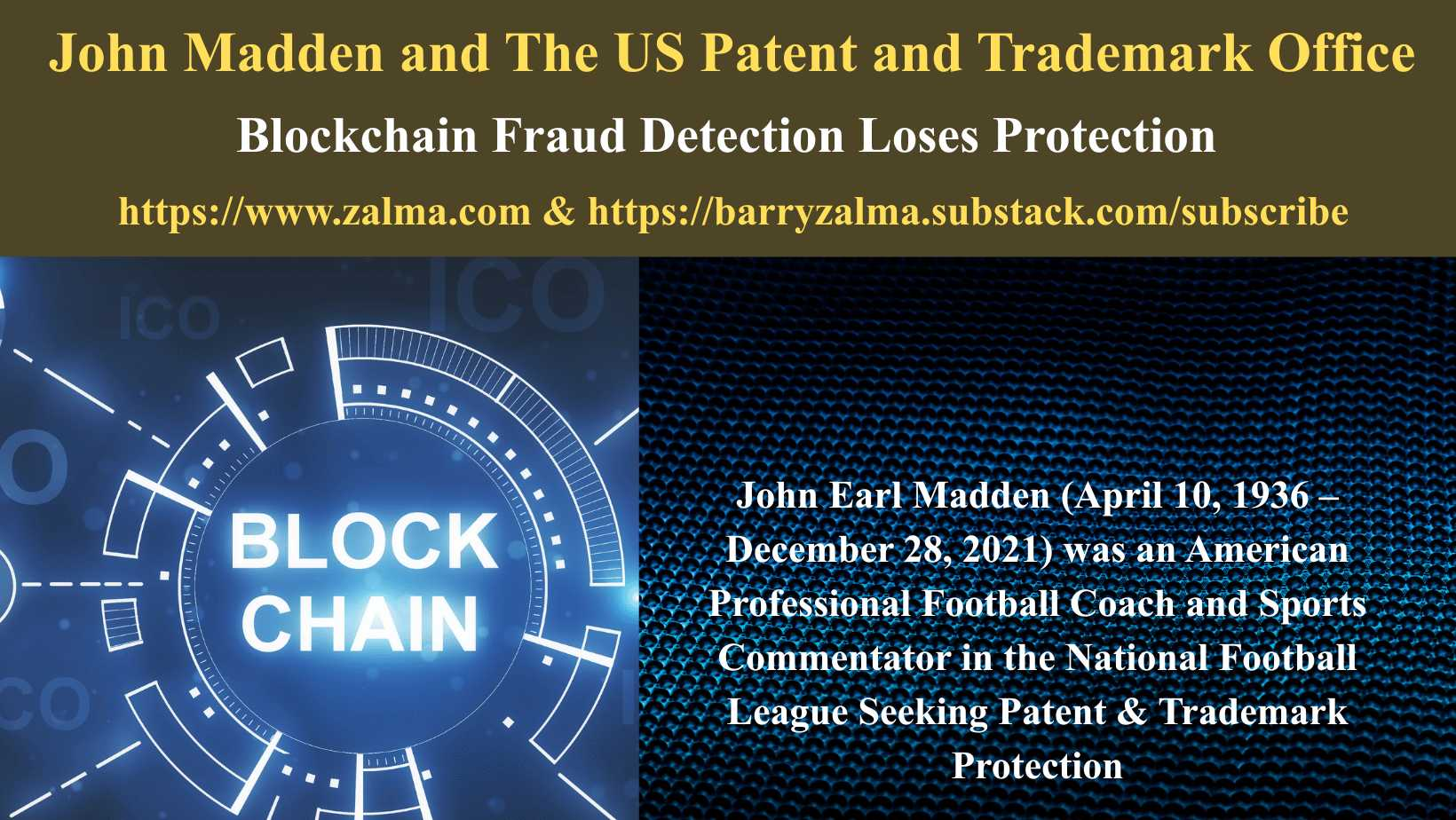
Blockchain Fraud Detection Loses Protection
Posted on October 22, 2026 by Barry Zalma
John Earl Madden (April 10, 1936 – December 28, 2021) was an American Professional Football Coach and Sports Commentator in the National Football League Seeking Patent & Trademark Protection
BLOCKCHAIN FRAUD
Mr. Madden was more than football. He was working to establish a program called “Fraud Protection Systems, Methods, and Computer Programs for Blockchain Financial Transactions.”
In Ex parte John Madden, Appeal 2026-001497, Application 18/495,506, Technology Center 3600, United States Patent and Trademark Office, Patent Trial and Appeal Board (October 14, 2026)
The Examiner rejected claims several numbered claims under 35 U.S.C. § 101 as directed to an abstract idea without significantly more.
THE LAW
Section 101 makes patentable any new and useful process, machine, manufacture, or composition of matter.Laws of nature, natural phenomena, and abstract ideas are implicitly excluded.
THE PATENT TRIAL AND ...
Sovereign Immunity Defeats Suit Against Police Officers
Post 4866
Posted on October 21, 2026 by Barry Zalma
In Chad Lightfoot, et al. v. Progressive Direct Insurance Company, et al., Civil Action No. 26-434, United States District Court, E.D. Louisiana (October 9, 2026) Chad Lightfoot was involved in an Orleans Parish automobile accident in 2011 and filed claims with several insurers, including Progressive.
After a related civil dispute, Progressive counsel allegedly submitted a false affidavit stating that Lightfoot had fraudulently received a $50,000 payment. A New Orleans police detective relied on the affidavit to obtain an arrest warrant, and Louisiana State Police Lieutenant Alan Arcana allegedly reported that Lightfoot had received the payment. Lightfoot was arrested in 2015 and charged with theft, insurance fraud, and perjury.
Plaintiffs alleged that no record of the payment existed and that the criminal charges were dismissed on October 15, 2024.
Lightfoot and Geralyn Hawkins filed suit in October 2025 and ...