
Fraud Perpetrator’s Attempt to Avoid Jail Fails
Read the full article at https://lnkd.in/gQ5tFc7C and see the video at https://lnkd.in/gAFhHHTv and at https://lnkd.in/gkt8idGF and at https://zalma.com/blog plus more than 4250 posts.
After being convicted of multiple counts of fraud Ejaz Shreef was sentenced to a term of imprisonment for 48 months on each count, concurrent, followed by two years of supervised release.
In Ejaz Shreef v. United States of America, Nos. 3:18-cr-157-RJC-DCK-2, 3:22-cv-78-RJC, United States District Court, W.D. North Carolina, Charlotte Division (July 8, 2022) resolved his motion to reduce his sentence.
BACKGROUND
A federal grand jury indicted Shreef, along with three coconspirators, with conspiracy to commit wire and bank fraud (Count One); and conspiracy to commit money laundering (Count Two). As to Count One, the Indictment charged that, “[f]rom in or about April 2009 through in or about April 2018, … [Shreef and the coconspirators] did knowingly, conspire to commit offenses against the United States, including violations of Title 18, United States Code, Sections 1343 (wire fraud) and 1344 (bank fraud).”
Shreef proceeded to a jury trial and the jury convicted him on both counts. On direct appeal, Shreef argued that the insurance fraud scheme supporting the wire fraud object of the conspiracy concluded prior to the running of the statute of limitations and, even if the charge was timely, insufficient evidence supported the jury’s verdict; evidence of prior bad acts was inappropriately admitted against him; and trial counsel was ineffective for failing to request a “reliance-on-expert” jury instruction.
On April 9, 2021, the Fourth Circuit affirmed the Court’s Judgment and declined to address the ineffective assistance of counsel claim.
Shreef, unwilling to accept the Fourth Circuit’s decision, filed a Motion to Vacate. Shreef argued:
prosecutorial misconduct for the Government submitting 18 U.S.C. §§ 1343 and 1344 to support Shreef’s conviction “without submitting such statutes to the grand jury;” and
ineffective assistance of trial and appellate counsel for failing to adequately investigate the case; and
allowing the Government to convict or maintain a conviction unconstitutionally.
DISCUSSION
Shreef argued that the Government “overreach[ed]” and the Verdict Form submitted to the jury mirrored the charges set forth in the Indictment. Consistent with the Indictment, the jury found that “wire fraud,” and “bank fraud,” were objects of the conspiracy.
Ineffective Assistance of Counsel
The Sixth Amendment to the U.S. Constitution guarantees the accused the right to the assistance of counsel for his defense. To show ineffective assistance of counsel, Shreef must establish a deficient performance by counsel and, second, that the deficient performance prejudiced him.
Courts are required to recognize the strong presumption that counsel’s conduct falls within the wide range of reasonable professional assistance. Furthermore, in considering the prejudice prong of the analysis, the Court can only grant relief if the result of the proceeding was fundamentally unfair or unreliable.
Shreef bears the burden of showing that there is a reasonable probability that but for counsel’s failure to raise an issue on appeal, the result of the proceeding would have been different; i.e., that he would have prevailed on appeal.
The court concluded that there was no deficient performance by Shreef’s trial or appellate counsel for their failure to raise or attempt to support a frivolous argument. Moreover, Shreef failed to allege or shown any prejudice.
Therefore, Shreef’s Motion to Vacate was dismissed and denied.
ZALMA OPINION
Insurance fraud perpetrators do not expect to be caught. Experience shows that a very small percentage of fraud perpetrators are caught, even smaller groups are prosecuted and even smaller groups are convicted. Those who are convicted, like Mr. Shreef, believe that the only reason they were caught and convicted had to be the fault of someone else and claim prosecutorial misconduct and inadequacy of counsel. Since their crimes, but for the conviction, were probably successful, they have funds to support appeals and motions to keep themselves out of jail. Mr. Shreef’s second attempt properly failed.
Just published
Random Thoughts on Insurance Volume XIV: A Collection of Blog Posts from Zalma on Insurance —
(c) 2022 Barry Zalma & ClaimSchool, Inc.
Barry Zalma, Esq., CFE, now limits his practice to service as an insurance consultant specializing in insurance coverage, insurance claims handling, insurance bad faith and insurance fraud almost equally for insurers and policyholders. He practiced law in California for more than 44 years as an insurance coverage and claims handling lawyer and more than 54 years in the insurance business. He is available at http://www.zalma.com and [email protected].
Subscribe and receive videos limited to subscribers of Excellence in Claims Handling at locals.com https://zalmaoninsurance.locals.com/subscribe.
Subscribe to Excellence in Claims Handling at https://barryzalma.substack.com/welcome.
Write to Mr. Zalma at [email protected]; http://www.zalma.com; http://zalma.com/blog; daily articles are published at https://zalma.substack.com.
Go to the podcast Zalma On Insurance at https://anchor.fm/barry-zalma; Follow Mr. Zalma on Twitter at https://twitter.com/bzalma; Go to Barry Zalma videos at Rumble.com at https://rumble.com/c/c-262921; Go to Barry Zalma on YouTube- https://www.youtube.com/channel/UCysiZklEtxZsSF9DfC0Expg; Go to the Insurance Claims Library – https://zalma.com/blog/insurance-claims-library/

Insurance Expert May Not Testify to Speculative and Contains Unsupported Conclusions.
Posted on September 18, 2026 by Barry Zalma
See the full video at and at https://rumble.com/v7fmifw-expert-may-only-testify-to-what-experience-supports.html
In Michele A. Over, and The Estate Of Paul R. Over v. State Farm Mutual Automobile Insurance Company, and State Farm Fire And Casualty Company, Civil Action No. 23-cv-02243-PAB-STV, United States District Court, D. Colorado (September 14, 2026) Michele and Paul Over sued State Farm Fire and State Farm Auto over hail-damage and stolen-vehicle claims.
The operative dispute concerned State Farm Auto’s motion to exclude or limit opinions from plaintiffs’ insurance-industry expert, Aaron Castillo. Castillo.
Law
The proponent of expert testimony must establish by a preponderance of the evidence that an expert is qualified and that the opinions are helpful, sufficiently grounded, and reliably derived and applied. Experience-based opinions must explain how the...
150 Months in Prison for Tax Fraud
Post 4846
Posted on September 17, 2026 by Barry Zalma
See the full video at https://lnkd.in/g8rh3JBX and https://lnkd.in/gmkdy-9C, In United States Of America v. Thomas Addaquay, Nos. 25-10609, 25-10611, United States Court of Appeals, Eleventh Circuit (September 9, 2026) the Eleventh Circuit affirmed all challenged convictions, the 150-month aggregate sentence, and the challenged $4,123,474.55 restitution award.
FACTS
In United States Of America v. Thomas Addaquay, United States Of America v. Thomas Addaquay, Nos. 25-10609, 25-10611, United States Court of Appeals, Eleventh Circuit (September 9, 2026) the Eleventh Circuit affirmed all challenged convictions, the 150-month aggregate sentence, and the challenged $4,123,474.55 restitution award.
FACTS
Thomas Addaquay controlled United Consolidated Accounting and Business Services (UC), nominally a check-cashing business.
The government proved a three-stage tax-refund scheme that converted the resulting refund checks into usable funds through ...
Major Fraud Perpetrator Asserts Fifth Amendment Privilege to Avoid Prosecution
Post 5489
Posted on September 14, 2026 by Barry Zalma
Fraudster Refuses to Answer Questions About His Alleged Fraud
See the full video at https://lnkd.in/gvicAMDr and at https://lnkd.in/gvicAMDr
In Great American Insurance Co. v. Gemstone Property Management, LLC, et al., No. 23-cv-9100 (LJL), United States District Court, S.D. New York (September 8, 2026) Great American Insurance Company alleged that it was defrauded through a scheme in which Subin Associates, LLP recruited individuals to stage construction-site injuries, arranged unnecessary medical treatment and litigation funding, and pursued fraudulent personal-injury claims.
Luis Manuel Garcia Salcedo, resulted in a $6 million settlement. Non-party Jose Hernandez allegedly worked as an assistant manager at Subin, operated Hernandez Associates, and owned litigation-funding companies that shared office space with Subin and provided services to its clients.
After Great American ...
No Breach of Contract no Bad Faith
Post 4568
Posted on October 23, 2026 by Barry Zalma
A Party Cannot Designate One Witness While Submitting An Undifferentiated Product Of That Witness And An Undesignated Collaborator.
Post 4568
In Dustin Cain; Amanda Cain v. State Farm Fire and Casualty Company, No. 25-60442, United States Court of Appeals, Fifth Circuit (October 16, 2026) Dustin and Amanda Cain sought homeowners’ insurance benefits after a tree fell on their Mississippi home on August 27, 2022. State Farm concluded that the tree caused only a roof puncture and that other damage resulted from excluded long-term conditions. It paid $10,042.90 and later an additional $3,130.08.
The Cains relied on an engineering report and contractor estimate asserting substantially greater damage, sued for breach of contract and related relief, and designated Sean Fee as their sole expert. Fee’s report and a later repair estimate were jointly authored with Jim Irmiter, but neither document identified which opinions, work, or ...

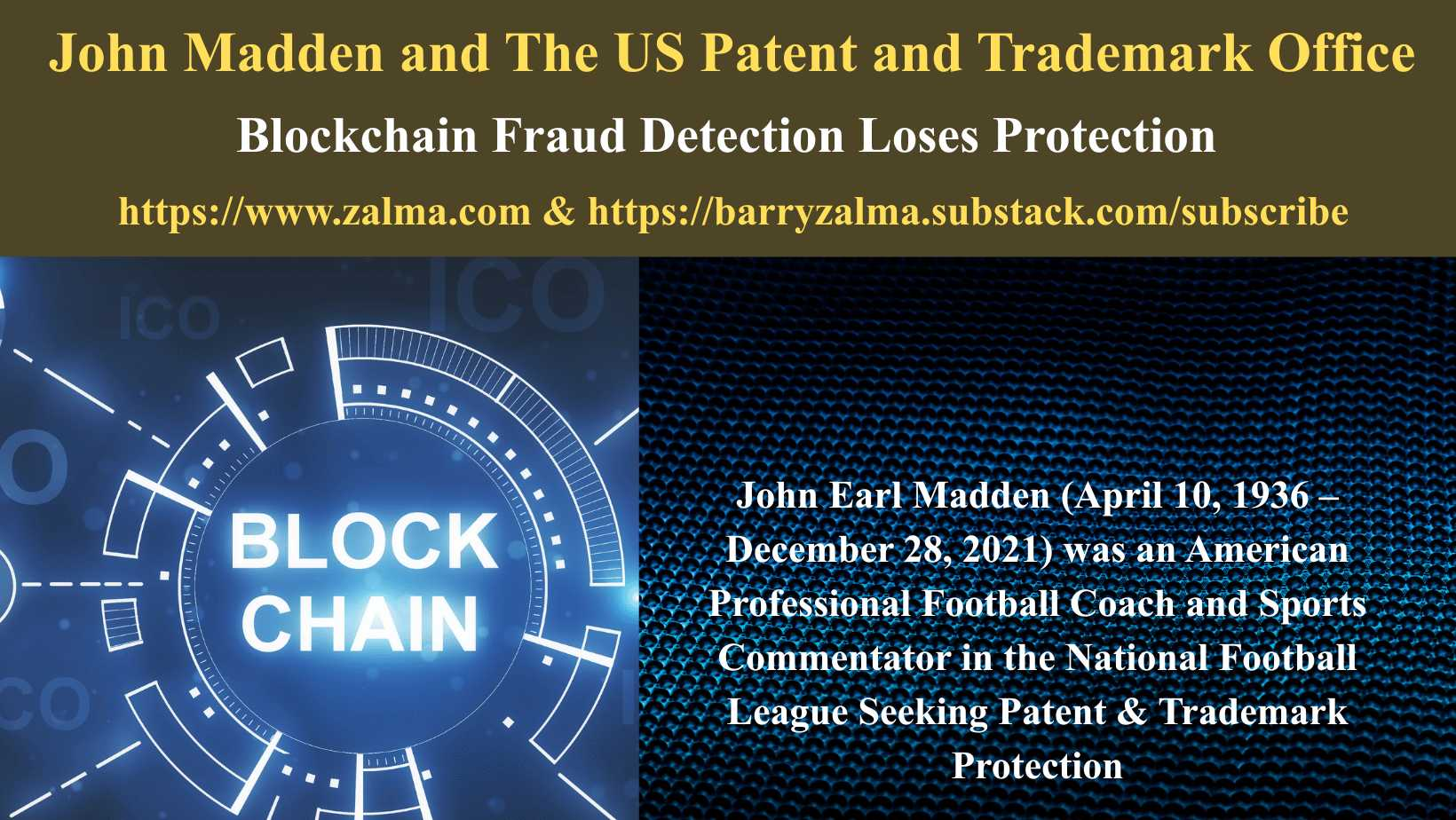
Blockchain Fraud Detection Loses Protection
Posted on October 22, 2026 by Barry Zalma
John Earl Madden (April 10, 1936 – December 28, 2021) was an American Professional Football Coach and Sports Commentator in the National Football League Seeking Patent & Trademark Protection
BLOCKCHAIN FRAUD
Mr. Madden was more than football. He was working to establish a program called “Fraud Protection Systems, Methods, and Computer Programs for Blockchain Financial Transactions.”
In Ex parte John Madden, Appeal 2026-001497, Application 18/495,506, Technology Center 3600, United States Patent and Trademark Office, Patent Trial and Appeal Board (October 14, 2026)
The Examiner rejected claims several numbered claims under 35 U.S.C. § 101 as directed to an abstract idea without significantly more.
THE LAW
Section 101 makes patentable any new and useful process, machine, manufacture, or composition of matter.Laws of nature, natural phenomena, and abstract ideas are implicitly excluded.
THE PATENT TRIAL AND ...
Sovereign Immunity Defeats Suit Against Police Officers
Post 4866
Posted on October 21, 2026 by Barry Zalma
In Chad Lightfoot, et al. v. Progressive Direct Insurance Company, et al., Civil Action No. 26-434, United States District Court, E.D. Louisiana (October 9, 2026) Chad Lightfoot was involved in an Orleans Parish automobile accident in 2011 and filed claims with several insurers, including Progressive.
After a related civil dispute, Progressive counsel allegedly submitted a false affidavit stating that Lightfoot had fraudulently received a $50,000 payment. A New Orleans police detective relied on the affidavit to obtain an arrest warrant, and Louisiana State Police Lieutenant Alan Arcana allegedly reported that Lightfoot had received the payment. Lightfoot was arrested in 2015 and charged with theft, insurance fraud, and perjury.
Plaintiffs alleged that no record of the payment existed and that the criminal charges were dismissed on October 15, 2024.
Lightfoot and Geralyn Hawkins filed suit in October 2025 and ...