
Fraudsters Seem to Have Unlimited Funds to Fund Attempts to Change Conviction
Read the full article at https://lnkd.in/gmxckaAC and at https://zalma.com/blog plus more than 4150 posts.
The case involved fraudulently billing of Blue Cross Blue Shield of Texas (“BCBS”) for hearing aids. On March 8, 2018, a jury convicted Terry Anderson of Counts One – Fifteen, and Rocky Anderson of Counts One – Four, Six, and Eight – Fifteen of the Superseding Indictment. The Court later found there was insufficient evidence to convict the Defendants on Counts One and Eight, acquitted the Defendants of those counts, and entered judgment on the other counts of conviction.
The Defendants appealed to the Fifth Circuit, and the Fifth Circuit affirmed the judgment (ECF Nos. 252-53). The Defendants now move for a new trial under Federal Rule of Criminal Procedure 33(b), claiming newly discovered evidence, in United States Of America v. Terry Lynn Anderson (1) Rocky Freeland Anderson, No. 3:17-CR-00222-M, United States District Court, N.D. Texas, Dallas Division (April 15, 2022).
ANALYSIS
The Defendants’ Motion for a New Trial was untimely under Rule 33(b)(1) because the Defendants filed this Motion for New Trial three years and ten months after the jury returned its verdict. The time to file a motion for new trial could not be extended because Defendants did not show excusable neglect.
The Government had more than 38 potential witnesses, who testified or were interviewed about events that took place over a decade ago, and at least one of them is now dead. It is reasonable to assume that the surviving witnesses’ memories of the events in issue have diminished and would continue to deteriorate until a new trial occurred. These factors significantly prejudice the Government.
The Motion Fails on the Merits
Even if the Court reached the merits, the Motion would have been denied.
The Defendants were convicted of health care fraud for submitting insurance claims for hearing aids that were medically unnecessary and for which Defendants did not conduct the requisite examinations.
The Defendants contend that two pieces of information constitute newly discovered evidence that, if admitted, would result in an acquittal: first, they cite the end, in
January 2022, of a DOJ criminal investigation into the hearing aid company, Eargo, Inc.; and second, they reference an FDA rule proposed in October 2021, that would permit some hearing aids to be sold over-the-counter, without requiring an examination by a professional. None of this information is relevant to the Defendants’ convictions, would not be admitted at trial, would not require Brady/Giglio production, and thus, would not probably produce an acquittal.
The unrelated investigation into Eargo is not new evidence that would entitle Defendants to a new trial. Defendants contend that the Government has access to evidence underlying DOJ’s decision not to prosecute Eargo criminally that would exculpate Defendants, because Defendants were also investigated for insurance fraud due to submissions for reimbursement for hearing aids.
DISCUSSION
Evidence from an unrelated DOJ investigation in 2021-2022 is not relevant to the Defendants’ actions, state of mind, and criminal intent during 2011-2014, which was the subject of the case against the Andersons.
The second alleged new evidence, a proposed FDA rule that would establish a new category of hearing aids that could be sold over-the-counter, without a hearing test, also does not constitute evidence that would entitle Defendants to a new trial. First, a change in the law does not constitute newly discovered evidence. Even if it did, the proposed rule is not relevant to Defendants’ fraud scheme, because Defendants were not selling over-the-counter hearing aids, but rather, were providing traditional hearing aids, subject to reimbursement by insurance companies.
Since the proposed FDA rule would not be admissible at trial, and therefore would not result in an acquittal; thus, the Motion failed on the merits.
Because Defendants’ Motion for a New Trial was untimely, and further did not cite newly discovered admissible evidence which would probably result in an acquittal of Defendants, the Motion for New Trial was denied.
ZALMA OPINION
Insurance fraud is a highly profitable and unusually effective crime. Even when the fraud perpetrators are caught, convicted and sentenced they have access to the millions of dollars they took from the insurers and the government from the fraud scheme, they can fund an appeal and when that fails, a tardy motion for new trial based on fairly spurious grounds. The USDC took the motion seriously and wrote a detailed opinion explaining why the motion – obviously not warranted and filed late – was a ludicrous waste of the court’s time and should have resulted in sanctions. It did not.
(c) 2022 Barry Zalma & ClaimSchool, Inc.
Barry Zalma, Esq., CFE, now limits his practice to service as an insurance consultant specializing in insurance coverage, insurance claims handling, insurance bad faith and insurance fraud almost equally for insurers and policyholders. He practiced law in California for more than 44 years as an insurance coverage and claims handling lawyer and more than 54 years in the insurance business. He is available at http://www.zalma.com and [email protected].
Subscribe to Zalma on Insurance at locals.com https://zalmaoninsurance.local.com/subscribe.
Subscribe to Excellence in Claims Handling at https://barryzalma.substack.com/welcome.
Write to Mr. Zalma at [email protected]; http://www.zalma.com; http://zalma.com/blog; daily articles are published at https://zalma.substack.com.
Go to the podcast Zalma On Insurance at https://anchor.fm/barry-zalma; Follow Mr. Zalma on Twitter at https://twitter.com/bzalma; Go to Barry Zalma videos at Rumble.com at https://rumble.com/c/c-262921; Go to Barry Zalma on YouTube- https://www.youtube.com/channel/UCysiZklEtxZsSF9DfC0Expg; Go to the Insurance Claims Library – https://zalma.com/blog/insurance-claims-library/

Insurance Expert May Not Testify to Speculative and Contains Unsupported Conclusions.
Posted on September 18, 2026 by Barry Zalma
See the full video at and at https://rumble.com/v7fmifw-expert-may-only-testify-to-what-experience-supports.html
In Michele A. Over, and The Estate Of Paul R. Over v. State Farm Mutual Automobile Insurance Company, and State Farm Fire And Casualty Company, Civil Action No. 23-cv-02243-PAB-STV, United States District Court, D. Colorado (September 14, 2026) Michele and Paul Over sued State Farm Fire and State Farm Auto over hail-damage and stolen-vehicle claims.
The operative dispute concerned State Farm Auto’s motion to exclude or limit opinions from plaintiffs’ insurance-industry expert, Aaron Castillo. Castillo.
Law
The proponent of expert testimony must establish by a preponderance of the evidence that an expert is qualified and that the opinions are helpful, sufficiently grounded, and reliably derived and applied. Experience-based opinions must explain how the...
150 Months in Prison for Tax Fraud
Post 4846
Posted on September 17, 2026 by Barry Zalma
See the full video at https://lnkd.in/g8rh3JBX and https://lnkd.in/gmkdy-9C, In United States Of America v. Thomas Addaquay, Nos. 25-10609, 25-10611, United States Court of Appeals, Eleventh Circuit (September 9, 2026) the Eleventh Circuit affirmed all challenged convictions, the 150-month aggregate sentence, and the challenged $4,123,474.55 restitution award.
FACTS
In United States Of America v. Thomas Addaquay, United States Of America v. Thomas Addaquay, Nos. 25-10609, 25-10611, United States Court of Appeals, Eleventh Circuit (September 9, 2026) the Eleventh Circuit affirmed all challenged convictions, the 150-month aggregate sentence, and the challenged $4,123,474.55 restitution award.
FACTS
Thomas Addaquay controlled United Consolidated Accounting and Business Services (UC), nominally a check-cashing business.
The government proved a three-stage tax-refund scheme that converted the resulting refund checks into usable funds through ...
Major Fraud Perpetrator Asserts Fifth Amendment Privilege to Avoid Prosecution
Post 5489
Posted on September 14, 2026 by Barry Zalma
Fraudster Refuses to Answer Questions About His Alleged Fraud
See the full video at https://lnkd.in/gvicAMDr and at https://lnkd.in/gvicAMDr
In Great American Insurance Co. v. Gemstone Property Management, LLC, et al., No. 23-cv-9100 (LJL), United States District Court, S.D. New York (September 8, 2026) Great American Insurance Company alleged that it was defrauded through a scheme in which Subin Associates, LLP recruited individuals to stage construction-site injuries, arranged unnecessary medical treatment and litigation funding, and pursued fraudulent personal-injury claims.
Luis Manuel Garcia Salcedo, resulted in a $6 million settlement. Non-party Jose Hernandez allegedly worked as an assistant manager at Subin, operated Hernandez Associates, and owned litigation-funding companies that shared office space with Subin and provided services to its clients.
After Great American ...
Habeas Relief Not Available for Sixty Year Sentence for Murder and Insurance Fraud
Post 4584
Posted on November 23, 2026 by Barry Zalma
The 60.5 Year Sentence Is Close To Being A Life Sentence For A Grown Woman.
In Tami Duvall v. State Of Indiana, No. 1:25-cv-01239-SEB-TAB, United States District Court, S.D. Indiana, Indianapolis Division (November 10, 2026) Tami Duvall was convicted by a jury in Bartholomew County of murdering her estranged husband, Alan Duvall, in August 2007. She was also convicted of insurance fraud and obstruction of justice.
Alan was first thought to have died of alcohol poisoning (BAC 0.436%). The autopsy also found a morphine level about 100 times a therapeutic dose and cyclobenzaprine about eight times a therapeutic dose. The couple had financial problems. Ms. Duvall had urged Alan to buy a $100,000 life insurance policy naming her as beneficiary shortly before his death. A bottle of Roxanol (liquid morphine) had gone missing from the nursing home where she worked as an aide.
Her total sentence was 60.5 years. ...

Posted on November 20, 2026 by Barry Zalma
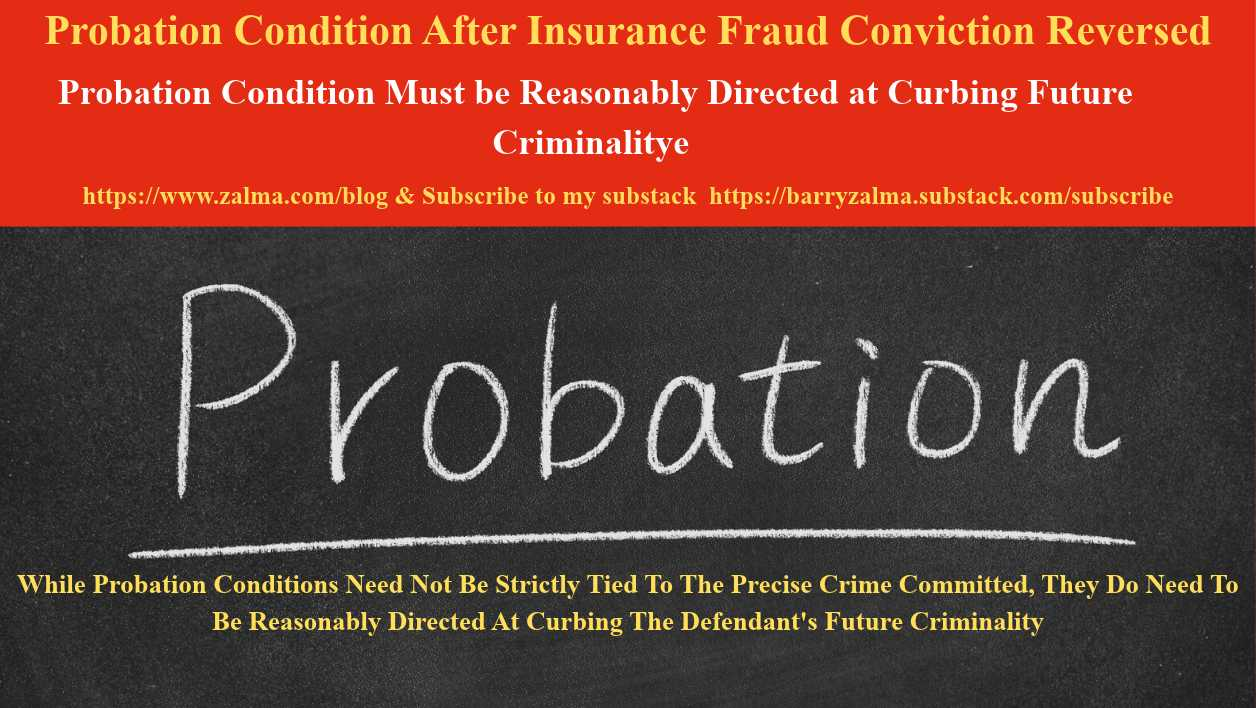
Probation Condition Must be Reasonably Directed at Curbing Future Criminality
Post 4584
While Probation Conditions Need Not Be Strictly Tied To The Precise Crime Committed, They Do Need To Be Reasonably Directed At Curbing The Defendant’s Future Criminality
In The People v. Nicolas Arpa, A174751, California Court of Appeals, First District, Third Division (November 19, 2026) Nicolas Arpa was charged in San Mateo County with five counts of insurance fraud, attempted grand theft by an employee or agent of $950 or more, grand theft by an employee or agent of $950 or more, and forgery.
He pled no contest to one count of insurance fraud (count 2) and to grand theft (count 5). His sentencing brief said he had suffered significant financial distress and felt remorse. It also said he no longer works in insurance and had made full restitution.
The trial court suspended the sentence and imposed two years of formal probation. One probation condition required him to abstain from using...
Dilatory, Obstructive Tactics Designed To Re-Open Proceedings And Vacate a Judgment Are Improper
Post 4583
In Three S Delaware, Inc. & Scott R. Steele v. Dataquick Information Systems, Inc. & Maxar Technologies, Inc., Civil Action No. 25-18991 (RK) (TJB), United States District Court, D. New Jersey (November 16, 2026) Three S Delaware (“3SD”) licensed real estate databases from a California company named DataQuick. A newly formed Delaware DataQuick bought the California DataQuick’s assets. The arbitrator later found that the sale included the 1996 license.
Delaware DataQuick sued 3SD in California. 3SD moved to compel arbitration and then counterclaimed. In May 2005, Steele and his counsel walked out of the merits hearing, and the arbitrator proceeded without them. He awarded about $6.17 million to DataQuick.
MARYLAND PROCEEDINGS:
The D. Md. (Judge Motz) confirmed the award, except for attorney’s fees. 3SD obtained a supersedeas bond of about $7.46 million from Federal Insurance Company. The Fourth Circuit affirmed in 2007.
Later ...