
Waiver of Subrogation Defeats Claims Against Contractor Who Caused Fire
Read the full article at https://www.linkedin.com/pulse/contract-made-action-even-signed-after-termination-zalma-esq-cfe and at https://zalma.com/blog plus more than 4150 posts.
Posted on March 31, 2022 by Barry Zalma
Commercial General Liability and Commercial Property Policies allow an insured to waive the insurer’s right of subrogation if made before a loss. In The State Of Delaware Insurance Coverage Office, and Factory Mutual Insurance Co., both as subrogee of the University of Delaware v. Disabatino Construction Co., Schlosser & Associates Mechanical Contractors, Inc., And V.E. Guerrazzi, Inc., C. A. No. N19C-08-080 EMD CCLD, Superior Court of Delaware (March 17, 2022) the court resolved motions for summary judgment regarding a waiver of subrogation.
INTRODUCTION
A breach of contract and negligence action where the State of Delaware Insurance Coverage Office and Factory Mutual Insurance Company (collectively, “Plaintiffs”) sued as subrogees of the University of Delaware (the “University”). Plaintiffs trued recover what they paid relating to a fire allegedly caused by Defendants DiSabatino Construction Company (“DiSabatino”), Schlosser & Associates Mechanical Contractors (“Schlosser”), and V.E. Guerrazi, Inc. (“Guerrazi,” and collectively, “Defendants”), who were working for the University as contractors.
BACKGROUND
Plaintiffs paid the University of Delaware $2.5 million and $2.75 million, respectively, for damages related to the fire at McKinly Hall. Plaintiffs are subrogated to the University’s rights to the extent of these payments.
The defendants provided contracting services for the University in 2017. DiSabatino was the general contractor on the project to renovate Lab 46 in McKinly Hall (the “Project”), Schlosser was the subcontractor, and Guerrazzi was the sub-subcontractor.
The University created a 424-page specifications manual (the “Specifications”) as a “road map” of the Project for potential bidders. The Specifications charged bidders to “[u]se A101 2007 and A201 2007 with the following supplemental information.” A101 2007 and A2 2007 refer to form construction contracts published by the American Institute of Architects. The AIA Contract includes a waiver of subrogation.
The University needed the Project to be completed before students returned in Fall 2017. The University authorized DiSabatino to begin work immediately after it received the construction permit.
DiSabatino had almost completed the Project when a fire occurred in McKinly Hall. After the fire, DiSabatino realized it had not received an executed contract from the University. The University suggested that the retroactive AIA Contract should have a contract commencement date of May 31, 2017. DiSabatino did not object. The University agreed that the original AIA Contract terms, as included by the University in the Specifications, would remain in place. The University never provided DiSabatino with an executed copy of the AIA Contract. DiSabatino did not ask the University to execute the AIA Contract because it “believed [they] were under contract,” such that the “actual signature” seemed “superfluous.”
Section 11.3.7 of the A201, titled “Waivers of Subrogation,” reads as follows:
The Owner and Contractor waive all rights against (1) each other and any of their subcontractors, sub-subcontractors, agents and employees, each of the other, and (2) the Architect, Architect’s consultants, separate contractors described in Article 6, if any, and any of their subcontractors, sub-subcontractors, agents and employees, for damages caused by fire or other causes of loss to the extent covered by property insurance obtained pursuant to this Section … The policies shall provide such waivers of subrogation by endorsement or otherwise. A waiver of subrogation shall be effective as to a person or entity even though that person or entity would otherwise have a duty of indemnification, contractual or otherwise, did not pay the insurance premium directly or indirectly, and whether or not the person or entity had an insurable interest in the property damaged.
Plaintiffs sued seeking-through subrogation-to recover damages to the University resulting from the fire.
Defendants moved to dismiss, arguing that the AIA Contract expressly waived subrogation claims. Following discovery, Defendants moved for summary judgment. Defendants argued that the AIA Contract is the operative agreement between the University and DiSabatino, and that because the AIA Contract included a waiver of subrogation, all Plaintiffs’ claims are barred
DISCUSSION
The Court held that the AIA Contract is the operative contract between DiSabatino and the University; that the COSA did not modify the waiver of subrogation in the A201; and that the waiver bars all of Plaintiffs’ claims against all Defendants. It concluded that basic contract law concludes that a valid contract exists when
the parties intended that the contract would bind them,
the terms of the contract are sufficiently definite, and
the parties exchanged legal consideration
The Court found that the University and DiSabatino objectively manifested assent to using the AIA Contract as their contract. In the Specifications, a section titled “Contract” directed bidders to “use A101 2007 and A201 2007 with the following supplemental information.” In other words, the University expressly informed DiSabatino during bidding that the contract would be the AIA Contract. DiSabatino agreed. By signing the Bid Form included in the Specifications, DiSabatino certified that it understood the requirements detailed in the Specifications and that it would carry out the Project “in accordance with the Specifications . . . .” Therefore, the University and DiSabatino objectively manifested assent to using the AIA Contract during the bidding stage of their relationship.
Although the University and DiSabatino did not execute the AIA Contract as the Specifications required, the Court found that their conduct after the University selected DiSabatino’s bid manifests an intent to be bound by the AIA Contract. The conduct of the parties after the fire provides the final proof of their intent. DiSabatino sent the University additional copies of the short-form contract and Supplement. The University, by its actions, clearly regarded the AIA Contract as the operative contract between itself and DiSabatino. Otherwise, the University would have had no reason to ask DiSabatino to sign and submit it. DiSabatino did, as requested submit the signed AIA Contract, thereby confirming its assent to being bound by its terms.
The Waiver of Subrogation Extends to all Damages
The fire in McKinly Hall damaged both the areas that Defendants were renovating for the Project and other areas, which were not part of the Project. Plaintiffs argued the waiver of subrogation should apply only to damages associated with the Project, and not to the non-Project areas.
The waiver in the A201 expressly states that the “Owner and Contractor waive all rights against (1) each other and any of their subcontractors, sub-subcontractors, agents and employees, each of the other . . . for damages caused by fire or other causes of loss . . . .” This language unambiguously means that the waiver extends to Schlosser and Guerrazzi. The Court finds that an argument to the contrary is an unreasonable interpretation of the unambiguous language of the operative document.
Defendants’ motions for summary judgment were granted.
ZALMA OPINION
Waivers of subrogation are important to the construction industry and act as a means to transfer the risks of loss of a negligently caused fire from the contractors to an insurer. The waiver saves money on the contract terms and makes it possible for an owner to quickly recover from losses by fire from their insurers and allows a contractor to protect its assets by insurance taken out by the owner who, with the permission of its insurer, waives the insurer’s right to subrogation. The only reason this case went to summary judgment was the fact that the parties acted loosely with regard to signing the contract. The actions of the parties established the intent to be bound by the AIA contract and its waiver of subrogation and the insurers, therefore, cannot recover from who it believed to be the party responsible for the fire.
(c) 2022 Barry Zalma & ClaimSchool, Inc.
Barry Zalma, Esq., CFE, now limits his practice to service as an insurance consultant specializing in insurance coverage, insurance claims handling, insurance bad faith and insurance fraud almost equally for insurers and policyholders. He practiced law in California for more than 44 years as an insurance coverage and claims handling lawyer and more than 54 years in the insurance business. He is available at http://www.zalma.com and [email protected].
Subscribe to Zalma on Insurance at locals.com https://zalmaoninsurance.local.com/subscribe.
Subscribe to Excellence in Claims Handling at https://barryzalma.substack.com/welcome.
Write to Mr. Zalma at [email protected]; http://www.zalma.com; http://zalma.com/blog; daily articles are published at https://zalma.substack.com. Go to the podcast Zalma On Insurance at https://anchor.fm/barry-zalma; Follow Mr. Zalma on Twitter at https://twitter.com/bzalma; Go to Barry Zalma videos at Rumble.com at https://rumble.com/c/c-262921; Go to Barry Zalma on YouTube- https://www.youtube.com/channel/UCysiZklEtxZsSF9DfC0Expg; Go to the Insurance Claims Library – https://zalma.com/blog/insurance-claims-library/

Insurance Expert May Not Testify to Speculative and Contains Unsupported Conclusions.
Posted on September 18, 2026 by Barry Zalma
See the full video at and at https://rumble.com/v7fmifw-expert-may-only-testify-to-what-experience-supports.html
In Michele A. Over, and The Estate Of Paul R. Over v. State Farm Mutual Automobile Insurance Company, and State Farm Fire And Casualty Company, Civil Action No. 23-cv-02243-PAB-STV, United States District Court, D. Colorado (September 14, 2026) Michele and Paul Over sued State Farm Fire and State Farm Auto over hail-damage and stolen-vehicle claims.
The operative dispute concerned State Farm Auto’s motion to exclude or limit opinions from plaintiffs’ insurance-industry expert, Aaron Castillo. Castillo.
Law
The proponent of expert testimony must establish by a preponderance of the evidence that an expert is qualified and that the opinions are helpful, sufficiently grounded, and reliably derived and applied. Experience-based opinions must explain how the...
150 Months in Prison for Tax Fraud
Post 4846
Posted on September 17, 2026 by Barry Zalma
See the full video at https://lnkd.in/g8rh3JBX and https://lnkd.in/gmkdy-9C, In United States Of America v. Thomas Addaquay, Nos. 25-10609, 25-10611, United States Court of Appeals, Eleventh Circuit (September 9, 2026) the Eleventh Circuit affirmed all challenged convictions, the 150-month aggregate sentence, and the challenged $4,123,474.55 restitution award.
FACTS
In United States Of America v. Thomas Addaquay, United States Of America v. Thomas Addaquay, Nos. 25-10609, 25-10611, United States Court of Appeals, Eleventh Circuit (September 9, 2026) the Eleventh Circuit affirmed all challenged convictions, the 150-month aggregate sentence, and the challenged $4,123,474.55 restitution award.
FACTS
Thomas Addaquay controlled United Consolidated Accounting and Business Services (UC), nominally a check-cashing business.
The government proved a three-stage tax-refund scheme that converted the resulting refund checks into usable funds through ...
Major Fraud Perpetrator Asserts Fifth Amendment Privilege to Avoid Prosecution
Post 5489
Posted on September 14, 2026 by Barry Zalma
Fraudster Refuses to Answer Questions About His Alleged Fraud
See the full video at https://lnkd.in/gvicAMDr and at https://lnkd.in/gvicAMDr
In Great American Insurance Co. v. Gemstone Property Management, LLC, et al., No. 23-cv-9100 (LJL), United States District Court, S.D. New York (September 8, 2026) Great American Insurance Company alleged that it was defrauded through a scheme in which Subin Associates, LLP recruited individuals to stage construction-site injuries, arranged unnecessary medical treatment and litigation funding, and pursued fraudulent personal-injury claims.
Luis Manuel Garcia Salcedo, resulted in a $6 million settlement. Non-party Jose Hernandez allegedly worked as an assistant manager at Subin, operated Hernandez Associates, and owned litigation-funding companies that shared office space with Subin and provided services to its clients.
After Great American ...
Plaintiff’s Reading of the Policy is Plaintiff’s Reasonable Allegations
Posted on October 19, 2026 by Barry Zalma
Post 4868
CLASS ACTION THAT STATES A SIMPLE CLEAR AND PLAUSIBLE CAUSE OF ACTION SURVIVES
In Sheila Marino v. Farmers New World Life Insurance Company, No. 2:25-cv-02200-JNW, United States District Court, W.D. Washington, Seattle (October 13, 2026) defendant Farmers New World Life Insurance Company’s (“FNWL”) moved to dismiss Plaintiff Sheila Marino’s putative class action involving flexible universal life insurance.
Marino filed a putative class action in King County Superior Court alleging: (1) breach of contract, (2) breach of the implied covenant of good faith and fair dealing, and (3) violation of the Washington Consumer Protection Act (CPA).
She pleaded two theories: an “overcharge” theory and an “underpayment of interest” theory asked the Court to take judicial notice of historical Federal Funds Effective Rates.
THE LAW
Pleading Standard.
To survive a Rule 12(b)(6) motion, a ...
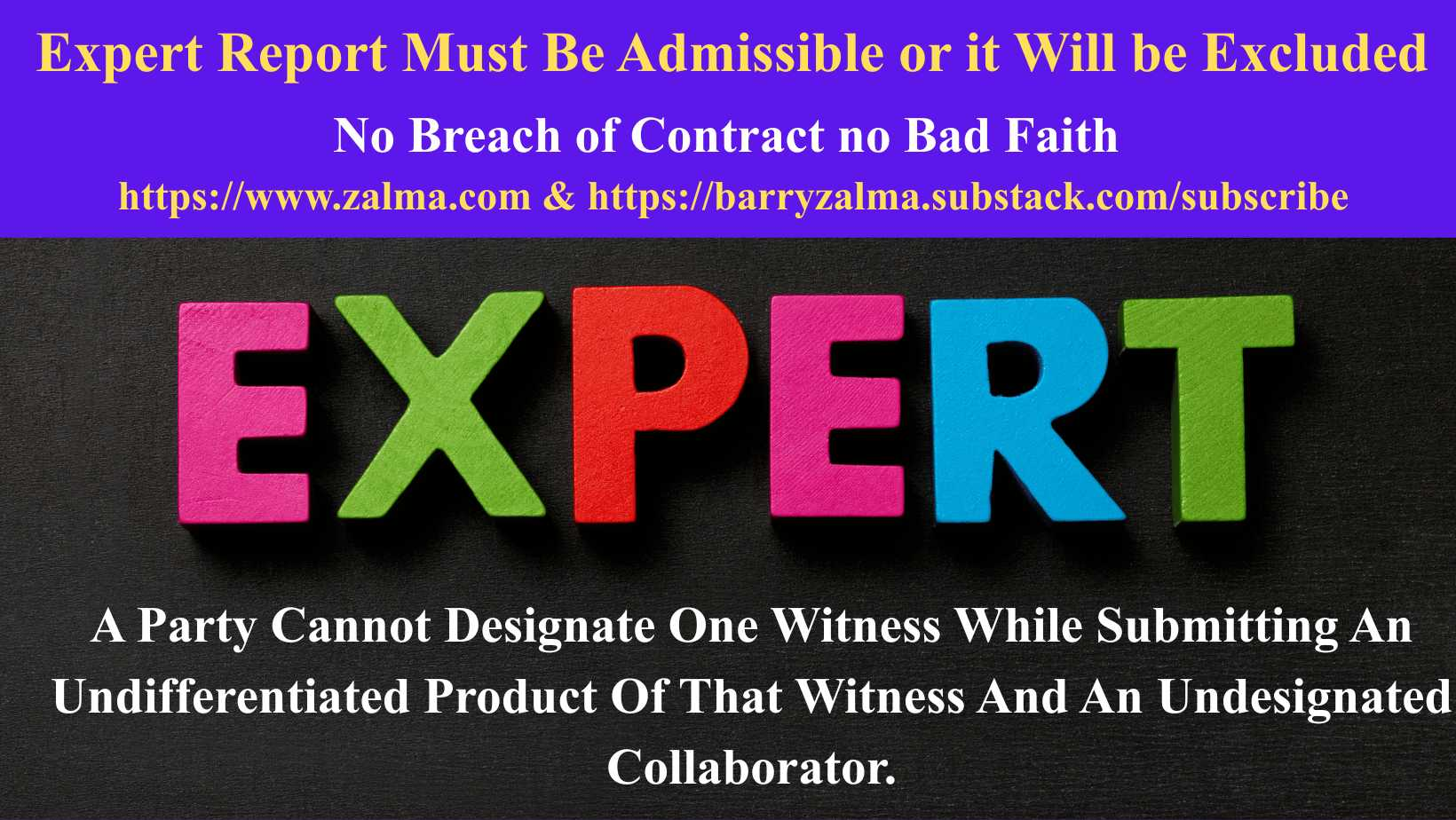
Blockchain Fraud Detection Loses Protection
Posted on October 22, 2026 by Barry Zalma
John Earl Madden (April 10, 1936 – December 28, 2021) was an American Professional Football Coach and Sports Commentator in the National Football League Seeking Patent & Trademark Protection
BLOCKCHAIN FRAUD
Mr. Madden was more than football. He was working to establish a program called “Fraud Protection Systems, Methods, and Computer Programs for Blockchain Financial Transactions.”
In Ex parte John Madden, Appeal 2026-001497, Application 18/495,506, Technology Center 3600, United States Patent and Trademark Office, Patent Trial and Appeal Board (October 14, 2026)
The Examiner rejected claims several numbered claims under 35 U.S.C. § 101 as directed to an abstract idea without significantly more.
THE LAW
Section 101 makes patentable any new and useful process, machine, manufacture, or composition of matter.Laws of nature, natural phenomena, and abstract ideas are implicitly excluded.
THE PATENT TRIAL AND ...
Sovereign Immunity Defeats Suit Against Police Officers
Post 4866
Posted on October 21, 2026 by Barry Zalma
In Chad Lightfoot, et al. v. Progressive Direct Insurance Company, et al., Civil Action No. 26-434, United States District Court, E.D. Louisiana (October 9, 2026) Chad Lightfoot was involved in an Orleans Parish automobile accident in 2011 and filed claims with several insurers, including Progressive.
After a related civil dispute, Progressive counsel allegedly submitted a false affidavit stating that Lightfoot had fraudulently received a $50,000 payment. A New Orleans police detective relied on the affidavit to obtain an arrest warrant, and Louisiana State Police Lieutenant Alan Arcana allegedly reported that Lightfoot had received the payment. Lightfoot was arrested in 2015 and charged with theft, insurance fraud, and perjury.
Plaintiffs alleged that no record of the payment existed and that the criminal charges were dismissed on October 15, 2024.
Lightfoot and Geralyn Hawkins filed suit in October 2025 and ...