
SLAPP Motion Appropriate When Fraud Perpetrators Sue Insurers and Their Lawyers
Read the full article at https://www.linkedin.com/pulse/settlement-fraud-suit-does-allow-doc-sue-insurers-zalma-esq-cfe and at https://zalma.com/blog plus more than 4150 posts.
Posted on March 29, 2022 by Barry Zalma
Nine insurers sued Ajay Mohabeer for fraudulently billing them for medical treatment never provided nor provided in the amounts charged. The insurers sued, lost a partial summary judgment, and rather than go on to trial on other causes of fraud, settled the suit with Dr. Mohabeer. Unhappy with the settlement Dr. Mohabeer sued the insurers and their lawyers for wrongful use of civil proceedings and damages (called malicious prosecution in other jurisdictions) in Ajay Mohabeer v. Farmers Insurance Exchange, a corporation; et al , 318 Or.App. 313, A172057, Court of Appeals of Oregon (March 16, 2022) where he sued nine insurance company defendants (collectively Farmers) and Farmers’ attorneys, for wrongful use of civil proceedings, alleging that defendants filed insurance fraud claims against plaintiff in federal court, which were ultimately settled. Mohabeer claimed the insurers sued him with malicious intent and without probable cause.
THE LITIGATION
The insurers and lawyers filed a special motion to strike the claims under Oregon’s Anti-Strategic Lawsuits Against Public Participation (anti-SLAPP) statute, contending that plaintiffs claims seek damages for conduct that is protected under ORS 31.150(2), and that plaintiff could not present substantial evidence that he would prevail on his claim. Defendants appealed from the trial court’s limited judgment denying the motion. The special motion to strike is Oregon Statute, ORS 31.150(1) requires four categories of claims subject to a special motion to strike:
Any oral statement made, or written statement or other document submitted, in a legislative, executive or judicial proceeding or other proceeding authorized by law;
Any oral statement made, or written statement or other document submitted, in connection with an issue under consideration or review by a legislative, executive or judicial body or other proceeding authorized by law;
Any oral statement made, or written statement or other document presented, in a place open to the public or a public forum in connection with an issue of public interest; or
Any other conduct in furtherance of the exercise of the constitutional right of petition or the constitutional right of free speech in connection with a public issue or an issue of public interest.
FACTS
A defendant making a special motion to strike has the initial burden to make a prima facie showing that the plaintiffs claim is of the type described in the statute. If the defendant meets that burden, the burden shifts to the plaintiff in the action to establish that there is a probability that the plaintiff will prevail on the claim by presenting substantial evidence to support a prima facie case.
Plaintiff is a licensed medical doctor who practiced medicine in association with First Choice Chiropractic clinics. In 2013, defendants filed several claims in federal court naming as defendants First Choice Chiropractic clinics, plaintiff, and several other individuals, based on allegations that the clinics and individual defendants had committed insurance fraud by making “false reports of alleged symptoms and exaggerated findings designed to make it appear that the patient either had or continued to have injuries/ symptoms which did not actually exist.” Plaintiff and the other named defendants sought summary judgment in the underlying action, and the federal district court granted the motion on some claims but denied it in part as to several of the claims, finding that there was evidence of conduct by plaintiff and the other named defendants that gave rise to genuine issues of fact on those claims. Farmers and plaintiff subsequently settled Farmers’ remaining claims against plaintiff in the underlying action and stipulated that plaintiff would be considered the prevailing party.
Plaintiff then brought this action for wrongful use of civil proceedings, alleging that Farmers named plaintiff as a defendant in the underlying action without a basis in fact so that Farmers could allege racketeering claims, for which Farmers would be entitled to treble damages and attorney fees. Plaintiff alleged that he was named as a defendant without probable cause and with malicious intent. Defendants filed their special motions to strike under ORS 31.150 and, after a hearing, the trial court determined that plaintiff had presented substantial evidence to support a prima facie case on his claim. The court thus denied the motions by limited judgment.
The allegations of plaintiffs claim are based solely on written statements and documents provided to the federal court in the context of the underlying action. The only dispute on appeal concerns whether plaintiff has met his burden to present prima facie evidence as to each element of his claim of wrongful use of civil proceedings.
ANALYSIS
One element of the claim of wrongful use of civil proceedings is an absence of probable cause to prosecute the underlying action. Probable cause means that the person initiating the underlying action “reasonably believes” that there is a good chance of prevailing, viz., the person “has that subjective belief and that belief is objectively reasonable.” Plaintiff contended that a probable cause determination is premature, because the existence of prima facie evidence of a lack of probable cause is a question for the factfinder that necessitates additional discovery. In the context of the special motion to strike, however, the existence of prima facie proof of the elements of the claim being challenged by the motion is something that the court determines as a matter of law, based on the pleadings and supporting and opposing affidavits stating the facts upon which the liability or defense is based.
Defendants contended that the summary judgment ruling of the federal district court in the underlying action conclusively establishes that Farmers had probable cause to bring the underlying action. In denying plaintiffs and the other named defendants’ motions for summary judgment against the claims in the underlying action, the federal district court concluded that Farmers had demonstrated genuine issues of material fact as to whether plaintiff:
made material misrepresentations, either knowingly or recklessly, by signing off on falsified chart notes;
engaged in a pattern of racketeering by committing indictable acts through wire and mail fraud;
engaged in a conspiracy to commit racketeering; and
was unjustly enriched by fraudulent claims made to Farmers by falsified chart notes.
The court agreed with defendants’ argument that that is evidence that the claims brought by defendants in the underlying action were objectively reasonable and based on probable cause. Independent of the federal district court’s summary judgment ruling in the underlying action, there is ample evidence in the record that defendants had probable cause to name plaintiff as a defendant in the underlying action, including affidavits of former clinic employees, who described plaintiffs participation in a scheme to over-treat patients and over-bill insurance. Plaintiff disputes that evidence but has not rebutted it with evidence to support his position.
The Court of Appeals of Oregon concluded that the trial court erred in denying the special motion to strike and therefore it reversed the limited judgment and remanded the case to the trial court for entry of a judgment dismissing plaintiffs claim because the plaintiff has not met his burden to present prima facie evidence of a lack of probable cause, and that the trial court erred as a matter of law in denying defendants’ special motion to strike.
ZALMA OPINION
Farmers and the other insurers defendant should be honored for proactively working to defeat a fraudulent claims. By not taking the case to trial after losing a partial summary judgment motion and stipulating that the case was resolved in the favor of the plaintiff they invited his suit. The Oregon Court of Appeal looked at the evidence and found that the insurers had probable cause to sue Dr. Mohabeer and dismissed the suit. The lesson learned by the insurers was that they should have taken Dr. Mohabeer to trial on the causes that they could have proved were fraudulent. Settlement is not appropriate when evidence of fraud exists.
(c) 2022 Barry Zalma & ClaimSchool, Inc.
Barry Zalma, Esq., CFE, now limits his practice to service as an insurance consultant specializing in insurance coverage, insurance claims handling, insurance bad faith and insurance fraud almost equally for insurers and policyholders. He also serves as an arbitrator or mediator for insurance related disputes. He practiced law in California for more than 44 years as an insurance coverage and claims handling lawyer and more than 54 years in the insurance business. He is available at http://www.zalma.com and [email protected].
Over the last 54 years Barry Zalma has dedicated his life to insurance, insurance claims and the need to defeat insurance fraud. He has created a library of books and other materials to make it possible for insurers and their claims staff to become insurance claims professionals.
Subscribe to Zalma on Insurance at locals.com https://zalmaoninsurance.local.com/subscribe. Subscribe to Excellence in Claims Handling at https://barryzalma.substack.com/welcome. Write to Mr. Zalma at [email protected]; http://www.zalma.com; http://zalma.com/blog; I publish daily articles at https://zalma.substack.com, Go to the podcast Zalma On Insurance at https://anchor.fm/barry-zalma; Follow Mr. Zalma on Twitter at https://twitter.com/bzalma; Go to Barry Zalma videos at Rumble.com at https://rumble.com/c/c-262921; Go to Barry Zalma on YouTube- https://www.youtube.com/channel/UCysiZklEtxZsSF9DfC0Expg; Go to the Insurance Claims Library – https://zalma.com/blog/insurance-claims-library/ Read posts from Barry Zalma at Go to the Insurance Claims Library – https://zalma.com/blog/insurance-claims-library/

Insurance Expert May Not Testify to Speculative and Contains Unsupported Conclusions.
Posted on September 18, 2026 by Barry Zalma
See the full video at and at https://rumble.com/v7fmifw-expert-may-only-testify-to-what-experience-supports.html
In Michele A. Over, and The Estate Of Paul R. Over v. State Farm Mutual Automobile Insurance Company, and State Farm Fire And Casualty Company, Civil Action No. 23-cv-02243-PAB-STV, United States District Court, D. Colorado (September 14, 2026) Michele and Paul Over sued State Farm Fire and State Farm Auto over hail-damage and stolen-vehicle claims.
The operative dispute concerned State Farm Auto’s motion to exclude or limit opinions from plaintiffs’ insurance-industry expert, Aaron Castillo. Castillo.
Law
The proponent of expert testimony must establish by a preponderance of the evidence that an expert is qualified and that the opinions are helpful, sufficiently grounded, and reliably derived and applied. Experience-based opinions must explain how the...
150 Months in Prison for Tax Fraud
Post 4846
Posted on September 17, 2026 by Barry Zalma
See the full video at https://lnkd.in/g8rh3JBX and https://lnkd.in/gmkdy-9C, In United States Of America v. Thomas Addaquay, Nos. 25-10609, 25-10611, United States Court of Appeals, Eleventh Circuit (September 9, 2026) the Eleventh Circuit affirmed all challenged convictions, the 150-month aggregate sentence, and the challenged $4,123,474.55 restitution award.
FACTS
In United States Of America v. Thomas Addaquay, United States Of America v. Thomas Addaquay, Nos. 25-10609, 25-10611, United States Court of Appeals, Eleventh Circuit (September 9, 2026) the Eleventh Circuit affirmed all challenged convictions, the 150-month aggregate sentence, and the challenged $4,123,474.55 restitution award.
FACTS
Thomas Addaquay controlled United Consolidated Accounting and Business Services (UC), nominally a check-cashing business.
The government proved a three-stage tax-refund scheme that converted the resulting refund checks into usable funds through ...
Major Fraud Perpetrator Asserts Fifth Amendment Privilege to Avoid Prosecution
Post 5489
Posted on September 14, 2026 by Barry Zalma
Fraudster Refuses to Answer Questions About His Alleged Fraud
See the full video at https://lnkd.in/gvicAMDr and at https://lnkd.in/gvicAMDr
In Great American Insurance Co. v. Gemstone Property Management, LLC, et al., No. 23-cv-9100 (LJL), United States District Court, S.D. New York (September 8, 2026) Great American Insurance Company alleged that it was defrauded through a scheme in which Subin Associates, LLP recruited individuals to stage construction-site injuries, arranged unnecessary medical treatment and litigation funding, and pursued fraudulent personal-injury claims.
Luis Manuel Garcia Salcedo, resulted in a $6 million settlement. Non-party Jose Hernandez allegedly worked as an assistant manager at Subin, operated Hernandez Associates, and owned litigation-funding companies that shared office space with Subin and provided services to its clients.
After Great American ...
Plaintiff’s Reading of the Policy is Plaintiff’s Reasonable Allegations
Posted on October 19, 2026 by Barry Zalma
Post 4868
CLASS ACTION THAT STATES A SIMPLE CLEAR AND PLAUSIBLE CAUSE OF ACTION SURVIVES
In Sheila Marino v. Farmers New World Life Insurance Company, No. 2:25-cv-02200-JNW, United States District Court, W.D. Washington, Seattle (October 13, 2026) defendant Farmers New World Life Insurance Company’s (“FNWL”) moved to dismiss Plaintiff Sheila Marino’s putative class action involving flexible universal life insurance.
Marino filed a putative class action in King County Superior Court alleging: (1) breach of contract, (2) breach of the implied covenant of good faith and fair dealing, and (3) violation of the Washington Consumer Protection Act (CPA).
She pleaded two theories: an “overcharge” theory and an “underpayment of interest” theory asked the Court to take judicial notice of historical Federal Funds Effective Rates.
THE LAW
Pleading Standard.
To survive a Rule 12(b)(6) motion, a ...

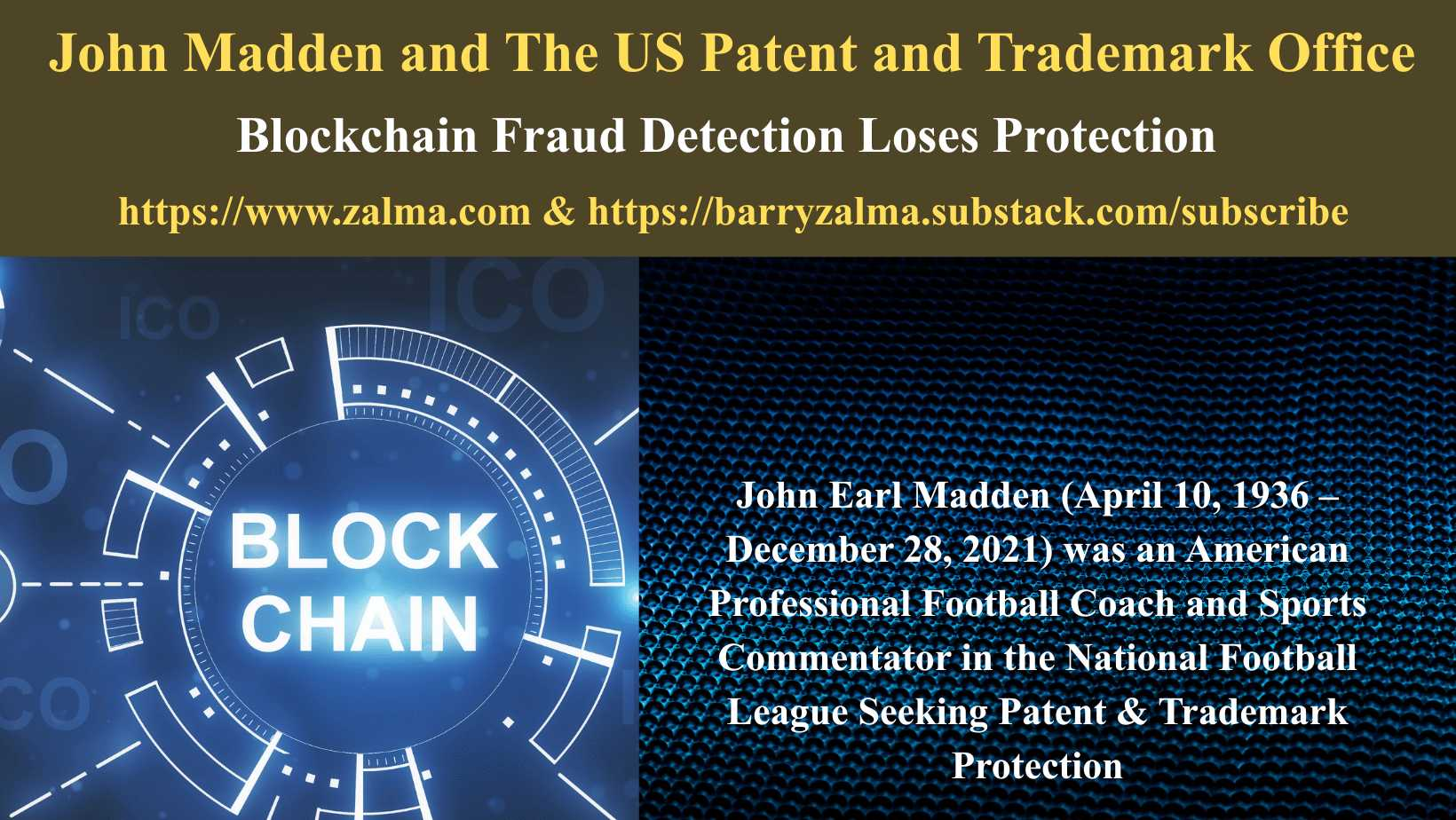
Blockchain Fraud Detection Loses Protection
Posted on October 22, 2026 by Barry Zalma
John Earl Madden (April 10, 1936 – December 28, 2021) was an American Professional Football Coach and Sports Commentator in the National Football League Seeking Patent & Trademark Protection
BLOCKCHAIN FRAUD
Mr. Madden was more than football. He was working to establish a program called “Fraud Protection Systems, Methods, and Computer Programs for Blockchain Financial Transactions.”
In Ex parte John Madden, Appeal 2026-001497, Application 18/495,506, Technology Center 3600, United States Patent and Trademark Office, Patent Trial and Appeal Board (October 14, 2026)
The Examiner rejected claims several numbered claims under 35 U.S.C. § 101 as directed to an abstract idea without significantly more.
THE LAW
Section 101 makes patentable any new and useful process, machine, manufacture, or composition of matter.Laws of nature, natural phenomena, and abstract ideas are implicitly excluded.
THE PATENT TRIAL AND ...
Sovereign Immunity Defeats Suit Against Police Officers
Post 4866
Posted on October 21, 2026 by Barry Zalma
In Chad Lightfoot, et al. v. Progressive Direct Insurance Company, et al., Civil Action No. 26-434, United States District Court, E.D. Louisiana (October 9, 2026) Chad Lightfoot was involved in an Orleans Parish automobile accident in 2011 and filed claims with several insurers, including Progressive.
After a related civil dispute, Progressive counsel allegedly submitted a false affidavit stating that Lightfoot had fraudulently received a $50,000 payment. A New Orleans police detective relied on the affidavit to obtain an arrest warrant, and Louisiana State Police Lieutenant Alan Arcana allegedly reported that Lightfoot had received the payment. Lightfoot was arrested in 2015 and charged with theft, insurance fraud, and perjury.
Plaintiffs alleged that no record of the payment existed and that the criminal charges were dismissed on October 15, 2024.
Lightfoot and Geralyn Hawkins filed suit in October 2025 and ...