
Failure to Acquire Required Insurance Breaches Contract
Read the full article at https://www.linkedin.com/pulse/failure-acquire-required-insurance-breaches-contract-barry and at https://zalma.com/blog plus more than 4100 posts.
Posted on March 21, 2022 by Barry Zalma
The Supreme Court, New York County (Barbara Jaffe, J.) [the trial court], ruled, granted the motion of defendants/third-party plaintiffs Hyatt Corporation and Hyatt Equities, L.L.C. (together, Hyatt) for summary judgment on their third-party claim for breach of an insurance procurement obligation because the Defendant Securitas failed to acquire a Commercial General Liability policy with limits of no less than $3 million.
In Dominick Benedetto et al. v. Hyatt Corporation et al., Hyatt Corporation, Sued Herein as Hyatt Corporation, Doing Business as Grand Hyatt New York, et al. v. Securitas Security Services USA Inc., Appeal No. 15506-15507 Nos. 2021-00256, 2020-00374, No. 2022-01732, Index Nos. 160322/14, 595457/15, Supreme Court of New York, First Department (March 15, 2022) the appellate court affirmed the decision of the trial court without costs.
DISCUSSION
A party moving for summary judgment on its claim for failure to procure insurance meets its prima facie burden by establishing that a contract provision requiring the procurement of insurance was not complied with. The burden then shifts to the opposing party, who may raise an issue of fact by tendering the procured insurance policy in opposition to the motion. As with any summary judgment motion, the evidence submitted both in support of and in opposition must be tendered in admissible form.
The appellate court found that Securitas failed to raise an issue of fact precluding summary judgment in Hyatt’s favor on their third-party claim for failure to procure insurance. The parties’ agreement required Securitas to procure $3 million worth of commercial general liability insurance coverage, but both the certificate of liability insurance and the policy declarations that Securitas submitted in support of its cross motion and in opposition to Hyatt’s motion only indicate $2 million worth of commercial general liability insurance coverage. While the certificate of liability insurance also indicates that Securitas procured an additional $1 million in umbrella liability coverage per occurrence – for a total of $3 million of coverage – this does not raise an issue of fact as to whether Securitas procured the $3 million of commercial general liability insurance coverage it was required to procure by the parties’ agreement.
Securitas also failed to raise an issue of fact as to whether Hyatt waived the insurance procurement provision in the parties’ agreement. A waiver, by definition, is the intentional relinquishment of a known right, it must be clear, unequivocal and deliberate. Hyatt’s annual acceptance of the certificates of insurance from Securitas constituted “mere silence” or, at most, “mistake, negligence, or thoughtlessness,” but never amounted to any intentional act “to relinquish a known right”. Securitas’s alternative argument that Hyatt was comparatively negligent does not bar summary judgment in Hyatt’s favor on this claim.
The trial court properly adhered to its original determination on renewal and reargument, since the policy that Securitas submitted in support of its motion for leave to renew and reargue was also a commercial umbrella liability policy, and therefore could not satisfy its contractual obligation to procure $3 million worth of commercial general liability insurance coverage.
To the extent Securitas sought to cure defects in its moving papers, raised by Hyatt in opposition, by submitting the complete policies in reply, this was new evidence submitted in reply that the court properly declined to consider.
ZALMA OPINON
Although this decision seems to be form over substance since Securitas did maintain $3 million in liability insurance, an umbrella policy is not a CGL. An umbrella simply adds (with different terms and condition unless it is a “follow form” policy) and, therefore, is not compliance with the contract terms. If Securitas could not obtain a $3 million limit on a CGL they were unable to fulfill the terms of the contract. Recognizing that they should have immediately advised Hyatt and requested a modification of the contract to read a CGL with a $2 million limit plus a $1 million umbrella.
(c) 2022 Barry Zalma & ClaimSchool, Inc.
Barry Zalma, Esq., CFE, now limits his practice to service as an insurance consultant specializing in insurance coverage, insurance claims handling, insurance bad faith and insurance fraud almost equally for insurers and policyholders. He also serves as an arbitrator or mediator for insurance related disputes. He practiced law in California for more than 44 years as an insurance coverage and claims handling lawyer and more than 54 years in the insurance business. He is available at http://www.zalma.comand [email protected].
Over the last 54 years Barry Zalma has dedicated his life to insurance, insurance claims and the need to defeat insurance fraud. He has created a library of books and other materials to make it possible for insurers and their claims staff to become insurance claims professionals.
Subscribe to Zalma on Insurance at locals.com https://zalmaoninsurance.local.com/subscribe. Subscribe to Excellence in Claims Handling at https://barryzalma.substack.com/welcome. Write to Mr. Zalma at [email protected]; http://www.zalma.com; http://zalma.com/blog; I publish daily articles at https://zalma.substack.com, Go to the podcast Zalma On Insurance at https://anchor.fm/barry-zalma; Follow Mr. Zalma on Twitter at https://twitter.com/bzalma; Go to Barry Zalma videos at Rumble.com at https://rumble.com/c/c-262921; Go to Barry Zalma on YouTube- https://www.youtube.com/channel/UCysiZklEtxZsSF9DfC0Expg; Go to the Insurance Claims Library – https://zalma.com/blog/insurance-claims-library/ Read posts from Barry Zalma at Go to the Insurance Claims Library – https://zalma.com/blog/insurance-claims-library/

Insurance Expert May Not Testify to Speculative and Contains Unsupported Conclusions.
Posted on September 18, 2026 by Barry Zalma
See the full video at and at https://rumble.com/v7fmifw-expert-may-only-testify-to-what-experience-supports.html
In Michele A. Over, and The Estate Of Paul R. Over v. State Farm Mutual Automobile Insurance Company, and State Farm Fire And Casualty Company, Civil Action No. 23-cv-02243-PAB-STV, United States District Court, D. Colorado (September 14, 2026) Michele and Paul Over sued State Farm Fire and State Farm Auto over hail-damage and stolen-vehicle claims.
The operative dispute concerned State Farm Auto’s motion to exclude or limit opinions from plaintiffs’ insurance-industry expert, Aaron Castillo. Castillo.
Law
The proponent of expert testimony must establish by a preponderance of the evidence that an expert is qualified and that the opinions are helpful, sufficiently grounded, and reliably derived and applied. Experience-based opinions must explain how the...
150 Months in Prison for Tax Fraud
Post 4846
Posted on September 17, 2026 by Barry Zalma
See the full video at https://lnkd.in/g8rh3JBX and https://lnkd.in/gmkdy-9C, In United States Of America v. Thomas Addaquay, Nos. 25-10609, 25-10611, United States Court of Appeals, Eleventh Circuit (September 9, 2026) the Eleventh Circuit affirmed all challenged convictions, the 150-month aggregate sentence, and the challenged $4,123,474.55 restitution award.
FACTS
In United States Of America v. Thomas Addaquay, United States Of America v. Thomas Addaquay, Nos. 25-10609, 25-10611, United States Court of Appeals, Eleventh Circuit (September 9, 2026) the Eleventh Circuit affirmed all challenged convictions, the 150-month aggregate sentence, and the challenged $4,123,474.55 restitution award.
FACTS
Thomas Addaquay controlled United Consolidated Accounting and Business Services (UC), nominally a check-cashing business.
The government proved a three-stage tax-refund scheme that converted the resulting refund checks into usable funds through ...
Major Fraud Perpetrator Asserts Fifth Amendment Privilege to Avoid Prosecution
Post 5489
Posted on September 14, 2026 by Barry Zalma
Fraudster Refuses to Answer Questions About His Alleged Fraud
See the full video at https://lnkd.in/gvicAMDr and at https://lnkd.in/gvicAMDr
In Great American Insurance Co. v. Gemstone Property Management, LLC, et al., No. 23-cv-9100 (LJL), United States District Court, S.D. New York (September 8, 2026) Great American Insurance Company alleged that it was defrauded through a scheme in which Subin Associates, LLP recruited individuals to stage construction-site injuries, arranged unnecessary medical treatment and litigation funding, and pursued fraudulent personal-injury claims.
Luis Manuel Garcia Salcedo, resulted in a $6 million settlement. Non-party Jose Hernandez allegedly worked as an assistant manager at Subin, operated Hernandez Associates, and owned litigation-funding companies that shared office space with Subin and provided services to its clients.
After Great American ...
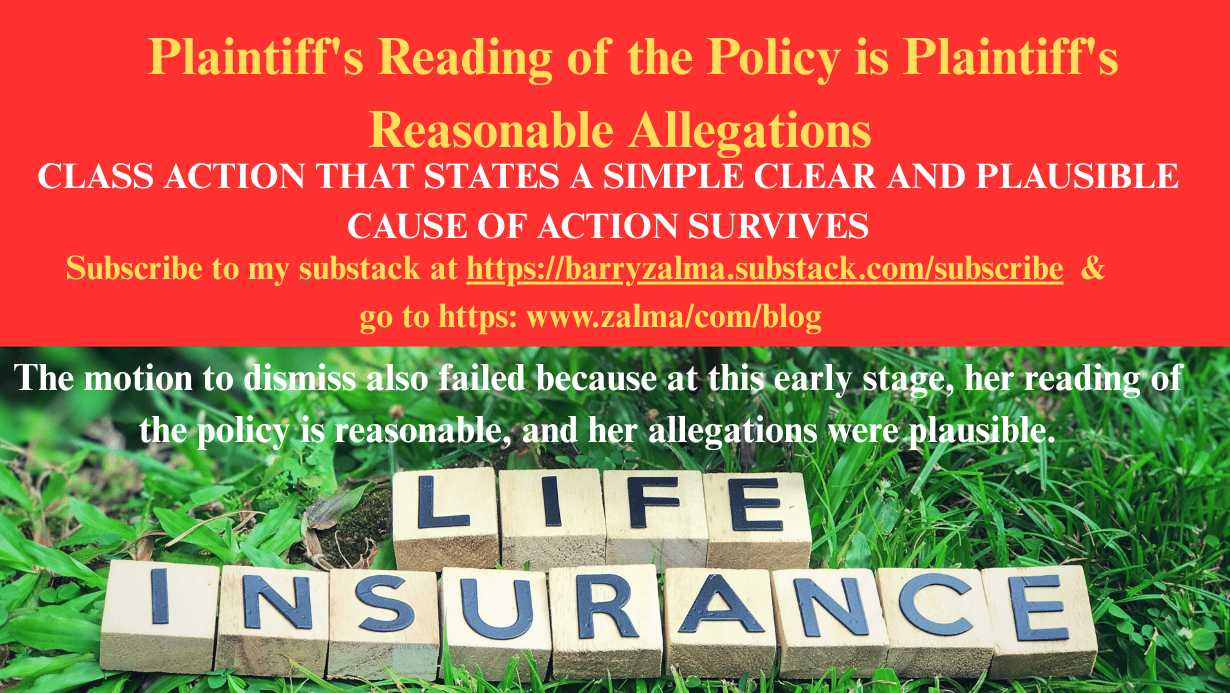
Plaintiff’s Reading of the Policy is Plaintiff’s Reasonable Allegations
Posted on October 19, 2026 by Barry Zalma
Post 4868
CLASS ACTION THAT STATES A SIMPLE CLEAR AND PLAUSIBLE CAUSE OF ACTION SURVIVES
In Sheila Marino v. Farmers New World Life Insurance Company, No. 2:25-cv-02200-JNW, United States District Court, W.D. Washington, Seattle (October 13, 2026) defendant Farmers New World Life Insurance Company’s (“FNWL”) moved to dismiss Plaintiff Sheila Marino’s putative class action involving flexible universal life insurance.
Marino filed a putative class action in King County Superior Court alleging: (1) breach of contract, (2) breach of the implied covenant of good faith and fair dealing, and (3) violation of the Washington Consumer Protection Act (CPA).
She pleaded two theories: an “overcharge” theory and an “underpayment of interest” theory asked the Court to take judicial notice of historical Federal Funds Effective Rates.
THE LAW
Pleading Standard.
To survive a Rule 12(b)(6) motion, a ...
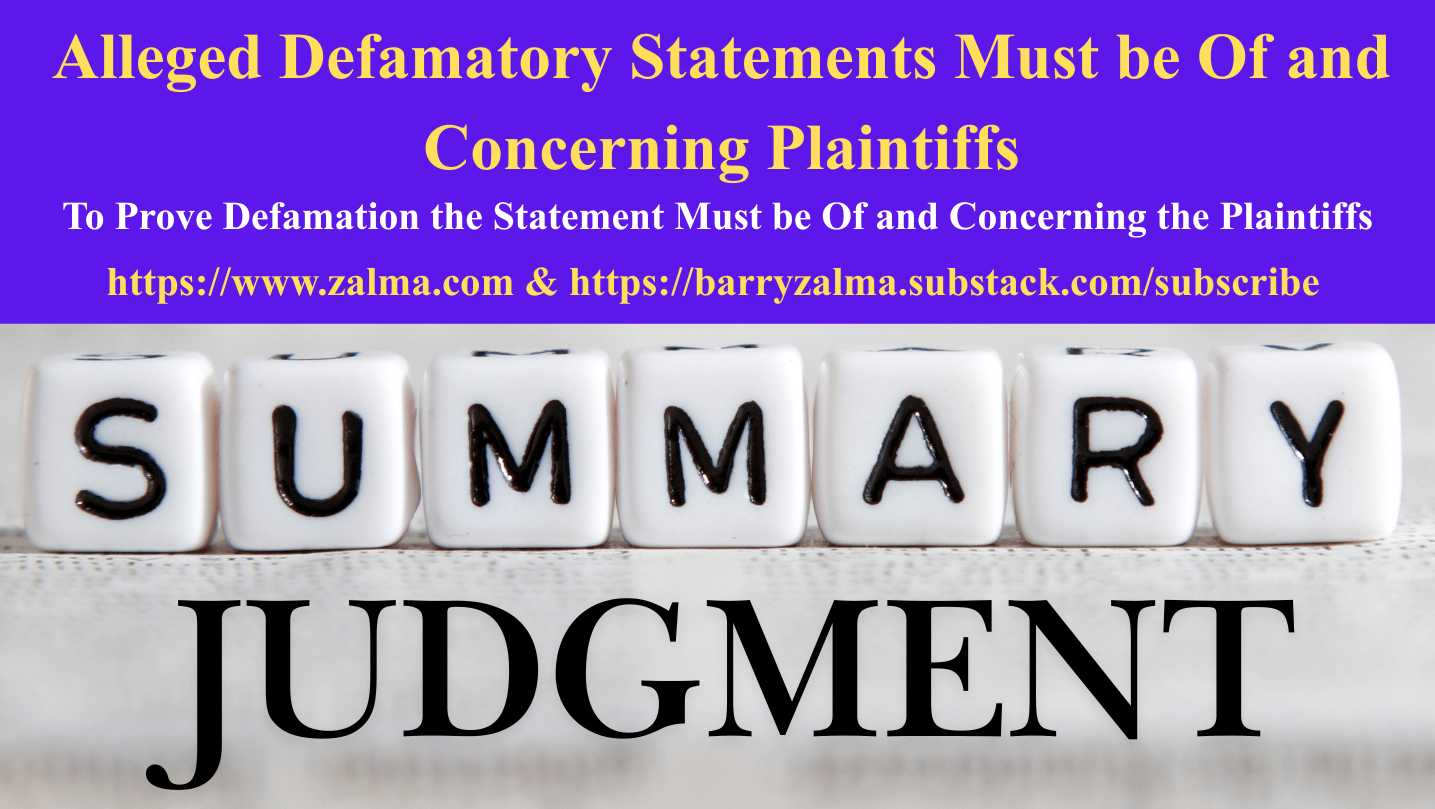
Alleged Defamatory Statements Must be Of and Concerning Plaintiffs
Posted on October 16, 2026 by Barry Zalma
To Prove Defamation the Statement Must be Of and Concerning the Plaintiffs
Post 4867
In Michael Moloney and Sergio Cantu v. United Services Automobile Association, No. 04-25-00519-CV, Court of Appeals of Texas, Fourth District, San Antonio (October 14, 2026) Michael Moloney and Sergio Cantu appealed from the trial court’s granting of a traditional motion for summary judgment in favor of United Services Automobile Association (“USAA”) on their defamation claim.
BACKGROUND
Moloney and Cantu sued USAA for defamation, alleging that they are the principals of Informed Roofing & Restoration, LLC (“Informed Roofing”), which is primarily engaged in the residential roofing repair and replacement business, and that an employee or agent of USAA had made false and defamatory statements to the San Antonio Police Department (“SAPD”) concerning them.
Specifically, Moloney and Cantu alleged that an employee of ...
ZIFL – Volume 30, Issue 20 Subscribe to ZIFL here https://lnkd.in/gfpn78FM
Posted on October 15, 2026 by Barry Zalma
THE SOURCE FOR THE INSURANCE FRAUD PROFESSIONAL
Zalma’s Insurance Fraud Letter (ZIFL) continues its 30th year of publication dedicated to those involved in reducing the effect of insurance fraud.
ZIFL is published 24 times a year is written by Barry Zalma.
It is provided FREE to anyone who visits the site at https://lnkd.in/gVT5G9s
Six Insane Fraud Schemes the Trump Administration Has Uncovered Stealing from the taxpayer has now become a multi-billion-dollar industry in America. Obamacare has been a magnet for scammers.
Florida Insurance Agent Pleads Guilty in $300,000 Premium Finance Scheme
Daniel Raney, 41, who managed Raney Insurance and Raney Ventures in Pensacola, was arrested after AFCO Direct.
RIFE WITH FRAUD ALLOWS DEMANDS TO ESTABLISH RESTITUTION
Six Insane Fraud Schemes the Trump Administration Has Uncovered
Stealing from the taxpayer has now become a multi-billion-dollar industry in America – and the ...