
Volume 26, Issue 4 – February 15, 2022,
Go to Barry Zalma videos at Rumble.com at https://rumble.com/zalma
Quote of the Issue
“Do Not Pray for An Easy Life; Pray for The Strength to Endure a Difficult One.” - Bruce Lee
Go Directly to Jail, Do Not Pass Go
Chutzpah: Convicted of Insurance Fraud Appeals to Avoid Going to Jail
Tarek Abou-Khatwa appealed his conviction of a complex, multi-year insurance fraud scheme. He previously asked the court to delay the start of his incarceration pending the outcome of that appeal. On January 31, 2022, the court denied his request, explaining that Defendant’s appeal did not present a “close question” as to each count on which he was sentenced to prison.
In United States of America v. Tarek Abou-Khatwa, Criminal No. 18-cr-67 (TSC), United States District Court, District of Columbia (February 4, 2022) Tarek’s multiple appeals in an attempt to avoid was again brought to the USDC.
Defendant filed an “Emergency Motion” with the USDC stating his intent to lodge a second appeal, this time challenging the court’s January 31 Order, and he requested that his self-surrender date be postponed pending the outcome of that new appeal.
Defendant’s conviction is presumed valid and he bears the burden of rebutting that presumption. In his previous motion, Defendant failed to rebut that presumption because he did not present a “substantial question of law” as to each count of his conviction for which he faces imprisonment. Accordingly, the court held Defendant’s self-surrender date in place.
Defendant, undeterred by his losses in the USDC, now argues that his self-surrender date should be delayed while he appeals that decision. He contended that his current self-surrender date is not “sufficient to allow time for briefing before both the district court and the court of appeals, as the parties originally intended.” He claims that additional time is necessary for “a motion to the D.C. Circuit appealing this Court’s order denying release pending appeal [to be] decided by that Court.” He also argues that refusal to grant further delay would “frustrat[e] his appeal rights under Section 3145(c) and Rule 9(b).”
The court disagreed that emergency action is necessary to avoid “frustrating his appeal rights under Section 3145(c) and Rule 9(b).”
ANALYSIS
First, 18 U.S.C. § 3145(c) pertains to appeals of detention orders, not release from custody, and so it is inapplicable. Second, nothing in the court’s January 31, 2022, Order restricts Defendant’s ability to seek relief from the Court of Appeals. The court, aware that the timeline for Defendant to both appeal this court’s January 31 Order and receive a decision on that appeal before his February 10 self-surrender date, is truncated. However, Defendant-not the court-bears responsibility for that accelerated schedule.
Actually, Defendant notified the court that he was appealing his conviction on June 10, 2021 and filed his opening appellate brief on November 1, 2021. Defendant could have moved to delay his surrender date pending appeal at that point, but instead waited until December 6, 2021. When Defendant did eventually file his motion, he requested only a one-month delay, from January 10 to February 10, 2022, which the court granted.
And third, rather than immediately appeal the court’s January 31 Order, Defendant waited two days to again move for relief and then proposed an additional two-day briefing schedule. In short, Defendant’s concerns about his ability to obtain relief from the Circuit are a product of his own doing.
Finally, in a footnote in his reply brief, Defendant requests that if the court denies the present motion that he be permitted “a short postponement, e.g., two weeks, so that he may appeal the Court’s disposition of the instant motion.” In other words, Defendant would like three appeal tracks: one attacking the merits of his conviction, which is now fully briefed and awaiting disposition from the Circuit; a second challenging the court’s January 31 Order denying his request to delay his sentence pending the first appeal, which Defendant reports “is being filed today,” and a third challenging this decision to deny his request to delay his sentence pending resolution of the second appeal.
Accordingly, the court denied Defendant’s latest request to delay the start of his incarceration.
ZIFL OPINION
Tarek’s fraud must have been very successful since he has the funds to have lawyers bring multiple motions and appeals to avoid incarceration. The actions are a clear explication of the concept of “chutzpah” or unmitigated gall. His efforts continue to fail and it is time that he reports to federal prison and begin his sentence after conviction for fraud. The USDOJ should consider determining what other crimes he was involved in that allows him funds to support the multiple motions and appeals.
Wisdom
“If they don’t give you a seat at the table, bring a folding chair.” – Shirley Chisholm
“The beauty of doing nothing is that you can do it perfectly. Only when you do something is it almost impossible to do it without mistakes. Therefore, people who are contributing nothing to society, except their constant criticisms, can feel both intellectually and morally superior.” – Thomas Sowell
“When you know what you are willing to die for, then you will know what to live for.” — Jewish saying
“It was an age of miracles, it was an age of art, it was an age of excess, and it was an age of satire.” — F. Scott Fitzgerald
“I myself know nothing, except just a little, enough to extract an argument from another man who is wise and to receive it fairly.” – Socrates
“When action grows unprofitable, gather information; when information grows unprofitable, sleep.” — Ursula K. Le Guin
“Education is the key to unlock the golden door of freedom.” – George Washington Carver
“If you are depressed you are living in the past, if you are anxious you are living in the future, if you are at peace, you are living in the present.” — Lao Tzu
“In the depths of Winter, I finally learned that within me there lay an invincible summer.” – Albert Camus
“No need to hurry. No need to sparkle. No need to be anybody but oneself.” – Virginia Woolf
“Patience is a necessary ingredient of genius.” – Benjamin Disraeli
Fraud by Insurance Company Officials
Insurance fraud is not a crime limited to people defrauding insurers. Sometimes, insurers and their officers commit fraud in many ways, including, but not limited to:
Submission of falsified financial statements.
Misuse of company funds.
Issuance of unauthorized insurance policies.
Insurance plans not authorized by the state Departments of Insurance.
Individuals not licensed to do the business of insurance.
Fraudulent group/individual health plans.
Some examples of fraud by insurers claimed under homeowners policies include:
Insisting that the insured allow the insurer to generate the loss inventory after a covered loss.
Issuing policies with a declaration page showing policy limits that the insurer knows is higher than the actual cash value or replacement cost of the property, the risk of loss of which is insured, to take premium for a greater risk than that actually taken.
Using economic coercion to force the claimant to use their preferred repair vendor.
Undercutting market rates to lure employers to acquire Workers’ Compensation insurance while failing to properly maintain sufficient funds in reserve to cover claims.
Use of an unqualified or dishonest Medical Examiner to avoid payment of claims.
Use of unethical defense attorneys to avoid payments of claims.
Use of unethical private investigators.
Use of Special Investigative Unit investigators whose only purpose is to deny claims rather than in an effort to avoid fraud.
In In re Insurance Brokerage Antitrust Litigation, 618 F.3d 300 (3rd Cir., 2010) understand that the allegations that gave rise to the litigation raised serious questions and caused the insurance industry enormous amounts of money to defend themselves.
Section 1 of the Sherman Act provides: “Every contract, combination in the form of trust or otherwise, or conspiracy, in restraint of trade or commerce among the several States, or with foreign nations, is declared to be illegal.” 15 U.S.C. § 1. In addition to demonstrating the existence of a “conspiracy,” or agreement, “the plaintiff must show that the conspiracy to which the defendant was a party imposed an unreasonable restraint on trade.”
As the District Court recognized, plaintiffs’ “broker-centered conspiracies” are alleged as hub-and-spoke conspiracies, with the broker as the hub and its insurer-partners as the spokes. This type of conspiracy has a long history in antitrust jurisprudence.
Overlaying the broker-centered conspiracies, plaintiffs aver, was a “global conspiracy.” In this alleged scheme, the defendant brokers, “with the complicity of the Defendant Insurers,” agreed “to conceal from the general public and other brokers [i.e., non-conspiring brokers]” the existence of the broker-centered conspiracies and the details of the contingent commission agreements. Plaintiffs contend that this “agreement not to disclose the Contingent Commission agreements and resulting profits was a naked horizontal restraint of informational output that directly affected the price of insurance.” The District Court concluded that the complaints’ factual allegations fail to plausibly imply horizontal non-disclosure agreements among the defendant brokers or the defendant insurers.
The court found that it is clear that at least the following activities are the business of insurance, either because they pertain to risk-spreading or to the contract between the insurer and the insured:
1. preparing and filing a rating-schedule, either on behalf of an individual company or jointly through a rating bureau;
2. deciding upon rating classification differences between individual policies and group marketing plans, either individually or jointly through a rating bureau;
3. authorizing agents to solicit individual or group policies;
4. accepting or rejecting coverages tendered by brokers.
Because the McCarran-Ferguson Act does not bar plaintiffs’ claims the court’s analysis is dispositive. Given the long path our discussion has taken, a brief synopsis of that analysis is in order. Courts confronted with a motion to dismiss must assess whether the complaint contains “enough factual matter (taken as true) to suggest that an agreement was made. The bid-rigging allegations supply the requisite “further circumstance.” Because they plausibly suggest an unlawful horizontal conspiracy not to compete for incumbent business, plaintiffs have adequately met the requirement for setting forth a claim against those defendants in the asserted commercial conspiracy who are alleged to have participated in bid rigging. This agreement to divide the market, if proven, would be a naked restraint of trade subject to per se condemnation.
The Third Circuit concluded:
For the forgoing reasons, we will vacate the dismissal of the Sherman Act claims with respect to defendants alleged to have engaged in bid rigging in the Marsh-centered commercial conspiracy; the dismissal of the RICO claims based on the alleged Marsh-centered commercial enterprise, with respect to those same defendants; the dismissal of the RICO claims based on the alleged CIAB enterprise, with respect to the defendant brokers; and the dismissal of the state-law claims. We will affirm the District Court’s judgment in all other respects and remand for further proceedings consistent with this opinion.
[This article was adapted from my book, Insurance Fraud Volume II – Volume One available as a Kindle book and a paperback at amazon.com. Volume Two Available as a Kindle book and a paperback]
California Department of Insurance Issues 14 Cease and Desist Orders to Protect California Consumers from Unlicensed Health Coverage
The California Department of Insurance has issued a Cease and Desist Order against First Continental Life & Accident Insurance Company for illegally acting as an insurance company in the state and providing health coverage without the proper certification. The Department also served 13 additional Cease and Desist Orders on multiple entities and licensees that aided and abetted First Continental.
“When consumers purchase health coverage they should have full confidence that they have the coverage they are promised,” said Insurance Commissioner Ricardo Lara. “Transacting insurance without the proper licensing or certification is not only breaking the law, it is putting consumers at risk. My Department will continue to take action to protect consumers and stop illegal actions by companies and licensees.
The Department launched an investigation after receiving information that California consumers were sold health plans underwritten by First Continental. The investigation uncovered allegations that between October 2019 and September 2021 consumers purchased health insurance plans underwritten by First Continental. Many of these consumers thought their policies included full medical coverage; however, when these consumers attempted to use the coverage they found the coverage was limited and did not cover the medical expenses they were led to believe when they purchased the policies.
First Continental did not have authorization at the time to transact insurance in California. First Continental was previously authorized to transact in California, but after failing to meet policyholder requirements the Department issued a Cease and Desist Order against the company in 2002. In June 2012, First Continental officially withdrew from the State of California and has remained without the proper certificate of authority to transact business in the state.
Consumers who have purchased health coverage through First Continental or any of the below entities or licensees should contact the California Department of Insurance at (323) 278-5000.
The Cease and Desist Orders were served against the following:
• First Continental
• Administrative Concepts, Inc. – License #0C38805
• Association for Better Health
• Association Health Care Management, dba Family Care
• Evolve Health
• First Health Network
• Get Me Care
• National Association of Preferred Providers
• Service Industry Trade Alliance
• Matthew Deprey – License #0M50797
• Curtis Garceau – License #4026934
• Fabian Vergara – License #0M31165
• Samantha Mabie – License #0L30001
• Scott Russell – License #0N03621
See the full issue at the .pdf below.
Insurance Expert May Not Testify to Speculative and Contains Unsupported Conclusions.
Posted on September 18, 2026 by Barry Zalma
See the full video at and at https://rumble.com/v7fmifw-expert-may-only-testify-to-what-experience-supports.html
In Michele A. Over, and The Estate Of Paul R. Over v. State Farm Mutual Automobile Insurance Company, and State Farm Fire And Casualty Company, Civil Action No. 23-cv-02243-PAB-STV, United States District Court, D. Colorado (September 14, 2026) Michele and Paul Over sued State Farm Fire and State Farm Auto over hail-damage and stolen-vehicle claims.
The operative dispute concerned State Farm Auto’s motion to exclude or limit opinions from plaintiffs’ insurance-industry expert, Aaron Castillo. Castillo.
Law
The proponent of expert testimony must establish by a preponderance of the evidence that an expert is qualified and that the opinions are helpful, sufficiently grounded, and reliably derived and applied. Experience-based opinions must explain how the...
150 Months in Prison for Tax Fraud
Post 4846
Posted on September 17, 2026 by Barry Zalma
See the full video at https://lnkd.in/g8rh3JBX and https://lnkd.in/gmkdy-9C, In United States Of America v. Thomas Addaquay, Nos. 25-10609, 25-10611, United States Court of Appeals, Eleventh Circuit (September 9, 2026) the Eleventh Circuit affirmed all challenged convictions, the 150-month aggregate sentence, and the challenged $4,123,474.55 restitution award.
FACTS
In United States Of America v. Thomas Addaquay, United States Of America v. Thomas Addaquay, Nos. 25-10609, 25-10611, United States Court of Appeals, Eleventh Circuit (September 9, 2026) the Eleventh Circuit affirmed all challenged convictions, the 150-month aggregate sentence, and the challenged $4,123,474.55 restitution award.
FACTS
Thomas Addaquay controlled United Consolidated Accounting and Business Services (UC), nominally a check-cashing business.
The government proved a three-stage tax-refund scheme that converted the resulting refund checks into usable funds through ...
Major Fraud Perpetrator Asserts Fifth Amendment Privilege to Avoid Prosecution
Post 5489
Posted on September 14, 2026 by Barry Zalma
Fraudster Refuses to Answer Questions About His Alleged Fraud
See the full video at https://lnkd.in/gvicAMDr and at https://lnkd.in/gvicAMDr
In Great American Insurance Co. v. Gemstone Property Management, LLC, et al., No. 23-cv-9100 (LJL), United States District Court, S.D. New York (September 8, 2026) Great American Insurance Company alleged that it was defrauded through a scheme in which Subin Associates, LLP recruited individuals to stage construction-site injuries, arranged unnecessary medical treatment and litigation funding, and pursued fraudulent personal-injury claims.
Luis Manuel Garcia Salcedo, resulted in a $6 million settlement. Non-party Jose Hernandez allegedly worked as an assistant manager at Subin, operated Hernandez Associates, and owned litigation-funding companies that shared office space with Subin and provided services to its clients.
After Great American ...
No Breach of Contract no Bad Faith
Post 4568
Posted on October 23, 2026 by Barry Zalma
A Party Cannot Designate One Witness While Submitting An Undifferentiated Product Of That Witness And An Undesignated Collaborator.
Post 4568
In Dustin Cain; Amanda Cain v. State Farm Fire and Casualty Company, No. 25-60442, United States Court of Appeals, Fifth Circuit (October 16, 2026) Dustin and Amanda Cain sought homeowners’ insurance benefits after a tree fell on their Mississippi home on August 27, 2022. State Farm concluded that the tree caused only a roof puncture and that other damage resulted from excluded long-term conditions. It paid $10,042.90 and later an additional $3,130.08.
The Cains relied on an engineering report and contractor estimate asserting substantially greater damage, sued for breach of contract and related relief, and designated Sean Fee as their sole expert. Fee’s report and a later repair estimate were jointly authored with Jim Irmiter, but neither document identified which opinions, work, or ...

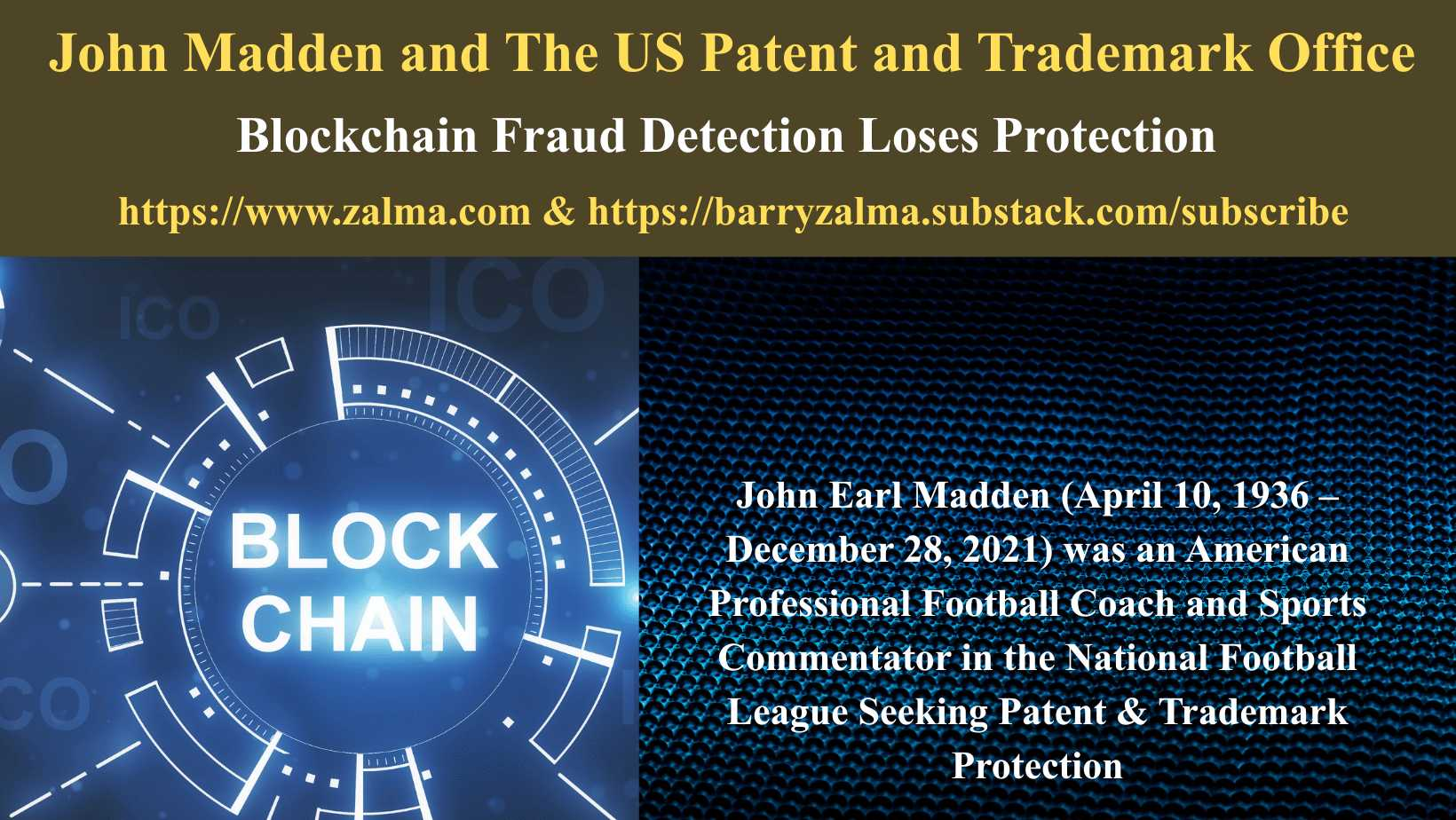
Blockchain Fraud Detection Loses Protection
Posted on October 22, 2026 by Barry Zalma
John Earl Madden (April 10, 1936 – December 28, 2021) was an American Professional Football Coach and Sports Commentator in the National Football League Seeking Patent & Trademark Protection
BLOCKCHAIN FRAUD
Mr. Madden was more than football. He was working to establish a program called “Fraud Protection Systems, Methods, and Computer Programs for Blockchain Financial Transactions.”
In Ex parte John Madden, Appeal 2026-001497, Application 18/495,506, Technology Center 3600, United States Patent and Trademark Office, Patent Trial and Appeal Board (October 14, 2026)
The Examiner rejected claims several numbered claims under 35 U.S.C. § 101 as directed to an abstract idea without significantly more.
THE LAW
Section 101 makes patentable any new and useful process, machine, manufacture, or composition of matter.Laws of nature, natural phenomena, and abstract ideas are implicitly excluded.
THE PATENT TRIAL AND ...
Sovereign Immunity Defeats Suit Against Police Officers
Post 4866
Posted on October 21, 2026 by Barry Zalma
In Chad Lightfoot, et al. v. Progressive Direct Insurance Company, et al., Civil Action No. 26-434, United States District Court, E.D. Louisiana (October 9, 2026) Chad Lightfoot was involved in an Orleans Parish automobile accident in 2011 and filed claims with several insurers, including Progressive.
After a related civil dispute, Progressive counsel allegedly submitted a false affidavit stating that Lightfoot had fraudulently received a $50,000 payment. A New Orleans police detective relied on the affidavit to obtain an arrest warrant, and Louisiana State Police Lieutenant Alan Arcana allegedly reported that Lightfoot had received the payment. Lightfoot was arrested in 2015 and charged with theft, insurance fraud, and perjury.
Plaintiffs alleged that no record of the payment existed and that the criminal charges were dismissed on October 15, 2024.
Lightfoot and Geralyn Hawkins filed suit in October 2025 and ...