

Read the full article at https://www.linkedin.com/pulse/treble-damages-punitive-excluded-policy-barry-zalma-esq-cfe and at https://zalma.com/blog plus more than 4050 posts.
Progressive Direct Insurance Company (insurer) alleged treble damages pursuant to the statute did not apply to its insurance policy because punitive damages were clearly excluded.
The trial court stated the issue for adjudication was whether public policy required statutory treble damages to be excluded from the policy's coverage.
ANALYSIS
The obvious public policy behind the treble damages provision is to provide an added level of deterrence against hit-and-run drivers who damage attended vehicles. The Legislature's public policy for imposing a criminal penalty and the treble damages in 47 O.S. § 10-103 were to create a deterrence by imposing punitive measures upon a driver "involved in an accident who did not fulfill the requirements of 47 O.S. § 10-104 and fled the scene of the accident.
Generally, a statutory multiplier for damages has a punitive nature when damages are meant to punish "the wrongdoer" and to act as a deterrent to others.
The treble damages provision in 47 O.S.2011, § 10-103 had a primary purpose to deter hit-and-run drivers, and "is more aligned with the definition of punitive damages than it is with non-punitive or compensatory" damages and the statutory treble damages in 47 O.S. 2011, § 10-103 were excluded by the policy.
ZALMA OPINION
It should be axiomatic, and it is in Oklahoma, that an insurer and insured are free to agree to a policy's provisions. The exclusion for intentional acts and punitive damages was conspicuous, plain and clear and the Supreme Court concluded that trial court was correct when it refused to allow coverage for the punishment damages established by the statute.
© 2022 – Barry Zalma
Barry Zalma, Esq., CFE, now limits his practice to service as an insurance consultant specializing in insurance coverage, insurance claims handling, insurance bad faith and insurance fraud almost equally for insurers and policyholders. Mr. Zalma practiced law in California for more than 44 years as an insurance coverage and claims handling lawyer and more than 54 years in the insurance business.
You can subscribe to "Zalma on Insurance" at https://zalmaoninsurance.locals.com/subscribe and "Excellence in Claims Handling" at https://barryzalma.substack.com/welcome.
You can contact Mr. Zalma at https://www.zalma.com, https://www.claimschool.com, [email protected] and [email protected] . Mr. Zalma is the first recipient of the first annual Claims Magazine/ACE Legend Award.
Go to the Insurance Claims Library – https://zalma.com/blog/insurance-claims-library/ The last two issues of ZIFL are available at https://zalma.com/zalmas-insurance-fraud-letter-2/

Insurance Expert May Not Testify to Speculative and Contains Unsupported Conclusions.
Posted on September 18, 2026 by Barry Zalma
See the full video at and at https://rumble.com/v7fmifw-expert-may-only-testify-to-what-experience-supports.html
In Michele A. Over, and The Estate Of Paul R. Over v. State Farm Mutual Automobile Insurance Company, and State Farm Fire And Casualty Company, Civil Action No. 23-cv-02243-PAB-STV, United States District Court, D. Colorado (September 14, 2026) Michele and Paul Over sued State Farm Fire and State Farm Auto over hail-damage and stolen-vehicle claims.
The operative dispute concerned State Farm Auto’s motion to exclude or limit opinions from plaintiffs’ insurance-industry expert, Aaron Castillo. Castillo.
Law
The proponent of expert testimony must establish by a preponderance of the evidence that an expert is qualified and that the opinions are helpful, sufficiently grounded, and reliably derived and applied. Experience-based opinions must explain how the...
150 Months in Prison for Tax Fraud
Post 4846
Posted on September 17, 2026 by Barry Zalma
See the full video at https://lnkd.in/g8rh3JBX and https://lnkd.in/gmkdy-9C, In United States Of America v. Thomas Addaquay, Nos. 25-10609, 25-10611, United States Court of Appeals, Eleventh Circuit (September 9, 2026) the Eleventh Circuit affirmed all challenged convictions, the 150-month aggregate sentence, and the challenged $4,123,474.55 restitution award.
FACTS
In United States Of America v. Thomas Addaquay, United States Of America v. Thomas Addaquay, Nos. 25-10609, 25-10611, United States Court of Appeals, Eleventh Circuit (September 9, 2026) the Eleventh Circuit affirmed all challenged convictions, the 150-month aggregate sentence, and the challenged $4,123,474.55 restitution award.
FACTS
Thomas Addaquay controlled United Consolidated Accounting and Business Services (UC), nominally a check-cashing business.
The government proved a three-stage tax-refund scheme that converted the resulting refund checks into usable funds through ...
Major Fraud Perpetrator Asserts Fifth Amendment Privilege to Avoid Prosecution
Post 5489
Posted on September 14, 2026 by Barry Zalma
Fraudster Refuses to Answer Questions About His Alleged Fraud
See the full video at https://lnkd.in/gvicAMDr and at https://lnkd.in/gvicAMDr
In Great American Insurance Co. v. Gemstone Property Management, LLC, et al., No. 23-cv-9100 (LJL), United States District Court, S.D. New York (September 8, 2026) Great American Insurance Company alleged that it was defrauded through a scheme in which Subin Associates, LLP recruited individuals to stage construction-site injuries, arranged unnecessary medical treatment and litigation funding, and pursued fraudulent personal-injury claims.
Luis Manuel Garcia Salcedo, resulted in a $6 million settlement. Non-party Jose Hernandez allegedly worked as an assistant manager at Subin, operated Hernandez Associates, and owned litigation-funding companies that shared office space with Subin and provided services to its clients.
After Great American ...
Theft of Confidential Information
Post 4581
Posted on November 12, 2026 by Barry Zalma
In People Center, Inc. v. Deel, Inc., et al., No. 25-cv-02576-CRB (LJC), United States District Court, N.D. California (November 7, 2026) People Center, doing business as Rippling, and Deel compete in payroll and human-resource management software. Rippling alleges that Deel and its executives recruited Rippling employee Keith O’Brien, based in Ireland, to disclose confidential information and trade secrets.
THE IRISH SUIT
Rippling sued O’Brien in Ireland and Deel in the United States. O’Brien subsequently retained separate counsel, supplied an affidavit describing the alleged espionage, and entered into a Cooperation Agreement with Rippling. In exchange for his cooperation, Rippling agreed to provide financial assistance, indemnification, and conditional dismissal of the Irish proceedings. The agreement also permitted renewed proceedings or a monetary judgment upon a material breach.
The Irish proceedings against O’Brien were dismissed...
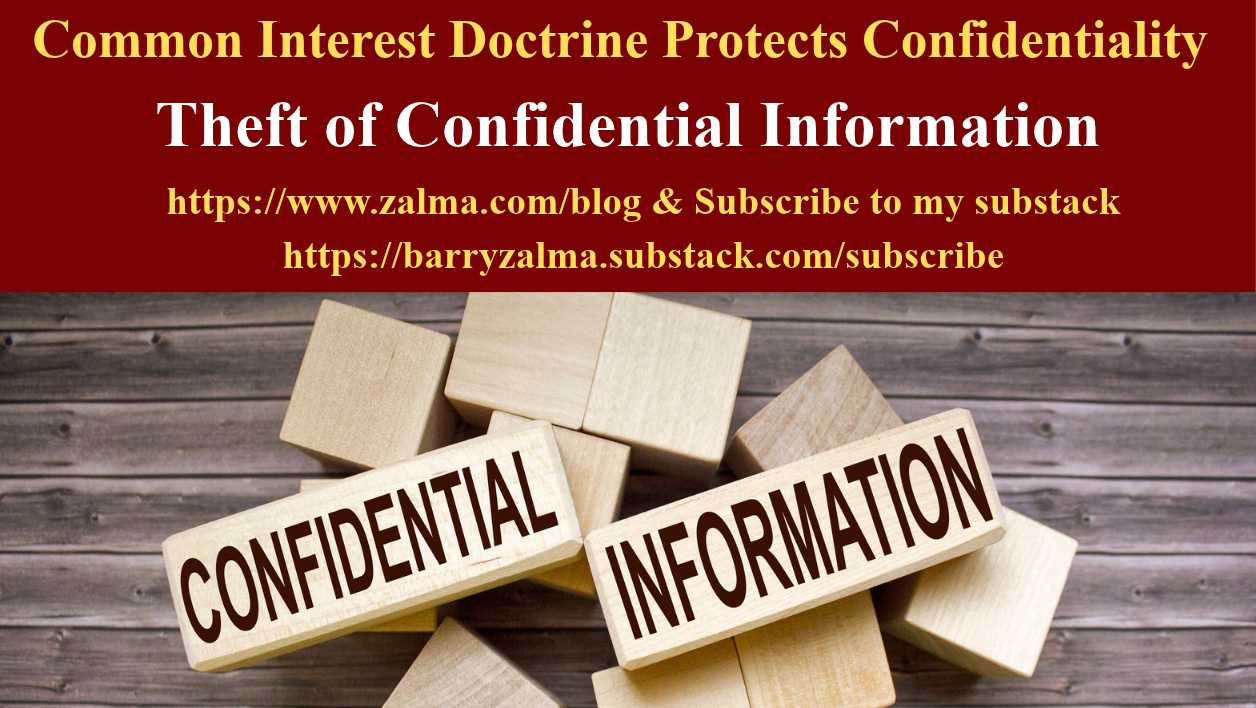
A Proposed Amended Complaint That Includes New Factual Allegations to Remedy Pleading Deficiencies
Posted on November 11, 2026 by Barry Zalma
After Dismissal Fraud Victim May Amend Complaint After Dismissal
Post 4580
If A Proposed Amendment Is Not Clearly Futile, Then Denial Of Leave To Amend Is Improper
In John Hancock Life & Health Insurance Company v. Caring Connections LLC, Arthur Feldheim, and Blime a/k/a Vera Feldheim, Civ. No. 25-7574 (MAS)(JBD), United States District Court, D. New Jersey (November 6, 2026) John Hancock sued Caring Connections LLC, Arthur Feldheim, and Blime a/k/a Vera Feldheim on June 5, 2025, asserting thirteen claims, including fraud, breach of contract, and aiding and abetting fraud.
On March 26, 2026, this Court entered an order granting Caring Connections’ motion to dismiss and granting in part and denying in part the Feldheims’ motion to dismiss. The dismissed claims were dismissed without prejudice, and John Hancock timely sought leave to amend.
They also argued that the New ...
Is Exhaustion Required to Seek Declaratory Relief From an Excess Insurer?
Post 4578
Posted on November 9, 2026 by Barry Zalma
In Fox Paine & Company, LLC, et al. v. Twin City Fire Insurance Company et al., S287404, 593 P.3d 832, 593 P.3d 838, 346 Cal.Rptr.3d 541, Supreme Court of California, (July 27, 2026) the Supreme Court noted that Insurance is sometimes procured in a series of layers, with an insured acquiring a primary insurance policy that provides an initial layer of coverage for loss or liability and an excess insurance policy or policies that provide additional coverage in the event the underlying coverage is exhausted. Usually, the first layer of coverage must be exhausted before the excess layers are available to the insured.
Exhaustion
Fox and Paine’s investment-firm dispute generated extensive litigation and competing insurance claims. Their insurance tower consisted of a $10 million primary policy and four $10 million excess layers.
The Fox Parties alleged that insurers paid their rivals, withheld information,...