
Denial of Flood Claim Starts the Limitation Period Running
Post number 5324
See the video at https://rumble.com/v78t566-nfpa-strictly-enforces-conditions.html and at https://youtu.be/UyUPPtbZWOk, and at https://zalma.com/blog plus more than 5300 posts.
Unlike Insurance Companies the NFPA is Enforced Strictly
Unlike Insurance Companies the NFPA is Enforced Strictly
In ZOZO Investments LLC, Bertie & Neeka LLC, Foreign Limited Liability Companies v. First Community Insurance Company, a Florida Corporation, No. 25-12492, United States Court of Appeals, Eleventh Circuit (April 15, 2026) Zozo Investments LLC and Bertie & Neeka LLC (“Zozo”) owned property in Fort Myers Beach, Florida, insured under the National Flood Insurance Program (NFIP) through First Community Insurance Company (“First Community”) and appealed the dismissal of their suit when their claim was denied..
FACTS
After the property suffered flood damage from Hurricane Ian, Zozo filed a claim. First Community initially paid the claim but later stopped payment and withdrew the funds. On March 13, 2023, First Community sent a denial letter.
Zozo responded with a sworn proof of loss to appeal, but First Community issued a second denial on October 19, 2023. Zozo filed suit on October 4, 2024, less than a year after the second denial but more than a year after the first.
LAW
The central legal issue involves 42 U.S.C. § 4072, which requires that claimants challenge the denial of “any claims for proved and approved losses” within one year after notice of denial is mailed. The question is whether the loss must be “proved” by a sworn proof of loss before the denial, or if the claim is considered “proved” upon the initial denial regardless of such proof.
DISCUSSION & ANALYSIS
Congress enacted the National Flood Insurance Act of 1968 (NFIA), which authorized the establishment of the National Flood Insurance Program” (NFIP). The NFIP is managed by the Federal Emergency Management Agency (FEMA). The NFIP provides Standard Flood Insurance Policies (SFIPs) to property owners. FEMA uses private insurers-like First Community-to issue SFIPs and to process SFIP claims on FEMA’s behalf, under terms and conditions controlled the NFIA and its corresponding regulations. The claims are paid out of the U.S. Treasury.
First Community moved to dismiss, arguing that more than year had elapsed since it mailed the first denial letter, so Zozo’s action was time-barred by Section 4072.
The NFIA grants FEMA the authority to adjust and disallow any claims for proved and approved losses covered by flood insurance. Further, upon the disallowance by the Administrator of any such claim, or upon the refusal of the claimant to accept the amount allowed upon any such claim, the claimant, within one year after the date of mailing of notice of disallowance or partial disallowance by the Administrator, may institute an action against the Administrator on such claim in the United States district court.
The Eleventh Circuit Court of Appeals examined whether Zozo’s loss was “proved” for purposes of § 4072 at the time of the first denial letter, or only after Zozo submitted a sworn proof of loss. If the loss was “proved” at the first denial, the one-year statute of limitations began then, making Zozo’s suit time-barred.
If a sworn proof of loss was required to “prove” the loss, the clock started with the second denial, allowing Zozo’s suit to proceed. The district court concluded that a sworn proof of loss was not required for a loss to be “proved” under the statute, so the limitations period began with the first denial.
CONCLUSION
The Eleventh Circuit affirmed the district court’s decision, holding that Zozo’s loss was “proved” without a sworn proof of loss, and the suit was therefore barred by the one-year limitations period in 42 U.S.C. § 4072.
The district court’s dismissal of the case with prejudice was AFFIRMED.
ZALMA OPINION
Normal insurance policies issued by corporate insurers have private limitation of action provisions that are applied with courtesy and warnings with courts giving empathy to those who fail to sue within the private limitation. Since the money to pay claims under an NFPA policy comes from the US Treasury US District Courts act differently, they interpret the private limitation of action strictly. As a result the plaintiff, who filed suit more than a year after denial, had their suit dismissed.
(c) 2026 Barry Zalma & ClaimSchool, Inc.
Please tell your friends and colleagues about this blog and the videos and let them subscribe to the blog and the videos.
Subscribe to my substack at https://gbarryzalma.substack.com/subscribe
Go to X @bzalma; Go to Barry Zalma videos at Rumble.com at https://rumble.com/account/content?type=all; Go to Barry Zalma on YouTube- https://www.youtube.com/channel/UCysiZklEtxZsSF9DfC0Expg; Go to the InsuranceClaims Library – https://lnkd.in/gwEYk.
Insurance Expert May Not Testify to Speculative and Contains Unsupported Conclusions.
Posted on September 18, 2026 by Barry Zalma
See the full video at and at https://rumble.com/v7fmifw-expert-may-only-testify-to-what-experience-supports.html
In Michele A. Over, and The Estate Of Paul R. Over v. State Farm Mutual Automobile Insurance Company, and State Farm Fire And Casualty Company, Civil Action No. 23-cv-02243-PAB-STV, United States District Court, D. Colorado (September 14, 2026) Michele and Paul Over sued State Farm Fire and State Farm Auto over hail-damage and stolen-vehicle claims.
The operative dispute concerned State Farm Auto’s motion to exclude or limit opinions from plaintiffs’ insurance-industry expert, Aaron Castillo. Castillo.
Law
The proponent of expert testimony must establish by a preponderance of the evidence that an expert is qualified and that the opinions are helpful, sufficiently grounded, and reliably derived and applied. Experience-based opinions must explain how the...
150 Months in Prison for Tax Fraud
Post 4846
Posted on September 17, 2026 by Barry Zalma
See the full video at https://lnkd.in/g8rh3JBX and https://lnkd.in/gmkdy-9C, In United States Of America v. Thomas Addaquay, Nos. 25-10609, 25-10611, United States Court of Appeals, Eleventh Circuit (September 9, 2026) the Eleventh Circuit affirmed all challenged convictions, the 150-month aggregate sentence, and the challenged $4,123,474.55 restitution award.
FACTS
In United States Of America v. Thomas Addaquay, United States Of America v. Thomas Addaquay, Nos. 25-10609, 25-10611, United States Court of Appeals, Eleventh Circuit (September 9, 2026) the Eleventh Circuit affirmed all challenged convictions, the 150-month aggregate sentence, and the challenged $4,123,474.55 restitution award.
FACTS
Thomas Addaquay controlled United Consolidated Accounting and Business Services (UC), nominally a check-cashing business.
The government proved a three-stage tax-refund scheme that converted the resulting refund checks into usable funds through ...
Major Fraud Perpetrator Asserts Fifth Amendment Privilege to Avoid Prosecution
Post 5489
Posted on September 14, 2026 by Barry Zalma
Fraudster Refuses to Answer Questions About His Alleged Fraud
See the full video at https://lnkd.in/gvicAMDr and at https://lnkd.in/gvicAMDr
In Great American Insurance Co. v. Gemstone Property Management, LLC, et al., No. 23-cv-9100 (LJL), United States District Court, S.D. New York (September 8, 2026) Great American Insurance Company alleged that it was defrauded through a scheme in which Subin Associates, LLP recruited individuals to stage construction-site injuries, arranged unnecessary medical treatment and litigation funding, and pursued fraudulent personal-injury claims.
Luis Manuel Garcia Salcedo, resulted in a $6 million settlement. Non-party Jose Hernandez allegedly worked as an assistant manager at Subin, operated Hernandez Associates, and owned litigation-funding companies that shared office space with Subin and provided services to its clients.
After Great American ...
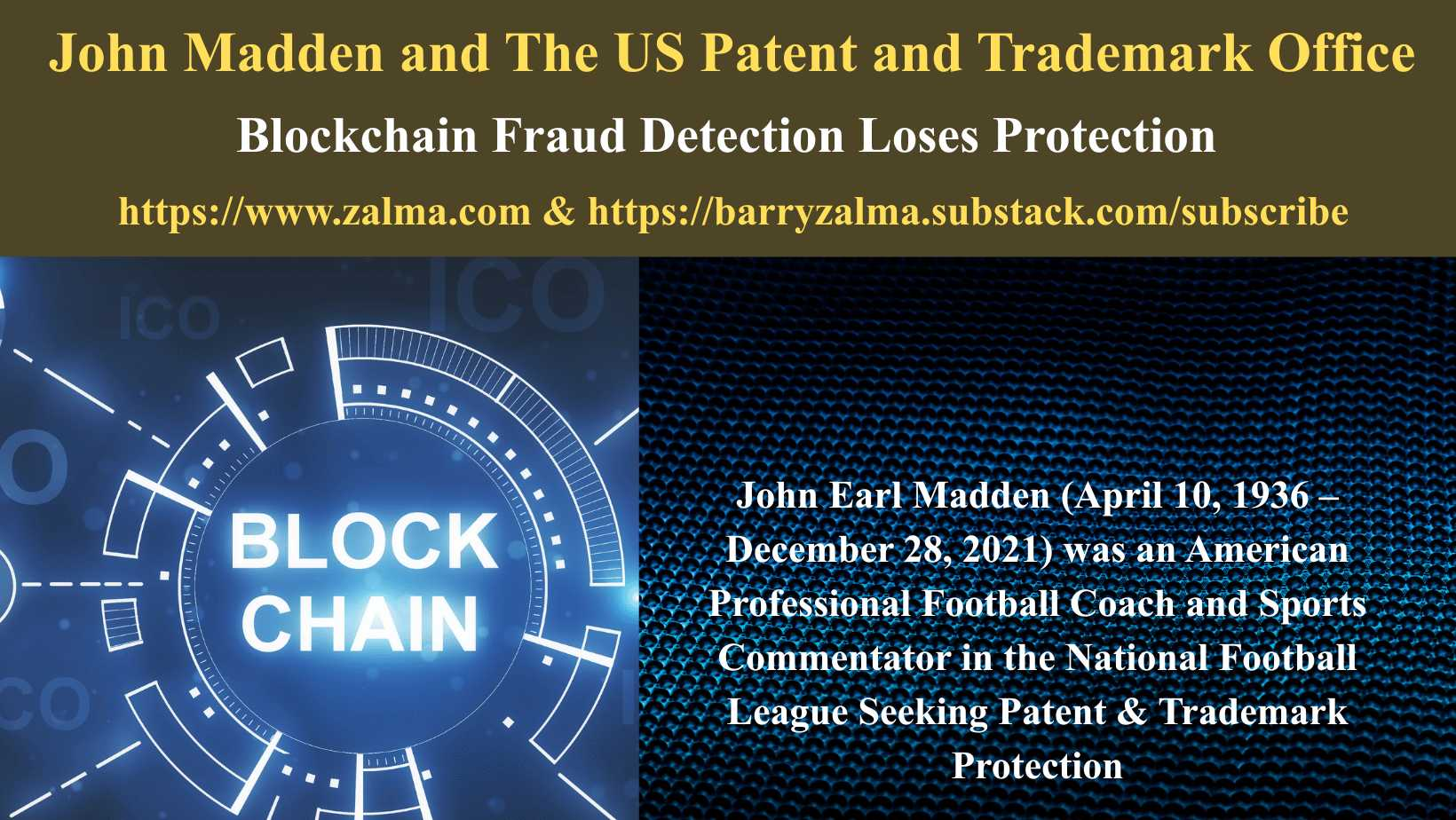
Blockchain Fraud Detection Loses Protection
Posted on October 22, 2026 by Barry Zalma
John Earl Madden (April 10, 1936 – December 28, 2021) was an American Professional Football Coach and Sports Commentator in the National Football League Seeking Patent & Trademark Protection
BLOCKCHAIN FRAUD
Mr. Madden was more than football. He was working to establish a program called “Fraud Protection Systems, Methods, and Computer Programs for Blockchain Financial Transactions.”
In Ex parte John Madden, Appeal 2026-001497, Application 18/495,506, Technology Center 3600, United States Patent and Trademark Office, Patent Trial and Appeal Board (October 14, 2026)
The Examiner rejected claims several numbered claims under 35 U.S.C. § 101 as directed to an abstract idea without significantly more.
THE LAW
Section 101 makes patentable any new and useful process, machine, manufacture, or composition of matter.Laws of nature, natural phenomena, and abstract ideas are implicitly excluded.
THE PATENT TRIAL AND ...
Sovereign Immunity Defeats Suit Against Police Officers
Post 4866
Posted on October 21, 2026 by Barry Zalma
In Chad Lightfoot, et al. v. Progressive Direct Insurance Company, et al., Civil Action No. 26-434, United States District Court, E.D. Louisiana (October 9, 2026) Chad Lightfoot was involved in an Orleans Parish automobile accident in 2011 and filed claims with several insurers, including Progressive.
After a related civil dispute, Progressive counsel allegedly submitted a false affidavit stating that Lightfoot had fraudulently received a $50,000 payment. A New Orleans police detective relied on the affidavit to obtain an arrest warrant, and Louisiana State Police Lieutenant Alan Arcana allegedly reported that Lightfoot had received the payment. Lightfoot was arrested in 2015 and charged with theft, insurance fraud, and perjury.
Plaintiffs alleged that no record of the payment existed and that the criminal charges were dismissed on October 15, 2024.
Lightfoot and Geralyn Hawkins filed suit in October 2025 and ...
A Suit Filed Before the Claim Exists is Fatal
Post 4870
Posted on October 20, 2026 by Barry Zalma
In Louis Briggs v. Shaun Wimberly; Somerset Services, Inc.; And Wimberly & Associates, PLLC, and Louis Briggs v. Shaun Wimberly And Wimberly & Associates, PLLC Nos. 2024-CA-1471-MR, 2025-CA-1366-MR, Court of Appeals of Kentucky (October 9, 2026) Louis Briggs was arrested in 2014 after an incident with police and charged with several offenses, including third-degree assault.
Probable cause was found and an indictment was returned, but the charges were eventually dismissed. His attorney, Shaun Wimberly, then filed a federal civil rights suit for Briggs in a United States district court, which also asserted state-law claims. The district court dismissed most of the claims and declined to exercise jurisdiction over the remaining state-law claims. Briggs blamed Wimberly for the result, fired him, and appealed to the Sixth Circuit.
While the federal appeal was pending, Briggs filed a legal malpractice action against Wimberly in the Jefferson Circuit Court. The Sixth ...