
Meaningful Linkage Between Notice & Class Action Requires Coverage
Post 4992
Read the full article at https://lnkd.in/gcUsUaV6, see the full video at https://lnkd.in/gtBCTmSF and at https://lnkd.in/g_MvEx3v, and at https://zalma.com/blog plus more than 4950 posts.
The Supreme Court of Delaware, En Banc, dealt with an insurance coverage dispute where Alexion Pharmaceuticals, Inc. appealed a decision from the Superior Court of Delaware.
In Re Alexion Pharmaceuticals, Inc. Insurance Appeals, Nos. 154, 2024, 157, 2024, Supreme Court of Delaware, en banc (February 4, 2025).
ISSUE
The issue before the Supreme Court was whether a Securities and Exchange Commission (SEC) investigation disclosed to Alexion’s insurers is related to a later securities class action brought against the company. The Superior Court found that the two were unrelated. The Supreme Court reversed this decision, finding that the securities class action arose out of the circumstances disclosed by Alexion to its first tower insurers.
FACTS
Alexion Pharmaceuticals, Inc. develops therapies for people living with rare disorders. Alexion was insured under two claims-made director and officer (“D&O”) liability insurance programs covering different periods. The first program provided $85 million of coverage for claims made between June 27, 2014 and June 27, 2015 (“Tower 1”). The second program provided $105 million of coverage for claims made between June 27, 2015 and June 27, 2017 (“Tower 2”). The two towers consist largely of the same insurers located in the same coverage layers. Both towers are structured as ABC directors and officers policies covering securities claims against the company. Each tower is composed of a primary policy and follow-form excess policies.
NOTICE REQUIRED BY POLICIES
The Insureds first became aware of facts or circumstances which may reasonably give rise to a future Claim covered under this Policy, and if the Insureds give written notice to the Insurer during the Policy Period a description of the anticipated Wrongful Act allegations.
Soliris is an “orphan drug” developed by Alexion that treats rare genetic diseases. In 2017, Soliris had about 11,000 customers worldwide. Soliris had a retail price of $500,000 to $700,000 for each patient. The SEC Investigation Order raised possible violations of the federal securities laws.
On June 18, 2015, Alexion sent its Tower 1 insurers a notice (“2015 Notice”) disclosing Alexion’s receipt of the SEC Subpoena. Alexion also stated that the SEC Subpoena “seeks information related to Alexion’s recalls of specific lots of Soliris and related securities disclosures.”
On July 2, 2020, Alexion settled with the SEC for about $21.5 million (“SEC Settlement”). On September 12, 2023, Alexion settled the Securities Class Action for $125 million (“Securities Class Action Settlement”) more than the available limits.
ANALYSIS
The Supreme Court agreed that “meaningful linkage” is the appropriate standard of comparison. Alexion’s 2015 Notice was not a claim. Chubb accepted Alexion’s 2015 Notice “as a notice of circumstance that may give rise to a claim.”
The Supreme Court concluded that the Securities Class Action was meaningfully linked to the wrongful acts disclosed in the 2015 Notice. Both involve the same alleged wrongdoing and the Securities Class Action alleged the same wrongdoing investigated by the SEC and disclosed by Alexion in the 2015 Notice.
Both SEC investigations involved the same Wrongful Act – Alexion’s grantmaking activities. A meaningful linkage exists between the Securities Class Action and the SEC investigation as disclosed by Alexion in its 2015 Notice. Under the policies of both towers, the Securities Class Action claim is deemed to have been first made at the time the 2015 Notice was received by Chubb – during the Tower 1 coverage period. Therefore, coverage is under Tower 1. Applying the Prior Notice Exclusion provision of Tower 2, no coverage is available under Tower 2. The judgment of the Superior Court was reversed.
ZALMA OPINION
Claims made policies require reports of potential claims. Alexion told its insurers about a potential claim under its Tower 1 and was entitled to coverage for the suit that followed. The prior notice exclusion eliminated coverage for tower 2. Parties, and judges, must read the policy wording before making a decision on coverage and since there was a “meaningful linkage” between the notice and the actual claim, coverage was available under Tower 1 and not Tower 2 as established by the Supreme Court.
(c) 2025 Barry Zalma & ClaimSchool, Inc.
Please tell your friends and colleagues about this blog and the videos and let them subscribe to the blog and the videos.
Subscribe to my substack at https://barryzalma.substack.com/subscribe
Go to X @bzalma; Go to Newsbreak.com https://www.newsbreak.com/@c/1653419?s=01; Go to Barry Zalma videos at Rumble.com at https://rumble.com/account/content?type=all; Go to Barry Zalma on YouTube- https://www.youtube.com/channel/UCysiZklEtxZsSF9DfC0Expg
Go to the Insurance Claims Library – https://lnkd.in/gwEYk
Insurance Expert May Not Testify to Speculative and Contains Unsupported Conclusions.
Posted on September 18, 2026 by Barry Zalma
See the full video at and at https://rumble.com/v7fmifw-expert-may-only-testify-to-what-experience-supports.html
In Michele A. Over, and The Estate Of Paul R. Over v. State Farm Mutual Automobile Insurance Company, and State Farm Fire And Casualty Company, Civil Action No. 23-cv-02243-PAB-STV, United States District Court, D. Colorado (September 14, 2026) Michele and Paul Over sued State Farm Fire and State Farm Auto over hail-damage and stolen-vehicle claims.
The operative dispute concerned State Farm Auto’s motion to exclude or limit opinions from plaintiffs’ insurance-industry expert, Aaron Castillo. Castillo.
Law
The proponent of expert testimony must establish by a preponderance of the evidence that an expert is qualified and that the opinions are helpful, sufficiently grounded, and reliably derived and applied. Experience-based opinions must explain how the...
150 Months in Prison for Tax Fraud
Post 4846
Posted on September 17, 2026 by Barry Zalma
See the full video at https://lnkd.in/g8rh3JBX and https://lnkd.in/gmkdy-9C, In United States Of America v. Thomas Addaquay, Nos. 25-10609, 25-10611, United States Court of Appeals, Eleventh Circuit (September 9, 2026) the Eleventh Circuit affirmed all challenged convictions, the 150-month aggregate sentence, and the challenged $4,123,474.55 restitution award.
FACTS
In United States Of America v. Thomas Addaquay, United States Of America v. Thomas Addaquay, Nos. 25-10609, 25-10611, United States Court of Appeals, Eleventh Circuit (September 9, 2026) the Eleventh Circuit affirmed all challenged convictions, the 150-month aggregate sentence, and the challenged $4,123,474.55 restitution award.
FACTS
Thomas Addaquay controlled United Consolidated Accounting and Business Services (UC), nominally a check-cashing business.
The government proved a three-stage tax-refund scheme that converted the resulting refund checks into usable funds through ...
Major Fraud Perpetrator Asserts Fifth Amendment Privilege to Avoid Prosecution
Post 5489
Posted on September 14, 2026 by Barry Zalma
Fraudster Refuses to Answer Questions About His Alleged Fraud
See the full video at https://lnkd.in/gvicAMDr and at https://lnkd.in/gvicAMDr
In Great American Insurance Co. v. Gemstone Property Management, LLC, et al., No. 23-cv-9100 (LJL), United States District Court, S.D. New York (September 8, 2026) Great American Insurance Company alleged that it was defrauded through a scheme in which Subin Associates, LLP recruited individuals to stage construction-site injuries, arranged unnecessary medical treatment and litigation funding, and pursued fraudulent personal-injury claims.
Luis Manuel Garcia Salcedo, resulted in a $6 million settlement. Non-party Jose Hernandez allegedly worked as an assistant manager at Subin, operated Hernandez Associates, and owned litigation-funding companies that shared office space with Subin and provided services to its clients.
After Great American ...
No Breach of Contract no Bad Faith
Post 4568
Posted on October 23, 2026 by Barry Zalma
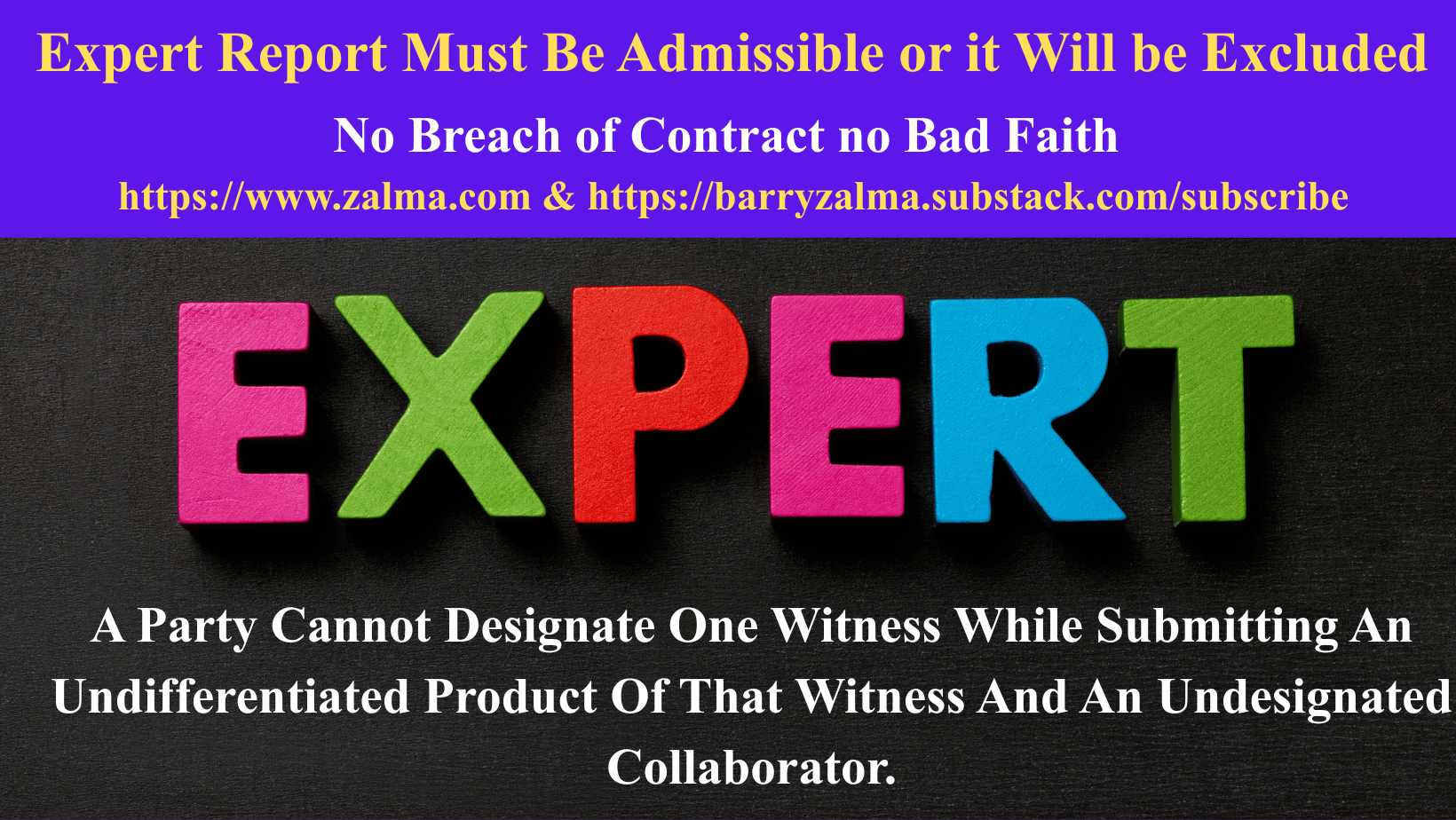
A Party Cannot Designate One Witness While Submitting An Undifferentiated Product Of That Witness And An Undesignated Collaborator.
Post 4568
In Dustin Cain; Amanda Cain v. State Farm Fire and Casualty Company, No. 25-60442, United States Court of Appeals, Fifth Circuit (October 16, 2026) Dustin and Amanda Cain sought homeowners’ insurance benefits after a tree fell on their Mississippi home on August 27, 2022. State Farm concluded that the tree caused only a roof puncture and that other damage resulted from excluded long-term conditions. It paid $10,042.90 and later an additional $3,130.08.
The Cains relied on an engineering report and contractor estimate asserting substantially greater damage, sued for breach of contract and related relief, and designated Sean Fee as their sole expert. Fee’s report and a later repair estimate were jointly authored with Jim Irmiter, but neither document identified which opinions, work, or ...
Blockchain Fraud Detection Loses Protection
Posted on October 22, 2026 by Barry Zalma
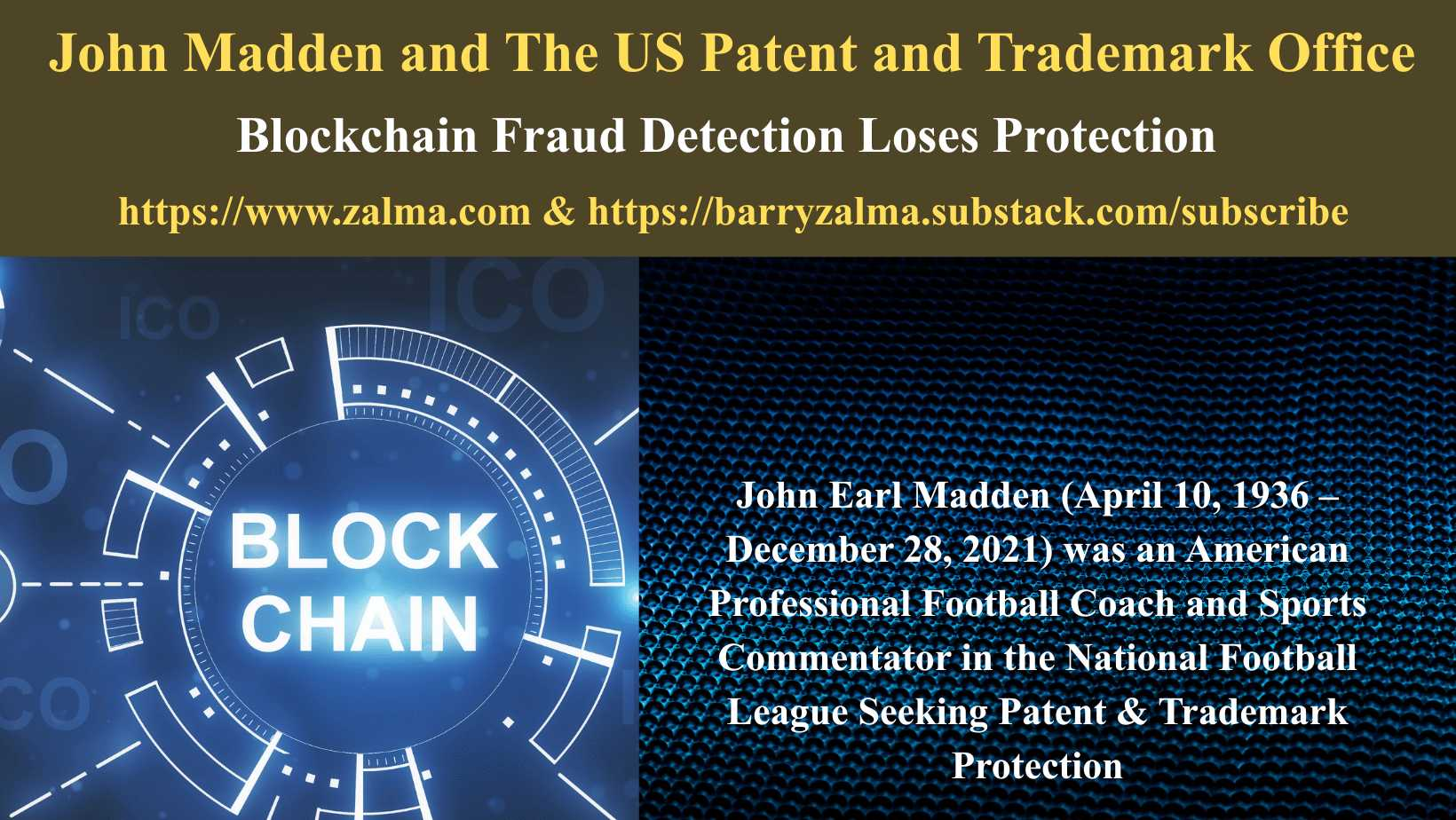
John Earl Madden (April 10, 1936 – December 28, 2021) was an American Professional Football Coach and Sports Commentator in the National Football League Seeking Patent & Trademark Protection
BLOCKCHAIN FRAUD
Mr. Madden was more than football. He was working to establish a program called “Fraud Protection Systems, Methods, and Computer Programs for Blockchain Financial Transactions.”
In Ex parte John Madden, Appeal 2026-001497, Application 18/495,506, Technology Center 3600, United States Patent and Trademark Office, Patent Trial and Appeal Board (October 14, 2026)
The Examiner rejected claims several numbered claims under 35 U.S.C. § 101 as directed to an abstract idea without significantly more.
THE LAW
Section 101 makes patentable any new and useful process, machine, manufacture, or composition of matter.Laws of nature, natural phenomena, and abstract ideas are implicitly excluded.
THE PATENT TRIAL AND ...
Sovereign Immunity Defeats Suit Against Police Officers
Post 4866
Posted on October 21, 2026 by Barry Zalma
In Chad Lightfoot, et al. v. Progressive Direct Insurance Company, et al., Civil Action No. 26-434, United States District Court, E.D. Louisiana (October 9, 2026) Chad Lightfoot was involved in an Orleans Parish automobile accident in 2011 and filed claims with several insurers, including Progressive.
After a related civil dispute, Progressive counsel allegedly submitted a false affidavit stating that Lightfoot had fraudulently received a $50,000 payment. A New Orleans police detective relied on the affidavit to obtain an arrest warrant, and Louisiana State Police Lieutenant Alan Arcana allegedly reported that Lightfoot had received the payment. Lightfoot was arrested in 2015 and charged with theft, insurance fraud, and perjury.
Plaintiffs alleged that no record of the payment existed and that the criminal charges were dismissed on October 15, 2024.
Lightfoot and Geralyn Hawkins filed suit in October 2025 and ...