
True Crime of Insurance Fraud Video Number 55
Read the full article at https://www.linkedin.com/pulse/true-crime-insurance-fraud-video-number-55-barry-zalma-esq-cfe and see the full video at
and at https://zalma.com/blog plus more than 4150 posts.
Most insurance companies are formed by major corporations with considerable assets. They are capitalized with serious money needed by the Insurer to cover losses until profits are made. The company is staffed with insurance professionals who believe in the concept of spreading risk. The insurers, whether new or old, provide a definite service to the public.
Betty Bruja wanted to start her own insurance company. She had been an insurance broker for ten years. In those ten years she had trained herself with books and training courses from the Insurance Risk Management Institute, the Society of Certified Property and Casualty Underwriters, the Insurance Institute and the Insurance Claims Library. By devoted and lengthy study Betty obtained the designation CPCU in the minimum time allowed by the Society of CPCU.
She studied underwriting and claims handling. No person, Betty thought, was as knowledgeable about insurance as she. No insurance company operated efficiently. Massive profits could be made if she only was put in control.
For ten years Betty Bruja toiled in the trenches of the insurance industry obtaining a small income off 5% to 15% commissions. She was frustrated. She knew she could make money if only there was capital to fund a new insurance company.
Ms. Bruja hired an independent adjusting company to investigate and adjust claims. Since none of the policies had any wording, she denied coverage on most claims by creating a policy exclusion to fit the claim. During the first year of her program of fraud she paid no claims and collected $500,000 in premium.
Robin Sleuth was the owner of a small traveling carnival. He had purchased a policy from Betty and renewed it with PPC. He was pleased with the premium. He needed a certificate of insurance in the name of the City of Ojai because his carnival was setting up on an empty lot owned by the City. Betty was slow in issuing the form. Robin looked at his insurance file and noticed he never received policy wording from Betty. He faxed her a letter demanding a complete copy of his policy and a certificate.
Betty, recognizing a trouble maker, sent Robin a notice advising, since they could not agree, that his policy was canceled flat and she returned the premium he had paid. Robin was furious. He was forced to cancel his appearance in Ojai and scramble to get insurance through another agent. The premium was twice that he paid to Betty.
PPC immediately hired a private investigator and counsel experienced in fraud investigation. They flew to Robin Sleuth’s home city and interviewed him. They obtained copies of all written evidence and obtained Robin’s promise to maintain the originals in a secure place that were not to be destroyed.
The lawyer and investigator then flew directly to the city where Betty did business and arrived at her new paneled offices. They demanded to see Betty.
Betty, resplendent in her tailored wool suit and silk blouse, met them with courtesy. They told her whom they represented and that she was issuing policies in the name of PPC without authority. Betty was shocked. She denied that she issued policies without approval. She would do everything she could to help them. Ms. Bruja wanted, however, before discussing it with them further, to speak with her lawyer.
Betty’s lawyer was an honest person. He would never go along with her fraud. She needed something to show him. On her computer she created a letterhead for Nicholas Claus Insurance Services, Houston, Texas. The letter, which she created, was dated six months before. Claus, as Managing General Agent for PPC, authorized Betty, as exclusive agent in her state, to write CGL policies for carnivals, bungee cord facilities and hang glider parks.
PPC and its lawyer were satisfied. They had stopped a fraud in progress. They reported Betty to the Insurance Department and advised the Department of the agreement. The Department, overburdened with other work, did nothing since PPC had solved its problem.
What was unknown to PPC, its lawyer, or Betty’s lawyer was that the next day she picked a new insurance company name. Betty rolled all of her clients into Surety and Providence Insurance Company (SAPIC). She told each that she had been duped by PPC but had protected them by getting insurance for them with SAPIC.
Betty is living well. Fraud seems to pay for her. Soon she will make enough money to actually capitalize a legitimate insurance company.
Unfortunately, for Betty, a three-year-old child fell out of a WhirlyGig and became paralyzed. The parents of the child sued the carnival who presented a claim to Betty. She immediately and retroactively cancelled the policy and refused the claim. The carnival had no option but to file bankruptcy and the child became a ward of the state. Betty, emptied her bank account and moved to a retirement community in Sao Paulo, Brazil and never tried to be in the business of insurance again.
ZALMA OPINION
Insurance fraud comes in many different guises. Betty hurt innocent people and profited from her crime. She should have been punished by the Department of Insurance and her license to sell insurance pulled. It didn’t happen and she is now living well in Sao Paulo.
(c) 2022 Barry Zalma & ClaimSchool, Inc.
Barry Zalma, Esq., CFE, now limits his practice to service as an insurance consultant specializing in insurance coverage, insurance claims handling, insurance bad faith and insurance fraud almost equally for insurers and policyholders. He practiced law in California for more than 44 years as an insurance coverage and claims handling lawyer and more than 54 years in the insurance business. He is available at http://www.zalma.com and [email protected].
Subscribe to Zalma on Insurance at locals.com https://zalmaoninsurance.local.com/subscribe.
Subscribe to Excellence in Claims Handling at https://barryzalma.substack.com/welcome.
Write to Mr. Zalma at [email protected]; http://www.zalma.com; http://zalma.com/blog; daily articles are published at https://zalma.substack.com.
Go to the podcast Zalma On Insurance at https://anchor.fm/barry-zalma; Follow Mr. Zalma on Twitter at https://twitter.com/bzalma; Go to Barry Zalma videos at Rumble.com at https://rumble.com/c/c-262921; Go to Barry Zalma on YouTube- https://www.youtube.com/channel/UCysiZklEtxZsSF9DfC0Expg; Go to the Insurance Claims Library – https://zalma.com/blog/insurance-claims-library/

Insurance Expert May Not Testify to Speculative and Contains Unsupported Conclusions.
Posted on September 18, 2026 by Barry Zalma
See the full video at and at https://rumble.com/v7fmifw-expert-may-only-testify-to-what-experience-supports.html
In Michele A. Over, and The Estate Of Paul R. Over v. State Farm Mutual Automobile Insurance Company, and State Farm Fire And Casualty Company, Civil Action No. 23-cv-02243-PAB-STV, United States District Court, D. Colorado (September 14, 2026) Michele and Paul Over sued State Farm Fire and State Farm Auto over hail-damage and stolen-vehicle claims.
The operative dispute concerned State Farm Auto’s motion to exclude or limit opinions from plaintiffs’ insurance-industry expert, Aaron Castillo. Castillo.
Law
The proponent of expert testimony must establish by a preponderance of the evidence that an expert is qualified and that the opinions are helpful, sufficiently grounded, and reliably derived and applied. Experience-based opinions must explain how the...
150 Months in Prison for Tax Fraud
Post 4846
Posted on September 17, 2026 by Barry Zalma
See the full video at https://lnkd.in/g8rh3JBX and https://lnkd.in/gmkdy-9C, In United States Of America v. Thomas Addaquay, Nos. 25-10609, 25-10611, United States Court of Appeals, Eleventh Circuit (September 9, 2026) the Eleventh Circuit affirmed all challenged convictions, the 150-month aggregate sentence, and the challenged $4,123,474.55 restitution award.
FACTS
In United States Of America v. Thomas Addaquay, United States Of America v. Thomas Addaquay, Nos. 25-10609, 25-10611, United States Court of Appeals, Eleventh Circuit (September 9, 2026) the Eleventh Circuit affirmed all challenged convictions, the 150-month aggregate sentence, and the challenged $4,123,474.55 restitution award.
FACTS
Thomas Addaquay controlled United Consolidated Accounting and Business Services (UC), nominally a check-cashing business.
The government proved a three-stage tax-refund scheme that converted the resulting refund checks into usable funds through ...
Major Fraud Perpetrator Asserts Fifth Amendment Privilege to Avoid Prosecution
Post 5489
Posted on September 14, 2026 by Barry Zalma
Fraudster Refuses to Answer Questions About His Alleged Fraud
See the full video at https://lnkd.in/gvicAMDr and at https://lnkd.in/gvicAMDr
In Great American Insurance Co. v. Gemstone Property Management, LLC, et al., No. 23-cv-9100 (LJL), United States District Court, S.D. New York (September 8, 2026) Great American Insurance Company alleged that it was defrauded through a scheme in which Subin Associates, LLP recruited individuals to stage construction-site injuries, arranged unnecessary medical treatment and litigation funding, and pursued fraudulent personal-injury claims.
Luis Manuel Garcia Salcedo, resulted in a $6 million settlement. Non-party Jose Hernandez allegedly worked as an assistant manager at Subin, operated Hernandez Associates, and owned litigation-funding companies that shared office space with Subin and provided services to its clients.
After Great American ...
Plaintiff’s Reading of the Policy is Plaintiff’s Reasonable Allegations
Posted on October 19, 2026 by Barry Zalma
Post 4868
CLASS ACTION THAT STATES A SIMPLE CLEAR AND PLAUSIBLE CAUSE OF ACTION SURVIVES
In Sheila Marino v. Farmers New World Life Insurance Company, No. 2:25-cv-02200-JNW, United States District Court, W.D. Washington, Seattle (October 13, 2026) defendant Farmers New World Life Insurance Company’s (“FNWL”) moved to dismiss Plaintiff Sheila Marino’s putative class action involving flexible universal life insurance.
Marino filed a putative class action in King County Superior Court alleging: (1) breach of contract, (2) breach of the implied covenant of good faith and fair dealing, and (3) violation of the Washington Consumer Protection Act (CPA).
She pleaded two theories: an “overcharge” theory and an “underpayment of interest” theory asked the Court to take judicial notice of historical Federal Funds Effective Rates.
THE LAW
Pleading Standard.
To survive a Rule 12(b)(6) motion, a ...

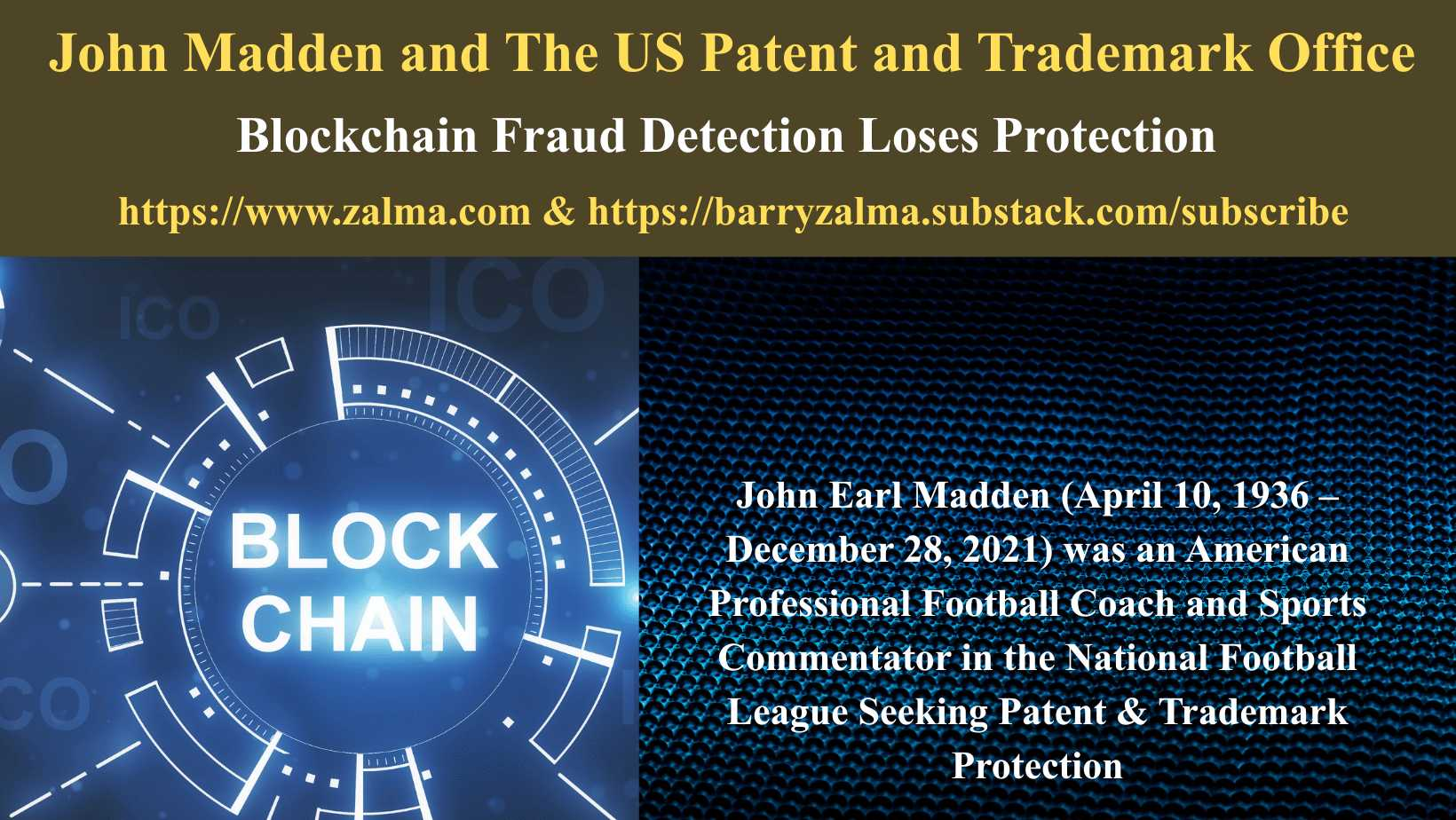
Blockchain Fraud Detection Loses Protection
Posted on October 22, 2026 by Barry Zalma
John Earl Madden (April 10, 1936 – December 28, 2021) was an American Professional Football Coach and Sports Commentator in the National Football League Seeking Patent & Trademark Protection
BLOCKCHAIN FRAUD
Mr. Madden was more than football. He was working to establish a program called “Fraud Protection Systems, Methods, and Computer Programs for Blockchain Financial Transactions.”
In Ex parte John Madden, Appeal 2026-001497, Application 18/495,506, Technology Center 3600, United States Patent and Trademark Office, Patent Trial and Appeal Board (October 14, 2026)
The Examiner rejected claims several numbered claims under 35 U.S.C. § 101 as directed to an abstract idea without significantly more.
THE LAW
Section 101 makes patentable any new and useful process, machine, manufacture, or composition of matter.Laws of nature, natural phenomena, and abstract ideas are implicitly excluded.
THE PATENT TRIAL AND ...
Sovereign Immunity Defeats Suit Against Police Officers
Post 4866
Posted on October 21, 2026 by Barry Zalma
In Chad Lightfoot, et al. v. Progressive Direct Insurance Company, et al., Civil Action No. 26-434, United States District Court, E.D. Louisiana (October 9, 2026) Chad Lightfoot was involved in an Orleans Parish automobile accident in 2011 and filed claims with several insurers, including Progressive.
After a related civil dispute, Progressive counsel allegedly submitted a false affidavit stating that Lightfoot had fraudulently received a $50,000 payment. A New Orleans police detective relied on the affidavit to obtain an arrest warrant, and Louisiana State Police Lieutenant Alan Arcana allegedly reported that Lightfoot had received the payment. Lightfoot was arrested in 2015 and charged with theft, insurance fraud, and perjury.
Plaintiffs alleged that no record of the payment existed and that the criminal charges were dismissed on October 15, 2024.
Lightfoot and Geralyn Hawkins filed suit in October 2025 and ...